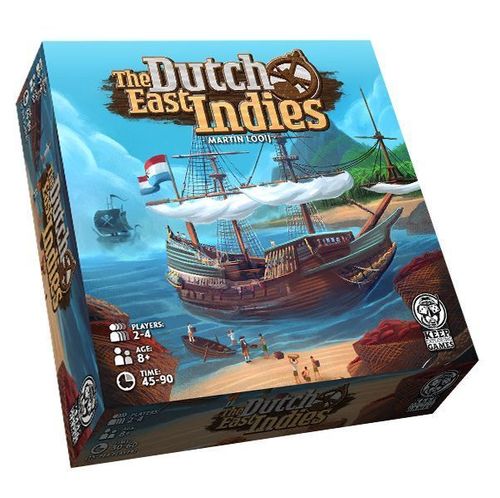
The Dutch East Indies
The Dutch East Indies Rulebook
Table of Contents
Table of Contents
Components
- 1 Game Board
- 15/18 Islands
- 10 Ships
- 40 Spices
- 30 Coins (20 x 1, 10 x 3)
- 60 Trading Goods
- 24 Markers
- 4 Player Boards
- 30 Trading Cards
- 12 Solo Cards
- 1 D8
- 2 D6
Goal of the Game
It is the 18th century in the East Indies. You are in charge of two ships and you have a clear mission. Find valuable spices, and bring them back home. But there are a few catches. You have to bring these spices home before any other country does. There are pirates out there who will shoot your ships to smithereens when given the chance. And about finding those spices. You and your competitors could just trade them with locals and bring them home. Or, you can battle and try to steal them from one another… Upgrade your ships at Market Island and increase your chances, a bigger cargo hold, more sails for more speed, or add cannons to increase your chances in a battle. The first player to bring home 2 copies of each of the four valuable spices wins the game!
The first player to collect two cardamom, two cinnamon, two clove and two nutmeg on their home island wins the game. Pepper counts as a wildcard and can be used to substitute any other spice.
Game Setup
Have each player choose a country. Give each player the player board of that country and 6 markers (3 transparent and 3 of their color). Place the markers in the players color on the fields that are marked with a large circle and the transparent markers on the fields marked with a small circle. Place the game board in the center of the table, and have each player place their home island in front of them. Please refer to the appendix for the recommended starting positions.
Next shuffle the trading cards and divide them across the islands, as depicted in the set-up in the appendix. The numbers on the wild islands indicate the number of trading cards on each wild island. Only when all trading cards are used will all discarded cards be reshuffled and replaced in the same way as the starting position. Place your two ships on the spots indicated and do the same for the two pirate ships. We strongly recommend you follow this set-up for the first few games.
Designing Your Own Archipelago
More experienced players can try their hand at designing their own archipelago. Depending on the number of players, we recommend placing the home islands in a rectangular, square or triangular shape relative to each other. Make sure the Market Island is placed at an equal distance for all players and all players have roughly equal distances to the nearest wild island. When building your own archipelago of islands, we recommend placing fewer cards on the islands close to players and more cards on the islands further away.
Determine a starting player. Our recommendation: the player with the most majestic beard.
Each player places this number of starting resources on their home island:
| Starting Player | Second Player | Third Player | Fourth Player | |
|---|---|---|---|---|
| Crates | 14 | 15 | 15 | 15 |
| Coins (total value) | 10 | 10 | 10 | 11 |
Place all remaining crates, coins and spices in an easy to reach place. You can also divide them across the wild islands and Market Island for extra visual flavor.
You are now ready to start the game! Each player takes a turn in clock-wise order until someone has achieved the goal of the game. It's a race!
First Step: Move the Pirates
When it is your turn, the first thing you do is move the pirates. You roll the D8 with the wind directions. You then move the big pirate ship one step in that direction. Pirate ships can never be in a space with land, another ship or a port of a player's home island, or off the game board. In the case of this happening, you move the ship in the opposite direction instead. In the rare case that this is also not possible, roll again until you roll a possible direction. Then you roll the dice again for the small pirate ship and also move this ship one space according to the same rules.
If either of the pirate ships is now not in a port and adjacent to a player's ship that is not in a port, it will immediately attack that ship. This will be explained in the section 'battle'.
Second Step: Moving and Other Possible Actions
After dealing with the pirates, you are free to do whatever you like. You are allowed to take any amount of actions described below, but you cannot interrupt a moving action, take another action and then move again. So you are allowed to take actions, move and take actions again, or take actions and move, or move and take actions. You can also only move, only take actions or do nothing at all. But you cannot move part of your movement allowance, take an action and finish the movement.
Movement
Movement is one of the three statistics of your ship, and is depicted by the sail on the player boards. At the start of the game, your big ship may move three squares and your small ship may move up to two squares per turn. During your turn, you may move none, one or both ships a number of squares up to the number of sails of that ship (movement points).
These ships are big, and therefore turning them isn't easy. You can move to any of the 5 squares next to your ship or in front of your ship by spending 1 movement point. You cannot sail to any of the 3 squares behind your ship. If you would like to sail there, you first need to turn your ship for 1 movement point.
So if you want to sail to a square marked with a turning icon, you can do so for 2 movement points. One to turn your ship, and one to sail to that square. You always move your ship with the front of the ship moving towards the square you are moving to. If you arrive at a port with at least one movement point left, you can turn your ship to face the direction you'd like to sail in next turn.
Special Rules for Movement
You can choose which of your ships to move first. The only situation in which you need to move a ship is when occupying a port at a wild island or the Market Island for two turns. So if you moved in there at turn 1, you can stay there at turn 2 but you have to leave at turn 3. In case of two adjacent port spaces, you are allowed to move to the other port space on the same island. You cannot enter the port of an opponent. If you move to a space adjacent to a pirate not in a port (that is not a port space), it will immediately attack you. If you are in a port and a pirate is next to you, you can move out of it to a space that is not adjacent to a pirate. The other way around is also possible without being attacked.
The ship can move into the other port square or to the space north of him without immediately being attacked by the pirate ship. Moving Northeast would trigger a battle, as indicated by the skull and swords.
Trading
When you anchor at a wild island with at least one trading card on it, you can take a private look at the top card of the deck. You can dock anywhere with an anchor symbol (except the home island of your opponents). These count as ports for all purposes. The trading card will look something like this.
In this case, the local inhabitants of the island you just visited would like to have two crates, filled with trading goods. In return, they will trade you two coins and a specific spice, in this case a nutmeg.
In order to fulfill this trade, you need to have these two crates in the ship you are visiting the island with. You can't trade with crates on your home island or on your other ship (unless that other ship is directly adjacent to this ship, also see the 'transferring' action.
When you take a private look at the card, you will decide whether to accept or refuse this trade. When you refuse it (because you are not carrying enough crates or don't like or need the coins/spices offered), place the card back on the island, facedown, unseen by your opponents. They will not know why you refused the trade. The next player to visit this island will need to draw this card again. If you accept the trade, you show the card to the other players. You remove the crates from the ship and place them in the general supply or on the island. Then you grab the listed amount of coins and spices from the general supply or any wild/Market island and place them in your ship. Make sure you don't exceed your ships' cargo hold. Each ship has a cargo statistic on the player board.
At the beginning of the game, the big ship can hold 7 items and the small ship can hold 5. This may be any combination of crates, coins and spices. When you exceed the maximum amount of cargo on a ship, you have to dump any excess in the sea on the square you are on. Any player including yourself can pick this up at any time during the game by sailing on that square.
You can look at one trading card per ship per island per turn. You can also look at a card without having any crates on board. The trading cards always ask for between 1 and 5 crates, and deliver coins and/or spices.
When all cards are used on a wild island, it is depleted. No spices can be gathered from this island anymore and the island no longer counts as a port. Players are no longer safe from pirates or other players at that island. Only when all trading cards are used will they be reshuffled and redistributed among the islands.
There is no trading possible between players. This would result in distrust and battling anyway.
There is some trading possible at the Market Island. Besides upgrading your ships (next paragraph), you can also perform these actions at Market Island:
- Trade 1 coin for 2 crates
- Trade 2 crates for 1 coin
- Trade 1 spice + 2 coins for 1 spice of your choice (except pepper)
Upgrading
You use the crates for trading with locals. You use the coins for upgrading your ship. Your ships have three statistics as listed on the player boards. Sail, cargo and cannons. The price in coins for upgrading them is depicted between the values.
The cargo track. The circles at 5 and 7 depict the starting positions. To move your small ship's cargo hold up from 5 to 7, you would need to pay 2 + 2 =4 coins.
The only place to upgrade your ships is at the Market Island. When docked there, you pay the coins (from the ship you just docked with or any other ship at a port at that island) required to upgrade either the cannons, sail and/or cargo hold of the ship(s) that you currently have docked there. You can move as many statistics up as far as you can afford.
Loading, Unloading and Transferring
When one of your ships is at your home port, you can load or unload anything you want, keeping in mind your cargo hold's limitation. You can do this at the beginning of your turn, at the end of it, even during other players' turns if you wish. When your ships are adjacent to each other, you can transfer items between them.
When your second ship is located at a square with a check mark, you are allowed to transfer goods between ships. This cannot be done when your second ship is located diagonally.
There are a few things to keep in mind when doing this. At all times you have to respect your ships' cargo limits. Since this counts as an action, you cannot sail anymore with the ship that you just brought next to the other ship. The ship that didn't sail yet is still allowed to move. When transporting spices in danger of being attacked by other players, it can be handy to have the second ship in between the ship with the spices and the home island. The ship with the spices can then sail next to the other ship. You can then load the spices onto the second ship, and sail home with that ship.
This transferring can also be used to have one ship in a port with the second one adjacent to it. That ship can then use the port facilities at a wild island or the Market Island, but he is not technically in the port and can be attacked by pirates and other players.
Battling
Player vs Player Combat
Players can live in peace and just trade their needed spices with locals. But they can also attack each other and try to steal each others spices and/or coins! This is where the third statistic of the ships comes into play: the cannons.
In order to attack another player, you need to be in any of the 8 squares surrounding the other ship, applying normal movement rules. Orientation of the ships doesn't matter, your range is one square in either orthogonal or diagonal direction. You cannot attack another player if either of you is in a port.
When you have applied this, you can call a battle. The attacked player cannot refuse this. Both ships compare their cannon statistic with each other. The large ship starts with 5 cannons, the small one has 3 cannons at the beginning of the game. Both players roll a D6 and add this result to their number of cannons. The attacker wins at a draw.
The loser has to give a spice of the winners choice to the winner. If the attacker won, the defender also has to give the attacker a coin when able (from that ship). If the loser did not have a spice on that ship, he has to downgrade a property of the ship that lost the battle.
Pepper is depicted as the general icon for spices. The winner of the battle chooses which spice to steal. Since player-to-player combat counts as an action, the player whose turn it is can move before or after the fight. The defending player is allowed to attack the attacking player back in his/her own turn, if so desired and still within range.
You can only attack a particular ship once per ship of yours that is in range per turn.
Pirate vs Player Combat
Pirate battles do not count as an action. Pirates attack at the start of anyone's turn when they are not in a port and adjacent to a players' ship that is not located in a port – in any orthogonal or diagonal direction. Pirates do not attack when they are located in a port themselves.
Pirates also attack when a player moves within range of a pirate during their turn, when neither one of the two involved ships are in a port. If the player wins the combat, they are allowed to continue their movement, since this does not count as an action.
Pirates also have a statistic for cannons, as depicted on the player aids. The large pirate ship always has 6 cannons while the small pirate ship has 4. Combat goes in a similar manner, with another player rolling the die for the pirates. Pirates win on a tie.
When you win against a pirate, you win nothing. If it was your turn, you may continue your movement. If you lose, pirates will shoot your ship to smithereens. You have to downgrade one (small pirate loss) or two statistics (big pirate loss – you may also lower one statistic by two marks) of the attacked ship.
You may choose which one(s) to downgrade. You also have to dump a spice of your choice or a coin over board if able. You are not allowed to pick this back up in this turn (when you triggered the attack) or in your next turn (when someone else triggered the attack).
To Summarize
- Move the pirates – check for and execute pirate vs player battles
- Move your own ships and take actions (Trading, upgrades, loading/unloading/transferring, battle)
- First player to have 2 of each of the four spices on their home island wins!
Solo Rules
First, choose a difficulty level:
- Easy
- Medium
- Hard
- Expert
| Easy | Medium | Hard | Expert | ||
|---|---|---|---|---|---|
| Cannons | Big ship | 5 | 6 | 7 | 7 |
| Cannons | Small ship | 3 | 4 | 5 | 6 |
| Sails | Big ship | Lowest 3 | Middle 3 | Middle 3 | Highest 3 |
| Sails | Small ship | Lowest 2 | Highest 2 | Lowest 3 | Middle 3 |
Regardless of the level of difficulty, you will be playing an AI. Choose a country for yourself and the AI and set-up the game as for two players, with these exceptions:
The AI does not have a statistic for the cargo hold. The other statistics depend on the level of difficulty (see the table above).
You will take 15 crates and 10 coins (total value) and place them on your home island. The AI does not use crates or coins. When the AI takes a trading card from a wild island, it delivers nothing and takes only the spices listed on the card. If the AI ever would gain coins through battle, it will keep them on his ship until that ship is at its home port, at which time the coins would go back into the general supply. The AI does not pick up coins or crates from the sea.
Look at the front of the solo cards and take only the 8 cards matching your level of difficulty (1, 2, 3 or 4). Shuffle the deck of solo AI cards and place it face down near the player board of the AI.
Starting with the AI, both the AI and you take turns until one of you has collected the 8 spices on their home island. You need 2 nutmeg, 2 cardamom, 2 cinnamon and 2 clove – the AI needs any combination of 8 spices. Unless listed in this rule section, all rules from the normal game apply.
In the first turn of the AI, start by moving the pirates as normal. You do this every turn of the AI and yours as normal. Then draw an AI card for the big ship and follow its instructions. Then do the same for the small ship. When it's a ships turn but it doesn't have a relevant and uncompleted action on its AI card, discard the AI card and draw another one. You only do this at the start of that ships turn.
You can find these actions on the AI cards.
AI Cards
Market Island: Sail with the ship to a harbor on Market Island via the shortest route possible. Then upgrade the statistic of that ship listed on the card. The AI does not have to pay any coins to do so.
Wild Island: Sail with the ship to the nearest harbor on a wild island with at least one trading card. When tied, sail to the island closest to the AI's home island. The target may change from turn to turn due to other ships blocking the way or a player taking the last card from that closest island. When the ship arrives at the island, draw the top card of that deck and if any spices are listed on it, place those on the ship. If the ship had any movement points left, turn it towards its home island. In the next turn(s), sail to its home island via the shortest route possible and place the spices on the AI's home island. If there are no spices on the trading card, this action ends. This action can also end when all spices collected on the ship are stolen by you before the AI can take them back home.
Hunting: If one of your ships – that's not in your home port - carries a spice right now, this ship of the AI will sail towards it and try to steal one spice! It will always try to meet the ship with neither of the two ships in a harbor. If that is not possible in this turn, it will try to get between your ship and your home port. If that's not possible, it will try to get as close to your ship as possible. Even if it is obvious that you can get your spice(s) home before the AI's ship gets there, it will still sail towards your ship with spice(s). If both of your ships carry spice(s), it will try to attack the ship closest by. If it can attack you, it will. If the AI wins, it will steal a spice of your choice and will try to get that spice back home. If you steal it back, it will try to steal it back again. It has targeted one ship. If that ship doesn't have any spices on board anymore, it will end the action, even if your other ship still has spices on board.
If the AI brought the spice back home, it will also finish this action, even if you have more spices in your ships. If you are ever in doubt as where to move the AI's ship to, try to make the decision that is the best for the AI / the most inconvenient for you.
If you see the hunting action on an AI card, it will always have another option on it in case you don't carry any spices at the moment.
One card has the shuffle symbol on it. When the action on this card is finished, shuffle that card and the discard pile back into the draw pile.
Solo Rule Exceptions and Clarifications
Furthermore, these rule exceptions and clarifications apply:
- You need to collect two copies of the four main spices (pepper can be used as a wild card). The AI needs to collect any 8 spices on its home island to win the game. Any combination is fine, the AI does not need to trade spices on the Market Island.
- The AI can never be attacked by pirates.
- The AI only picks up spices from the sea if it is on the shortest route to its destination.
- The AI does not use the transfer action to load spices from one ship to another.
- If the player wins a battle against a ship of the AI without spices, the player may choose the property to downgrade.
- If the AI wins a battle, the player decides what spice to give to the AI. All other battle consequences apply as normal.
- The AI will always use both ships in each of its turns. The AI will always sail with the big ship first.
- The pirates will move as normal in the turns of the AI.
- The AI can only attack once per ship per turn, so can you.
- When playing on hard or expert, remove the two trading cards that yield three spices each.
- If an AI's ship has upgraded the sails or cannons to the maximum and draws a card that would upgrade that property, discard the card and draw another one.
- We included an empty solo card you can use to customize the difficulty level of the game yourself.
If you encounter a situation not mentioned in this manual, either make a decision that sounds most fair to you or feel free to send us an email to [email protected] to receive an answer within one workday!