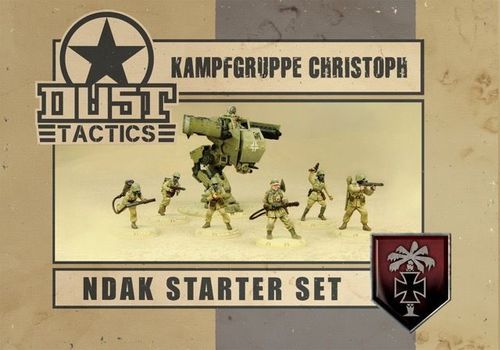
Dust Tactics: Kampfgruppe Christoph
Official rulebook: Dust Studio · PDF
Dust Tactics: Kampfgruppe Christoph Rulebook
Table of Contents
Table of Contents
Summary of Play
Each game of Dust Tactics simulates a complete battle. Players alternate activating units until the game is complete. During an activation, units can move, attack other units, use special skills, or do nothing. To determine the success or failure of actions, such as attacks, hiding behind cover, and using special skills, players roll special dice called "Dust Dice."
Dust Dice
Dust Dice have six sides with three different symbols: a crosshair, a shield, and a bloc symbol. The symbols vary in appearance depending on the bloc or faction the dice were designed to represent, such as the Allies bloc symbol, the Axis symbol, the SSU symbol, the Mercenaries symbol, and the Blutkreuz Korps symbol.
Typically, attacks score hits for each bloc symbol rolled, but certain skills units possess may modify this, allowing hits to be scored for rolls of both the bloc symbol and the crosshair. Throughout the remainder of the rules, descriptions of actions that require a dice roll will include which symbol(s) indicate success.
Game Set-Up
Players agree on the scenario they will play. Several scenarios are included at the end of this book. The first of these scenarios, Firefight, is a perfect selection for your first game. Each player determines the Units they will play (for now, the Units included in their Starter Set or Units totaling 25 points for a player who owns Dust models, but no Starter Set). Players set out game mats and terrain to complete game set-up (see page 30). Each Starter Set comes with one game mat. Combining the game mats from two Starter Sets creates a perfectly-sized battlefield that conforms to the scenarios at the end of this book.
Types of Units
Dust Tactics keeps the battlefield varied and interesting through the broad range of Units that are available for the game. In the Starter Sets, you will find three types of Units:
- Infantry – A squad of specially trained soldiers.
- Vehicles – Walkers are some of the most powerful military vehicles on the battlefield.
- Heroes – An Infantry Unit made up of a single miniature that represents a famous fighter or legendary leader in the World of Dust.
Game Mats
Dust Tactics game mats represent the battlefield and are divided in squares. Each Starter Set Unit occupies a single square. Some vehicles have weapons and other equipment that overhangs the edge of the square. For game purposes, this does not affect which square the Unit occupies.
Turns
A game of Dust Tactics is divided into Turns. At the beginning of each Turn, Dust Dice are rolled to determine which player will go first. The first player Activates their first Unit, then players alternate Activating Units until all Units have been Activated and the Turn ends. Unless Victory conditions are met, the game continues, and players begin a new Turn (see Victory, below).
Initiative
Each Turn begins with all players rolling three Dust Dice (the number of dice may be modified by certain Skills). The player who rolls the most bloc symbols gains the Initiative. If there is a tie, the player with the most crosshairs gains the Initiative. If a tie still exists, players re-roll their dice until a player gains the Initiative based on the aforementioned criteria. Once Initiative has been determined, the player who gains Initiative determines which player will take the first Activation.
Activations
The player selects the Unit they will Activate, and assigns two Actions to that Unit. A player may also choose to Pass on the Activation if they have fewer Units left to Activate than their opponent. Heroes joined to Infantry Units or piloting Vehicles are counted as a single Unit.
When a player assigns Actions to a Unit, they must declare all Actions, including the use of any Special Actions, Skills, or Special Weapons, prior to resolving any of the Actions. The following Actions can be assigned to a Unit:
- Nothing (page 15)
- Move (pages 15-16)
- March Move – Costs Two Actions (page 16)
- Attack (pages 17-23)
- Sustained Attack – Costs Two Actions (page 23)
- Special – To use some Skills and Equipment a Unit must be assigned a Special Action (pages 27-29).
Players may assign any combination of Actions, however, they may not assign two: Move (this would be a March Move), March Move (this would take four actions), Attack (this would be a Sustained Attack), or Sustained Attack (this would take four actions) Actions.
Some Skills allow Units to take a third Action. These Skills cannot be stacked to allow more than three Actions. Units may not be assigned more than three Actions in a single Activation.
Victory
The game ends at the end of the Turn where one of the following conditions is satisfied:
- One of the players completes the Objective specified in the scenario.
- One or more of the players no longer has any Units left on the game mats.
- The game reaches the Turn limit specified in the scenario.
The player who completed the scenario Objective or eliminated the other player's Units wins the game. If neither side completed the Objective or eliminated all of their opponents forces, both sides total the army points of the Units they eliminated from their opponent's army, and the player who destroyed the most army points wins. An equal number of points destroyed results in a draw.
Example Turn
Players 1 and 2 have played several Turns already and Player 2's Walker Unit has been destroyed. Player 1 still has three Units left on the battlefield (Unit A, Unit B, and Unit C), however Player 2 only has two Units left (Unit D and Unit E).
To start a new Turn, both players roll three dice. Player 1 rolls a bloc symbol, a shield, and a shield, and Player 2 rolls a bloc symbol (Axis), a crosshair, and a shield. Based on the bloc symbols, the players would tie for Initiative, but the crosshair acts as a tie-breaker, so Player 2 gains the Initiative and the ability to select which side will go first. Having lost one Unit already, Player 2 decides to go first.
Player 2 activates Hero Unit D and assigns it a Sustained Attack Action against Player 1's Walker Unit A. Unit A takes two Hits but is not destroyed.
Player 1 would like to Pass, hoping that Player 2's Infantry Unit E leaves Cover to attack one of Player 1's Units, but Player 1 still has three Units to Activate and Player 2 only has one Unit left to Activate. Player 1 decides to Activate Walker Unit A and assign it a Move Action (to move towards Unit E, bringing them within the range of Unit A's weapons, but keeping Unit A outside the range of Unit E's weapons) and an Attack Action (to fire all of its weapons at Unit E). One soldier in Unit E is destroyed.
Player 2 would like to Pass because none of Player 1's Units are within range of Unit E. Having only one Unit left to Activate compared to Player 1's two Units left to Activate, Player 2 successfully passes.
Player 1 activates Hero Unit B assigning it a March Move Action and specifying the use of its Charge Skill to perform a Close Combat Attack against Hero Unit D following the March Move. Unit B inflicts three Hits on Unit D, but it is not destroyed.
Player 2 would like to Pass again, because all of Player 1's Units are still out of range, but both players have one remaining Unit to Activate, so Player 2 cannot Pass. Instead, Player 2 activates Unit E, assigning it a Move Action (to bring them within range of Unit A) and an Attack Action that causes sufficient Hits to destroy Unit A.
Player 1 activates Infantry Unit C assigning them a Move Action (to bring them within range of Unit E) and an Attack Action that destroys 2 soldiers in Unit E.
All Units have been Activated and the Turn is complete.
Reading Unit Cards
Unit Cards provide a quick reference for the abilities of a player's Units. They are also useful for tracking whether a Unit has been Activated during a Turn. A description of the information provided on both sides of each card is provided below.
Unit Name. Indicates the Unit's name, faction affiliation, and tactical function.
Damage Capacity. Indicates the amount of damage a Hero or Vehicle can withstand before being destroyed.
Unit Special Weapons and Skills. This is a list of the Special Weapons and Skills the Unit possesses. See pages 25-29.
Weapons Table. This table lists the weapons carried by the Unit and each weapon's capabilities. The first column contains a letter for each weapon that corresponds to the image on the opposite side of the card, the number of these weapons possessed by the Unit (if more than one), and the weapon's name. The Range column indicates the weapon's range in squares.
The next 14 columns are grouped by Unit Type (Infantry, Vehicle, and Aircraft) with each column indicating the number of Dust Dice to roll and the amount of damage caused by each Hit when attacking the Armor Rating listed at the top of the column for that Unit Type. Vehicles have an additional column that indicates where or how the weapon is mounted to determine its Fire Arc.
Please note that Limited-Ammo weapons (see page 26) also include check-boxes to mark off expended ammunition.
Unit Type. This symbol indicates the type of Unit described by the card and is followed by the Unit's Armor Value.
- Infantry Unit (Squads, Support Weapons, and Heroes)
- Vehicle Unit (Walkers, Tanks, and Trucks)
- Aircraft Unit (Planes and Helicopters)
Move Value. Indicates the number of squares the Unit will move when assigned a Move Action. See pages 15-16.
March Move. Indicates the number of squares the Unit will move when assigned a March Move Action. See page 16.
Army Value. The point cost of the Unit for use when building an army for play. The Units in each Starter Set are already balanced as a group for play against any other Starter Set.
Unit Photo. This photo can be used to identify the miniatures included in the Unit. The Unit's weapons are indicated with a letter that corresponds to the Weapons Table on the opposite side of the card.
Damage Track. Check-boxes used to indicate the amount of damage a Hero or Vehicle has sustained. Indicate damage to Infantry Units by removing miniatures (e.g., one miniature for each Hit) and do not include a Damage Track.
Unit Special Weapon and Skill Quick Reference. This quick reference provides a brief description of the Special Weapons and Skills the Unit possesses. For complete descriptions see pages 25-29.
Vehicle Size/Hero Indicator. Some cards have a small notation in the lower left hand corner on the front side which indicates a Vehicle of unusual size (Light, Large, or Huge) or Hero status of a single miniature Infantry Unit.
Bloc/Faction Symbol. This symbol indicates the Unit's affiliation with a specific Bloc or Faction: Allies, Axis, SSU, Mercenaries, or Blutkreuz.
Note: Dust Tactics cards are specially coated to allow them to be used with dry-erase markers. You can mark check-boxes on your cards or make other notes during game play with a dry-erase marker, then wipe them clean when the game is over.
Nothing Action
A Unit that is assigned a Nothing Action uses a single Action to do nothing.
Move Action
A Unit that is assigned a Move Action uses a single Action to move a number of squares equal to or less than its Move Value. The direction the Unit is facing has no effect on movement. The Unit may move any direction and end its Move Action facing any edge of the square.
Units may pass through squares occupied by other friendly Units with the following exceptions:
- Vehicle Units may not pass through friendly Vehicle Units.
- A Unit cannot end its movement in an occupied square unless the Unit is a Hero sharing a square with a friendly Unit.
Units cannot pass through or end their movement in a square that contains an enemy Unit.
Movement can also be blocked or affected by Terrain. In Dust Tactics there are eight types of Terrain:
- Open – Represents flat, open areas, such as plains and recently harvested farm fields. Units can pass through or occupy and Obstacles can be placed in Open Terrain squares.
- Tree – Represents a large tree or cluster of small trees. Units can pass through and occupy Tree squares.
- Rubble – Represents piles of debris from destroyed Terrain, such as shattered buildings and destroyed roadways. Wheeled and Tracked Vehicle Units cannot pass through or occupy a Rubble square. Other Units (including Walker Vehicle Units) can pass through or occupy a Rubble square.
- Structure – Represents impassible man-made structures that cannot be entered, such as pillars or fuel tanks. Units cannot pass through or occupy a Structure square.
- Water – Represents deep water, such as lakes, oceans, and rivers. Units cannot pass through or occupy a Water square.
- Ammo Crates – 3-D obstacles that also act as Cover (see page 22). Units can pass through and occupy a square containing an Ammo Crate. Vehicle Units passing through or occupying a square containing an Ammo Crate may choose to destroy the crate (removing it from play).
- Tank Traps – 3-D obstacles that also act as Cover (see page 22). Vehicle Units, including Walkers, cannot pass through or occupy a square containing a Tank Trap. Other Units can pass through or occupy a square containing a Tank Trap.
- Walls and Buildings – Units cannot pass through Walls, but may move through openings in wall and buildings. Openings are classified into three sizes, small openings (less than one square wide), large openings (one square wide), and huge openings (two or more squares wide). Infantry Units can move through openings of any size. Vehicle Units cannot move through small openings, but may pass freely through large and huge openings. Infantry Units can also move up or down a floor in a multi-story building (this includes moving form [sic] the top floor to the roof of a building), at a cost of one square of movement per floor.
Units can also move diagonally. The first diagonal movement a Unit makes into a square counts as moving one square, but all subsequent diagonal movements the Unit makes into a square count as moving two squares. Adjacent enemy Units or impassible Terrain can limit diagonal movement. Vehicle Units cannot move diagonally across the corner of a square occupied by impassible Terrain or an enemy Unit. Infantry Units can move diagonally across the corner of a square occupied by impassible Terrain or an enemy Unit, but cannot move diagonally through the adjacent corners of two squares occupied by impassible Terrain or enemy Units.
March Move Action
A Unit that is assigned a March Move Action uses two Actions to move a number of squares equal to or less than its March Move Value. Other than the difference in the maximum number of squares moved, a March Move Action works identically to a Move Action.
Move/March Move (diagram). Unit A has a Move Value of 2 and a March Move Value of 4. Note that the Walker can move less squares than these Move Values and end movement facing any direction.
Moving Around Corners (diagram). Infantry Unit A can move across the building corners and the corner of the adjacent square that contains enemy Vehicle Unit B, however, they cannot move through the adjoining corners of the building and Unit B. Vehicle Unit C cannot cross the building corner to enter the diagonally adjacent square for one square of movement, but must instead move forward one square, then move one square to the left, entering the diagonally adjacent square for two squares of movement.
Movement in Buildings (diagram). Infantry Unit A cannot leave the building through the walls, but may leave through an opening, including moving diagonally through an opening to exit the building. Vehicle Unit B requires a large opening to enter or exit the building and cannot pass through the opening diagonally.
Attack Action
A Unit that is assigned an Attack Action follows these steps in order: Check Range (page 17), Check Fire Arc (page 18), Check Line of Sight (pages 19-20), Declare Target Units (page 21), Roll to Hit Target Units (page 21), Target Units Roll Saves (page 22), Target Units Take Damage (page 22), and Resolve Close Combat (page 23).
Zero – Check Range
Units can only Attack Targets that are within the Range of their Weapons. Each Weapon's Range, in squares, is specified on the Unit Card in the Range column of the Weapons Table. When measuring range diagonally, the first square counts as one square, but all subsequent measurement of diagonal range counts each square as two squares. A Range of "C" indicates Close Combat Weapons that can only Attack Targets in adjacent squares (see page 23).
Range (diagram). Unit A was assigned an Attack Action. Checking the Weapons Table on its Unit Card reveals that it has a weapon with a Range of six and a weapon with a Range of three. This means that Unit B is within range of all of Unit A's weapons, but Unit C is only within range of the weapon with a Range of six.
One – Check Fire Arc
Unless otherwise noted in the Weapons Table, Infantry Units (including Heroes) have a 360-degree Fire Arc, allowing them to fire in any direction. Vehicle Unit weapons have a specified Fire Arc, as indicated in the Weapons Table on the Unit Card. The four Fire Arcs are:
- Front-mounted weapons can only attack targets in squares that are 45 degrees to either side of the square directly in front of the Vehicle.
- Rear-mounted weapons can only attack targets in squares that are 45 degrees to either side of the square directly to the rear of the Vehicle.
- Side-mounted weapons can only attack targets in the 180 degrees to the side of the Vehicle (excluding the squares directly in front of the Vehicle and directly behind the Vehicle).
- Turret-mounted weapons can attack targets in any direction (360-degree arc).
Firing Arcs (diagram): Turret weapons may fire into any arc of fire.
If a Unit attempts to target a Unit that is not in their Fire Arc, the player will need to assign a Move Action to the Unit first, to change its facing.
Two – Check Line of Sight (LoS)
Each square on the game mat that contains a dot does not block Line of Sight (LoS). To determine LoS, players trace an imaginary line from the dot in the square occupied by the Unit assigned an Attack Action to the dot in the center of the square occupied by the Target Unit.
If the line passes through a square that does not contain a dot or contains Terrain that would block LoS, then LoS is blocked.
If LoS passes through the corner of a square without a dot, then LoS is not blocked, but the targeted Unit will receive the benefit of Cover (see page 22).
If the line passes through the corners of squares that would block LoS on both sides of the line, then LoS is blocked.
A square containing any Infantry Unit does not block LoS, but a square containing any Vehicle Unit does block LoS.
Squares containing smoke block LoS to Units on the far side, but Units in the smoke can be targeted.
Tree squares block LoS to Units on the far side, but Units in the Terrain can be targeted.
Walls, structures, and buildings block LoS, however, openings do allow for LoS. A Unit inside a building can only target a Unit outside the building if the attacking Unit or the target Unit is adjacent (including diagonally adjacent) to the opening the attacking Unit's LoS passes through.
A Unit outside a building can only target a Unit inside the building if the attacking Unit or the target Unit is adjacent (including diagonally adjacent) to the opening the attacking Unit's LoS passes through.
Line of Sight Example 1. Unit A has LoS to Unit B even though the line drawn from the dot in Unit A's square to the dot in Unit B's square passes through the corner of a square without a dot. Unit A does not have LoS to Unit C, however, as the line drawn between the dots in the two Unit's squares passes through a square without a dot.
Unit A has LoS to Unit D because the line drawn between the dots in the center of the two Unit's squares passes through two corners of squares without dots that are not opposing. Unit B does not have LoS to Unit E, however, because the line traced between the squares occupied by the two Units passes through two opposing corners of squares without a dot.
Line of Sight Example 2.
- LoS through openings: Unit G inside the building has LoS to Unit B outside of the building because Unit G is adjacent to an opening. Unit B also has LoS to Unit G that is inside the building. Unit G has LoS to Unit F because they are both inside the building, but does not have LoS to Unit J because Unit G is not adjacent to any opening through which it could target Unit J.
- LoS through other Units: Infantry Unit A has LoS to enemy Infantry Unit C and enemy Vehicle Unit D, even though they are firing through friendly Infantry Unit B. Units C and D can likewise target Units A and B, however, Infantry Unit E cannot target Units A and B because LoS is blocked by friendly Vehicle Unit D.
- LoS through Terrain: Unit J has LoS to Unit I even though it is located in a Tree square, but does not have LoS to Unit H because it is on the other side of a Tree square.
Three – Declare Target Units
Once Range, Fire Arc, and LoS have been checked to determine which Units can be targeted by the Unit that has been assigned an Attack Action, the player must declare which Unit will be targeted by each weapon used, and any Skills that will apply to the attack. Once targets are declared, they cannot be changed.
When performing attacks, all attacks are considered simultaneous. If a player declares a Unit is firing all its weapons against the same target but destroys it with the first weapon, the other weapons are still considered to be used in the attack, and cannot be used against another target. If a player declares that a Unit is using a Limited-Ammo Weapon (such as a Panzerfaust), the ammo is still expended, even if the other weapons destroy the target Unit first. A Unit does not have to use all of its Weapons or Skills, but if a Unit does not declare a target for one of its Weapons or does not indicate that a Skill will be used in conjunction with a Weapon that was declared, it is not used during that Activation.
Vehicle Units can use all of the weapons in their Weapons Table during each Attack Action. However, each surviving soldier in an Infantry Unit can use only one Ranged Weapon and one Close-Combat Weapon in each Attack Action. If they have several Ranged Weapons available to them, they must choose which one they will use for each Attack Action. Heroes are an exception to this rule and can use all of the weapons in their Weapons Table during each Attack Action.
Each weapon that can be used by the attacking Unit can be declared against a different target. A Vehicle or Hero with multiple weapons and Infantry Units with multiple soldiers can choose to declare multiple targets or focus their attack on a single target.
Multiple Weapons Firing at Multiple Targets (example). Infantry Unit A has three shotguns and two flame-throwers. They choose to target adjacent Walker Unit B with the flame-throwers, Infantry Unit C that is two squares away with two shotguns, and Hero D with the remaining shotgun.
Four – Roll to Hit Target Units
The number of Dust Dice to be rolled for each weapon is indicated in the Weapon Table on the Unit Card. Locate the row that provides specifications for the weapon, and then find the column that represents the Unit Type and Armor Value for the target Unit. The number to the left of the forward slash is the number of dice that should be rolled.
If the Blast symbol appears to the left of the forward slash, the weapon is a Blast Weapon. Blast Weapons deliver explosive payloads or spray over a large area. The Blast symbol indicates that this weapon rolls one die for each miniature in the target Unit.
Roll the number of dice identified for the weapon, scoring a Hit for each bloc symbol rolled unless modified by a Skill or Equipment (pages 25-29).
Blast (example). Unit A targets Unit B with an Auto Grenade Launcher. Unit A rolls "Blast/1" (Blast symbol to the left of the slash, 1 to the right) for the Auto Grenade Launcher. Unit B contains five soldiers, so Unit A rolls five dice to hit.
Five – Target Units Roll Saves
Units that occupy a square containing ammo crates, tank traps, trees, rubble, buildings, or smoke are considered to be in Cover. A Target Unit is also considered to be in Cover if the attacking Unit's Line of Sight to the Target Unit passes through the corner of a square without a center dot (see page 19).
For an Infantry Unit in Cover the player rolls a die for each Hit their Target Infantry Unit received. Each bloc symbol or shield rolled negates one Hit.
For a Vehicle Unit in Cover the player rolls a die for each Hit their Target Vehicle Unit received. Each bloc symbol rolled negates one Hit.
An Infantry Unit that is not in Cover receives an Infantry Save. This Save represents the ability of Infantry to "hit the dirt" or dive to the ground to avoid incoming fire. The player rolls a die for each Hit their Target Infantry Unit received. Each bloc symbol rolled negates one Hit.
Cover (diagram examples).
- Infantry Cover Save: Infantry Unit C attacks Infantry Unit D rolling four Hits. Unit D is in Cover so it rolls four dice with a result of two Axis symbols, a shield, and a crosshair, negating three Hits. Unit D takes the one remaining Hit.
- Infantry Save: Vehicle Unit A attacks Infantry Unit B, rolling four Hits. Unit B is not in Cover, but still receives an Infantry Save. Unit B rolls four dice with a result of two Axis symbols, a shield, and a crosshair, negating two Hits. Unit B takes the two remaining Hits.
- Vehicle Cover Save: Vehicle Unit A attacks Vehicle Unit E, rolling three Hits. Vehicle Unit E is in smoke, so it receives a Cover Save. Unit E rolls three dice with a result of a bloc symbol, a shield, and a crosshair, negating one Hit. Unit E takes the two remaining Hits. Unit E retaliates, rolling three Hits against Unit A. Unit A has no Cover, so it receives no Cover Save and takes all three Hits.
Six – Target Units Take Damage
Assign Hits not canceled by Saves to miniatures one at a time, resolving each Hit before moving on to the next. Each Hit assigned to an Infantry Unit eliminates one miniature selected by the Unit's player. Each Hit on a Hero or Vehicle inflicts the amount of damage indicated in the Weapon Table on the Unit Card. Locate the row that provides specifications for the weapon, then find the column that represents the Unit Type and Armor Value for the target Unit. The number to the right of the forward slash is the number of points of damage caused by each Hit with that weapon.
If the Automatic Kill symbol appears to the right of the forward slash, the weapon inflicts Automatic Kill damage. Automatic Kill damage is equal to the Unit's remaining Damage Capacity (remaining "crosses" on the Unit's Damage Track).
Automatic Kill (example). Vehicle Unit A attacks Vehicle Unit B with a weapon that rolls 1/Automatic Kill. Unit A rolls one die, rolling one Hit against Unit B. Unit B is destroyed.
Seven – Resolve Close Combat
Weapons that indicate a Range of "C" in the Weapons Table on the Unit Card are Close Combat Weapons. These Weapons can only be used if the attacking Unit and the target Unit occupy adjacent squares (including squares diagonally adjacent). Close Combat Weapons may be used in addition to Ranged Weapons (in the same Attack Action), but their use must be declared with Ranged attacks before any attacks are resolved. Ranged Weapon attacks are resolved first and casualties are removed before resolving the effects of attacks with Close Combat Weapons.
Attacks with Close Combat Weapons allow the target Unit to retaliate with its own Close Combat Weapons. Both the attack and the retaliatory attack are resolved simultaneously with casualties being removed following the resolution of both side's attacks. Hits with Close Combat Weapons are not subject to Cover or Infantry Saves. When performing a Sustained Attack, the player must choose whether the attack with Ranged Weapons or the attack with Close Combat Weapons will be Sustained (the other Attack will remain just a standard Attack). Regardless, the target Unit's retaliatory attack with Close Combat Weapons is not a Sustained Attack.
Regardless of the weapons listed in the Weapons Table on the Unit Card, Infantry and Vehicle Units have the ability to perform Close Combat Attack Actions with Improvised Weapons. These weapons may be thought of as shovels, grenades, the buttstock of a weapon, or a piece of battlefield debris. Improvised Weapons use the statistics listed below.
Improvised Close Combat Weapon Table. Range "C". Every Infantry, Vehicle, and Aircraft column reads 1/1.
Close Combat (example). Infantry Unit A occupies a square adjacent to Infantry Unit B. Unit A declares that it will perform a Ranged Attack followed by a Close Combat Attack. Unit A's Ranged Attack destroys two soldiers in Unit B.
Unit A and Unit B now roll simultaneously for Close Combat, with Unit A rolling for all of its soldiers and Unit B rolling for its three surviving soldiers. Unit A destroys three more of Unit B's soldiers, completely wiping out the Unit.
Unit B's Close Combat attack is simultaneous, however, so Unit A has to remove the two soldiers destroyed by Unit B. Unit A ends Close Combat with 3 surviving soldiers.
Sustained Attack Action
A Unit that is assigned a Sustained Attack Action uses two Actions to increase the likelihood that it will hit its target. After rolling the number of dice indicated for the weapon(s) used for the Sustained Attack Action, the player re-rolls all misses and counts any additional Hits as successes. Other than re-rolling misses, a Sustained Attack Action works identically to an Attack Action.
Heroes
Heroes are the main characters of the Dust universe – famous warriors and legendary fighters, they lead the troops on the battlefield.
Heroes are Infantry Units of one miniature that can share a square with a friendly Unit or a friendly Vehicle. Heroes are unique individuals, so an army can never have two of the same Hero.
Joining Infantry Squads
Before the game begins, a Hero and an Infantry Unit that have the same Armor Value, can be joined to form a combined Unit that Activates simultaneously for the remainder of the game (unless the player decides to permanently separate the Hero from the Unit during the game). If the Hero and the Infantry Unit's movement rates differ, the combined Unit uses the lower rate. The combined Unit shares Skills (if applicable). When the combined Unit takes Damage, the Unit's player assigns Hits between the Infantry Unit and the Hero joined to it using the rules for assigning Hits (see page 22). Count the combined Unit as a single Unit when determining how many Units have yet to Activate for the Passing rule (see page 11).
A player may choose to break up a combined Unit by separating the Hero from the Infantry Unit they joined before the game began. This may be done during any Turn before the combined Unit is assigned an Action. The player Activates either the Hero or Infantry Unit for a Move or March Move Action to separate them. The player then completes that Unit's Activation. The other Unit may be Activated later in that same Turn. Once the Hero is separated from the combined Unit, it may share a square with any friendly Unit, but may not be joined to any Infantry Unit for the remainder of the game.
Piloting Vehicles
A Hero with the Pilot or Ace Pilot Skill can pilot a Vehicle. Only one Hero may pilot a Vehicle at a time. For a Hero to pilot a Vehicle, the player must assign the Hero to the Vehicle before the game begins. The Hero and Vehicle Unit now form a combined Unit until the end of the game or the destruction of the Vehicle.
When a Vehicle with a pilot Activates, its pilot also Activates performing the same Action as the Vehicle.
Count the Hero and Vehicle as a single Unit when determining how many Units have yet to Activate for the Passing rule (see page 11).
While piloting a Vehicle, a Hero cannot be the target of an Attack and cannot use their own weapons, but can use their Skills.
If the Vehicle is destroyed, the pilot's player rolls a die. On a roll of a bloc symbol or a shield, the Hero escapes unharmed. On a roll of a crosshair the Hero takes a point of damage. The Hero is placed in any valid square adjacent to the square the Vehicle occupied, and counts as having Activated for this Turn.
A Hero can dismount from a Vehicle before the Vehicle Activates by performing a Move or March Move Action to move away from the Vehicle. If a Vehicle's pilot dismounts, they may not remount and the Vehicle is considered destroyed.
Special Weapons
Some weapons are subject to additional rules that represent their combat effects. These combat effects may be the result of VK-enhanced technology (e.g., Laser Weapons) or a function of how they operate (e.g., Grenade Weapons). The following are some common Special Weapons and the rules that govern their use.
Flame Weapons
Flame-throwers, napalm throwers, sulphur jets, and other similar weapons fire a spray of burning fuel or caustic liquid, engulfing the target Unit and any other Units in its path.
Units hit by Flame Weapons do not receive an Infantry or Cover Save against those weapons (see page 22). In addition, Flame Weapons attack all Units in squares between the attacking Unit and the target Unit, including friendly Units. The flame follows the shortest possible path to the target (measured in the same way as movement and range), and may only pass through squares along a path through which the attacking Unit has LoS to the targeted Unit. The player controlling the Unit performing the attack with the Flame Weapon may choose between alternative shortest paths.
Grenade Weapons
Grenade launchers and other weapons that fire small explosives project their rounds over cover so they land amidst the targeted Unit. Units hit by a Grenade Weapon retain their Infantry Save (see page 22), but do not receive a Cover Save.
Laser Weapons
When Blutkreuz Korps scientists applied the technology they found in Antarctica to weapons development, they discovered the incredible destructive capability of intensely focused beams of light. The resulting laser technology has created some of the most powerful anti-tank weapons in the world. Capable of quickly cutting through any armor; the longer Laser Weapons are held on target, the deeper they cut.
For each Hit a Laser Weapon rolls, roll one die, scoring an additional Hit on a roll of a bloc symbol. Continue scoring Hits and rolling an additional die for each Hit until a miss is rolled for that die.
If the Laser Weapon has a special rule that allows it to hit on a roll of a crosshair as well as a bloc symbol, it only counts a crosshair as a Hit on the first roll. Additional rolls only Hit on a roll of a bloc symbol.
Laser (example). Vehicle Unit A performs a Sustained Attack against Infantry Unit B with a Laser Weapon. The Unit rolls five dice, rolling two successes and three failures. The three failures are re-rolled, scoring one more success. The player now rolls three more dice for the three successes, scoring one success and two failures. One more die is rolled for the single success, but rolls a failure. Unit A inflicts a total of four Hits on Unit B.
Limited-Ammo Weapons
Some weapons have limited ammunition capacity. Once all of its ammunition is expended, the weapon can no longer fire.
Limited-Ammo weapons are indicated by check-boxes in the Weapons Table on the Unit Card. Mark one of these boxes each time an Infantry or Vehicle Unit makes an Attack or Sustained Attack Action with the Limited-Ammo weapon. Once all of the check-boxes have been marked, the weapon can no longer fire.
While a soldier (individual miniature) in an Infantry Unit can only use the weapons they are modeled with, they are assumed to pick up extra ammunition from fallen comrades that are part of their Infantry Unit. As long as there is a soldier remaining in the Infantry Unit that is modeled with that weapon, they still possess all of the Unit's remaining ammunition for that weapon.
Some weapons, such as artillery, require ammunition to be manually loaded before firing. These weapons must be reloaded after every shot. At the beginning of the game, use a Loaded token to indicate that the Reload Weapon is loaded. When the Reload Weapon is used for an Attack or Sustained Attack Action, remove the Loaded token. The Unit with the Reload Weapon, must be assigned a Reload Special Action to return the Loaded token to the Unit before the weapon may be fired again. A Unit may perform an Attack Action and a Reload Action during the same Activation, allowing it to complete an Attack Action each Activation.
Sniper Weapons
In the hands of a trained sniper, Sniper Weapons can be used to selectively target officers or other individuals in a Unit. When declaring the target of a Sniper Weapon's Attack or Sustained Attack Action, the player may specify a miniature in the targeted Unit. All unsaved Hits from this attack are assigned to the specified miniature.
Under-Barrel Weapons
Some modern weapons systems combine two weapons into one. An example of this is the M1 automatic rifle paired with an under-barrel grenade launcher.
Each soldier that carries a weapon with an Under-Barrel weapon can fire both the main weapon and the Under-Barrel weapon at the same target in a single Attack or Sustained Attack Action.
Skills
Some Units and Heroes possess Skills, aptitudes, training, or equipment that allows them to perform at a level that leaves less gifted soldiers in awe. A player must declare that a Unit is using a Skill before rolling any dice that might be modified by that Skill. Unless otherwise stated, Skills possessed by a Hero apply to a Unit they have joined, and Skills possessed by a Unit apply to a Hero that has joined their Unit. If a Hero and Unit possess the same Skill, it is not doubled in effectiveness nor do they gain a second use of the Skill. If the Skill may be used only once per game, the Hero and the Unit use it at the same time.
Ace Pilot
A Hero with the Ace Pilot Skill rolls a die when the Vehicle that they are piloting Activates. On a bloc symbol or a crosshair the Vehicle gains a third Action for this Activation. A Hero with the Ace Pilot Skill does not share it with any Unit they Join.
Airmobile
An Airmobile Vehicle can be carried by an Airlifter, such as the Mil Mi-48 'Carrier' Walker transport helicopter.
And Stay Down
Any Unit hit by this Unit's Ranged Weapons removes any Under Fire tokens on it and gains a Suppression token if it does not already have one. A Hero with this Skill does not share it with any Unit they Join.
Artillery Observer
One of the greatest advantages of artillery is that it does not need to see its target. It can use an observer to radio back the coordinates of the enemy then fire at them from afar.
When a Unit with Artillery Observer performs an Attack or Sustained Attack Action, they may use the Artillery Weapons of a friendly Unit that has not yet Activated, rather than their own Unit's weapons. The Artillery Unit immediately Activates and performs an Attack or Sustained Attack Action (whichever the Artillery Observer is performing) with its Artillery Weapons. The Artillery Unit uses the Artillery Observer to determine LoS (rather than its own position), but must check its Fire Arc and Range as normal.
If the Artillery weapon is a Reload weapon and it did not perform a Sustained Attack action, it may perform a Reload Action either before or after the Attack Action. The Artillery Unit finishes its Activation, then the Artillery Observer continues its Activation with any remaining Actions.
Assassin
A Hero with the Assassin Skill chooses which enemy Soldiers are assigned Hits when performing an Attack Action with Close Combat Weapons. A Hero with the Assassin Skill does not share it with any Unit they Join.
At the Double
A Unit with the At the Double Skill (and any Unit it has Joined or Hero that has Joined it) may perform a free Move Action immediately after performing a March Move Action.
Berserk
For each Hit a Unit with the Berserk Skill rolls with a Close Combat Weapon, roll one die, scoring an additional Hit on a roll of a bloc symbol. Continue scoring Hits and rolling an additional die for each Hit until the Unit rolls a miss.
If the Hero has a special rule that allows it to Hit on a roll of a crosshair as well as a bloc symbol, rolls of a crosshair only count as a Hit for the first roll. Additional rolls only Hit on a roll of a bloc symbol. A Hero with the Berserk Skill does not share it with any Unit they Join.
Black Ops
A Unit with the Black Ops Skill rolls four dice for Initiative rolls (see page 11).
Brave
A Brave Unit rolls three dice instead of two when rolling to remove Under Fire or Suppression tokens.
Camouflage
A Unit with the Camouflage Skill may take a Camouflage Special Action. Once it has done so, no enemy Unit has Line of Sight to it if it is in Cover from them and at Range three or more. This benefit ends if the Camouflaged Unit takes any Action other than a Move or Nothing Action (Artillery Observers can still use their Skill to attack with an Artillery Unit). The Unit starts the game Camouflaged. A Unit with the Camouflage Skill does not share it with any Unit they Join nor with Heroes that Join this Unit.
Charge
A Unit with the Charge Skill (and any Unit it has Joined or Hero that has Joined it) may perform a free Attack Action using Close Combat Weapons immediately after performing a March Move Action.
Coordinated Fire
All Auto Grenade Launchers in a Unit, or possessed by a Hero Joined to this Unit, targeting the same Unit, must select the same target square. Resolve all of their attacks at the same time. For each miniature in the target square, roll one die for each Auto Grenade Launcher.
Damage Resilient
Each time an Infantry Unit that is Damage Resilient is assigned a Hit that is not canceled by a Save (see page 22), roll a die. On a result of a bloc symbol, cancel the Hit.
Each time a Hero or Vehicle Unit that is Damage Resilient is assigned a Hit that is not canceled by a Save, mark off the resulting Damage on the Unit's Damage Track as normal. Roll one die for each point of Damage marked off as a result of the assigned Hit(s). Each bloc symbol rolled cancels one point of Damage (clearing the mark on the Unit/Hero Card).
A Unit with the Damage Resilient Skill does not share it with any Unit they Join nor with Heroes that Join this Unit.
Damage Resilient (example). Vehicle Unit A attacks Vehicle Unit B which is in Cover and Damage Resilient. Unit A scores three Hits against Unit B. Unit B rolls for Cover, and successfully negates one Hit. Unit B must now roll one die for each of the remaining Hits. Unit B rolls a bloc symbol and a crosshair, canceling one of the remaining Hits and taking the other.
Defensive Tactics
A Unit with the Defensive Tactics Skill (and any Unit it has Joined or Hero that has Joined it) gains the Damage Resilient Skill while in Cover.
Expert – Weapon
A Hero with the Expert Skill hits on rolls of a crosshair as well as a bloc symbol when making an Attack or Sustained Attack Action with the specified weapon.
Fighting Spirit
Once per game, a Unit with the Fighting Spirit Skill (and any Unit it has Joined or Hero that has Joined it) hits on rolls of a crosshair as well as a bloc symbol when making an Attack or Sustained Attack Action.
Flying
A Unit with the Flying Skill is outfitted with equipment (e.g., jetpacks) that allow it to fly over obstacles. The Unit can pass over enemy Units and any Terrain as if it were Open Terrain, provided that it ends its Move or March Move Action in Terrain that it could normally occupy. If a Hero has Joined a Unit, both must possess the Flying Skill for either to use it when they Activate together.
Infantry Ace
A Hero with the Infantry Ace Skill rolls a die when it Activates. On a crosshair or a bloc symbol the Hero (and any Unit it has Joined or Hero that has Joined it) gains a third Action for this Activation.
Lucky
Once per game, a Hero with the Lucky Skill may re-roll any dice that failed to Hit with any of their weapons when making an Attack or Sustained Attack Action. A Hero with the Lucky Skill does not share it with any Unit they Join.
Mercenary
A Unit with this Skill can be fielded by any Bloc or Faction.
Pilot: Name
A Vehicle with the Pilot: Name attribute can only be piloted by the named Hero. The Vehicle can still be fielded without a pilot. This Vehicle is unique, so only one may be included in any player's army.
Scout
A Unit with the Scout Skill (and any Unit it has Joined or Hero that has Joined it) may take a March Move Action as its first Action of the game. This counts as a single Action, leaving the Unit with one further Action during this Activation.
Smoke Launchers
Once per game, a Vehicle with Smoke Launchers may take a free Launch Smoke Special Action, that does not count towards the three Actions per Activation limit, to place a Smoke Screen on itself. The Smoke Screen fills any one square occupied by the Vehicle.
Trailblazer
A Unit with the Trailblazer Skill (and any Unit it has Joined or Hero that has Joined it) can move through enemy Units.
Zombie
A Zombie Unit never makes Cover Saves, but always passes Infantry Saves on a roll of a shield as well as a bloc symbol. A Zombie Unit cannot be the target of a Command Squad Special Action, mount a Vehicle or Aircraft, or join/be joined by a non-zombie.
Scenarios
Players must choose a scenario before starting play. Players can choose one of the four scenarios provided in this book, use a scenario provided online at www.dust-models.com or www.dustgame.com, or create their own scenario. Firefight is the recommended scenario for first-time players. If you prefer to randomize scenario selection, roll two dice and consult the chart below:
| Roll | Scenario |
|---|---|
| Two bloc symbols | 1 – Firefight |
| Two shields, or a bloc symbol and a shield | 2 – Reload |
| Two crosshairs, or a bloc symbol and a crosshair | 3 – Fuel Run |
| A crosshair and a shield | 4 – Radio Free Babylon |
Once the scenario is selected, each player provides a game mat, placing it on the table as shown in the scenario. Players roll for Initiative, and the player who wins Initiative chooses which of the indicated board edges his forces will use to enter the battlefield.
Unless Terrain placement is specified by the scenario, the player with Initiative then places one Terrain item on the play area (game mats). Players alternate placing Terrain until they have each placed two Terrain tiles and a Tank Trap. Terrain items may not be placed in a square that would block a building opening.
Players will likely be using the force supplied with their Starter Set. However, if players care to select alternate or additional Units, the scenarios provided in this book work best with 25 to 75 point forces.
Once the play area is set, players again roll for Initiative (see pages 11-12). Each of the scenarios provided in this book begin with no Units on the play area. During the first Turn, players will move Units on to the play area from the edge indicated in the scenario.
Scenario 1: Firefight
Two small scouting forces happen upon each other in a relatively desolate area. With no place to hide, they must engage and eliminate the enemy force to prevent them from reporting any intelligence they have gathered.
- Type: Skirmish
- Game End: All of one player's Units destroyed or end of Turn eight.
- Victory: Player with the most Victory Points calculated by totaling the point value of Units destroyed.
- Deployment: Players enter from indicated edges of the play area (long edges).
Scenario 2: Reload
Ammunition is in short supply on the front lines. Two opposing forces seek to capture nearby caches of ammunition.
- Type: Capture Objectives
- Game End: One player controls both Objectives on or after Turn three, all of one player's Units destroyed, or end of Turn eight.
- Victory: The player who controls the most Objectives wins. A player controls Objectives by occupying the square containing the Objective on or after Turn three, providing there are no enemy Units in any square adjacent to the Objective square. In the case of a tie, the player with the most Victory Points wins, as calculated by totaling the point value of Units destroyed.
- Deployment: Players enter from indicated edges of the play area (long edges).
Scenario 3: Fuel Run
Fuel is in short supply on the front lines. Two opposing forces seek to capture nearby fuel caches.
- Type: Capture Objectives
- Game End: One player controls both Objectives on or after Turn three, all of one player's Units destroyed, or end of Turn eight.
- Victory: The player who controls the most Objectives wins. A player controls Objectives by occupying the square containing the Objective on or after Turn three, providing there are no enemy Units in any square adjacent to the Objective square. In the case of a tie, the player with the most Victory Points wins, as calculated by totaling the point value of Units destroyed.
- Deployment: Players enter from indicated edges of the play area (short edges).
Scenario 4: Radio Free Babylon
Cut off from their main force, two opposing scouting forces search for a way to radio for support. A nearby building holds a radio set that can mean the difference between victory and defeat.
- Type: Capture & Hold Building
- Game End: The end of Turn eight or when all of one player's Units are destroyed.
- Victory: The player who has uncontested control of the designated building at the end of Turn eight wins. To have uncontested control of the building a player must have a Unit inside the building with no enemy Units inside the building. If no player has uncontested control of the designated building, the player with the most Victory Points wins, as calculated by totaling the point value of Units destroyed.
- Deployment: Players deploy from indicated edges of the play area (long edges).
Quick Reference
Turn Order
- Initiative – Players roll three dice. Most bloc symbols wins; most crosshairs is the tie-breaker. If still tied, reroll. The winner chooses which player goes first this Turn (page 11).
- Activation – Players alternate activating Units (a player may Pass if they have fewer Units left to Activate than their opponent, page 11).
- Actions – The Activated Unit is assigned two Actions (page 11). Available Actions: Nothing (page 15); Move (pages 15-16); March Move, costs two Actions (page 16); Attack (pages 17-23); Sustained Attack, costs two Actions (page 23); Special – to use some Skills and Equipment a Unit must be assigned a Special Action (pages 27-29).
- Turn Ends – Remove Activation indicators from Unit Cards, then begin the next Turn starting with Initiative. Track the Turn with the Turn Counter (Turns 1 to 8).
Movement.
- Move – Units use one Action to move a number of squares equal to or less than the Unit's Move Value (pages 15-16).
- March Move – Units use two Actions to move a number of squares equal to or less than the Unit's March Move Value (page 16).
- First measurement of diagonal movement counts as one square, all subsequent count as two squares.
- Units may pass through squares occupied by other friendly Units, except Vehicle Units may not pass through friendly Vehicle Units or end movement in an occupied square unless the Unit is a Hero sharing a square with a friendly Unit.
- Movement can be blocked or affected by Terrain (page 15).
- Vehicle Units cannot move diagonally across the corner of a square occupied by impassible Terrain or an enemy Unit.
- Infantry Units can move diagonally across the corner of a square occupied by impassible Terrain or an enemy Unit, but cannot do so through the adjacent corners of two such squares.
Heroes.
- May share a square with friendly Infantry Units.
- May join Infantry Unit with same Armor Value before game begins. Activate simultaneously. Combined Unit uses lowest Move Value. Player assigns Hits between Hero and Infantry Unit. Combined Unit counts as single Unit for Passing rule. Unit separates by assigning Move or March Move to Infantry Unit or Hero before combined Unit Activates. Hero separated from combined Unit may not rejoin Unit or join any other Unit for remainder of game.
- A Hero with Pilot or Ace Pilot Skill can be assigned to pilot Vehicle before game begins, forming combined Unit until end of game or destruction of Vehicle. Activate together performing same Action. Count as single Unit for Passing rule. If Vehicle destroyed, on a roll of a bloc symbol or a shield, the Hero escapes unharmed, but on a roll of a crosshair the Hero takes a point of damage. Hero placed in square adjacent to destroyed Vehicle. Hero can Move or March Move away from Vehicle to dismount, but Vehicle is considered destroyed.
Attack
- Zero – Check Range. Range in squares indicated in Range column of the Weapon's Table. First measurement of diagonal range counts as one square, all subsequent count as two squares. Range "C" indicates Close Combat.
- One – Check Fire Arc.
- Front – 45 degrees to either side of the square directly in front of the Vehicle.
- Rear – 45 degrees to either side of the square directly to the rear of the Vehicle.
- Side – 180 degrees to the side of the Vehicle excluding the squares directly in front of and behind the Vehicle.
- Turret – 360 degree Fire Arc.
- Two – Check Line of Sight (LoS). Draw an imaginary line between dots in center of squares occupied by Unit with Attacking and Target Unit and check for the following:
- If line passes through a square that does not contain a dot or contains LoS-blocking Terrain, no LoS.
- If LoS passes through a corner of a square that would block LoS, LoS not blocked, but Target Unit is in Cover.
- If LoS passes through opposing corners of squares that would block LoS, no LoS.
- A square containing an Infantry Unit does not block LoS, a square containing a Vehicle Unit blocks LoS.
- Squares containing smoke or trees block LoS through them, but Units in these squares may be targeted (receive Cover).
- Walls, structures, and buildings block LoS, but adjacency to openings allow LoS.
- Three – Declare Target Units.
- All targets for Ranged and Close Combat Weapons must be declared along with any Skills being used.
- Infantry Units can only use one Ranged Weapon and one Close Combat Weapon per soldier.
- Hero Units and Vehicle Units can use all weapon lines.
- Each weapon being used by a Unit can be declared against a different target.
- Four – Roll to Hit Target Units. In the Weapon's row in the Weapon Table, locate the column that represents the Unit Type and Armor Value for the target Unit and roll the number of dice to the left of the forward slash. If the Blast symbol appears to the left of the forward slash, roll one die for each miniature in the target Unit and score a Hit for each bloc symbol rolled unless modified by a Skill or Equipment (pages 25-29).
- Five – Target Units Roll Saves. Units that occupy a square containing ammo crates, tank traps, trees, rubble, buildings, or smoke are in Cover as are Units receiving corner Cover (see LoS).
- Infantry Units in Cover roll one die for each Hit received and each bloc symbol or shield rolled negates one Hit.
- Vehicle Units in Cover roll one die for each Hit received and each bloc symbol rolled negates one Hit.
- Infantry Units not in Cover roll an Infantry Save by rolling one die for each Hit received. Each bloc symbol rolled negates one Hit.
- Flame Weapons eliminate both Cover Save and Infantry Save (page 25).
- Grenade Weapons eliminate Cover Save, but allow Infantry Save (page 25).
- Six – Target Units Take Damage. Hits not cancelled by Saves are assigned to miniatures and resolved one at a time. Each Hit assigned to an Infantry Unit eliminates one miniature chosen by the Unit's player. Each Hit assigned to a Hero or Vehicle Unit inflicts the amount of damage indicated to the right of the forward slash in the Weapons Table row for the weapon and column for the target. The Automatic Kill symbol indicates damage equal to the Unit's remaining Damage Capacity.
- Seven – Resolve Close Combat. Weapons with Range "C" are Close Combat Weapons. Close Combat occurs after Ranged attacks are resolved. Sustained Attack Actions only affect Ranged or Close Combat Attack, but not both. Both Units roll for Close Combat Attacks and damage is simultaneous. Improvised Weapons may be used with the values shown in the Improvised Close Combat Weapon Table (page 23), where every column reads 1/1.
Victory
Game ends at the end of a Turn where one of the following conditions is satisfied (page 11):
- One of the players completes the Objective specified in the Scenario.
- One or more of the players no longer has any Units left on the game mats.
- The game reaches the Turn limit specified in the Scenario.
The player who completed the Scenario Objective or eliminated the other player's Units wins the game. If neither side accomplished this, the player who destroyed the most army points of their opponent's Units wins. Equal points destroyed results in a draw.