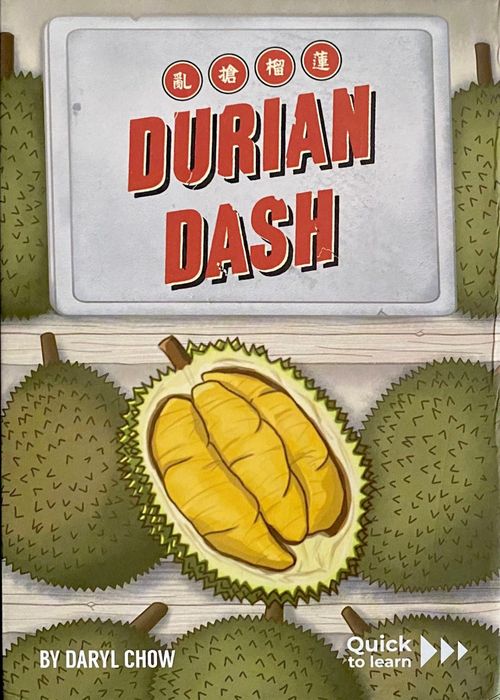
Durian Dash
Durian Dash Rulebook
Table of Contents
Table of Contents
Overview
Love it or hate it, the durian is Singapore's most iconic fruit. Known as the King of Fruits, durians are known to smell like hell but taste like heaven. In Durian Dash, players will need to visit different plantations to collect their favourite durians and earn the most thumbs up. But watch out for the spikes of the other players!
Game Components
- 60 Durian cards
- 50 Action cards
- 8 Preference cards
- 6 Player location cards
- 6 Player aid cards
- 2 Plantation cards (Pahang and Johor)
Aim of the Game
Being durian aficionados, all players jostle to visit the durian plantations of Johor and Pahang to collect Durian cards of their choice before other players. They visit the plantations by playing their Location card together with an Action card of their choice. The winner is the player who earns the most Thumbs Up!
Game Setup
- Shuffle the Action cards into a deck. Deal 3 cards to each player, and place the deck face-down in reach of all players.
- Shuffle the Durian cards into a deck. For 2/3/4 players, remove 30/20/10 cards from the game. Lay out 2 rows of Durian cards face-up, each row containing cards equal to (3 + number of players). For example, in a 4 player game, lay out 7 Durian cards in each row (14 in total).
- Place the Pahang card above the top row and the Johor card below the bottom row.
- Deal each player 1 Preference card to be looked at and kept secret from other players, as well as 1 Player Location card and 1 Player Aid card. You are ready to begin!
Flow of the Game
Durian Dash is played over a number of rounds. Every round, players secretly choose their Action cards to collect durians from either Johor or Pahang. Action cards will be resolved by the smallest number first. The game ends at the end of the round after the Durian deck runs out, and the player with the most Thumbs Up wins.
Flow of a Round
Each round consists of 3 steps in the following order:
- Choose an Action
- Resolve Actions
- Resupply
1. Choose an Action
Each player simultaneously and secretly chooses one of their three Action cards to play that round, and rotates their Plantation card to their preferred location. Note that Action cards numbered 5 to 14 can also be rotated.
Example: Hasan plans to head left into Pahang to take two durians and give one away. Jin also plans to head left into Pahang to take one durian and drop one.
2. Resolve Actions
When all players are ready, all players lay or flip over their two Action cards on the table face-up at the same time for all players to see. Starting from the player who has the smallest Action card number, actions are resolved. Players execute the Action card icons in order from top to bottom. All taken or given Durian cards are placed face-up in front of a player in their collection. After resolving actions, players take back their Location card and discard their used Action card to a discard pile to be placed next to the Action deck.
Action Card Icons:
- Take a Durian: For each icon shown, take one Durian card from the row in the direction stated on the card.
- Place a Durian: Choose any one Durian card from your collection to place in the row in the direction of the card.
- Give a Durian: Give a Durian card from your collection to a player of your choice.
Example A: Jin's lower Action card number enables her to resolve first. Heading left, she takes 1 Sultan. But with no other Durian cards in her collection, she places it back in the row.
Example B: Hasan goes next. He takes 2 Sultans and gives 1 to Jin.
3. Resupply
Once all players have completed their actions, there is a resupply to end the round. If there are 3 or less Durian cards in a row, refill the row by flipping up new cards from the Durian deck to the number equal to (3 + number of players). Do not move the existing cards and fill the rows with cards, Pahang first, from left to right.
Example C: As there are only 3 cards remaining, the row is refilled by flipping up two Durian cards.
If any row contains half or more Rotten durians after resupplying (e.g. 3 Rotten out of 6), remove the entire row from the game and flip up a new row equal to (3 + number of players).
If the Durian deck runs out, the next round will be the last round. If there are insufficient Durian cards to fill a row, that row is not filled.
Each player then draws 1 Action card so that they have 3 cards for the next round. If there are insufficient Action cards in the deck, shuffle the discard pile to form a new deck.
Supplementary Example D: In the next round, Hasan plans to head right into Pahang to take three durians. With an Action card that offers players the choice of either direction, Jin chooses to head right into Johor to take one durian.
Supplementary Example E: Jin has the lower Action card number and resolves first, taking 1 Golden Phoenix in Johor.
Supplementary Example F: Hasan takes 1 Black Pearl, 1 Red Prawn, and 1 Mao Shan Wang in Pahang. Both resupply and the game continues.
End of the Game and Scoring
The game ends at the end of the round after the Durian deck runs out. Players now count their scores to see who gained the most Thumbs Up.
Players use their secret Preference cards to determine how many Thumbs Up or Thumbs Down each durian scores:
- If they LIKE a Durian, that Durian scores 2 Thumbs Up.
- If they LOVE a Durian, that Durian scores 3 Thumbs Up.
- If they HATE a Durian, that Durian scores 1 Thumbs Down.
In addition:
- Each Mao Shan Wang scores 3 Thumbs Up.
- Each Rotten durian scores 1 Thumbs Down.
- All other durians score 1 Thumbs Up.
Tally all your Thumbs Up, then minus all of your Thumbs Down from this total. The player with the most Thumbs Up wins the game and is crowned King of the King of Fruits!
In the case of a tie:
- The player who has the least Rotten durians wins.
- If it is still tied, the player who played the lowest Action card number in the final round wins.
Example G: This is Hasan's secret Preference card. He loves Red Prawn but hates Golden Phoenix. By the end of the game, he has collected: 2 Red Prawns, 2 Mao Shan Wang, 3 Black Pearl, 2 Golden Phoenix, 2 Rotten. Red Prawn: 2 x 3. Mao Shan Wang: 2 x 3. Black Pearl: 3 x 1. Golden Phoenix: 2 x (-1). Rotten: 2 x (-1). Hasan's tally is 6 + 6 + 3 - 2 - 2 = 11.
Durian Haters Variant
For players who hate Durians, you can play this variant instead. The only change to the game is that the player with the LEAST thumbs up wins. All other rules remain the same.
Glossary
Durians are a quintessential part of Singaporean life, and durian aficionados will go to great lengths to get their hands on the rich and creamy fruit.
There are a multitude of durian varieties, each with different flavour profiles, names and numbers (Dxx). Here is some background information about the featured durians in the game:
Mao Shan Wang
The Mao Shan Wang, also known as the Musang King, is the most popular and well-loved durian in Singapore. 'Wang' means King in Mandarin Chinese, and it reigns over all the other durians with its perfect profile of creamy and bittersweet flavours. 'Mao Shan' literally means 'Cat Mountain', not because the civet cat enjoys the fruit, but because the mountain where this variety is said to originate from is home to many civet cats.
Black Pearl
Like the Black Thorn, the Black Pearl from Johor is a rare breed of durian. Also contributing to its name is its tinier husk and smaller, rounder pearl-like seeds, which are pale yellow with a touch of gray. Its slightly bitter and milky taste makes it more palatable than the intense Black Thorn.
Golden Phoenix
Hailing from both Johor and Pahang, the watery flesh of the uncommon Golden Phoenix has a pale yellow complexion. Its intense sharp and bitter taste makes it less welcoming for durian newbies, but perfect for those who dislike flesh that is cloyingly sweet.
Red Prawn
Native to Penang, the flesh of the Red Prawn has a distinctive curve and a light orange-pink colour, leading to its name. The delicate, creamy sweet flesh has undertones of berries and wine as well as a sweet aftertaste, making it a hit with casual eaters and connoisseurs alike.
Note that Singapore Red Prawn (D13) from Johor and Penang Red Prawn (D175) are quite different varieties of durian!
Sultan
The flesh of the D24 is thick, soft, creamy and bittersweet and a perfect starting point for newcomers to the fruit. It is said that due to the limited availability of this variety in its earlier days, only sultans (rulers) had access to the fruit.
The most popular variety in the 20th century, the Sultan has lost ground to Mao Shan Wang but remains widely eaten and used in desserts and pastries.