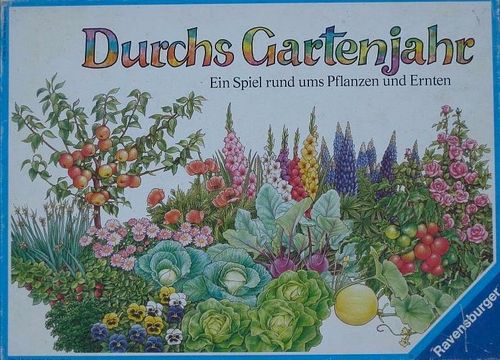
Durchs Gartenjahr
Durchs Gartenjahr Rulebook
Table of Contents
Table of Contents
Contents
- 1 game board
- 4 game figures
- 1 die
- 60 cards
- 150 chips
Goal of the Game
Each player moves their figure around the board through the twelve months of the garden year. Depending on the month, they can plant or harvest.
For every plant whose harvest time has come, the player receives one harvest point (chip). Field voles, snails, frost or drought can reduce the points if one does not take precautions with help cards.
The winner is the player with the most harvest points at the end of the year.
Setup
-
Game board: The game board is placed in the middle of the table.
-
One figure per player: Each player receives a game figure and places it on "Start".
-
Game leader: A game leader is chosen by lot. The game leader hands out the chips and the cards. He watches over the observance of the rules and checks that the harvest times are stated correctly.
-
15 chips per player: Each player receives 15 chips at the start.
-
Cards: There are plant cards and help cards. Each plant card shows one plant. Below it are the planting or sowing time and the harvest time. The months in which the plant can be sown or planted are marked green. The months in which the plant can be picked or harvested are marked red. Help cards become important when the player's figure reaches an event space on which he would have to pay points. He can prevent this by playing a suitable help card (see "Events on the Board and Help Cards" below).
-
4 cards with dark green backs per player: Some of the cards have dark green backs. These are needed at the start of the game, while the cards with light green backs only become important from February/March.
The cards with dark green backs are sorted out and shuffled. Each player receives 4 of them and lays them face up on the table in front of him. These are the plants that are already growing in his garden from the beginning. Help cards may be among them as well.
If a player has received a help card but would rather have a plant instead, he may slide the help card under the draw pile and take a new card in its place. If that card is again a help card, he may keep exchanging until he has a plant. At the start of the game a player may therefore exchange more than one help card in this way.
The game can now begin.
Course of Play
-
Roll the die: The youngest player begins.
-
Move the figure: The player moves his figure along the track as many spaces as the die shows.
-
Events: If there is a small picture on the space where he lands, he must observe the event (see "Events on the Board and Help Cards" below).
-
Draw a card and check whether it can be planted: After moving his figure, the player lifts a card from the face-down draw pile. He then has several options:
- He has drawn a plant that can be planted or sown in the month the player's figure is in (the months marked green on the card). He lays the card in front of himself; that is, "he sets the plant in his garden".
- He has drawn a plant that cannot be planted in the month the player's figure is in. He places this card face up back on the open pile (discard pile). He may not draw another card.
- He has drawn a help card (hedgehog, scarecrow and so on). The player may decide whether to keep it or to put it back face up on the open pile. Excepted is the "vole card" (see the description on page 7). The player may not draw another card.
-
Harvesting: Now the player checks all plants "in his garden" to see whether he can harvest. For each plant that can be harvested or picked in the month his figure is in (the months marked red on the card), he takes 1 point (chip) from the bank. Plants that were only just planted can earn points only the next time.
A player may harvest from a plant over several rounds. Each time he is on turn again, he harvests as long as the harvest time still applies. Once the harvest time is over, the card is placed on the open pile.
End of the Game
The game ends when the first three players have reached the goal space.
The player who first reaches the big garden party receives 3 points (chips) from each of the other players, because he hosts the big party. The second player to arrive there receives 2 points, and the third player receives 1 point from each of the other players. A player does not have to reach the goal with an exact throw.
The winner is the player with the most points (chips).
Events on the Board and Help Cards
The track shows various events that can occur during the year. If a player lands on one with his figure, he may receive points (chips), but he may also have to pay points. Help cards protect against these losses: if a player plays a matching help card, he does not have to give up any points. The help card then goes back onto the open pile.
Events on the Board
- You were away and did not salt the path during icy conditions. -2 points. Help card: Neighbourly help. The neighbour is so friendly that he salts the path for you.
- You were diligent and turned the compost. +1 point.
- You receive a gift of a bouquet of flowers. +1 point.
- Your snowman is the most beautiful. +1 point.
- You may take 2 cards from the draw pile instead of one.
- Frost damage. -2 points. Help card: Foil to cover.
- Caterpillars have caused damage in your garden. -2 points.
- A thunderstorm with hail has caused damage. -2 points. Help card: Foil to cover.
- You give a garden party. Everyone is delighted. +2 points.
- Birds have pecked up your fresh sowing, or they have eaten from your berries. -2 points. Help card: Scarecrow or net to cover. (Birds destroy many pests and are therefore very important and useful. That we nevertheless cover our berries and new sowings is understandable. We also want to harvest something.)
- Snails have damaged your plants. -2 points. Help card: Hedgehog.
- You were away and did not water. Your plants wilt. -2 points. Help card: Neighbourly help.
Help Cards
-
Container plants: Container plants are plants that the gardener offers all year round in a planting tub (container) and that can also be planted all year round. With a "Container plants" card a player may plant a plant in his garden even when its planting time is actually over.
Caution! This does not work for all plants. The plants for which it is possible are marked with a small flowerpot symbol. The "Container plants" card returns to the open pile after planting.
-
Foil or net: With it you can protect your plants from frost and thunderstorms, and your berries from birds.
-
Scarecrow: With it you can keep birds away from the fresh sowing, or from the berries and cherries.
-
Hedgehog: A hedgehog lives in your garden. It eats the snails.
-
Neighbourly help: Your neighbour waters your plants or gritts the path when it is icy.
Remarks on Planting and Sowing Times
- Some plants have two different planting times. Fruit trees and berry bushes can be planted both in autumn and in early spring. In spring the player thus has another opportunity to get a fruit tree or berry bush into his garden. In our game, players may receive harvest points for a dormant tree or bush even when in reality it could not be harvested.
- Harvest, planting and sowing times differ in different regions, depending on whether the climate is harsh or mild. In our game we have given average times. It can be very enjoyable to talk about it as a family and to compare how it is "with us".
- Some plants are mostly sown rather than planted. For these plants the sowing times are given. Other plants are better bought pre-grown from the gardener. For these plants the planting time is given.
Plants for which the sowing time is given: Radishes, Rettich, Mohre (carrot, as printed), pea, bean, cucumber, dill, parsley, summer savory (Bohnenkraut), lamb's lettuce (Feldsalat).
Plants for which the planting time is given: Apple tree, pear tree, cherry tree, walnut tree, plum tree, strawberry, raspberry, gooseberry, blackberry, currant (Johannisbeere), rose, crocus, tulip, lettuce, onion, tomato, magnolia, dahlia, sage.