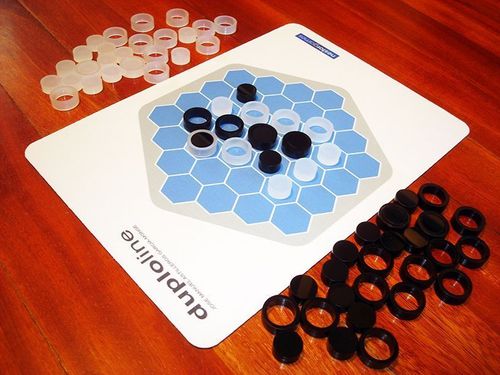
DuploLine
DuploLine Rulebook
Table of Contents
Table of Contents
Material
- A hexagonal board with four hexagons per side
- 18 white discs and 18 black discs
- 18 white rings and 18 black rings
Rules of the Game
The game begins with an empty board. Each player has an allocated color: black or white. White starts by placing one of his pieces (disc or ring) on any cell of the board. From now on, starting with black, on your turn, you must perform two actions: a disc action and a ring action, although in whichever order you like:
-
Disc action menu: a. Add one of your discs to an empty cell, adjacent to at least one opponent piece (ring or disc), or… b. Move one of your discs already on the board inside any ring (black or white) in an adjacent cell.
-
Ring action menu: a. Add one of your rings to an empty cell, adjacent to at least one opponent piece (ring or disc), or… b. Move one of your rings already on the board surrounding any disc (black or white) in an adjacent cell.
Connection Rule: If a move would split the pieces on the board into more than a single contiguous group, it is not allowed.
Once a disc and a ring share a cell, they are locked in place: Neither piece can move for the rest of the game.
Players may not pass. Pieces cannot be stacked.
If you cannot perform a legal action on your turn, you must add one of your discs or rings to any cell of the board already occupied by a ring or a disc, respectively.
Examples
Diagram 1: It is White's turn. He must perform two actions. In the first action he can either: (a.) add a new ring or a disc to an empty cell, adjacent to an opponent piece (i.e. any cell marked with an "a") or (b.) move his ring to any adjacent cell occupied by a disc (i.e. any cell marked with a "b"). Note that he is not allowed to move his disc at the moment, because doing so would break the Connection Rule. He decides to add a ring (red arrow, below)….
Diagram 2: …and now his second action must be a disc action. He can either: (a.) add a new disc to an empty cell adjacent to an opponent piece (i.e. any cell marked with an "a") or (b.) move his disc to an adjacent cell occupied by a ring (i.e. any cell marked with a "c"). Note that he is allowed to move his disc now, because after the move, all pieces on the board will remain connected in a single group.
Diagram 3: Example of a game won by black (4 rings in a row).
End of the Game
You win immediately if you establish a line of at least 4 discs or a line of at least 4 rings of your color. The game ends in a draw if the board fills up before anyone makes such a line.