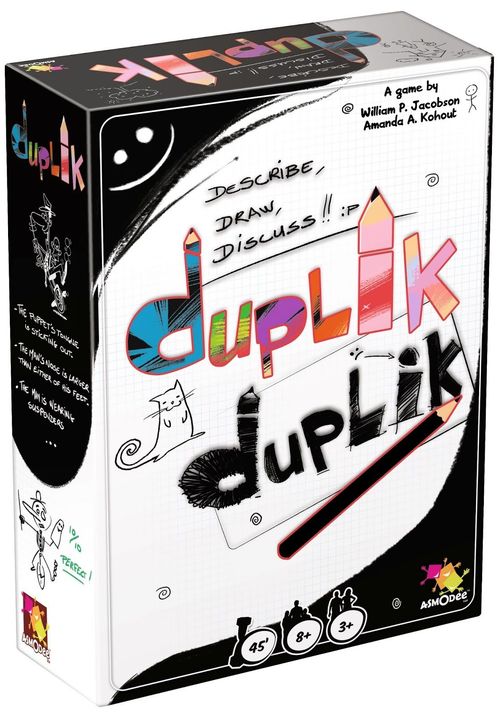
Duplik
Duplik Rulebook
Table of Contents
Table of Contents
Setup
- Each player rolls the die. The player who rolls the highest score is the Portrayer for the first round; the other players are the Artists.
- The Portrayer tears a sheet from one of the drawing pads and turns it over. This becomes the game's score sheet.
- The Portrayer writes each player's name on this sheet twice: once on the top half (A) (the Portrayers' score sheet) and once on the bottom half (B) (the score sheet).
- Each player takes a drawing sheet and a pencil, and writes their name at the bottom of the sheet.
A Round of Play
1. Preparation
- The Portrayer chooses (or draws at random) a scene card. The Portrayer must not let the Artists see the picture.
- The Portrayer rolls the die to determine the golden criterion. The Artists mark the die result on the grid at the bottom of the first sheet of their pad.
2. Description and Drawing
- The Portrayer first reads the title of the scene aloud, then turns the hourglass. From that moment, the Portrayer has 90 seconds to describe the scene to the Artists.
- The Portrayer must describe the scene shown on their card as precisely and quickly as possible, so that the Artists can reproduce it exactly. The Portrayer may express themselves however they wish, with no restriction on vocabulary, but may not make gestures or look at the drawings in progress.
- The Artists must faithfully represent, on the first sheet of their pad, the scene described by the Portrayer. They must not speak or, in any way, communicate with each other or with the Portrayer. No questions are allowed.
- As soon as the hourglass runs out, the Artists put down their pencils and the Portrayer stops describing the scene.
If you are the Portrayer, be quick and direct. In particular, describe the position of elements relative to one another, and the size and number of the different objects.
If you are an Artist, do not draw too small, and do not waste time on stylistic flourishes. This is not a drawing contest.
3. Judging
- Each Artist passes their drawing to the neighboring Artist, to the left or to the right, according to the Portrayer's decision. Each Artist thus ends up with another player's drawing, and places it clearly visible in front of them. From this point on, the Artists change hats and become Judges.
- The Portrayer places the red cover to the right of the drawing and reads, one by one and in order, each of the ten criteria, clearly stating the numbers.
- For each criterion, the Judges must decide whether or not it is satisfied by the drawing in front of them. If a Judge decides a criterion is satisfied, they check the "check mark" box above the corresponding number. If the criterion is not satisfied, they check the "X" box.
For a criterion to be satisfied, all of its elements must actually appear in the drawing. For example, a criterion such as "The cat is under the table" requires that a table exist. If there is a cat but no table, the criterion is not satisfied.
- During this phase, only the Portrayer is allowed to look at the scene card. The Portrayer must not intervene in the Judges' decisions. The Portrayer may not help clarify a criterion, show the original scene, or reveal a criterion that has not yet been evaluated.
Keep an eye on your own drawing so you can dispute the Judge's decision if necessary. In case of doubt or dispute, a Judge should appeal to the judgment of their fellow Judges. Failing consensus, the Judges may hold a vote, in which the Portrayer does not take part. In the event of a tie among the other Judges, the Artist in question casts the deciding vote.
4. Scoring
- Each Artist scores 3 points if their drawing satisfies the golden criterion, and 1 point for each of the other criteria it satisfies.
- The Portrayer scores 1 point for each criterion that was satisfied by at least one Artist. If several artists satisfied the same criterion, the Portrayer still scores only one point for it. Likewise, the Portrayer scores only one point, not three, if the golden criterion is met.
- As criteria are resolved, the Portrayer checks the corresponding boxes (check mark or X).
- Once all criteria have been revealed and evaluated, each Judge writes the drawing's total score in the box at the bottom right of the sheet. It will later be transferred to the score sheet by the Portrayer.
- The Portrayer must also record their own score, first on the top half (the Portrayers' score sheet), then on the bottom half (the score sheet).
5. End of the Round
- The Portrayer then reveals the original drawing, which may be displayed on the table alongside the works of all the Artists. It changes nothing about the score, but it is still one of the best moments of the game!
- Each Artist takes back their drawing and sets it aside until the end of the game.
- Play moves to the next round: the player seated to the left of the Portrayer becomes the Portrayer for the next round.
End of the Game
- The game ends when every player has been the Portrayer exactly once. For a longer game, you can decide in advance that each player will be the Portrayer two or even three times.
- At the end of the game, each player calculates their total score by adding up the scores on the score sheet. The player with the highest total wins.
If, despite all the care taken in developing Duplik, we mistakenly kept a draft version and thus let a few errors slip through, do not hesitate to write to us at [email protected]. We will correct these flaws as quickly as possible!
— Asmodee