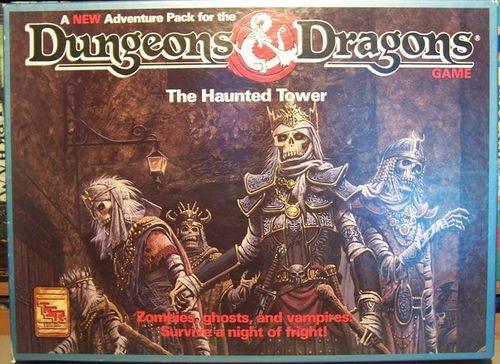
Dungeons & Dragons: The Haunted Tower
Dungeons & Dragons: The Haunted Tower Rulebook
Table of Contents
Table of Contents
Object of the Game
The object of the Haunted Tower Game is to kill the Specter of Sir Jameson, an evil ghost who is haunting the Fighters' Academy, which he used to run. You must defeat the monsters that have made their home in the academy in order to collect enough magical treasures to make you strong enough to defeat the powerful specter.
Setting Up the Game
You will need the following to play the Haunted Tower Game:
- These rules.
- The hero cards.
- Game chits.
- A cup (a mug is perfect).
- Monster and player stand-ups.
- Two dice, a six-sided die (1d6) and a ten-sided (1d10). The ten-sided die is printed with numbers from 0 to 9. The "0" is counted as a 10.
- The Fighters' Academy poster map.
- From 3-6 players.
Putting Together the Game
The game will only have to be assembled once.
Punch out the blue, purple, and green game chits that say "Haunted Tower" on the back. The other chits of the same size are not used in the Haunted Tower Game.
Assemble the six stand-up hero counters and the following monster stand-ups: one basilisk, two black widow spiders, one bone golem, one carrion crawler, two dire wolves, one displacer beast, two gargoyles, four ghouls, two giant bats, one giant rat, two giant vampire bats, one mummy, two pit vipers, one robber fly, one rust monster, six skeletons, one specter, two tiger beetles, one vampire, two werewolves, three wights, one wraith, and two zombies.
To assemble a stand-up, simply detach the counter from the sheet. Then fold it along the score lines, with the color side out, to form an "A"-shaped stand-up counter. Lock the tab in the slot. For added durability, you may want to glue or tape the tab into the slot.
Use the hollow space beneath the cardboard insert in the box to store your counters.
Setting Up the Board
Everyone should pick a hero to play. Each hero is represented by a cardboard stand-up, and a character card tells about that hero's abilities.
Place the Heroes. Heroes start the game just outside the double front doors to the first level of the tower. The first level is labeled "Tower 1."
Place the Blue Chits. Place all the blue-backed chits in a cup and shake them. Everyone draws the appropriate number of blue chits from the cup for placement. The players may look at these chits.
| Number of Players | Number of Chits |
|---|---|
| 3 | 17 |
| 4 | 13 |
| 5 | 10 |
| 6 | 8 |
Roll 1d10. The person who rolls highest starts first. He or she places one chit face down on any square in any room in the tower. The words "Haunted Tower" should be face up.
Chits are never placed in the hallways. A hallway is any place on the board that has a stairway in it or is connected to one. A chit can't be placed in a square that already contains another chit. Also, chits can't be placed in the four squares directly in front of the double doors. Lastly, for every square occupied by a blue chit in a room, the room must contain two empty squares. (This will help ensure an even distribution of chits.)
The player clockwise from the first player places the next chit. Players continue placing chits until they are out of them. When the players have finished placing all the chits they drew, any leftover blue chits are set aside.
Place the Purple Chits. All the purple-backed chits except the "Specter of Sir Jameson" are put in a cup and shaken. The first player picks a purple chit from the cup and, without looking at it, places it on any square in any room on the first level.
After the first person has gone, pass the cup clockwise. The next person picks a chit (sight unseen), places it in a different room, and passes the cup. This continues until every room on the first level has one purple chit placed in it. There are no empty square requirements for purple chits; a purple chit can be placed in any room (but not in a hallway).
When every room on the first level has one purple chit placed in it, continue passing the cup and placing chits in the rooms on the second level. When every room on the second level has a purple chit placed in it, add the "Specter of Sir Jameson" chit to the cup and shake. Then continue placing chits for every room on the third level.
You are now ready to enter the Haunted Tower and defeat the Specter of Sir Jameson!
The Order of Play
After the chits are placed, the players roll 1d10 to see who goes first (roll off ties). Play proceeds clockwise from the person who rolls the highest number.
- Hero movement. The player who rolled highest moves his or her hero.
- Chit encounters. Face-down chits are revealed if a hero stops moving next to one and wants to encounter it. The chit is either picked up if it's a magical item, or it is attacked if it's a monster. Any monster attacks against a hero are handled by the player to his or her right.
- Repeat. Repeat steps one and two until each player has gone, then roll again. The player with the highest number begins the next round of play.
The Rules
Movement
Heroes move the number of squares equal to their speed plus a 1d6 roll. Heroes must stop moving for their turn when they run out of movement or when they stop to encounter a chit. (If a hero ends his or her turn adjacent to more than one chit, the hero may choose which chit to encounter.) Heroes may stop moving before they reach the end of the movement they rolled. Heroes may stop next to a chit and choose not to turn it over.
Restrictions: Heroes may not double back on themselves while moving. Heroes may move through squares that other heroes or face-down chits are in, but they cannot end their movement in the same square as another hero or a chit.
Doors and Stairs: It costs an extra point of movement to move through a door or onto a staircase square. The staircases overlap from one floor to another. For example, when you are at the top of the staircase connecting Tower 1 with Tower 2, you step off the staircase onto the space on the second floor that is right in front of the room with the double doors.
Chits that lie directly behind a door are adjacent to a hero as long as the hero stopped moving with at least one point of movement remaining. (This represents the hero opening the door to encounter the chit, but not stepping through the door.)
Climbing to a New Level: Heroes cannot leave Tower 1 until they have three or more blue chits. (A purple chit counts as two blue chits.) Heroes cannot leave Tower 2 for Tower 3 until they have six or more blue chits (or any combination of blue and purple chits that make up six). If all the chits have been removed from a level, heroes who have fewer chits than they need can climb to the next level.
Encountering a Chit
Chits are revealed when they are encountered. A chit is encountered when a hero moves adjacent to it. If a hero moves next to more than one chit, he or she can pick which chit to encounter. The hero can choose not to encounter any chit, even if he or she is adjacent to one.
When a hero moves adjacent to a chit, he or she stops moving for the turn and may turn over the chit. If the chit is a magical item, the hero may take the chit. (Note: Heroes can't pick up magical items they can't use.) If the chit is a monster, put the appropriate stand-up in place of the chit. The monster then attacks the hero.
Magical Items
Armor chits have gold shield symbols on them. Weapon chits have red crossed sword symbols on them. Other magical item chits have orange potion bottle symbols on them.
A hero may have only one kind of armor, two weapons, and one shield. If heroes encounter chits that would bring them over this limit, they can either ignore the new chit or trade an old item for it. They must drop any excess chits they carry in a square adjacent to them. Any exception to this rule is noted on a hero's character card. Heroes may have as many chits bearing the orange potion symbol as they want.
Dropping a Chit: Heroes may voluntarily drop a magical item in an adjacent square at the end of their movement. Magical item chits that have been revealed are not turned over again if they are dropped.
Trading: Heroes may trade chits. To trade, two heroes must be adjacent to one another. Stopping to trade ends a hero's movement. Once the heroes who want to trade are adjacent, they may work out their trade however they wish. They may trade as many magical items as they want as long as neither ends the trade with too many armor, weapon, or shield chits.
Limited Uses: Some magical items have a limited number of uses, as indicated on the chit. When the item is used for the last time, it is removed from the game.
Initiative
When an attack begins because a hero and a monster are adjacent to one another, both the hero and the monster roll 1d6 to see who attacks first. The one who rolls the highest gets to attack first. The monster and hero then take turns attacking each other until one or the other is dead or the hero runs away. Initiative is rolled every round.
Attacking
Both monsters and heroes attack the same way. Attackers roll 1d6 and add their attack number for the result. Special ability and magical items can add to the attack number. Only one magical weapon at a time may be used in an attack. If the attacker's result is higher than or equal to the defender's armor class, the attack does damage. Special abilities and magical items can add to the defender's armor class and to the damage inflicted by the attacker.
All attacks must be made on an adjacent opponent. Attacking continues until either the monster or hero is dead or the hero runs away.
Running Away
When engaged with a monster, a hero may try to run away rather than attack. To run away, the hero must roll 1d10. If the result is greater than or equal to the monster's attack number, the hero successfully runs away. If the hero rolls less than the monster's attack number, the hero did not escape, and the monster now gets its attack roll. If a hero runs away from a monster, the monster and its chit are removed from the board.
Damage
Damage is subtracted from hit points. Damage from an attack can be normal damage or an energy drain.
Normal Damage: Normal damage is done by a successful attack from either a hero or a monster. Normal damage is one hit point plus any bonuses to damage from magical items or special abilities.
Energy Drain: An energy drain is a nasty form of damage. Such monsters drain one hit point of damage and drain one point from the hero's attack number. (Use a green "-1" chit to keep track of energy drains.) If a monster has a double energy drain, it causes two hit points of damage, but subtracts only one from the attack number. An energy-draining monster inflicts a maximum of one "-1" chit to a hero.
Dying
If a monster's hit points reach zero or below, it is dead. When a monster dies, the player who killed it gets to keep the monster's stand-up.
If a hero's hit points reach zero or below, he subtracts one from his attack number. The hero then takes a green "-1" chit, is placed outside the tower, and must reenter the tower through the front doors. The hero's hit points are restored to maximum. The "-1" chit gotten from "dying" can be removed just as any other "-1" chit can be (see Experience). The stand-up of the monster that killed the hero is removed from the board. A hero whose hit points reach zero or below a second time is dead and out of the game.
Experience
When monsters are killed, the hero who killed them gets to keep their stand-ups and chits. If a hero takes energy-draining damage from a creature, he or she may trade in two blue monster chits or one purple monster chit to remove the "-1" chit. The hero can do this at any time (including on his or her deathbed). The player then no longer has that penalty to his or her attack. Chits may only be traded in to regain lost attack numbers, not to add extra to a hero's attack number.
Undead
Undead monsters are listed in the Monster Listing.
Special Abilities
The heroes and some of the monsters have special abilities. Each hero's special ability is listed on his or her character card. Monsters' special abilities are listed under the Monster Listing in these rules.
The Specter of Sir Jameson
The specter of Sir Jameson is special. It is not removed from the board until it is killed. If a hero successfully runs away from the specter, he or she backs up two spaces in the direction the hero came from. The specter remains where it was originally encountered.
Each time the specter is encountered, it is at full strength (HP 8). Wounds from an attack with one hero are not carried over to attacks by other heroes.
Ending the Game
The game ends when the Specter of Sir Jameson is killed.
Winning
Players get points for the number of chits and stand-ups they have at the end of the game and for doing certain things. The player with the most points wins.
| Condition | Points |
|---|---|
| Each monster stand-up | 1 |
| Each blue-backed chit | 1 |
| Each purple-backed chit | 2 |
| Killing the vampire with the stake | 4 |
| Damaging the specter of Sir Jameson | 5 |
| Killing the specter of Sir Jameson | 15 |
Monster Listing
Here are the statistics for the monsters in the Haunted Tower game. HP is hit points, Att is attack number, and AC is Armor Class.
- Basilisk. HP 5; Att 6; AC 8. Heroes hit by a basilisk must roll 1d10. On a 1-4, they take normal damage. On a 5-9, they take double normal damage. On a 10, they have their hit points reduced to zero, as the basilisk has turned them to stone and they die!
- Black Widow Spider. HP 2; Att 3; AC 6. Heroes hit must roll 1d10. On a 1-7, they take normal damage. On an 8-10, they take double normal damage.
- Bone Golem. HP 4; Att 6; AC 10. The bone golem does double normal damage.
- Carrion Crawler. HP 3; Att 4; AC 5. Heroes hit by a carrion crawler must roll 1d10. On a 1-6, they take normal damage. On a 7-10, they take normal damage and are at -2 to hit on their next attack roll on the carrion crawler because its paralyzing venom has slowed them down. They return to normal for the following roll unless hit again.
- Dire Wolf. HP 4; Att 5; AC 6.
- Displacer Beast. HP 4; Att 5; AC 9.
- Gargoyle. HP 4; Att 5; AC 7. Can only be damaged by magical weapons or magic.
- Ghoul. HP 2; Att 3; AC 6; Undead. Heroes hit by a ghoul must roll 1d10. On a 1-7, they take normal damage. On an 8-10, they take normal damage and cannot move on their next turn. They can finish the current attack normally.
- Giant Bats. HP 2; Att 2; AC 6.
- Giant Rats. HP 1; Att 1; AC 5.
- Giant Vampire Bat. HP 2; Att 3; AC 6. Does double normal damage.