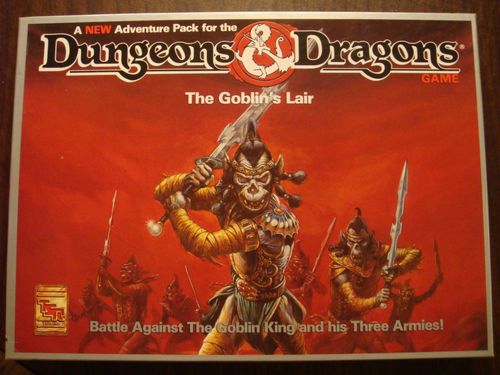
Dungeons & Dragons: The Goblin's Lair
Dungeons & Dragons: The Goblin's Lair Rulebook
Table of Contents
Table of Contents
Winning the Games
Goblin's Lair has one crucial goal: the heroes must find the goblin king and defeat him! There are other goals, such as collecting treasures, defeating other monsters, and clearing out the entire dungeon, but the fall of the goblin king must happen to complete the game. The monsters' goal in the Goblin's Lair mini-game is to defeat the heroes in combat and prevent them from exploring the entire dungeon.
Starting the Game
This box gives you all you need to play Goblin's Lair, except for some paper and pencils. You'll need one of the color maps, this pull-out Goblin's Lair Rules Section, at least one ten-sided die, and the fold-up figures for the monsters and heroes.
One player controls the monsters and the other players each control one hero. The monster player chooses the mapsheet and places it on the table. He or she then places stand-up door counters on the mapsheet at any possible locations desired.
Next, each player selects a hero and takes the fold-up figure for that hero and the character card with the hero's or heroine's game statistics. Place the hero figures in the area marked "1" on the mapsheet, and the game is ready to go!
Heroes and Monsters
This game allows heroes to explore the unknown for treasure and adventure. Monsters are the main hazard they face. Fold-up figures represent all the heroes and monsters in this set.
Ability Scores
Each figure has ability scores, given on the Hero Roster and the Monster Roster, that define what the figure can do. The scores for heroes are also on character cards for easy reference.
- Move shows how many squares a figure moves in a turn.
- Attack reveals how deadly a fighter the figure is.
- Defense tells how good the figure is at avoiding being hit.
- Search shows how easily a hero can find hidden treasure (heroes only).
- Lives shows how many times a hero or the goblin king can be wounded before being put out of action.
- Notes refer to spellcasting and missile fire, which will be explained later (heroes only).
The Monster Player
The role of the monster player is very similar to the role of the Dungeon Master in a DUNGEONS & DRAGONS role-playing game. When a hero opens a room, movement is temporarily stopped. This player then rolls on the Monster Table to determine what creatures lurk in the shadows. He then places the indicated monsters in the room and then hero movement is finished. The monster player also decides where the monsters move and makes all the dice rolls for them.
Turn Sequence
The game is played in turns, and each turn is split into a number of phases:
- In the hero move phase, the heroes are moved and any randomly discovered monsters are placed;
- In the monster move phase, the monsters are moved;
- In the hero combat phase, the heroes attack monsters;
- In the monster combat phase, the monsters fight back;
- In the search phase, the heroes can search for treasure.
A turn may not consist of all phases at all times. For example, if no monsters are found, there is no monster move phase and no combat phase--play goes straight to the search phase. If a battle takes more than one turn, then there is no search phase for the heroes involved in battle until the monsters are all defeated.
Movement
Figures can move a number of squares up to their Move score. A move can be in any direction or any combination. Diagonal movement can only occur if there are two open squares adjacent to an obstacle, figure, or wall, for example, if a figure is in a doorway, another figure cannot move (or fight) diagonally through the doorway. A figure may not move through solid rock or wooden obstacles.
A figure cannot enter a square occupied by another figure. A figure's movement ends when it moves next to an enemy--the figures are now in combat.
Movement Order
Monsters move in any order the monster player desires. The heroes also move in any order they wish. If there are arguments over heroes' movement, all hero players roll a 10-sided die and move in order from the highest to the lowest.
Doors, Half Squares and Obstacles
Opening or closing a door costs one additional movement point. Half-squares on the map count as full squares for movement purposes. Any obstacles printed on the map (pools, tables, furniture, etc.) can be moved around by normal movement. Streams and rivers, like the one on the Red Hand Trail mapsheet, do not affect movement at all in this mini-game and count as normal squares.
Any figures can move onto tables and furniture at the cost of one extra movement point. There are no advantages in moving on top of obstacles.
Movement in Combat
When a figure moves next to an enemy figure, the moving figure stops and both figures are considered to be in combat. Any figures starting next to an enemy can move one square during its move as long as it stays next to any enemy figures it is in contact with.
A figure in combat may also escape in its move. The figure moves normally, but its opponent gets a free attack with a +2 bonus to the dice roll (See Combat).
Monster Placement and Movement
When the heroes open a new area (opening a door during the hero movement phase), they might find monsters. The monster player rolls on the Monster Table. If monsters appear, the monster player sets the fold-up figures in the room wherever he or she chooses. However, monster figures cannot be placed next to the door. If there are more monsters than squares in the room, the extra monsters don't appear. After monsters are placed, the hero figures resume movement (a hero might even shut the door he just opened!). Once the monsters are set up and the heroes' movement is concluded, the monster movement phase begins.
Examples of Illegal Movement (diagram): four small grid examples showing figure A moving in directions it is not allowed to. The caption reads: "Figure A cannot move in the arrow's direction."
Do not roll for monsters in a room if the heroes have already opened the room and defeated all the monsters there. Such rooms are cleared for the rest of the game.
Combat
In order to fight each other, two figures must be in adjacent squares, including diagonally adjacent squares. The only exceptions to this are missile fire and magic.
Combat takes place in two phases. First the heroes attack, and then the monsters strike back. A hero cannot [attack] another hero. (The printed text reads "A hero cannot another hero"; the verb is missing from the print and is bracketed here.)
To attack, roll a 10-sided die and add the attacker's Attack score. If the result is equal to or greater than the target's Defense score, the attack hits. Note that all natural rolls of 1 count as misses and all natural 10s count as hits, regardless of Attack adjustments or an enemy's Defense score. If a monster is hit, it is defeated and removed from play; if a hero or the goblin king (see Game Goals) is hit, one Life is lost. Each player should keep careful track of his or her hero's current number of Lives. A hero reduced to zero Lives is incapacitated and out of the game.
Each player should keep a count of the Attack points of all the monsters his or her hero has defeated. The monster player should do the same for all the heroes his or her monsters have beaten. At the end of the game, these points are added up for each surviving hero, and they are used to find out who has won.
Missile Fire
Hugo and Rissiel carry missile weapons that allow them to hit targets from a distance. Hugo has a sling and Rissiel wields a bow. Roll a 10-sided die as a normal attack, and make sure there is a clear line of sight to the target. If a straight line from attacker to target must pass through a square containing an enemy figure or another obstruction, then there is no line of sight and the attacker must select another target. If in doubt, lay down a ruler or a piece of string on the mapsheet. Hugo and Rissiel can attack with missile weapons through other hero figures, provided there is still a line of sight.
Magic
Ariel, Bryn, and Rissiel can cast spells in certain phases during the turn. At the start of the game, each hero selects two spells--except Ariel, who can choose four spells.
To cast a spell at a target, line of sight is needed--see the section on missile fire. When a character first casts a spell, it is automatically successful. Each time after that, the player must roll 1d10 for the character before casting the same spell. Each spell is marked with a number; if the d10 roll is less than that number, the spellcaster has forgotten the spell and cannot use it for the rest of the game. The spells available to all spellcasters are the following:
Spell List
- Cure Light Wounds (5): This spell is cast in the hero movement phase and restores up to 2 Lives to the caster or a hero adjacent to the caster. A hero cannot have more than 4 Lives.
- Haste (4): Cast in the hero movement phase, this spell allows the caster or a hero next to the caster to move up to twice his or her Move score this turn. Hasted heroes can move past monsters without stopping due to their speed. This spell does not replace movement if used by the caster, but using it on another hero negates the caster's movement.
- Hold Person (4): This spell is cast on an enemy figure during the hero combat phase. That held figure cannot attack during the monster combat phase.
- Magic Missile (5): This spell can only be cast during the hero combat phase. The magic missile automatically hits any target in a straight line of sight and is not impeded by other heroes.
- Paralysis (3): When cast in the hero movement phase, one enemy target is paralyzed and may not move during the monster movement phase. That enemy figure can still attack during the monster combat phase, however.
- Shield (3): This spell is cast in the hero combat phase instead of attacking. It increases the caster's Defense score alone by 2 points for the rest of this battle (defeat all monsters in room).
Searching
Heroes in a numbered room without monsters can search it for treasure. Roll a 10-sided die and add the hero's Search score. If the score is more than six, the hero has found something. The player then checks the Treasure Table, noting down what has been found. If a search roll is a 12 or greater, the player rolls a 10-sided die and consults the Special Treasures Table. A hero can search a room only once--the monster player should keep a note of which rooms each hero has searched.
Game Goals
The Goblin King
The monster player's most important and potent monster is the goblin king. This creature is the only monster that has multiple lives, just as the heroes do. The goblin king must be found and defeated three times by the heroes before the game can end.
The goblin king is not on the Monster Table since he does not appear randomly on the mapsheet. After the heroes explore at least 50% of the dungeon, the monster player rolls a 6-sided die. The result is which of the six highest numbered areas on the mapsheet the goblin king is in. The monster player secretly marks the area on some scrap paper. When a hero opens that room, the monster player rolls normally on the Monster Table, and includes these monsters with the goblin king.
The goblin king is a unique monster and can use special treasures. When he is placed, the monster player rolls on the Special Treasures Subtable to find what magical item the king owns. The goblin king can use special items as the heroes can, but player heroes can claim his special items as treasures once he is defeated. The goblin king cannot use potions; roll again for another item if this is rolled.
Ending the Game
The game can end two different ways. If half or more of the heroes have been incapacitated by the monster player, the game ends. It also stops when the heroes have explored every room on the mapsheet, and there are no new rooms to enter.
To find out who has won the game, add up the total Attack points of monsters defeated by each surviving hero (or heroes defeated by the monsters), and add the gold piece value of treasure found to that total. Special treasures (the sword, shield, charm, and any unused potions) count as 10 gold pieces each; magical potions that are used during the game do not count toward the final scoring. The player with the highest total is the winner. Keep in mind that players whose heroes are incapacitated (lost all four Lives) can still win if they have enough points when they are removed from the game.
Mini-Game Reference Sheet
The following is the Goblin's Lair Reference Sheet (Palace of Dread booklet, page 10), reproduced as printed.
Hero Roster
| Name | Move | Attack | Defense | Search | Lives | Notes |
|---|---|---|---|---|---|---|
| Ariel Dreamweave | 6 | 4 | 10 | 2 | 4 | 4S |
| Bryn the Pious | 5 | 4 | 13 | 2 | 4 | 2S |
| Corinna Ravenshield | 4 | 6 | 14 | 2 | 4 | |
| Hagrim Flintfist | 4 | 6 |
Notes: #S = # of spells, M = missile weapon.
Spells
Three heroes in this mini-game can cast magic: Bryn the Pious, Rissiel Stillglade, and Ariel Dreamweave. Unless otherwise stated, spells replace the normal activity of the phase in which they are using magic. Casting cure light wounds replaces movement as it's cast in the hero movement phase. For more information on the spells and spellcasting, see the Spell List in the Magic section.
When a character first casts a spell, it is automatically successful. Each time after that, the player rolls a 10-sided die before the hero casts the same spell. If the d10 roll is less than the number listed with the spell, the spellcaster has forgotten the spell and cannot use it for the rest of the game.
- Cure Light Wounds (5): Cast in the hero movement phase; restores up to 2 Lives to the caster or a hero next to the caster.
- Haste (4): Cast in the hero movement phase; double Move score for the caster or a hero next to the caster for this turn.
- Hold Person (4): Cast during the hero combat phase; held figure cannot attack during the monster combat phase.
- Magic Missile (5): Cast during the hero combat phase; magic missile automatically hits target in straight line of sight.
- Paralysis (3): Cast in the hero movement phase; enemy is paralyzed during the monster movement phase.
- Shield (3): Cast in the hero combat phase; increases caster's Defense by 2 points for this battle.
Monster Roster
| Name | Move | Attack | Defense |
|---|---|---|---|
| Air Elemental | 7 | 10 | 15 |
| Carrion Crawler | 5 | 8 | 10 |
| Dire Wolf | 7 | 9 | 12 |
| Fire Beetle | 5 | 5 | 10 |
| Gargoyle | 5 | 10 | 14 |
| Giant Rat | 6 | 4 | 8 |
| Goblin | 4 |
* Goblin King has three Lives; heroes must score three successful hits against him to defeat him. Heroes gain Attack points as experience for each hit on the goblin king, but only the person who defeats the king the third time gets his magical item.
Monster Table
Roll 2d10 and add the total number of heroes to the roll.
| Total Roll | Monster |
|---|---|
| 3-9 | No Monsters In Area |
| 10 | 2 Goblins |
| 11 | 3 Fire Beetles |
| 12 | 1 Carrion Crawler |
| 13 | 2 Goblins and 1 Goblin Chief |
| 14 | 2 Skeletons and 1 Giant Rat |
| 15 | 2 Giant Rats |
| 16 | 5 Goblins |
| 17 | 3 Goblins and 1 Dire Wolf |
| 18 | 3 Dire Wolves |
| 19 | 1 Owl Bear |
| 20 | 1 Wight |
Treasure Table
Roll a 10-sided die and add the hero's Search score.
| Search Total | Treasure |
|---|---|
| 3-6 | Nothing--there was no treasure to find! |
| 7-11 | Gold--you find 1d10 gold pieces. |
| 12 | Roll again on the Special Treasure Subtable. |
Special Treasure Subtable
| D10 Roll | Treasure |
|---|---|
| 1-3 | Healing Potion--restores 1 Life to 1 hero |
| 4-5 | Super-Healing Potion--restores 2 Lives to 1 hero |
| 6 | Magic Shield--adds 2 to the character's Defense |
| 7 | Magic Sword--adds 2 to the character's Attack |
| 8-9 | Potion of Speed--adds 2 to drinker's Move |
| 10 | Lucky Charm--adds 1 to the character's die rolls |
Note: Drinking a potion is done in the hero movement phase and replaces movement for that turn.