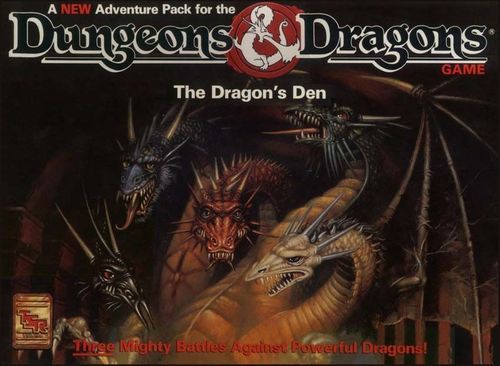
Dungeons & Dragons: The Dragon's Den
Dungeons & Dragons: The Dragon's Den Rulebook
Table of Contents
Table of Contents
Setting Up the Game
You will need the following to play the Dragon's Den Game:
- These rules.
- The hero cards.
- Game chits.
- Two cups (mugs are perfect).
- Monster and player stand-ups.
- Two dice, 1d6 and 1d10.
- Any one of the three poster maps.
Step 1: Select Hero and Dragon Players
Two to eight people can play Dragon's Den. One person plays the dragon, and the others may choose from seven heroes. Each player rolls 1d10; the person with the highest roll gets first choice at being the dragon or a hero. The player with the second highest roll gets second choice, and so on. If no one has chosen to be the dragon, the person with the lowest roll must be the dragon. Roll again if die rolls are tied.
Each hero player takes the appropriate hero card and stand-up and places both in front of him or her.
The dragon player selects one of the three dragon dens and pulls out the appropriate poster map.
Step 2: Set Up the Heroes
Play goes in order from largest to smallest hero number (for instance, Sam Barleyman, #7, is before Grochek Hammerfist, #1), and each player places his or her hero stand-up in the entrance to the dragon den. If there is more than one entrance, the player may choose which entrance to enter. (Note: Heroes may not enter the Wild Dragon Den through Entrance C because that entrance is sealed by the dragon.) Only as many heroes may be placed at an entrance as there are spaces to hold them.
Play begins with the hero who has the largest number.
Step 3: Set Up the Dragon Den
The dragon player should set up the dragon den using the following steps.
3A: Place the Dragon. Put the 12 dragon chits into a cup and draw one chit at random. Look at it, then place it face down in the dragon's lair on the map. Do not reveal this chit to the players. Check the Dragon Notes below to find out which dragon is indicated by the number and to find the information on that dragon's abilities.
Now draw out two more chits and discard those; nine chits should remain in the cup. These chits will be drawn later in the game after the alarm has sounded; they are used to count off the turns until the entrances are closed.
Note: If the players desire a slightly longer game, do not set aside the two extra chits; use a total of 11 chits instead of nine to count down the turns.
3B: Place Room Chits. There are a total of 40 room chits—half are monsters, the other half are treasures. Put all the chits into the second cup and randomly draw one chit at a time, placing it face down in each of the rooms numbered 1-20. (Do not put any chits in rooms numbered higher than 20.) Repeat the drawing until there are two chits in each room. Do not reveal the numbers of the chits to the players. The numbers correspond to Monster Notes and the Monster Treasure Table below.
Note: Random placement will result in some rooms having two treasures and some having two monsters. If the dragon player prefers, he or she can separate the room chits into monsters and treasures and disperse them so that each room has one monster and treasure.
3C: Place Dragon Treasure Chits. Place all ten dragon treasure chits face down anywhere in the dragon's lair. The numbers on the chits correspond to the Dragon Treasure Table below.
The Rules of the Game
Hero Players
You receive a hero card describing your hero's abilities (the reverse includes D&D® game statistics for using the hero as a PC) and the hero's stand-up for moving on the map. Each hero card contains the following information:
- Hero Number and Name. Heroes are numbered from 1-7. The high-numbered hero moves first because larger numbers reflect dexterity. Thus, Sam Barleyman (#7), a halfling, moves before Grochek Hammerfist (#1), a dwarf.
- Speed. When moving (advancing or running), add this number to the score rolled to determine how many squares your hero may move in one turn.
- Health Score. This score represents your hero's spirit and vitality. If reduced to zero, your hero is dead.
- Special Ability. You must reduce your hero's health score by one point every time you use his or her special ability.
Dragon Player
Like heroes, monsters and dragons have speed and health scores; some monsters and all dragons also have special abilities. You'll find the information you need for each monster and dragon in the sections on Monster Notes and Dragon Notes below. In addition, for variety's sake, the dragon player can compose his or her own lists of monsters to replace the ones in these rules.
Treasure
Heroes may gain treasure chits from monsters or dragons. Each chit bears a number that corresponds to either the Monster Treasure Table or the Dragon Treasure Table (below). (The dragon player can create new tables with different treasure items as desired.) Hero players keep the treasure chits gained as a record of their loot. Treasure is acquired by:
- "Attacking" a Treasure. Heroes can advance and "attack" a treasure just as they do monsters. They automatically pick up the treasure they announce they are taking; there is no need to roll a die.
- Successfully Attacking the Dragon. Each time a hero successfully attacks the dragon, he or she takes one chit from the face-down treasure chits in the dragon's lair.
- Slaying the Dragon. The hero whose attack slays the dragon takes all the remaining treasure chits in the dragon's lair.
Movement
Movement consists of advancing or running and stopping. Heroes, monsters, and the dragon can all advance; only heroes may run. Neither monsters nor the dragon may leave their respective rooms until the alarm has sounded (see below). After that, they may advance normally like heroes.
A hero may leave the dragon den at any time by moving to an entrance square; however, once a hero has left the dragon den, he or she may not return. Remove the stand-up from the map.
1: Advancing. When advancing, players roll 1d6, add their speed number to the die roll, and then move their counters up to that many squares. (They do not need to move the entire score.) All stand-ups may move diagonally, even when entering a room. Monsters and the dragon cannot advance through squares occupied by heroes, monsters, or the dragon; heroes, however, may advance through squares occupied by other heroes, though they cannot advance through squares occupied by monsters or the dragon. Players may choose not to advance at all. Doors do not affect advancing.
2: Running. Only heroes may run. To do so, the hero players roll 1d6 and 1d10, add the results, and then add the hero's speed number for a total. Their stand-ups may run that many squares. Heroes may run diagonally, but they cannot run through squares occupied by heroes, monsters, or the dragon. Doors do not affect running.
3: Stopping. When a hero advances or runs into any room that contains a face-down chit, the hero's movement ends on the first square upon entering that room. The room chits are revealed (see below), and the hero has the option of attacking if the dragon player places a monster or a treasure in an adjacent or a diagonal square.
Attacking
Heroes and monsters must choose their targets before they attack, and they may make only one attack per turn. Heroes and monsters must move to a square that is adjacent or diagonal to the target they wish to attack. Heroes may attack monsters and the dragon; monsters may attack heroes; and the dragon may use his special ability against the heroes.
To attack, a player rolls 1d6. If the score is equal to or less than the attacking player's current health score, the attack is a success. Subtract a health point from the target's health score, and keep track of losses on a scrap piece of paper.
Note: In some instances, the attack roll will be an automatic success, particularly early in the game when the heroes, a few of the monsters, and the dragon are at full health score points.
A hero, monster, or dragon that reaches zero health points is dead. If a hero is slain, any treasures he or she has gathered are lost to the heroes; set the treasure chits aside, taking care not to mix them with other players' chits or with the chits on the map.
The Alarm
An alarm sounds in the dragon's lair when the first treasure chit is garnered by a hero. Once the alarm has sounded, monsters and the dragon may advance outside their respective rooms. During the dragon player's turn, the dragon player draws a chit from the dragon cup to signify the countdown to the end of the game. When the last dragon chit is drawn from the cup, the gates to all entrances slam shut. Heroes still inside the dragon den are trapped and taken prisoner, certain to face a terrible doom. The game ends immediately.
Special Abilities
Both heroes and dragons have special abilities. Each hero's special ability is listed on his or her hero card. Each dragon's special ability is given in the Dragon Notes (below). See those items for detailed information on using special abilities.
The Order of Play
Each player moves in turn, starting with the player who has the largest hero number (for instance, Sam Barleyman is #7, and if he is used, his hero player goes first). Play goes on in sequence, from largest to smallest hero number, and then the dragon player takes his or her turn. Play begins again with a new turn.
Hero Players' Turn
During his or her turn, a hero player may:
1: Advance and attack. The player rolls 1d6, adds the hero's speed number to the die roll, and moves the counter up to that many squares. The hero must stop on the first square upon entering a room that has face-down chits in it. The dragon player reveals the chits (see below) and places the appropriate monster or dragon counter in the room (or reveals the treasure if it is a treasure chit). If the monster or dragon is placed in an adjacent or diagonal square to the hero, the hero may attack.
If the dragon player places the stand-up away from the hero, the hero will have to wait until the following turn before he or she can advance again and attack.
Attacking is resolved as noted above. The player rolls 1d6; if the roll is equal to or less than the hero's current health score, the attack succeeds. The monster or dragon loses a health point.
2: Run. A hero may choose to run if necessary. (See Movement above.) If a hero runs into a room with face-down chits, his or her movement ends immediately; the chits are revealed (see below).
Dragon Player's Turn
After all the heroes have taken their turns, the dragon player takes his or her turn and may:
1: Draw a dragon chit from the dragon cup. If the alarm has sounded (see above), draw one dragon chit and set it aside. When the last dragon chit has been drawn, the game ends.
2: Move all monsters. Any monsters may advance; monsters advance just like heroes (see above). They may not leave their rooms, however, until the alarm has sounded, which occurs when the first piece of treasure is gained. Once the alarm has sounded, monsters may move freely from room to room. Any treasure in a room with a monster remains in that room. The dragon player may move the monsters in any order.
3: Have monsters attack heroes. When all monsters have advanced, they may attack any heroes in squares adjacent or diagonal to the monsters. The dragon player resolves these attacks in any order.
4: Move the dragon. The dragon may advance just like the heroes (see above). The dragon may not leave its lair, however, until the alarm has sounded. Once the alarm has sounded, he may move freely from room to room. The dragon, unlike the monsters, carries his treasure with him; for convenience, leave the dragon treasure chits lying face down in the dragon's lair.
5: Have the dragon attack. The dragon attacks by using his breath weapon as indicated in the Dragon Notes (see below). All heroes in the same room or lair as the dragon are affected by the dragon's breath, regardless of where they may be in a room.
Revealing Chits
If a hero's stand-up advances or runs into a chamber with face-down chits, the hero must stop and his or her movement is over for that turn. The dragon player turns over the chits.
- If it is a treasure chit, the dragon player consults the appropriate treasure table for the type and quantity of treasure. The dragon player tells the hero what the results are.
- If it is a monster chit, the dragon player consults the Monster Notes and reads aloud the entry. The dragon player places the stand-up anywhere in the room except on squares occupied by heroes. If there is no free space in the room, the dragon player may move hero stand-ups to squares outside the room up to two squares away.
- If it is a dragon chit, the dragon player consults the Dragon Notes and reads aloud the correct entry. The dragon player puts the counter in the lair in any square not occupied by a hero.
Ending the Game
When the last chit is drawn from the dragon cup during the dragon player's turn, the game ends immediately. The hero players and the dragon player total their scores and consult the victory charts (below). Any heroes left inside the dragon den when the gates slam shut are dead and out of the game.
Heroes' Victory
The heroes who escape the dragon den should total the value of all the treasure taken from the dragon den. For each hero slain or trapped inside the dragon den, subtract 1,000 gp for the cost of raising a monument to the hero's memory in his or her hometown. The final figure is the heroes' haul; look on the Heroes' Victory Chart for the result.
Heroes' Victory Chart
| Result | Outcome |
|---|---|
| Dragon slain! | A great triumph! The Duke invites you all to a hero's banquet. |
| 10,000+ gp | A fabulous success! Songs of your brave deeds are sung throughout the land. |
| 5,000-9,999 gp | A notable feat! Your names are known throughout Karameikos. |
| 2,000-4,999 gp | Quite a haul. Old acquaintances and relatives appear, hoping to borrow money from you. |
| 500-1,999 gp | Not bad. You pay all your expenses and have something left over for a victory celebration. |
| 250-499 gp | Nothing to brag about. Better luck next time. |
| 0-249 gp | Humiliating disaster. Serving maids in taverns snicker behind your backs when you order. |
| Heroes slain! | Dragon food! If you were all slain or trapped inside the dragon den, your calories go into making the great beast even more terrible. |
Dragon Victory
For each hero slain or trapped inside the dragon den, add one dragon happiness point. For each dragon treasure chit still remaining inside the dragon's lair, add one dragon happiness point. (Such chits held by slain or trapped heroes are counted as still remaining in the dragon's possession.) Total your happiness points and check the Dragon's Victory Chart for the result.
Dragon's Victory Chart
| Result | Outcome |
|---|---|
| Dragon rules! | Huzzah! If all heroes are slain and/or trapped inside the lair at the end of the game, princes, knights, and wizards throughout the land quake when your name is spoken. |
| 15+ points | That'll teach them a lesson! Daunted by your fierceness, adventurers avoid your lair. |
| 10-14 points | A fearsome monster still . . . but a little nervous. You saved most of your trove, but you worry about other heroes yet to come. |
| 5-9 points | Fie on manthings! You sit upon your now-tiny treasure trove and grumble about heroes. |
| 0-4 points | Shame and desolation. Your monstrous minions turn upon you and drive you from the lair. |
| Dragon slain! | Total defeat! Your severed head is paraded throughout the great cities of the land. |
Dragon Notes
1) Aged Black Dragon
Health Score: 24 · Speed: 10
Special Ability: Greater Acid Breath. Each hero in the same room as the dragon loses 2 health points unless he rolls his current health score or lower on 1d6, in which case he loses 1 health point only. Costs 1 health point to use.
2) Adult Black Dragon
Health Score: 20 · Speed: 8
Special Ability: Greater Acid Breath. Each hero in the same room as the dragon loses 2 health points unless he rolls his current health score or lower on 1d6, in which case he loses 1 health point only. Costs 1 health point to use.
3) Young Black Dragon
Health Score: 18 · Speed: 6
Special Ability: Lesser Acid Breath. Each hero in the same room as the dragon loses 1 health point. Costs 1 health point to use.
4) Yearling Black Dragon
Health Score: 16 · Speed: 4
Special Ability: Lesser Acid Breath. Each hero in the same room as the dragon loses 1 health point. Costs 1 health point to use.
5) Aged Green Dragon
Health Score: 24 · Speed: 10
Special Ability: Greater Chlorine Gas Breath. Each hero in the same room as the dragon loses 2 health points unless he rolls his current health score or lower on 1d6, in which case he loses 1 health point only. Costs 1 health point to use.
6) Adult Green Dragon
Health Score: 20 · Speed: 8
Special Ability: Greater Chlorine Gas Breath. Each hero in the same room as the dragon loses 2 health points unless he rolls his current health score or lower on 1d6, in which case he loses 1 health point only. Costs 1 health point to use.
7) Young Green Dragon
Health Score: 18 · Speed: 6
Special Ability: Lesser Chlorine Gas Breath. Each hero in the same room as the dragon loses 1 health point. Costs 1 health point to use.
8) Yearling Green Dragon
Health Score: 16 · Speed: 4
Special Ability: Lesser Chlorine Gas Breath. Each hero in the same room as the dragon loses 1 health point. Costs 1 health point to use.
9) Aged Red Dragon
Health Score: 24 · Speed: 10
Special Ability: Greater Fire Breath. Each hero in the same room as the dragon loses 2 health points unless he rolls his current health score or lower on 1d6, in which case he loses 1 health point only. Costs 1 health point to use.
10) Adult Red Dragon
Health Score: 20 · Speed: 8
Special Ability: Greater Fire Breath. Each hero in the same room as the dragon loses 2 health points unless he rolls his current health score or lower on 1d6, in which case he loses 1 health point only. Costs 1 health point to use.
11) Young Red Dragon
Health Score: 18 · Speed: 6
Special Ability: Lesser Fire Breath. Each hero in the same room as the dragon loses 1 health point. Costs 1 health point to use.
12) Yearling Red Dragon
Health Score: 16 · Speed: 4
Special Ability: Lesser Fire Breath. Each hero in the same room as the dragon loses 1 health point. Costs 1 health point to use.
Dragon Treasure
As noted above, the dragon player should feel free to modify the Dragon Treasure Table or to create a new table for variety in play.
Dragon Treasure Table
| Roll | Treasure | Value |
|---|---|---|
| 1 | Silver ring | 200 gp |
| 2 | Amber amulet | 300 gp |
| 3 | Silver armband | 300 gp |
| 4 | Gem-studded brooch | 500 gp |
| 5 | Pearl necklace | 500 gp |
| 6 | Jade statuette | 500 gp |
| 7 | Diamond tiara | 1,000 gp |
| 8 | Sack of diamonds | 1,500 gp |
| 9 |
Monster Notes
For variety's sake, the dragon player can create a new list of monsters or replace any on the following list.
1) Fire Beetle
Health Score: 1 · Speed: 1
2) Giant Rat
Health Score: 1 · Speed: 4
3) Goblin
Health Score: 1 · Speed: 6
4) Giant Racer Snake
Health Score: 1 · Speed: 2
5) Lizard Man
Health Score: 2 · Speed: 1
6) Troglodyte
Health Score: 2 · Speed: 2
7) Giant Centipede
Health Score: 2 · Speed: 3
8) Giant Crab Spider
Health Score: 2 · Speed: 4
9) Troglodyte Warrior
Health Score: 3 · Speed: 2
10) Harpy
Health Score: 3 · Speed: 6
11) Carrion Crawler
Health Score: 4 · Speed: 4
Special Ability: Paralysis. May use instead of an attack. A hero in a square next to the carrion crawler may not advance, run, or attack for one turn after being paralyzed. Costs 1 health point to use.
12) Grizzly Bear
Health Score: 4 · Speed: 2
13) Gelatinous Cube
Health Score: 6 · Speed: 1
14) Lizard Man Warrior
Health Score: 5 · Speed: 2
15) Troll
Health Score: 4 · Speed: 1
Special Ability: Regenerate. May use instead of an attack. Regains 3 health points; cannot increase to more than 4 health points. Costs 1 health point to use.
16) Shadow
Health Score: 5 · Speed: 3
17) Wererat
Health Score: 6 · Speed: 4
18) Hill Giant
Health Score: 8 · Speed: 2
19) Lizard Man Chieftain
Health Score: 8 · Speed: 3
20) Wraith
Health Score: 8 · Speed: 2
Special Ability: Cause Wounds. May use instead of an attack. Any hero, monster, or dragon in a square next to the wraith loses 2 health points. Costs 1 health point to use.
Monster Treasure
As noted above, the dragon player should feel free to modify the Monster Treasure Table or to create a new table for variety in play.
Monster Treasure Table
| Roll | Treasure | Value |
|---|---|---|
| 1 | Small bag of coins | 200 gp |
| 2 | Small bag of coins | 300 gp |
| 3 | Small bag of coins | 400 gp |
| 4 | Small bag of coins | 500 gp |
| 5 | Small gemstone | 500 gp |
| 6 | Large sack of coins | 500 gp |
| 7 | Large sack of coins | 1,000 gp |
| 8 | Large sack of coins | 1,500 gp |
| 9 |
Hero Notes
Hero #1: Grochek Hammerfist, Dwarf
Health Score: 14 · Speed: 1
Special Ability: Dragonbane Rune Axe. May use instead of an attack. A dragon in a square adjacent or diagonal to Grochek loses 1d6 health points. Monsters are not affected. Counts as a successful attack. Costs 1 health point to use.
Hero #2: Jared O'loria, Fighter
Health Score: 12 · Speed: 1
Special Ability: Deathblow. May use instead of an attack. A monster or dragon in a square adjacent or diagonal to Jared loses 4 health points. Can be used a maximum of four times. Counts as a successful attack. Costs 1 health point to use.
Hero #3: Reverend Elin, Cleric
Health Score: 10 · Speed: 2
Special Ability: Heal Spell. May use instead of an attack. Elin must be in a square next to the hero she heals; she may always heal herself for 2 health points. The hero may regain 2 health points; he never gains health points above his health score. Costs 1 health point to use.
Special Ability: Cause Wounds Spell. May use instead of an attack. A monster or dragon in a square adjacent or diagonal to Elin loses 2 health points. Counts as a successful attack. Costs 1 health point to use.
Hero #4: Ren Wardo, Magic-User
Health Score: 7 · Speed: 4
Special Ability: Shield Spell. If desired, if Ren is successfully attacked, roll 1d6. If the result is 1-5, Ren does not lose any health points from that attack. If the result is a 6, the spell fails. Ren loses the health points from the attack and from casting the spell. Costs 1 health point to use.
Special Ability: Magic Missile Spell. May use instead of an attack. A monster or dragon within six squares of Ren loses 1d6 health points. Counts as a successful attack. Can be used a maximum of four times. Costs 1 health point to use.
Hero #5: Talina, Thief
Health Score: 8 · Speed: 3
Special Ability: Clever Trickster. May use instead of an attack. A monster within six squares of Talina is tricked into giving her its treasure. A dragon within six squares is tricked into giving her two treasures. (Select randomly.) Costs 1 health point to use.
Hero #6: Cara Windwright, Elf
Health Score: 8 · Speed: 3
Special Ability: Haste Spell. May use instead of an attack. If desired, when Cara advances or runs, roll 1d6. A result of 1-5 adds that many extra spaces to the movement. A result of 6 indicates the spell fails; Cara may not move extra spaces that turn, and the spell still costs her. Costs 1 health point to use.
Special Ability: Charm Spell. May use instead of an attack. A monster or dragon in a square next to Cara is charmed into giving her one treasure. The monster or dragon is unharmed. Costs 1 health point to use.
Hero #7: Sam Barleyman, Halfling
Health Score: 8 · Speed: 2
Special Ability: Sneak. May use instead of an attack. This ability has no effect on monsters. If Sam is in a square adjacent or diagonal to the dragon, it allows him to take one treasure chit from the dragon's hoard. Dragon breath has no effect on Sam for this dragon turn only as Sam is cowering under the great beast's bulk. Costs 1 health point to use.
Rules Summary
Heroes move first, from largest to smallest hero number. Each hero can either:
- Advance (roll 1d6, add speed number, and move that many squares) and/or attack (roll 1d6 equal to or less than the hero's current health score to successfully attack a monster or dragon adjacent to the hero).
- Run (roll 1d6 and 1d10, add speed number, and move that many squares).
If a hero enters a room with a face-down chit in it, he or she must stop immediately. The dragon player turns over the chit(s) and reveals the monster or treasure; if the hero is next to a chit, he or she may attack the monster or pick up the treasure. Otherwise, the hero's turn is over.
The dragon player goes after all the heroes have moved and attacked. The dragon player:
- Draws a dragon chit from the cup if the alarm has sounded.
- Moves all monsters (roll 1d6, add speed number, and move that many squares). Note: Monsters may not move out of a room until after the alarm has sounded.
- Attacks heroes who are in squares adjacent to monsters (roll 1d6 equal to or less than the monster's current health score to successfully attack a hero).
- Moves the dragon (roll 1d6, add speed number, and move that many squares). Note: The dragon may not move out of his lair until after the alarm has sounded.
- Attacks with the dragon (the dragon uses its breath weapon as noted under "Dragon Notes" in the rules).