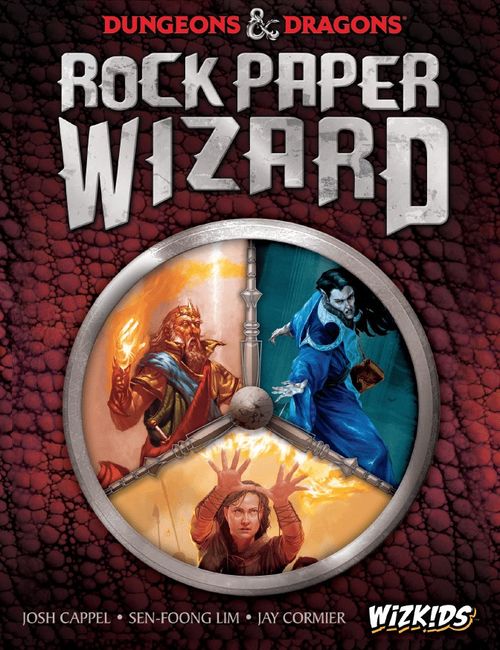
Dungeons & Dragons: Rock Paper Wizard
Dungeons & Dragons: Rock Paper Wizard Rulebook
Table of Contents
Table of Contents
Components
- 23 Spell Cards
- 6 Player Placards
- 6 Wizard Markers (Plastic bases are included so that your Wizard markers can stand up on the Dragon's Cave board.)
- 64 Gold Piece (gp) Tokens — Three different values: 1gp, 5gp, and 10gp. Players may make change at will.
- 1 Dragon's Cave Board — marked with the Exit Zone, the Starting space, and the Hoard Zone.
- 1 First Player Marker
Overview & Objective
Over the course of several rounds, players will simultaneously be casting Dungeons & Dragons spells from the shared spellbook at each other by making specific hand gestures; spells have all sorts of effects but often involve pushing the target away from the hoard, moving the caster closer to the hoard, or affecting the target's gold piece (gp) stash. At the end of each round, the wizards closest to the hoard grab some gold pieces. If at the end of a round at least one player holds at least 25gp, the game ends and the richest player wins!
Setup
-
Each player takes 3gp, a Player placard, and the matching Wizard marker. Player placards are kept on the table in front of the players to identify which player is which wizard.
-
Take the remaining gold pieces and make a stockpile on the right side of the board; this is the hoard.
Players may make change from the hoard whenever they wish. It is recommended for players to change up to the fewest coins possible so that everyone can easily count each others' gold.
-
Each player places their Wizard marker on the Starting space of the Dragon's Cave; it is marked with a star.
-
Shuffle the spell cards and make a face-down draw deck.
Leave space nearby for a discard pile. If the draw deck ever runs out for any reason, shuffle the discard pile to form a new draw deck.
-
Draw and lay out face-up spell cards in a line beside the draw deck, one at a time starting from beside the deck and working your way away. Use the same number of cards as you have players, but no more than 5 cards. This line of cards is called the spellbook, and it will be changing over the course of the game.
If any drawn card would cause the spellbook to contain more than two cards of the same spell type (red, blue, or green), discard the card and draw a fresh one to replace it.
-
Randomly pick one player as the first player and give them the First Player marker.
Throughout the rulebook we use circular markers in the examples to represent the Wizard markers on the Cave board.
Gameplay
Rock Paper Wizard plays in rounds. Each round, all players will attempt to cast one of the spellbook spells on an opposing player of their choice. Once each player's spell has been resolved, the round is over and the wizards closest to the hoard will earn a reward of gold pieces.
Each round is made up of 5 quick steps:
- STUDY Wizards secretly pick the spells they want to cast at whom.
- CAST All together, everyone points their gesture at their target.
- RESOLVE Clockwise from First player, all spells are resolved.
- SCORING Closest wizards to the hoard earn gold pieces.
- REFRESH Some wizards reposition, and the spellbook evolves.
Parts of a Spell Card
Each spell card shows: the Spell Name, the Hand Gesture, the spell effect shown in icons, the spell text description, and the spell type.
Spell Types
- Red — Attack spells
- Blue — Movement and defense spells
- Green (GP) — Gold-affecting spells
Common Icons on the Cards
The caster. The target. The target gesturing. A wizard. A poorer wizard. Move 1 space towards the cave exit. Move 1 space towards the hoard. The Dragon's Cave track. 1gp.
1. Study
All players take a few moments to peruse the spellbook. Each player secretly decides which spell to cast, and whom they would like to target with the spell. Each player should have their chosen spell's hand gesture firmly in mind. When a player is ready to cast, that player should raise their hand into a fist gesture to indicate readiness.
You can quickly scan the spell types to see which spells are generally for attacking, defending/moving, or gold-effects. The icons provide a great reminder about what each spell does; you'll need to read the spell text at first but will learn the icon system in no time!
2. Cast
When all players are ready, everyone together chants "Rock, Paper, WIZARD!", pumping their fists down with each word of the chant. On "wizard", all players simultaneously point their spell's hand gesture at their intended target. (For example if casting Fireball you would point a closed fist at the player of your choice.)
- A player may not point at him or herself intentionally, although spell effects might cause that to happen later.
Each player must hold their gesture in place, pointing at their target, until their spell has been resolved in turn order.
A Sample Casting
Red has cast Fireball at Yellow.
Yellow has cast Misty Step at Blue.
Blue and Green have cast Dimension Door at each other... a Wild Surge! They both draw spell cards and point them at each other, replacing their Dimension Door gestures.
Wild Surges
If two players cast the same spell on each other, this creates an unpredictable Wild Surge. Both players should draw a spell card from the deck and, keeping it face-down for now, point the new spell card at their target (each other) instead of the spell gesture they'd originally chosen.
3. Resolve
Starting with the First Player and proceeding clockwise, each player's spell is resolved. Resolve each spell fully before proceeding to the next player in turn order.
To resolve your spell, relax your gesture and simply follow the instruction text on your spell card. Then play passes to the next player clockwise.
Some Important Spell Terms
Advance. To advance means to move right towards the orange end of the Dragon's Cave where the gold hoard lies.
Get Pushed. To get pushed means to move left towards the blue end of the Dragon's Cave, where the cave exit is located.
Poorer Wizard. A poorer wizard is any wizard that has fewer gp than the target or caster in question.
Resolving Wild Surges
If you are pointing a spell card instead of a normal spell gesture, that means that the unpredictable forces of magic within the dragon's cave have caused an unexpected effect... a Wild Surge! On your turn, reveal the card you are holding to everyone, and resolve as if you'd cast that spell at the target. Then discard that card.
What's it going to be? Sometimes it will work out well for the caster, sometimes for the target, and sometimes for neither! However it unfolds, it will definitely be entertaining!
Do the Best You Can
Sometimes circumstances make it so that spells will not be able to resolve fully, or not at all. The rule here is to always resolve as much of the spell's effect as you can, then ignore anything un-doable.
Example: Your Fireball spell is supposed to push your target back 5 spaces, but your target only has 3 spaces to the cave exit; Your target simply goes to the cave exit and stops there.
Example: Your Confusion spell is supposed to advance you 2 and pivot your target's gesture, but your target has already acted this round and so has no gesture any more; you'd get to advance but would ignore the pivot effect.
Watch out for this drawback to spells that affect the target's gesture; if the target acts before you in the round, their gesture will be gone!
Example: You draw Meteor Swarm due to a Wild Surge; it gets stronger depending on how many cards sit to the right of it in the spellbook. It's not currently in the spellbook so there are zero cards to the right of it; it will just push the target the base value of 1.
A Sample Resolution; All Spells Resolved in Clockwise Order from the First Player
Here is the game state following the sample Casting, including Green and Blue's Wild Surges. Red has the First Player token, so he will resolve first and then we'll proceed clockwise.
Red casts Fireball on Yellow. Yellow is supposed to get pushed 5 spaces, but the cave exit is only 4 spaces away so she stops there.
Green had a Wild Surge with Blue, so she reveals the card she is pointing... it's Wall of Force! Green moves forward 2 spaces, and Blue is forced to reverse his gesture (which happens to be an unrevealed Wild Surge) to point back at himself! Green discards the Wall of Force card.
Yellow casts Misty Step on Blue, so her Wizard marker moves all the way back up to join Blue's!
Finally Blue reveals the Wild Surge he is casting on himself (thanks to Green's Wall of Force from earlier). It is Burning Hands, so Blue is pushed back 1 space and loses 1 coin. Then he discards the Burning Hands card.
4. Scoring
Once every player's spell has been resolved, the closest wizard to the hoard collects 5gp from the hoard and the second-closest wizard collects 3gp from the hoard.
If there are ties then all tied wizards gain that amount of gold pieces. For example if two wizards are tied for being the closest then they both get 5gp and then if there's a tie between three wizards for second-closest then all three get 3gp each.
Example: Blue and Yellow are tied for closest, so they each get 5gp. Red is second-closest so he gets 3gp.
Check for Victory
If, after scoring, at least one wizard has 25gp or more, the game is over and the wizard with the most gold pieces wins! If there is a tie, keep playing rounds (with all players) until one player emerges as the clear winner.
If no player yet has 25gp or more, the game is not yet over... proceed to Refresh.
5. Refresh
There are four steps to getting ready for the next round:
-
Wizards pushed out of the cave run back in to join the fray, and wizards too close to the hoard shrink back from the intense heat!
Any Wizard in the blue Exit zone on the Cave track moves up to the space just to the right of the Exit zone, and any Wizard in the orange Hoard zone moves down to the space just to the left of the Hoard zone.
In this example Yellow will move up out of the Exit zone and Blue will move down out of the Hoard zone.
-
Discard the leftmost spell from the spellbook.
Example: Passwall is leftmost, so it is discarded.
-
Shift all remaining spells left. Draw a new spell from the draw pile and add it to the right end of the spellbook.
Example: All spells shift left, and we draw a new card to fill the gap; we get Confusion.
Just like in starting setup, if any drawn card would cause the spellbook to contain more than two cards of the same spell type (red, blue, or green), discard the card and draw a fresh one to replace it.
-
Pass the First Player marker one player clockwise, then begin a new round!