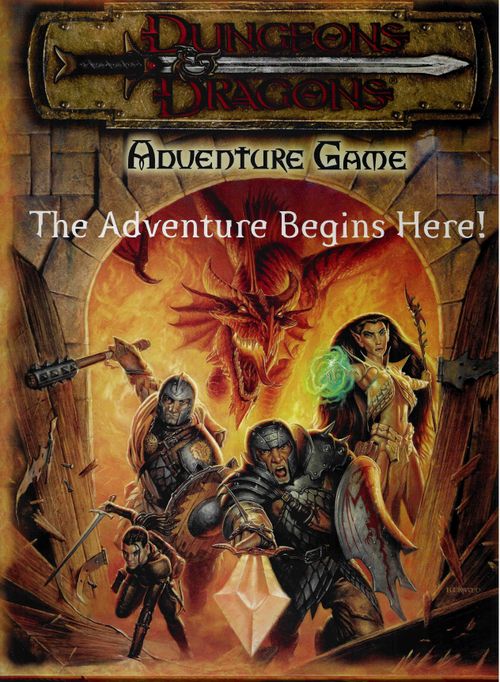
Dungeons & Dragons Adventure Game
Dungeons & Dragons Adventure Game Rulebook
Table of Contents
Table of Contents
Playing the Game
In the D&D game, the Dungeon Master and the other players get together to create a story. The DM begins an adventure with one of the scenarios presented in the Adventures Book or with one of his or her own devising. The scenario provides a basic plot for the adventure; how the story develops depends on what the players have their characters do.
The other players each take one of the Hero Folders. These contain ready-to-play characters, complete with game statistics; weapons, armor, and other equipment; and other pertinent data about each character.
An adventure scenario contains a background for the adventure, a map of the "dungeon" in which the adventure takes place, and bits of text the DM reads out loud that either sets the mood or describes what the heroes see in a specific location.
After the DM presents the read-aloud text, the players can ask questions and tell the DM what they want their characters to do. It's the DM's job to tell the players what their characters see and hear, explaining what happens after each character performs an action. Here's an example:
DM: You see a dagger jutting from the pile of trash in the corner.
Player: I pick up the dagger.
DM: Its hilt is intricately carved in the shape of a dragon's head. The handle is warm to the touch, and the jeweled eyes glow.
Player: Hmm, that doesn't sound too good. I drop it back into the trash pile.
DM: You try, but the dagger refuses to leave your hand ....
Winning
The D&D game isn't like any other game you've ever played. You don't win by beating the other players. Instead, there are a lot of different ways to "win the game."
The first way to win is to help the entire group tell a fun and exciting story. You can either successfully complete the adventure or you can fail miserably, but if everyone has a good time and you create a story that everyone is going to remember, then the group wins.
Each adventure has a different "victory condition." Sometimes "winning" is just the heroes escaping from the dungeon in one piece. Other times, the adventure may call for a specific goal to be accomplished or a specific monster to be defeated.
Individual players win when their characters defeat monsters and villains, gain treasure and experience points, and increase their personal power and reputation. It's also satisfying to create a personality for your character that grows and develops over time.
That's the other cool thing about the D&D game-each adventure is just one tale in the continuing saga of your hero characters. Sure, you can play once and have a great time, but the real excitement comes from watching your character improve and get better from one adventure to the next. For example, if your wizard finds a scroll full of spells in one adventure, she can keep it and use it in the next adventure!
The Dice
There are six dice in this box. Each die is a different shape and has a different number of sides.
These dice help determine the outcome of actions in the game. If a player wants his or her character to try something (attack a monster, disarm a trap, break open a locked door, etc.), the dice are used whenever the action isn't a sure thing.
The dice used in the D&D game are described below. How to use them will be explained shortly.
- d4: A die with four sides, numbered from 1 to 4.
- d6: A die with six sides, numbered from 1 to 6.
- d8: A die with eight sides, numbered from 1 to 8.
- d10: A die with ten sides, numbered from 1 to 10.
- d12: A die with twelve sides, numbered from 1 to 12.
- d20: A die with twenty sides, numbered from 1 to 20.
The Hero Folders
Each player selects one of the Hero Folders. Each Hero Folder details one D&D character. Here's what you'll find on each four-page folder:
-
Name: The hero's name.
-
Player: Write your name here so everyone knows who's running this character.
-
Class: All D&D characters belong to a general class. The class helps define a character, providing advantages that characters of other classes don't have.
- Fighters are warriors, trained to use their great size and strength to best advantage. Fighters generally use swords, shields, and metal armor. They believe in hacking and slashing their way to fame and fortune.
- Paladins are a special kind of fighter. They are holy warriors dedicated to a specific cause or faith. Their unyielding belief gives them limited healing powers and some resistance to evil creatures.
- Priests are dedicated to a holy mission, using spells to heal and weapons to defend the weak. They travel the land, proclaiming their faith with every quest they accept and every monster that they banish.
- Thieves are fast of foot, nimble of fingers, and sneaky like you would not believe. They aid an adventuring party by finding traps, picking locks, and doing stealthy things. Thieves rarely steal from their companions, but they have been known to swipe valuables from the evil rich of that long-ago time.
- Wizards are highly intelligent but physically unimposing. Long years of magical study have left them unable to use most weapons but have made them powerful spellcasters. Magical spells are their tools and trade, their weapons and defenses.
The fantasy world and characters we're talking about here are imaginary. As such, we make a big distinction between players and characters. They are not the same! You are a player. You describe the actions of an imaginary character. This is important for many reasons. In game play, for example, you may know things your character does not-and vice versa! Keep the two separate for maximum fun and game clarity.
Game Rules
There really aren't a lot of rules involved in the D&D game. It all comes down to how characters move, fight, perform actions, cast spells, and gain experience. For everything else, we have a Dungeon Master. If something comes up that isn't specifically covered by these rules, the DM decides what to do.
Using the Dice
Whenever a character wants to do something important, the DM calls for a die roll. Important activities include fighting or performing game-related activities. The DM won't make you roll dice if your character wants to walk across a room, but if your character tries something that isn't a sure thing (attacking a monster, picking a lock, etc.), the dice are used to add that element of suspense and excitement the game requires.
Most actions in the game require the roll of the twenty-sided die (d20). The other dice are used to determine damage and for a few select actions, as described later.
The short way to refer to the dice is d4, d6, etc. If you have to roll more than one die of a particular type, you'll see a number in front of the notation, like this: 2d4. This one means you need to roll two four-sided dice and add the results together.
You will also see this kind of notation: 2d4+3. This means you roll two four-sided dice, add them together, then add an additional three points to get the result. Weapon or monster attack damage might look like this, for example.
Time in the Game
Time is very flexible and should be used to help advance the story. The DM can move time along as he or she sees fit to get on to the "good parts" of the story. "Three days pass as you travel along the road ...." for example, or "Six hours after nightfall, your camp is attacked by howling beasts ...." are ways the DM might do this.
In combat situations, time is measured in rounds. A character can do one thing in a round-attack a monster, cast a spell, pick a lock, etc. The DM can decide if a simple action takes one round (drinking a potion) or several rounds (searching a dead body), depending on the situation.
Moving
We measure how far a character can move by his or her move number. Each point of movement indicates that the character can walk 10 feet in a cautious manner in a single round. So, a hero with a movement rate of 12 can walk up to 120 feet in a round. Characters can also move up to half their total movement and attack once in the same round.
Running doubles movement totals, but a running character can't do anything else in that round. When running in an unexplored dungeon, a hero might miss spotting traps or wind up lost just to gain a little speed. This could be very bad for the hero ....
Fighting
Sooner or later, your characters will be confronted by a monster that refuses to negotiate or flee. When this happens, it's time for your characters to draw their weapons and take the battle right to the monsters! When characters attack, the players roll dice to see when and if they hurt the monsters. When the monsters (or other characters not controlled by the players) strike back, the DM rolls.
The DM controls the actions of the monsters. The DM can decide to have monsters gang up on one character, or fight them all separately. The DM decides when the monsters flee from the battle-or stay to fight until the bitter end!
Remember, the point of the game is to have fun. The DM isn't the players' opponent. It's not the DM's job to try to kill the characters. The DM's job is to fairly determine the consequences of the characters' actions and use common sense to make the monsters behave in reasonable ways.
How does combat work? Well, let's imagine that our adventuring party is moving cautiously down a dark dungeon corridor. Suddenly, three small humanoids with red skin and yellow eyes burst into the small ring of light thrown by the torch one of the heroes carries.
Who Goes First? Each side rolls a d10. One player rolls for the adventurers, and the DM rolls for the monsters. The side with the lower roll goes first. This side has the initiative over the other. If the rolls are tied, roll again.
Then What? Okay, we know who has initiative. Now the side with initiative takes its actions. Let's assume that the heroes are going first. The DM goes around the table and, in turn, asks each player what his or her character is going to do. If a character is doing anything other than casting a spell, resolve the action immediately. If a character is casting a spell, have the player say which spell and then wait until the end of the round.
(If the heroes were expecting trouble, they probably already have weapons in hand. If not, they have to spend their first round drawing a weapon.)
After all attacks and actions for the side are resolved, spellcasting is resolved. (See below.)
Then the DM gets to make an attack roll or perform an action for each of the monsters still in the fight.
Here's how to make an attack roll. Each character has an attack number, listed as the THACO (the number needed To Hit Armor Class 0). Roll a d20. Subtract the die roll from the character's THACO number. If the result is less than or equal to the target's Armor Class, the attack hits.
Example: Elanna's player rolls a 15 on the d20. Her THACO is 19. 19-15 = 4. Elanna hits any target that has an AC of 4 or higher (4, 5, 6, 7, etc.).
What if Elanna's player had rolled a 20? 19-20 = -1! That's a great roll! It means that Elanna would hit a monster with an Armor Class as good as -1.
If the attack is successful, roll for damage (every weapon and monster has a damage code, usually expressed as 1d8, or 2d4, etc.). Write the total in the wounds space on the Hero Folder or on scrap paper for the monster. When the wounds total exceeds the number of hit points the hero or monster has, it dies.
If the monsters had won the initiative, they'd attack first. Any spellcasters in the adventuring party that are successfully attacked can't cast spells that round. Instead, they should try to get away from the monsters or use weapons to attack the monsters directly.
What Else Can A Character or Monster Do? Quite a bit. During a round, a character or monster can move normally, move half the normal distance and attack, try to run away (at twice the normal move), bind the wounds of a companion, change weapons, pick up or drop an item, use a special ability, drink a potion, or just stand around and watch the battle.
Magic Happens Last. After all other actions on a side have been resolved, go back and determine the effects of any spells that side cast. Why do spells occur after all other actions? Because it takes time to perform the complicated gestures and say the enchanted words necessary to cast a spell. Note that during a round in which a spellcaster loses initiative (goes after the other side), he or she cannot cast a spell if successfully attacked that round, because the damage inflicted on the wizard disrupts his or her concentration.
Go On To The Next Round. That's the end of the first round of combat. If there are still characters or monsters left on both sides who want to fight, the combat continues. Repeat these steps every round until one side is defeated, runs away, or surrenders.
Death. Characters and monsters in the D&D game die. The potential for a hero to die lends the game drama and a sense of danger for the players' characters. A dead character can mean the end of an adventure, but it's not the end of the game! Just grab a different Hero Folder or change the name of your departed character and you can start over with this new hero. (You might have to wait until the other adventurers get back to town for the character to logically join them, but otherwise it's as easy as that.)
When a monster drops to 0 hit points or below (its wounds equal or exceed its hit point total), it has been killed. For a character, however, dropping to 0 hit points or below means he is unconscious. Every round thereafter, that character loses 1 hit point and is in danger of dying until another character performs an action to bind his wounds. Binding the wounds stems the dying condition-the character remains unconscious but returns to and remains at 0 hit points until healed by magic or through rest.
If a hero drops 10 points below 0 (to -10 hit points), the character is well and truly dead. Some powerful magic might still change his fate, but otherwise say farewell to our valiant hero and select a new character.
Common rules of thumb for D&D combat include:
- No more than two characters can stand and fight side by side in a typical 10-foot-wide corridor.
- No more than two characters can attack the same side of a human-sized target (front, back, or either side).
- If a character tries to run away from a fight that has already started, any opponents fighting the character get to make a final attack. This applies to both monsters and heroes.
Performing Actions
A character can perform one action in a round. Simple actions require time but don't require any dice rolls. These include drawing a weapon from a scabbard, retrieving a dropped weapon, readying a magical item, drinking a potion, moving, binding a character's wounds, or searching a dead body.
Ability Checks: Other types of actions can be handled by ability checks. To make an ability check, a player must roll less than or equal to his or her character's specific Ability Score on a d20. (Low rolls are good for ability checks, high rolls are bad!) With an ability check, a DM can determine if a character succeeds at a physical or mental feat not covered by other rules.
Examples of ability checks include pushing a large object out of the way (Strength check), leaping over a gaping pit (Dexterity check), overcoming the effects of eating spoiled food (Constitution check), determining if a character recalls an old legend (Intelligence check), seeing if a character spots an obscure clue (Wisdom check), and negotiating with a monster (Charisma check).
Use common sense when calling for ability checks. If an action is just completely impossible (leaping the Grand Canyon comes to mind) or exceedingly easy, then no roll is required. The DM will say, "That looks like an impossible feat." If the player still wants his character to attempt it, the DM will say, "Okay. The hero makes a running leap ... and falls far short of the other side. He hits the rocky ground many long seconds later. It isn't a pretty sight. ..."
The DM can also modify the check to match the situation. Subtract from the die roll for easier tasks, add to the die roll for more difficult tasks. Sample modifiers are listed below. The DM can adjust the modifiers as he or she sees fit.
| Type of Situation | Modifier |
|---|---|
| Extremely Easy | -6 |
| Easy | -3 |
| Moderate | 0 |
| Difficult | +3 |
| Extremely Difficult | +6 |
Character Abilities: The Hero Folders list abilities that may only be available to a particular character. These abilities, such as the thief's skills, are explained on the folders.
Searching: Sometimes a character might want to search an area for hidden things. A searching hero might find a secret door, a partially buried clue, or a discarded bit of treasure. Searching takes time; it takes 10 rounds to search a 10-foot by 10-foot area. It can't be done in the middle of combat or with hostile creatures around. Each character can search an area once.
When a player declares that his character is searching, the DM secretly makes a Wisdom check for the hero. The DM can modify the check according to the situation. The DM makes the check even if there is nothing to find so that the players are never certain if their characters missed something important or not.
Casting Spells
Magic exists in the imaginary world depicted in the D&D game. The power to call forth magic is gathered by spellcasters during a restful process that occurs between adventures. Wizards study their spell books and memorize the spells they need. Priests pray to their gods for the spells of their faith. Once cast, the spell is used up and can't be cast again until the character has rested.
Characters with wizard or priest magic can cast spells. Only those characters with the spellcasting ability listed on their Hero Folders can cast spells.
To cast a spell, the player announces which spell her hero is casting during her turn in a round. At the end of the round, spells go off in the order in which they were cast and the effects take place. See the spell descriptions in the Hero Folders for individual spell effects.
Once a spell is cast, the player marks it off. That spell can't be used again until the hero has rested and re-memorized it.
Casting a spell is an action. In the round that a hero casts a spell, he can move up to half his move number.
If the spellcaster is successfully attacked before he gets to act in a round, he can't cast a spell that round.
Resting: If the heroes get a full night's rest, uninterrupted by wandering monsters or other dangers, they receive a few benefits. First, those who rest regain 1 hit point; reduce any wounds suffered by 1 point. Second, spellcasters regain their full compliment of spells.
Saving Throws: To avoid the effects of harmful spells or some monster attacks, characters get to make saving throws. Every character has a saving throw number. To make a saving throw, the character's player rolls a d20 and tries to get a number equal to or greater than the saving throw number.
If a saving throw fails, the character receives the full effects of the spell or special attack. If a saving throw succeeds, the character either suffers no effects or receives half the total damage. See the spell or monster descriptions for complete details.
Note that saving throws don't work against all spells. If a spell description states that no saving throw is allowed, then the target of that spell doesn't get to make a roll.
Gaining Experience
Heroes gain experience by working together, defeating monsters, completing specific quests, and coming up with good ideas that enhance the group's storytelling fun.
The ready-to-play adventures list the amount of experience the heroes gain. The DM's section later in this book gives additional guidelines.
Write the number of XPs gained on your character's Hero Folder. When the XPs equal or exceed the number listed for the next highest level, your hero goes up a level! With a new level, heroes gain more hit points, improve their THACOs and certain character abilities, and spellcasters increase the number of spells they can cast in a day. See the Hero Folders for more details.
A Game Session
How do you really play a D&D game? After you've decided to be the DM and you've read this book, looked over the Hero Folders, and read the first adventure, get a few friends together. You need at least one other friend to play, and there are enough folders for up to eight players plus the DM.
Find a comfortable place with a flat surface to roll the dice on. The kitchen table works nicely. The DM sits where the other players can't look over his shoulder and puts the DM Screen up in front of him so that it hides the Adventures Book and his scrap paper. It also provides a spot where he can roll the dice in secret.
The players need their Hero Folders, scrap and mapping paper, and pencils. Plenty of snacks and beverages are also recommended, as a D&D game session is as much a social event as it is an epic quest.
When the players roll the dice, they should roll them openly so that everyone can see the results. The DM may make some rolls behind the screen for suspense and to maintain mystery, but all combat rolls should be rolled so the players can see them.
A game session can last as long as you want, but two to four hours is a good amount of time. Remember, your heroes' adventures continue the next time you get together to play!
Last Words for Players
The first couple of game sessions might be a bit uneven as you and your friends learn how to play the game. Players are allowed to refer to their Hero Folders and the beginning of this book (up to this page) at any time during a game session. The players should not look at the DM portions of this book or any of the Adventures Book. The excitement of facing unknown monsters and discovering new magic can be spoiled if someone other than the DM looks up details during play.
During the game, the players have a few tasks to handle in addition to playing their characters. Every gaming group needs a mapper, a caller, and a recorder.
The mapper draws the map of the dungeon the characters are exploring. The Hero Folder for Niles the thief has a mapmaking kit. Draw the map in pencil, as the DM describes its twists and turns, so that you can better imagine the scene.
The caller announces what the adventuring party is doing. The caller checks with the other players whenever a decision must be made and tells the DM what the consensus is. The caller doesn't tell the other players what to do; she speaks with the other players and reports to the DM with detailed information. "We're marching north up the corridor; what do we see?" the caller might say. During combat, the DM will bypass the caller and ask each player what his or her character is doing.
The recorder keeps notes about the adventure, writing down important clues and keeping track of all monsters the party has defeated and any treasure they have found. This helps the DM award experience at the end of the game session.
Marching Order: The players should decide how their characters are arranged. Characters move around either in single file or two by two. Fighters or heroes with the best Armor Class or hit points should be in front. Spellcasters and weaker heroes should be situated in the center for maximum protection. If you ever decide to change the order, let the DM know.
Dividing Treasure: As your characters adventure, they're going to accumulate treasure. Treasure comes in two forms: magical and normal treasure. Don't base how much treasure a hero gets on how much time a hero spent in the spotlight. Every hero shares in the risk equally, so all should share equally in the treasure.
Magical items should be given to the characters that can best use them. If any "general use" magical items remain, have each player roll a d20. High roller picks an item, then the next highest, etc., until all magical treasure is passed out.
All normal treasure (gems, gold, non-magical items, etc.) should be divided equally among all the heroes.
The Game Session: Pick an evening or weekend afternoon or some other convenient time when you and your friends can spend a few hours playing the D&D game. Set a time limit and stop playing about 15 minutes early so the DM has time to wrap things up. (Two to four hours is a good length for a typical game session.)
Your very first game session begins with the DM describing a location beneath the small village of Haven. Listen carefully to the descriptions and play the role of your character as the situation develops.
When the heroes run into monsters, the fighters should move forward to meet the threat. Wizards need to stay back to cast spells, while thieves and priests may want to serve as rear guards. Of course, if the fighters need help, any hero can leap into the fray!
Not every encounter is solved by battle, however. Sometimes adventurers gain more by talking their way through a situation if the other side is willing to negotiate.
There are times when a particular character's talents are called for. A thief might want to move to the head of the group to check for traps or pick a lock, or a cleric might advance when attempting to "turn" undead creatures. After doing the job, these heroes should return to their normal spot in the marching order.
It's Your Character: Sometimes you'll disagree about the best course of action. That's okay. Just remember that you control your character's actions. You get the final say as to what your character is doing. After that the DM tells you what happens.
For the DM Only
The DUNGEONS & DRAGONS game has a unique element that makes it different from all other games. One player assumes the special role of the Dungeon Master. The DM is a movie director, storyteller, and central processing unit all in one. The DM tells the players what their characters see and hear, determines the outcomes of their actions, and keeps the adventure moving. With a DM, players can have their characters try anything or go anywhere. The only limit in the D&D game is your imagination.
If you're reading this section, you must want to be the DM for your group. Congratulations! The DM's role is not only the most important in the game, it's also the most challenging. You have to narrate the adventures, run all the characters and monsters not controlled by the players, and determine the course of the story by evaluating the players' actions and die rolls. If you're up to the challenge, keep reading. A good DM is worth his or her weight in gold!
DM Basics
DM Laws: The DM decides what happens, using the actions the players declare for their characters, the game rules, and her imagination. If in doubt, just make it up! It's better to keep the story moving and the game fun than to get bogged down in the details.
Use ability checks to determine success if the players want their characters to try things not covered by any other rules. If an action is just impossibly difficult or ridiculously easy, the DM can decide that it automatically fails or succeeds.
Remember that the DM isn't competing against the players, even though he controls the monsters that challenge the heroes. Instead, the DM is like a referee, helping to advance the story by deciding how the players' actions influence each situation.
Above all else, the DM must always be fair. If you determine that a rule works in a specific way, it should work that way all the time. If one hero can't leap across the giant pit, don't arbitrarily decide that another hero can. Be consistent and the game will make sense to the players and a good time will be had by all.
It isn't the DM's story or the players' story-it's the group's story. The DM is just around to help it along and to narrate it for the players.
The DM plays the D&D game by running the adventures for the other players. So, the DM gets to read an adventure beforehand, think about the possible outcomes, then bring the story to life as the players add their contribution to the adventure. (The players are the main characters of the story, the heroes!)
Before you play the first game session, read the first adventure in the Adventures Book. Things will go more smoothly if you have a good feel for the pace of the story.
Read or paraphrase the read-aloud text. In the adventures, read-aloud text is presented in boxes. The text sets a scene, offers descriptions, or sets up a situation that the heroes must react to.
Then ask the players what their characters are going to do. Use the game rules, the encounter secrets (the text not presented in boxes), the players' actions, and your own judgment and imagination to determine what happens.
If the scene involves monsters or other characters, you must play their roles. The adventure provides suggestions for how to do this, but you'll have to do what feels right in any given situation.
Our best advice to you is to have fun and be fair. The rest comes together like magic!
Narrating an Adventure
The read-aloud portions of each adventure provide information that the characters can see, hear, or smell at a particular point in the story. After you provide this information, the players may have questions. Be careful not to give away any secrets! For example, don't tell them what's on the other side of a closed door before the characters open it.
You might say, "There's a door at the end of the hall." The players might respond, "What kind of door?" Check the text following the read-aloud box to see if there are any obvious details you can share with the players. For example, the text may tell you that the door is made of iron, with no knob or keyhole. If the players ask, you can tell them this, as it's obvious their characters can see it. If it doesn't provide any additional details, you get to make something up. That's what DMs do; they're allowed to fill in the blanks.
Never reveal whether or not something is in the adventure or if you're making it up. Just don't get carried away or attempt to reveal too many details and the players won't know if it's in the text or not. As long as you're fair and consistent, they won't even care!
Running the Monsters
The Dungeon Master gets to run the monsters that the heroes must face in the course of every adventure. A selection of monsters is described at the end of this book, and each appropriate encounter in an adventure provides details about a particular monster's (or group of monsters') goals, needs, and behavior. Most monsters want to destroy whatever comes their way, but some can be talked to. Remember to play the monsters as intelligent creatures (unless the text says otherwise)-monsters always lead with their best attack, and many will try to flee if severely injured.
The DM also plays the roles of other characters the heroes meet. Townsfolk, such as the Patriarch and shopkeepers of Haven, and villains, like Restad the vampire, allow the DM to do a little roleplaying, too. Remember that just like the players, the DM must separate what she knows as the DM from what her characters or monsters know.
Winging It
The D&D game isn't just about rolling dice and following set encounters. Players will eventually try to do something that isn't covered in the rules. That's okay. In fact, that's one of the best things about the game-you never know what's going to happen next! That's why there's a DM.
When a situation comes up that you don't have a set answer to, make something up. If you stick to the DM mantra (Be Fair! Be Consistent! Have Fun!) everything will turn out fine. Remember that the goal is to have fun and tell an exciting, challenging group story set in our magical world of long ago. Winging it is a perfectly acceptable tactic for handling the unexpected.
Session One is Just the Beginning
The D&D game is designed to be played on an ongoing basis. When you reach the set ending time for the first game session, and it isn't the end of the adventure, have the players note the hit points and items their characters currently have. Spellcasters should also mark which spells they've cast. Put all the notes and books and Hero Folders back in the box so nothing gets lost between sessions. Then set a time for the next game session. And the one after that.
Awarding Experience
End the story portion of each game session about 15 minutes early so that you can award experience and the players can divide the treasure among their characters.
Experience point awards for monsters are listed in the monster entries and in the adventures. Monsters don't have to be killed for heroes to earn awards; they just have to be defeated or otherwise overcome.
Story awards are based on how well the players did in the adventure.
Individual awards include:
- Player has a clever idea (50-100 xp)
- Player has an idea that saves the group (100-500 xp)
- Player acts out his or her character well (100-200 xp)
Award experience for monsters and individual achievements at the end of a game session. Story awards should be saved until an adventure is completed.
When a hero achieves enough XP to gain a level, that hero must find someone to train him. A wizard character seeks out a wizard of a higher level, for example, and a fighter goes to a warrior of higher level for training. See the Adventures Book for more details.
Random Dungeon Generator
After you've played through the three adventures in the Adventures Book, you might want to try to create a dungeon of your own. Use this random dungeon generator to help you with the design.
A. Pick a Starting Area. Roll 1d4 for your dungeon's starting area. Possible starts include a natural cavern (1), stairs down to a small (2) or large (3) room, and a door into ancient ruins (4).
| 1d4 | Starting Area |
|---|---|
| 1 | Cave opening (natural cavern) |
| 2 | Small room |
| 3 | Large room |
| 4 | Ruins entrance |
B. Dungeon Corridors. Adventurers march through dusty dungeon corridors. Whenever you enter an unexplored portion of your dungeon map or are not directed elsewhere, use this step. Roll 1d20 and follow the directions below:
| 1d20 | Result |
|---|---|
| 1-4 | Continue straight for 40 feet (re-roll on B) |
| 5-6 | Door (go to C) |
| 7-8 | Dead end, corridor ends (check for secret doors; go to F) |
| 9-13 | Side Passage (go to G) |
| 14-17 | Room (go to H) |
| 18-19 | Trick or trap (go to L) |
| 20 | Wandering monster (go to M) |
C. Doors. There's a door in the dungeon corridor:
| 1d20 | Result |
|---|---|
| 1-6 | Door on left-hand wall (go to D); passage continues for 20 feet (go to B) |
| 7-12 | Door on right-hand wall (go to D); passage continues for 20 feet (go to B) |
| 13-20 | Door straight ahead (go to D) |
D. Door Type. Roll for type of door (go to E to determine what's on the other side of the door):
| 1d20 | Door Type |
|---|---|
| 1-6 | Wooden door |
| 7-10 | Wooden door, locked |
| 11-16 | Opening in wall |
| 17-18 | Metal door |
| 19-20 | Metal door, locked |
E. Space Beyond the Door. Check to see what lies beyond the door:
| 1d20 | Result |
|---|---|
| 1-8 | Passage straight ahead 20 feet (go to B) |
| 9-16 | Room (go to H) |
| 17-18 | False door; opening door reveals blank wall behind it |
| 19-20 | Trick/Trap; opening door reveals a blank wall and triggers the effect (go to L) |
F. Secret Doors. Check to see if there are secret doors in the area:
| 1d20 | Result |
|---|---|
| 1-3 | Secret door on the left side of the room or corridor |
| 4-6 | Secret door on the right side of the room or corridor |
| 7-9 | Secret door on the opposite side of the room or straight ahead in the corridor |
| 10-20 | No secret doors |
G. Side Passages. A side passage intersects the corridor:
| 1d20 | Result |
|---|---|
| 1-5 | Passage intersects from the left; both continue 20 feet (go to B for both) |
| 6-10 | Passage intersects from the right; both continue 20 feet (go to B for both) |
| 11-15 | Passage intersects from left and right, dead-ends ahead (T-shaped); both continue 20 feet (go to B for both) |
| 16-20 | Passage forms a four-way intersection (cross-shaped); all continue 20 feet (go to B for all) |
H. Rooms. The area ahead opens up into a room (unless otherwise noted, go to I to determine the number of exits the room contains):
| 1d20 | Room Size |
|---|---|
| 1-2 | Square, 10x10 feet (no exits) |
| 3-4 | Square, 20x20 feet |
| 5-6 | Square, 30x30 feet |
| 7-8 | Square, 40x40 feet |
| 9-10 | Rectangle, 10x20 feet |
| 11-12 | Rectangle, 20x30 feet |
| 13-14 | Rectangle, 20x40 feet |
| 15-16 | Rectangle, 30x40 feet |
| 17-18 | Rectangle, 10x30 feet |
| 19-20 | Rectangle, 30x50 feet |
I. Room Exits. Roll to determine the number of exits the room contains (go to J to determine where each exit is located):
| 1d20 | Result |
|---|---|
| 1-8 | 1 exit |
| 9-13 | 2 exits |
| 14-16 | 3 exits |
| 17-20 | No exits (check for secret doors; go to F) |
J. Exit Locations. Roll to determine where each exit is located (go to D to determine the type of exit):
If Table I result is 1 exit:
| 1d20 | Location |
|---|---|
| 1-10 | Located opposite the entrance |
| 11-15 | Located on the right-hand wall |
| 16-20 | Located on the left-hand wall |
If Table I result is 2 exits:
| 1d20 | Locations |
|---|---|
| 1-10 | One each located on the right-hand and left-hand walls |
| 11-15 | One each located on the right-hand and opposite walls |
| 16-20 | One each located on the left-hand and opposite walls |
If Table I result is 3 exits: Don't roll. Place one exit each on the right-hand, left-hand, and opposite walls.
K. Room Contents. Roll to determine what's in a particular chamber:
| 1d20 | Result |
|---|---|
| 1-3 | Room is empty |
| 4-6 | Room contains a trick/trap (go to L) |
| 7-10 | Room contains a monster (go to M or N) |
| 11-12 | Room contains treasure (go to O) |
| 13-14 | Room contains trick/trap and monster (go to L and M or N) |
| 15-16 | Room contains trick/trap and treasure (go to L and O) |
| 17-20 | Room contains monster and treasure (go to M or N and O) |
L. Tricks and Traps. Roll to see what kind of trick or trap is present:
| 1d20 | Result |
|---|---|
| 1-5 | Secret door hidden here (go to F) |
| 6-7 | 10'-deep pit; Dexterity check to avoid falling in |
| 8-9 | 10'-deep pit with spikes (1d6 additional damage); Dexterity check to avoid falling in |
| 10-12 | Oil and flaming cinder splatters random target from hole in wall or ceiling; target suffers 2d6 damage, or roll a saving throw for half |
| 13-14 | Arrow trap springs from wall; Dexterity check or suffer 1d8 damage |
| 15-16 | Spear trap springs from wall; Dexterity check or suffer 1d6 damage |
| 17 | Gas trap; each character rolls a saving throw or falls asleep for 1d6+1 rounds |
| 18 | Gas trap; each character rolls a saving throw or suffers 1d6+2 poison damage |
| 19 | Cave-in, rocks fall to block passage; Dexterity check or suffer 1d8+2 damage |
| 20 | Pool of water; roll 1d6: 1-2 empty; 3 contains treasure; 4 acid, 1d4 damage; 5 heals first two characters (as per spell); 6 hides spiked pit |
M. Standard Monsters. Roll 1d8 + 1d12 to determine the type of monster encountered (either in a room or as a wandering monster):
| 1d8 + 1d12 | Monsters |
|---|---|
| 2-3 | 1d6+1 bats |
| 4 | 1d6+1 xvargs |
| 5 | 1d4 gnolls |
| 6-7 | 2d4 rats, giant |
| 8-9 | 1d4+1 goblins |
| 10-11 | 1d4+1 kobolds |
| 12 | 1d4 myconids |
| 13 | 1d6 skeletons |
| 14-15 | 1d6 orcs |
| 16-17 | 1 gelatinous cube |
| 18-19 | 1d4-1 spiders, giant |
| 20 | 1d4 worgs |
N. Special Monsters. For a room only, or to provide a more challenging encounter, roll 1d8 + 1d12:
| 1d8 + 1d12 | Monsters |
|---|---|
| 2 | 1d4 carrion crawlers |
| 3-4 | 1 pudding, deadly |
| 5 | 1d4 spiders, giant |
| 6-7 | 1d4 snakes, giant |
| 8 | 1d4-1 ettercaps |
| 9-10 | 2d4 stirges |
| 11-12 | 1d6+2 bugbears |
| 13 | 1d4 ghouls |
| 14 | 1d4+2 hobgoblins |
| 15 | 1d4 lizardmen |
| 16 | 1 ogre |
| 17 | 1 troll |
O. Treasure. Roll to determine the type of treasure:
| 1d20 | Treasure |
|---|---|
| 1-4 | Gems (go to P) |
| 5-6 | Jewelry (go to P) |
| 7-13 | Gold pieces (go to P) |
| 14-16 | Armor (go to Q) |
| 17-19 | Weapon (go to R) |
| 20 | Magical item (go to S) |
P. Gems, Jewelry, and Gold. Roll for the value of each gem, the value of each piece of jewelry, or the number of gold pieces (when treasure is guarded by a monster, multiply its value by the monster's level):
| 1d20 | Value |
|---|---|
| 1-7 | 10 gp |
| 8-17 | 100 gp |
| 18-20 | 500 gp |
Q. Armor. Roll for the type of armor:
| 1d20 | Armor |
|---|---|
| 1-10 | Shield |
| 11-14 | Leather |
| 15-18 | Chain mail |
| 19-20 | Plate mail |
R. Weapons. Roll for the type of weapon:
| 1d20 | Weapon |
|---|---|
| 1-2 | 1d6 arrows |
| 3-4 | Battle ax |
| 5-6 | Bow |
| 7-9 | Dagger |
| 10-11 | Mace |
| 12-13 | Quarterstaff |
| 14-15 | Spear |
| 16-18 | Short sword |
| 19-20 | Long sword |
S. Magical Items. Roll for the type of magical item (for descriptions of these items, see the Adventures Book):
| 1d20 | Magical Item |
|---|---|
| 1-5 | Potion (go to T) |
| 6-8 | Scroll (go to U) |
| 9-10 | Ring (go to V) |
| 11 | Staff or wand (go to W) |
| 12-15 | Miscellaneous item (go to X) |
| 16-17 | Armor (go to Y) |
| 18-19 | Weapon (go to Y) |
| 20 | Artifact (go to Z) |
T. Potions. Roll for the type of potion:
| 1d20 | Potion |
|---|---|
| 1-3 | Fire resistance |
| 4-7 | Strength |
| 8-13 | Healing |
| 14-16 | Invisibility |
| 17-19 | Speed |
| 20 | Poison |
U. Scrolls. Roll for the type of scroll:
| 1d20 | Scroll |
|---|---|
| 1-6 | One wizard spell |
| 7-10 | Two wizard spells |
| 11-12 | Three wizard spells |
| 13-16 | One priest spell |
| 17-19 | Two priests spells |
| 20 | Cursed |
V. Rings. Roll for the type of ring:
| 1d20 | Ring |
|---|---|
| 1-4 | Feather falling |
| 5-8 | Fire resistance |
| 9-10 | Invisibility |
| 11-16 | Protection +1 |
| 17-19 | Protection +2 |
| 20 | Clumsiness |
W. Staves and Wands. Roll for the type of staff or wand:
| 1d20 | Staff or Wand |
|---|---|
| 1-3 | Fear |
| 4-6 | Fire |
| 7-10 | Illumination |
| 11-13 | Lightning |
| 14-17 | Curing |
| 18-20 | Magic missile |
X. Miscellaneous Magic. Roll for a miscellaneous item:
| 1d20 | Item |
|---|---|
| 1 | Boots of elvenkind |
| 2 | Bracers of defenselessness |
| 3 | Cloak of elvenkind |
| 4-5 | Cloak of protection |
| 6-7 | Dust of appearance |
| 8-9 | Gauntlets of ogre strength |
| 10-11 | Portable hole |
| 12-13 | Rope of climbing |
| 14 | Rope of constriction |
| 15-16 | Stone of good luck |
| 17-18 | Chime of opening |
| 19-20 | Pearl of wisdom |
Y. Magical Armor and Weapons. Roll first for the type of armor (go to Q) or weapon (go to R). Then roll for the magical enchantment:
| 1d20 | Enchantment |
|---|---|
| 1 | -1 |
| 2-11 | +1 |
| 12-17 | +2 |
| 18-20 | +3 |
Z. Artifacts. Roll 1d6 for the type of artifact:
| 1d6 | Artifact |
|---|---|
| 1 | Ax of hurling |
| 2 | Mace of disruption |
| 3 | Cursed sword of berserking |
| 4 | Short sword of quickness |
| 5 | Sword +1, flame tongue |
| 6 | Sword +1, luck blade |
Dungeon Generation Example
Stan wants to generate a dungeon for his players using the Random Dungeon Generator. He takes a piece of mapping paper, and goes to Table A to see what kind of entrance he's going to start with. He rolls a 2, so he draws a small chamber with a set of stairs in the center of his paper.
With one door leading out of the room, Stan rolls on Table E to see what lies on the other side of the door, getting a 9-another room. Stan rolls on Table H and gets a 16, a rectangular 30x40-foot room. He then checks Table J and gets a 10-two exits. He checks Table K, under the section for two exits, and rolls a 6, so he knows that one exit goes on each side of the room from the original door. Stan finally rolls twice on Table D, getting a 19 and a 12, so he marks on his map that one of the exits is a locked metal door and the other is actually a hallway, which he makes 20 feet long. Finally, he marks a "1" on this room, so his map now looks something like this (example map omitted).
Now Stan wants to figure out what is in the room he just added, so he rolls on Table L and gets a 5-a monster! Stan rolls 1d8 and 1d12 and adds them together, then looks on Table M (deciding against using the Special Monsters table so early in the dungeon) and the result is myconid. Stan rolls 1d4 and gets a 3, so he takes a piece of notebook paper and writes on the top line, "1: 3 myconids." He figures he'll go back later and roll their hit points.
Now Stan is ready to find out where that corridor leads (he could also choose to find out what's on the other side of the locked metal door by checking Table E), so he rolls on Table B and gets an 11-a side passage. He rolls on Table G and gets a 4, so he draws in the appropriate side passage to the left of the current one, extending both of them 20 feet.
Deciding to continue checking on his current passage, Stan rolls on Table B again and comes up with a 5; there's a door in the passageway. He goes to Table C and rolls a 9, so he draws a door on the right-hand side of the hall, then continues the passage another 20 feet. Still interested in where this passage goes, he rolls on Table B once more, and gets a 19, a trick or trap.
Stan marks a "2" on his map at that spot in the hallway, then rolls on Table I, getting a 6. There's a 10-foot-deep pit here, so he writes on his piece of notebook paper the following: "2: Hidden pit trap, 10' deep." He remembers from the Adventures Book that a pit trap like this inflicts 1d6 points of damage, so he adds, "Front row of marching order roll a Dexterity check to avoid falling in, characters who do fall suffer 1d6 damage."
Stan extends the hallway another 20 feet on his map, which now looks like this (example map omitted).
At this point, Stan can continue to see where this hallway goes, move to the side passage that showed up earlier, or check either of the doors (the one in the hallway or the locked metal one back in room 1). By the time he's finished, he will have filled his entire sheet of mapping paper with rooms, corridors, doors, and numbered encounters, and his piece of notebook paper will have a complete list of each numbered encounter.
Even though he's rolling up this dungeon randomly, he will ignore results that don't make sense (like a hallway that doubles back to where stuff is already drawn) or that let his map go off the edge of the page. He might even choose at some point to place a very large room that has a weird shape or size, and then put one of the really special monsters (like the dragon or the vampire) in it.
Editor's note: the table references in this example are transcribed as printed, and three of them do not match the table they name. The two-exit wall placement is printed as "Table K" (the two-exit wall table is Table J); the pit trap roll is printed as "Table I" (the trick and trap table is Table L; Table I is Room Exits); and the roll of 5 is printed under "Table L," where 5 is a secret door rather than a monster.
Monsters
Monsters inhabit the imaginary world of the D&D game. Some of these foul and amazing creatures are drawn from legends and mythology. Others have been specially created for this game.
AC stands for Armor Class and describes a monster's defense. Level is a measure of its power. Monsters roll 1d8 per level to generate hit points (unless otherwise noted). 3+1 indicates that the monster has 3d8+1 hit points. THACO is its attack number. Actions is the number of attacks it gets in a round. Damage is the amount of damage it inflicts on a successful attack. Alt. Attack is short for Alternate Attack and describes another attack form the monster can use. Sp. Defense is short for Special Defense and describes something unusual that protects a monster from certain attacks. Saving Throw is its defense number against spells. Move is how far it can move in a round. It can move half that distance and attack in the same round. Intelligence describes how a monster thinks. Attitude is how the monster normally approaches other creatures. Size is how large it is.
Experience shows how many points the heroes receive for defeating the monster. This number is for one monster and is divided among the surviving heroes. Multiply the experience by the number of monsters defeated.
Bat, Giant
- AC: 8
- Level: ½ (1d4)
- THACO: 20
- Actions: 1
- Damage: 1d4-2
- Alt. Attack: None
- Sp. Defense: AC 5 when flying
- Saving Throw: 19
- Move: 3 (Fly 18)
- Intelligence: Animal
- Attitude: Neutral
- Size: 3'-long body, 5'-long wings
- Experience: 35
Carnivorous giant bats attack creatures, including humans, if they are hungry or their lairs are disturbed. To attack, a giant bat must land on its victim. It can land and attack in the same round. It can't attack in a round in which it takes to the air.
Its high-pitched squeaks act like sonar, allowing it to see shapes in total darkness.
When flying, the giant bat has an AC 5.
Bugbear
- AC: 5
- Level: 3+1
- THACO: 17
- Actions: 1
- Damage: 1d8+2
- Alt. Attack: None
- Sp. Defense: None
- Saving Throw: 16
- Move: 9
- Intelligence: Low
- Attitude: Hostile
- Size: 7' tall
- Experience: 120
Large, strong humanoids, bugbears dwell and hunt in dank dungeons and other underground areas. Bugbears are greedy and intimidating. Their weapon of choice is the battle ax. While not brilliant, they aren't stupid. If overmatched, they flee or send for help.
Bugbears like to set ambushes. In the first round of combat, they attack first. After that, roll for initiative normally.
Carrion Crawler
- AC: 3 or 7
- Level: 3+1
- THACO: 17
- Actions: 1
- Damage: 1 hit point
- Alt. Attack: Paralyzation
- Sp. Defense: None
- Saving Throw: 16
- Move: 9
- Intelligence: Insect
- Attitude: Neutral
- Size: 9'-long body
- Experience: 420
These monsters can crawl along walls and ceilings. If attacked head on, a crawler benefits from a tough hide (AC 3); its body isn't as tough (AC 7).
It attacks with writhing tentacles, four attacks in a round aimed at a single target. Each time a tentacle hits, the target must make a saving throw or become paralyzed for 2d6 rounds. It munches on a paralyzed victim for 1 hit point per round.
Dragon, Red
- AC: 0
- Level: 9
- THACO: 11
- Actions: 3
- Damage: 1d8+1 / 1d8+1 / 2d8+1
- Alt. Attack: Fire
- Sp. Defense: Immune to fire
- Saving Throw: 13
- Move: 9 (Fly 27)
- Intelligence: High
- Attitude: Hostile
- Size: 20'-long body
- Experience: 5,000
The highly intelligent young red dragon is exceptionally evil and greedy.
It attacks with both claws and a bite at a single target in a round. It can choose to use its breath weapon instead, shooting a stream of fire that hits everything in a front of it up to 30 feet away. The fire inflicts 2d10+1 damage. A target that makes a saving throw suffers only half the amount of damage.
Ettercap
- AC: 6
- Level: 5
- THACO: 15
- Actions: 3
- Damage: d4-1 / d4-1 / 1d8
- Alt. Attack: Poison
- Sp. Defense: None
- Saving Throw: 14
- Move: 12
- Intelligence: Low
- Attitude: Hostile
- Size: 6' tall
- Experience: 500
An ettercap, often found with giant spiders, is a cruel and cunning creature. It can attack a single target three times in a round, twice with its claws and once with a powerful bite.
If the bite attack is successful, a victim must make a saving throw or be immobilized by the monster's poison for 1d8+4 rounds. Like spiders, the ettercap wraps poisoned victims in webbing for later consumption.
Gelatinous Cube
- AC: 8
- Level: 4
- THACO: 17
- Actions: 1
- Damage: Paralyzation
- Alt. Attack: Digestion (2d4)
- Sp. Defense: Surprise, immune to spells
- Saving Throw: 16
- Move: 6
- Intelligence: None
- Attitude: Neutral
- Size: 10x10x10-foot cube
- Experience: 650
This cube of living slime meanders down dungeon corridors, absorbing trash to slowly digest. Transparent, the hard-to-spot creature always attacks first. After the first round, roll for initiative.
The cube attacks by touching a target, who must make a saving throw or be paralyzed for 2d4 rounds. A paralyzed character is absorbed by the cube and suffers 2d4 damage every round.
Ghoul
- AC: 6
- Level: 2
- THACO: 19
- Actions: 3
- Damage: d4-1 / d4-1 / 1d6
- Alt. Attack: Paralyzation
- Sp. Defense: Spells
- Saving Throw: 17
- Move: 9
- Intelligence: Low
- Attitude: Hostile
- Size: 5' tall
- Experience: 175
The disgusting, undead ghoul eats dead bodies for sustenance. Anyone killed by a ghoul rises as a ghoul controlled by the DM the next night.
Ghouls attack twice with claws and once with a bite in a round. Anyone hit must make a saving throw or become paralyzed for 1d6+2 rounds. Elves are immune to this effect.
A ghoul is immune to sleep, hold, and fear spells. It can be turned by a priest.
Giant, Cyclops
- AC: 3
- Level: 5
- THACO: 15
- Actions: 1
- Damage: d6+4
- Alt. Attack: None
- Sp. Defense: None
- Saving Throw: 14
- Move: 12
- Intelligence: Low
- Attitude: Hostile
- Size: 8' tall
- Experience: 270
The cyclops is a type of giant. Not very smart, this creature has a reputation for great strength and aggressiveness. It carries a massive club that is too heavy for human-sized characters to use.
The raggedly dressed, one-eyed cyclops smells of dirt and sweat. It is barbaric, easily made angry, and sometimes very reckless. It hates adventurers, sometimes going out of its way to attack them.
Giant, Ettin
- AC: 3
- Level: 10
- THACO: 10
- Actions: 2
- Damage: 2d8 / 3d6
- Alt. Attack: None
- Sp. Defense: -1 bonus to initiative roll
- Saving Throw: 12
- Move: 12
- Intelligence: Low
- Attitude: Hostile
- Size: 13' tall
- Experience: 3,000
The fearsome and extremely powerful ettin is a two-headed giant. It receives a bonus to all initiative rolls, subtracting 1 point from the total each round. If anything, it is covered with even more dirt and filth than the related cyclops.
The ettin fights with two spiked clubs. The left arm inflicts 2d8 damage, the right arm 3d6. If weaponless, its left fist inflicts 1d10, its right 2d6.
Gnoll
- AC: 5
- Level: 2
- THACO: 19
- Actions: 1
- Damage: 1d8 (ax)
- Alt. Attack: Bow (1d8)
- Sp. Defense: None
- Saving Throw: 17
- Move: 9
- Intelligence: Low
- Attitude: Hostile
- Size: 7' tall
- Experience: 35
An evil, humanoid hyena, the gnoll hates humans and elves. It is typically a bully, not particularly brave, and ready to flee the moment the battle turns against it.
The gnoll attacks with a weapon, usually a battle ax. A gnoll might also carry a bow and arrows (12 total in a makeshift quiver). Found in ruins or underground settings, the gnoll travels in packs.
Goblin
- AC: 7
- Level: 1-1
- THACO: 20
- Actions: 1
- Damage: 1d6 (spear)
- Alt. Attack: None
- Sp. Defense: None
- Saving Throw: 19
- Move: 6
- Intelligence: Low
- Attitude: Hostile
- Size: 4' tall
- Experience: 15
Small, evil, and cowardly, the goblin hates dwarves. A single goblin isn't much of a threat. In great numbers, however, they can take even a powerful opponent down.
Goblins sometimes utilize worgs as riding mounts and lair guards. It isn't unusual for a gang of goblins (eight or more) to be led by a hobgoblin.
Goblins don't like to fight fairly. They prefer to ambush their enemies.
Hobgoblin
- AC: 5
- Level: 1+1
- THACO: 19
- Actions: 1
- Damage: 1d8 (sword)
- Alt. Attack: By weapon type
- Sp. Defense: None
- Saving Throw: 17
- Move: 9
- Intelligence: Average
- Attitude: Hostile
- Size: 6-½' tall
- Experience: 35
A hobgoblin is a fierce, warlike humanoid with an organized mind. It lives in a tribal military society, though an individual sometimes works as a mercenary for those with gold or power.
The hobgoblin fights with a long sword or a halberd (1d10 damage).
Seeing itself as a "superior" race, a hobgoblin often rules over goblins or orcs. It uses these creatures as battle fodder.
Kobold
- AC: 7
- Level: ½ (1d4)
- THACO: 20
- Actions: 1
- Damage: 1d6 (short sword)
- Alt. Attack: None
- Sp. Defense: None
- Saving Throw: 19
- Move: 6
- Intelligence: Average
- Attitude: Hostile
- Size: 3' tall
- Experience: 7
Crude and cowardly, a kobold resembles a humanoid canine. It can be bribed fairly easily, and because of its small size, it isn't taken very seriously. This can be a fatal mistake, as a kobold makes up for lack of size with ferocity and tenacity.
In a group, kobolds attempt to overwhelm opponents with superior numbers. They always attack two or three to one when possible.
Lizardman
- AC: 5
- Level: 2+1
- THACO: 19
- Actions: 3 or 1
- Damage: 1 / 1 / 1d6
- Alt. Attack: By weapon type
- Sp. Defense: None
- Saving Throw: 17
- Move: 6 (Swim 12)
- Intelligence: Low
- Attitude: Hostile
- Size: 7' tall
- Experience: 65
This savage, semi-aquatic reptilian humanoid is a scavenger and raider. It attacks with both claws (1 point of damage each) and a bite against the same target in a round, or it can attack once with a weapon.
Lizardmen utilize halberds (1d10 damage), tridents (1d6+1 damage), and two-handed swords (1d10 damage). These creatures sometimes take captives as slaves or as a food source.
Minotaur
- AC: 6
- Level: 6+3
- THACO: 13
- Actions: 2 or 1
- Damage: 2d4 / 1d4
- Alt. Attack: Huge ax (1d10+2), charge (4d4)
- Sp. Defense: -2 initiative bonus
- Saving Throw: 13
- Move: 12
- Intelligence: Low
- Attitude: Hostile
- Size: 7-½' tall
- Experience: 1,400
With the head of a bull and the body of a very strong man, a minotaur can be a fearsome opponent. Each round, subtract 2 points from its initiative roll.
It attacks by goring with its horns (2d4 damage) and biting (1d4) against a single target in a round. Instead, it can attack once with its huge ax.
It has a special attack. From 30 feet or more away, it can charge an opponent and strike with its horns on a successful attack for 4d4 damage.
Myconid
- AC: 10
- Level: 2
- THACO: 19
- Actions: 1
- Damage: 2d4
- Alt. Attack: Spores
- Sp. Defense: None
- Saving Throw: 17
- Move: 9
- Intelligence: Average
- Attitude: Neutral
- Size: 4' tall
- Experience: 120
This intelligent fungus lives in underground communities. It hates violence and prefers to be left alone. If forced, it punches for 2d4 damage.
It can spray clouds of spores into a 20x20-foot area instead of attacking. One kind of spore allows it to communicate since it doesn't talk. Another kind paralyzes all targets who fail a saving throw for 1d4 rounds. A third spore is poisonous (save or 1d4 damage).
Ogre
- AC: 5
- Level: 4+1
- THACO: 17
- Actions: 1
- Damage: 1d10 (fist)
- Alt. Attack: Club (1d8+2)
- Sp. Defense: None
- Saving Throw: 16
- Move: 9
- Intelligence: Low
- Attitude: Hostile
- Size: 9' tall
- Experience: 270
Big, ill-tempered, and nasty, an ogre lives to raid and steal. It has a taste for elf and dwarf flesh.
An ogre attacks either with its meaty fists or with a huge club. This greedy creature mingles freely with giants and trolls. It sometimes serves as a mercenary among orc and gnoll tribes. Even evil humans have been known to employ ogres as soldiers and guards from time to time.
Ooze, Gray
- AC: 8
- Level: 3+3
- THACO: 17
- Actions: 1
- Damage: 2d8
- Alt. Attack: Dissolves metal
- Sp. Defense: Immune to spells, fire, and cold
- Saving Throw: 16
- Move: 1
- Intelligence: Animal
- Attitude: Neutral
- Size: 8' long
- Experience: 270
This slimy horror looks like a wet puddle. It slides and oozes along dungeon floors, scavenging for metal to eat. It strikes like a snake, causing damage as it seeks to eat metal weapons and armor.
Metal weapons and chain mail dissolve in a single round, plate mail in two. Each magical plus adds one round. Lightning and weapons hurt the ooze, but metal ones dissolve after causing harm.
Orc
- AC: 7
- Level: 1
- THACO: 19
- Actions: 1
- Damage: 1d6 (short sword)
- Alt. Attack: None
- Sp. Defense: None
- Saving Throw: 17
- Move: 9
- Intelligence: Average
- Attitude: Hostile
- Size: 6' tall
- Experience: 15
Orcs wage constant war on other races, including other orcs, as they seek to expand their territory. Clans are sometimes led by hobgoblins.
The bloodthirsty orc has learned to use a variety of weapons due to its constant state of warfare. In addition to short swords, orcs may be armed with battle axes (1d8), hand axes (1d6), spears (1d6), or sometimes short bows and arrows (1d6).
Owlbear
- AC: 5
- Level: 5+2
- THACO: 15
- Actions: 3
- Damage: 1d6 / 1d6 / 2d6
- Alt. Attack: Hug
- Sp. Defense: None
- Saving Throw: 14
- Move: 12
- Intelligence: Low
- Attitude: Hostile
- Size: 8' tall
- Experience: 420
A horrifying combination of a giant owl and a great bear, this creature always attacks on sight. It is vicious and ravenous, attacking with two claws and its beak against a single target in a round.
If the owlbear's claw attack hits with a roll of 18 or better, it drags the target into a crushing hug for an additional 2d8 damage. Then it releases the victim and attacks again the next round.
Piercer
- AC: 3
- Level: 1
- THACO: 19
- Actions: 1
- Damage: 1d6
- Alt. Attack: None
- Sp. Defense: -5 initiative bonus
- Saving Throw: 17
- Move: 1
- Intelligence: Non-
- Attitude: Neutral
- Size: 2' tall
- Experience: 35
A piercer is a gastropod that lives within a shell that resembles a stalactite. It clings to the ceilings of caves, waiting to sense living things.
When a living creature passes below it, the piercer drops (it subtracts 5 points from its first initiative roll). On a successful attack roll, it inflicts 1d6 damage and begins to eat its victim (1 point of damage per round). It won't stop until killed. If it misses, it can be avoided or killed.
Pudding, Deadly
- AC: 6
- Level: 6
- THACO: 15
- Actions: 1
- Damage: 2d8
- Alt. Attack: None
- Sp. Defense: Immune to cold, divides
- Saving Throw: 14
- Move: 6
- Intelligence: Non-
- Attitude: Neutral
- Size: 6' long
- Experience: 975
This voracious monster resembles a giant pudding. When it senses a living creature, it attacks. A pudding can ooze through cracks and travel along ceilings and walls. When it attacks, its touch dissolves organic matter.
Lightning and blows from weapons divide the pudding in two, forming two smaller but equally powerful creatures. Fire and magic missiles inflict normal damage.
Rat, Giant
- AC: 7
- Level: 1+1
- THACO: 20
- Actions: 1
- Damage: 1d4
- Alt. Attack: Disease
- Sp. Defense: None
- Saving Throw: 19
- Move: 12 (Swim 6)
- Intelligence: Animal
- Attitude: Neutral
- Size: 4' long
- Experience: 65
Giant rats travel and attack in packs. They can be aggressive, especially if hungry or if threatened. Fire frightens them and can drive them away.
The bite of a giant rat carries a deadly disease. Any victim who suffers damage from a giant rat attack must make a saving throw. If the save fails, the victim is infected. An infected victim can't be healed of wounds until cured by cure spell.
Skeleton
- AC: 7
- Level: 1
- THACO: 19
- Actions: 1
- Damage: 1d6
- Alt. Attack: None
- Sp. Defense: Immune to cold, some spells; some weapons do half damage
- Saving Throw: 17
- Move: 12
- Intelligence: Non-
- Attitude: Neutral
- Size: 6' long
- Experience: 65
Skeletons can be animated by evil wizards and priests to serve a variety of purposes. They attack with rusty weapons that always cause 1d6 damage.
Edged and piercing weapons, such as swords and spears, only do half damage to skeletons. Blunt weapons (maces, staves) do normal damage. They are immune to sleep, hold, and fear spells. Priests can turn skeletons.
Snake, Giant
- AC: 6
- Level: 3+2
- THACO: 17
- Actions: 1
- Damage: 1 (bite)
- Alt. Attack: Squeeze
- Sp. Defense: None
- Saving Throw: 16
- Move: 9
- Intelligence: Animal
- Attitude: Neutral
- Size: 25' long
- Experience: 175
The giant snake is a massive constrictor that hides in high, concealed places. It drops to attack (-3 initiative bonus in the first round), biting for 1 point of damage.
Alternately, it can attempt to coil around its victim (on a successful attack). Every round thereafter, the victim suffers 1d6 points of damage. The victim can escape by making a successful Strength check with a +2 penalty to the roll.
Spider, Giant
- AC: 8
- Level: 1+3
- THACO: 19
- Actions: 1
- Damage: 1d4
- Alt. Attack: Poison
- Sp. Defense: None
- Saving Throw: 17
- Move: 6, Web 15
- Intelligence: Animal
- Attitude: Hostile
- Size: 4'-long body
- Experience: 175
The giant spider is an aggressive predator. It spins webs in dungeons and ruins to capture prey. A target must make a successful Wisdom check to avoid becoming entangled in a web. If entangled, it takes a successful Strength check to break free. While entangled, the victim can't do anything else.
If bitten, a victim must make a successful saving throw or suffer poison damage (1d10+2).
Stirge
- AC: 8
- Level: 1+1
- THACO: 17
- Actions: 1
- Damage: 1d4-1
- Alt. Attack: Blood drain
- Sp. Defense: None
- Saving Throw: 17
- Move: 3, Fly 18
- Intelligence: Animal
- Attitude: Hostile
- Size: 2'-long body
- Experience: 175
The blood-drinking stirge flies in groups, descending when warm-blooded creatures are nearby. They swarm a victim, each attempting to pierce flesh with its proboscis.
On a successful attack, a victim suffers 1d4-1 damage. Every round thereafter, the stirge drains blood (1d4 damage). It must be killed to be removed. When a stirge has drained 12 points, it is full and flies off to digest.
Troglodyte
- AC: 5
- Level: 2
- THACO: 19
- Actions: 3 or 1
- Damage: 1d4-2 / 1d4-2 / 1d4+1 or by weapon
- Alt. Attack: None
- Sp. Defense: Odor
- Saving Throw: 17
- Move: 12
- Intelligence: Low
- Attitude: Hostile
- Size: 6' tall
- Experience: 120
This creature belongs to a warlike race that dwells beneath the earth.
A troglodyte attacks with two claws and a bite against a single target in a round, or fights with a weapon. It prefers long swords (1d8 damage) and great javelins that it can throw to inflict 2d4 damage. It carries two javelins.
The troglodyte's foul odor inhibits actions; save or +4 penalty to initiative rolls.
Troll
- AC: 4
- Level: 6+6
- THACO: 13
- Actions: 3
- Damage: 1d4+4 / 1d4+4 / 1d8+4
- Alt. Attack: None
- Sp. Defense: Regeneration
- Saving Throw: 14
- Move: 12
- Intelligence: Low
- Attitude: Hostile
- Size: 9' tall
- Experience: 1,400
A horrid carnivore that doesn't fear death, a troll preys on all but the most powerful creatures. It attacks with two claws and a bite in a round; it can target three opponents in that round.
Three rounds after it suffers damage it begins to regenerate, healing 3 points every round thereafter. If reduced to 0 hit points, it still heals. To kill it, it must be reduced to 0 and then burned.
Unicorn
- AC: 2
- Level: 4+4
- THACO: 15
- Actions: 3
- Damage: 1d6 / 1d6 / 1d12
- Alt. Attack: Charge
- Sp. Defense: Teleport, immune to hold
- Saving Throw: 14
- Move: 24
- Intelligence: Average
- Attitude: Friendly
- Size: 7' long
- Experience: 0
The magical unicorn protects forests from harm. Sometimes a good elf or fair maiden can ride a unicorn. If treated kindly, the magical creature can become a life-long friend.
It receives a -6 bonus to all initiative rolls. It attacks with its front hooves and its thrusting horn. If it is more than 30 feet away, it can charge to inflict 3d12 damage with its horn. It can teleport away once per day.
Vampire, Lesser
- AC: 3
- Level: 5+3
- THACO: 14
- Actions: 1
- Damage: 1d4+2
- Alt. Attack: Drain (target loses 1 point of Constitution per round)
- Sp. Defense: None
- Saving Throw: 14
- Move: 12, Fly 12
- Intelligence: High
- Attitude: Hostile
- Size: 6' tall
- Experience: 3,000
This undead beast looks human until it attacks; then its true form is revealed. It casts no reflection, moves silently, and is destroyed by sunlight.
Its powerful fists cause 1d4+2 damage. If it uses a weapon, it receives a +1 to hit and +2 to damage.
Most fearsome is its ability to drain Constitution points. It must hit successfully to drain Constitution. A target reduced to 0 Constitution dies and becomes a lesser vampire.
Worg
- AC: 6
- Level: 3+3
- THACO: 17
- Actions: 1
- Damage: 2d4
- Alt. Attack: None
- Sp. Defense: None
- Saving Throw: 17
- Move: 18
- Intelligence: Animal
- Attitude: Neutral
- Size: 7' long
- Experience: 120
Worgs are huge wolves. They travel in packs, are slightly more intelligent than their smaller cousins, and tend to be somewhat more aggressive. Some think their barks are a primitive language.
The worg attacks with a powerful bite and works with others to bring a target down swiftly.
Worgs can be found among goblin tribes, serving as mounts or guarding the tribe's lair.
Xvarg
- AC: 7
- Level: 1-1
- THACO: 20
- Actions: 1
- Damage: 1d4+1
- Alt. Attack: None
- Sp. Defense: None
- Saving Throw: 17
- Move: 3
- Intelligence: Low
- Attitude: Hostile
- Size: 2-½' tall
- Experience: 15
These small humanoids are cruel and cowardly. They often serve as go-betweens for warring goblin and kobold clans. They try to avoid the larger races unless they have a numerical advantage.
The xvarg fights with a small sword (1d4+1 damage). It fears larger beings, but will fight if forced or if there are great numbers of the xvarg present. They utilize giant rats as guards and mounts.
Zombie
- AC: 8
- Level: 2
- THACO: 19
- Actions: 1
- Damage: 1d8 (fists)
- Alt. Attack: None
- Sp. Defense: Immune to sleep, hold, and fear spells, cold, poison
- Saving Throw: 17
- Move: 6
- Intelligence: Non-
- Attitude: Hostile
- Size: 6' tall
- Experience: 65
A zombie is a mindless corpse that has been animated for some foul purpose, usually by an evil wizard or priest.
In battle, a zombie never rolls initiative; it always attacks last. It keeps fighting until it is destroyed.
In addition to being immune to some spells and conditions, a zombie is also immune to paralyzation. It can be turned by a priest.