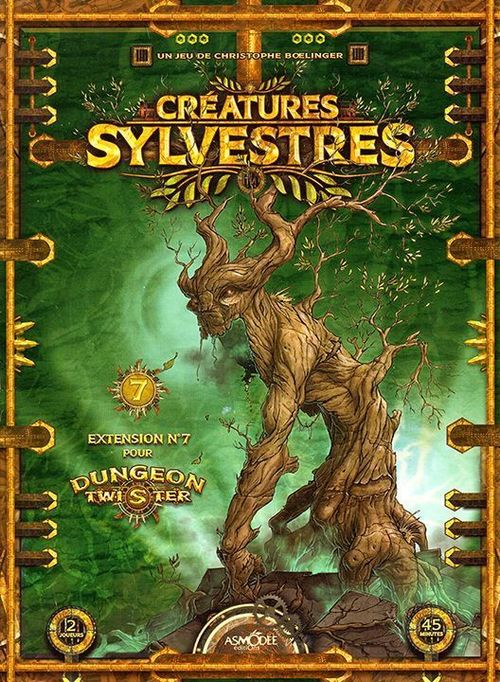
Dungeon Twister: Créatures Sylvestres
Dungeon Twister: Créatures Sylvestres Rulebook
Table of Contents
Table of Contents
Components
- 8 room cards
- 2 sets of tokens (one per player), each containing 8 characters and 7 objects
- 2 sets of 8 figures (two colours) for the characters
- 6 Climbing Plant markers (two colours)
- 6 Cobweb markers (two colours)
- 2 sets of Ent tokens (3 Ents per player)
- 2 Living Trap tokens (one per player)
- 2 Undergrowth tokens (one per player), each with values 0 and 4
- 2 Living Tree markers (one per player), each with values 0 and +2
- 5 neutral Ropes and 5 neutral Torches (white tokens)
- 31 Stump markers
- Several "open" and "broken" gate markers
- 1 rulebook
How to Play with This Expansion
You can play either exclusively with this expansion, for two players, using only the contents of this set, or you can mix the characters, rooms and objects of this expansion with other Dungeon Twister sets. Each player must choose 2 pairs of rooms (8 rooms in total), 8 characters and 6 objects (unless the scenario or special rules say otherwise).
If the players decide to play with more than one set, there are three ways to do it.
Free Closed Selection
Each player chooses a colour and takes all the characters and objects of that colour that are available. Each player secretly chooses 8 characters and 6 objects to use in the game. Return the unused characters and objects to the expansion boxes. Then each player secretly chooses 2 pairs of rooms. The 8 rooms are shuffled and placed face down on the table, as usual. Then follow the basic rules. This is the most common variant, in which each player can assemble the team they like.
Mutual Selection (Equal Strength)
Each player chooses a colour and takes all the characters and objects from all the expansions that are available. Randomly determine who goes first. The first player chooses a pair of rooms, then the opponent chooses a pair of rooms. The first player then chooses another pair, and so on until four pairs of rooms have been chosen. Build the labyrinth as usual.
Both players place all their characters and objects behind their screens. The first player chooses one of his characters and places it openly in front of his screen so that the opponent can see it. The opponent, in turn, places the same character in front of his own screen, and then chooses one of his other characters and places it in front of his screen. The first player finds the same character in his collection, places it openly in front of his screen, and so on until eight characters have been chosen. Objects are chosen in the same way. In the end, both players must have the same 8 characters and 6 objects. Return the unused characters and objects to the boxes. Then follow the usual rules.
If you are playing with a handicap, one of the players secretly removes a certain number of characters from behind his screen during team building. Alternatively, you may allow your opponent to block one or several of your characters.
Scenarios
Scenarios offer you to play with some specific teams and rooms. Sometimes they also add special rules or certain elements.
Ranged Combat
The Elven Archer may initiate ranged combat by shooting an arrow for 1 action point (AP). He targets the first character on his line of sight, at unlimited distance (in the same way as the Wizard's Fireball). Ranged combat is resolved in exactly the same way as melee combat, with one exception: the Elven Archer will not be wounded if his final attack value is lower than his opponent's. The arrow's attack value is "2". It cannot be modified by terrain, objects or character abilities. On the other hand, the effects of terrain and objects on the opponent's defence value are taken into account (for example: Armour, Silvanit Shield, Ring of Weakness). Special abilities are also taken into account (for example, the Water Elemental and the Fire Elemental also get +1 to their combat value in their own elements, and the Vampire takes into account the bonuses from blood markers). All character abilities that affect combat are not taken into account during ranged combat (Berserker, Weapon Master, General, Assassin, Samurai, Scroll of Confusion, Torch, Mummy, etc.).
The Elven Archer cannot initiate ranged combat if he is adjacent to his target, or if he is adjacent to an unwounded opponent character.
The Elven Archer can also take part in a group attack from a distance. This requires only 1 AP, which includes both melee combat and shooting at the same time. Add together the combat values of all attacking characters and the arrow value "2", together with the combat card (see Figure 2, the paragraph on the Elven Archer).
The Elven Archer cannot take part in group combat as a defender. Ranged combat is treated as an attack. This means that you cannot initiate combat with a character who was wounded in the current turn, regardless of how that character was wounded.
Note that the Crossbow object can also be used to declare ranged combat. A character carrying it can do so, just as the Crossbowman (from the Mercenaries expansion) can use a crossbow for ranged combat.
New Characters
Druid
Speed 4. Strength 1.
Climbing Plants. Each Druid has 3 Climbing Plant markers of its colour. For 1 AP, a Druid may place from 1 to 3 Climbing Plant markers on any obstacle squares in its line of sight. If the Druid places more than 1 marker, all the subsequent markers must be placed adjacent to each other (see Figure 1). Climbing Plants have the same property as the Rope, except that they cannot be picked up or moved. It is not necessary to have two anchor points to use Climbing Plants. Although Climbing Plants are markers, they are still not considered when applying the rules for building the labyrinth. Once a Druid has placed one or more Climbing Plant markers, they cannot be moved until the end of the game. The Magofag does not destroy placed Climbing Plants. However, this does not allow Climbing Plants to be placed on squares adjacent to the Magofag.
Figure 1: Climbing Plants placed by Druids (the figure is not reproduced).
The Druid is a magical character. It can use scrolls.
Undergrowth
Speed 0. Strength 4.
For 1 AP, the Druid may place an Undergrowth token on any empty floor square in the same room where the Druid itself is. It does not need to see the target square in its line of sight. Characters cannot move through Undergrowth, except bodiless characters (Ghost, Specter), which may move through Undergrowth but may not stop on it. Undergrowth does not move and cannot perform any actions. The square occupied by Undergrowth is no longer considered a normal empty floor square. Undergrowth blocks line of sight.
Undergrowth may be attacked. It defends itself with combat cards, as in normal combat. If Undergrowth loses a combat, the Undergrowth token returns to the hand of its owner. Undergrowth does not earn victory points (VP). If Undergrowth wins a combat, the enemy characters that declared the combat become wounded. Undergrowth never takes part in group combat, whether as an attacker or as a defender.
The Druid may create new Undergrowth elsewhere for 1 AP. Remove the Undergrowth token from its old position and place it on an empty floor square in the same room where the Druid is. The Druid may also simply remove its own Undergrowth from the labyrinth for 1 AP. A Druid cannot have more than 1 Undergrowth token in the game (of its colour).
Undergrowth is removed from the game if the Druid dies, or if the Magofag ends its action on a square adjacent to the Undergrowth.
Ent
Speed 2. Strength 1.
Ents can be created only by the Plodovik (see the Plodovik section). Ents have no special abilities. They earn VP for leaving the labyrinth through the opponent's starting line, and they give VP to the opponent if they die. Ents can be wounded.
Earth Elemental
Speed 3. Strength 8.
The Earth Elemental cannot initiate combat, but it can fully defend itself if it is attacked. It cannot take part in group combat as an attacker. On the other hand, it can take part in group combat as a defender. It cannot take part in ranged combat (through the use of objects such as the Crossbow).
The Earth Elemental can break gates, as a Warrior can. It can pass under Falling Rocks (this terrain is found in other Dungeon Twister expansions, such as "Paladins and Dragons" or "Mercenaries"). If it ends its movement on Falling Rocks, it destroys the Falling Rocks. Place a "broken gate" marker on the Falling Rocks trap square. This square can now be passed through as a normal square by any character, even after the Earth Elemental has left the square. Characters may also stop on this square, but nevertheless it is not considered a normal floor square.
Plodovik
Speed 3. Strength 2.
For 1 AP, the Plodovik may place an Ent on any adjacent empty floor square. The Ent has speed 2 and strength 1. It is considered an ordinary character without any abilities. You earn 1 VP if your Ent leaves the labyrinth through the opponent's starting line. Your opponent earns 1 VP if he kills one of your Ents.
The Plodovik cannot create Ents on a starting-line square; in that case those squares are not considered ordinary floor squares.
Elven Archer
Speed 4. Strength 2.
The Elven Archer may initiate ranged combat with arrows for 1 AP (see the ranged combat rules). The Elven Archer can use arrows to take part in group combat as an attacker. This takes only 1 AP for the group combat and includes the Elven Archer's ranged attack as well. The total combat value is made up of all the attacking characters, including the Elven Archer, plus the combat card (see Figure 2). It is also possible to combine several ranged attacks on the same targets with other characters in melee combat, all for 1 AP.
Figure 2: Group combat with a ranged attack (the figure is not reproduced).
The blue player decides to initiate a group combat, combining the ranged attack of the blue Elven Archer and the melee attack of his Trap against the yellow Woodcutter. The Elven Archer can see the Woodcutter in its line of sight, through the gap. Total combat value: 2 + 2 = 4. The yellow Elven Archer cannot take part in the group combat as a defender. The total combat value of the yellow side equals the strength of the Woodcutter, 3. If the blue side loses the battle, only the Trap will be wounded. If the yellow Druid were on the tree, it would be adjacent to the blue Elven Archer; in that case the Elven Archer could not shoot at the yellow Woodcutter.
Elven Enchantress
Speed 5. Strength 1.
For 0 AP and only on its own turn, the Elven Enchantress may animate a tree that is under her or in her line of sight. Place a Living Tree marker of the same colour as the Enchantress on the enchanted tree. She cannot enchant a tree that is already enchanted by another Elven Enchantress. The magical charm lasts until the Living Tree loses a battle, or until the Elven Enchantress enchants another tree.
The Living Tree can attack and defend itself, which also applies to group combat. The Living Tree is not considered a character, and it cannot use objects. The marker only shows that the tree is alive and whose control it is under. This marker is not taken into account in the setup rules.
An enemy or friendly character may stop on a Living Tree, even if it carries an object or a wounded character. If an enemy character is on the Living Tree, or adjacent to it, the player controlling the tree may attack the enemy character for 1 AP. The strength value of the Living Tree is 2. If it loses the battle, the Living Tree marker returns to its owner, and nobody earns victory points. If a friendly character is on the Living Tree, it gets a +2 strength bonus, both in attack and in defence, for as long as the tree is alive. The Living Tree's strength corresponds to this bonus. If a Woodcutter fells the Living Tree, the marker returns to its owner and the rules for felling trees apply.
The Elven Enchantress is a magical character. She can use scrolls.
Example: Two Elven Enchantresses duel on the trees. Let us imagine it is now the blue player's turn. For 1 AP, blue may declare a group combat, including the blue Araknis, the Living Tree and the blue Druid (3 + 2 + 1 = 6), against the yellow Araknis, the yellow Woodcutter and the yellow Living Tree (3 + 3 + 2 = 8). If it were the yellow player's turn, he could carry out the same battle. Or else, the yellow player could fell the tree on which the blue Druid stands for 1 AP. He would replace the Living Tree marker with a Stump marker, and the blue Druid would be wounded. Then, for another 1 AP, he could fell the blue living tree. He would return the blue Living Tree marker to the blue player, earning no VP, and place a Stump marker. The yellow Elven Enchantress could then move to a tree adjacent to the blue Araknis for 1 AP and enchant that tree for 0 AP. As a result, the yellow Druid, the yellow Araknis and the yellow Living Tree could declare a group combat against the blue Araknis and the blue Elven Enchantress for 1 AP. In this case, the strength value of yellow would be 3 + 2 + 1 = 6, and blue 3 + 1 = 4.
Translator's note: the Russian text of this example names the yellow character "Дриада" (Dryad) where the figure and the strength total (1) show the Druid. The Druid is used here.
Figure 3 (the figure is not reproduced).
Araknis
Speed 4. Strength 3.
For 1 AP, Araknis may create a Cobweb between two squares. Place the Cobweb marker on the edge of the square occupied by Araknis. The edge between the two squares must be empty: there must be no wall, gate, secret passage or anything else there. A Cobweb may be placed in place of broken gates or a broken wall, but not on open gates (since they can be closed again). A Cobweb is always placed within a single room, never between rooms. If the Cobweb is spun on the edge of a room, the player controlling Araknis must clearly indicate which room the placed Cobweb marker belongs to.
Araknis can spin only 3 Cobwebs per game. A Cobweb cannot be torn by the Golem. A Cobweb can be removed from the game by a character carrying a Torch, which can burn the Cobweb for 1 AP. The Fire Elemental can also burn the Cobweb for 1 AP. The Red Dragon can burn the Cobweb for 1 AP using fire breath, and the Wizard can do so with the Fireball. When a Cobweb is destroyed, remove this marker from the game.
Araknis is an animal.
Trap
(Called Zapadnya in the Russian text.)
Speed 5. Strength 2.
For 1 AP, a Trap standing on an empty ordinary floor square may turn into a Living Trap. Replace the Trap figure with a Living Trap token. This square is now considered a Trap Pit, which is described in the basic Dungeon Twister rules. The Trap cannot use this ability when it is wounded, or when it carries any object or a wounded character. The Living Trap may turn back into a character for 0 AP, but only during its own turn.
If a character, an object or any other token falls into a Living Trap, the Living Trap devours it. If an enemy character falls into the Living Trap, the player controlling the Living Trap earns the corresponding victory points (VP); if a friendly character falls in, the VP go to the opponent. Devoured objects are removed from the game. Any markers (for example, Climbing Plants) return to their owners and may be used again. While the Trap is in the form of a Living Trap, it cannot be attacked. On the starting line, or when a room is opened, the Trap always enters the game in its humanoid form, not as a trap.
Woodcutter
Speed 3. Strength 3.
A Woodcutter standing next to a tree may fell it for 1 AP. Place a Stump marker on the square of the felled tree. This square is now freely passable and does not block line of sight. Nevertheless, it is not considered an ordinary floor square for the other rules.
If a character was on the tree when the Woodcutter felled it, that character becomes wounded but stays on the same square (it is forbidden to finish off this wounded character in the current turn). If a wounded character was on the tree when the Woodcutter felled it, the character dies immediately. It is allowed first to wound a character in combat and then fell the tree, thereby killing the character in the current turn. This is permissible, since felling a tree is not an attack.
New Objects
Amulet of the Elven Eye
A character with the Amulet of the Elven Eye can see the elves' Secret Passages, and can also use these passages. A character with the Amulet of the Elven Eye can also see elves in trees, and can therefore declare them as its target.
Crossbow
For 1 AP, a character with a Crossbow may use it once per turn (because reloading takes time). It may also declare ranged combat as an Elven Archer does. The Crossbow's combat value is 2 and cannot be changed. When ranged combat is made with the Crossbow, never use the character's own combat value.
Scroll of Levitation
For 1 AP, a magical character may levitate itself, or levitate a character in its direct line of sight. The effect of the Scroll lasts until the end of the turn. Remove the Scroll from the game after use. Levitation (flight) is a magical ability.
Ring of Paralysis
A character with the Ring of Paralysis may use it for 0 AP during the opponent's turn, but only when an opposing character performs a movement to enter the character's direct line of sight. A jump, a teleportation, the rotation of a room, the creation of Ents, etc. are not movement. As soon as the player declares that he is using the ring, the target character immediately stops moving and cannot perform any actions until the end of the turn. It also cannot take part in group combat.
To use the ring, the character must discard a combat card of its choice (except card 0) and show it to the opponent. This represents the exhaustion caused by the mental concentration needed to use the ring. The Ring of Paralysis can be used only once per turn. It is not removed from the game after use. A character entering the line of sight can be immobilised, but not one leaving it.
It is forbidden to paralyse a character if this would put it in a situation that breaks the rules. If a character (for example, the Thief, or the Elven Scout, etc.) is paralysed on a dangerous terrain (a Trap Pit, a Chasm, etc.), it is affected by that terrain.
Orb of Peace
A character with the Orb of Peace may use it for 0 AP during the opponent's turn (either at the moment the opponent plays an Action card, or at the end of any unfavourable Action). Melee combat is forbidden "on the game card" until the end of the turn (translator's note: the source wording of this restriction is unclear, and it is rendered here literally). Ranged combat and other Actions are allowed. After use, the Orb of Peace is removed from the game.
Steam Saw
The Steam Saw allows its carrier to fell a tree for 1 AP, like a Woodcutter. It also gives a +1 combat bonus in attack. Although it acts as a weapon, it cannot be processed in the forge from the Mercenaries expansion. Only characters with strength 3 or more (the value on the character token, without modifications) can carry or use this object, because of its size and weight. However, a Telekinetic may move this object by telekinesis. A Woodcutter with a Steam Saw may fell a tree for 0 AP.
Torch
The Torch allows its carrier to burn an adjacent Araknis Cobweb for 1 AP. A character adjacent to Darkness squares that carries a Torch may light them for 0 AP (see the rules of the expansion "Forces of Darkness").
New Locations
Fountain of Youth
A wounded character adjacent to the fountain may drink from it for 1 AP and be healed. Remember the second Golden Rule after drinking from the fountain. A healed character may act in the same turn, immediately after drinking from the fountain. The Fountain of Youth is a 3D obstacle.
Lianas
Any character may pass through, or stop on, a square with Lianas. Characters on a square with Lianas may cut a Liana for 1 AP for use as a rope. Place a neutral Rope token, on a white background, under the character that cut the Liana. Each square with Lianas can provide only 1 Rope per game. A character that already carries an object cannot cut a Liana (except the Paladin). The line of sight includes the square with Lianas but does not cross it, even after the Rope has been taken from there.
Crack in the Wall
The line of sight of a character adjacent to the Crack continues through the opening, as if the walls were not there. The line of sight of a character that is not adjacent to the Crack does not continue through the Crack; it stops on it, as on an ordinary wall. A character behind the Crack may shoot at a character on the other side of it. These two characters are not adjacent, since they are separated by a wall with a Crack, so melee combat is impossible. However, direct line of sight exists, so ranged combat and any actions requiring direct line of sight are possible. The Crack does not allow discovering closed rooms. A Crack in a wall has the same characteristics as a wall. It can be destroyed by a Golem, or crossed by the Walker-through-walls.
Fog
A character in the Fog cannot be targeted. Line of sight cannot cross or reach a square with Fog. A character in the Fog has line of sight out of the Fog, but this line of sight is blocked as soon as it reaches another square with Fog. Thus a character on a square with Fog can see other characters, while it itself is not visible to them. A character in the Fog may be attacked in melee, as usual. Characters may pass through Fog squares as normal squares. However, Fog squares are not considered ordinary floor squares (characters and objects cannot be placed on them when a room is opened).
Secret Passages
There are Secret Passages, hidden in walls and forests. Only elves can temporarily open these Secret Passages. Elves may move through Secret Passages as if the wall were not there. It is impossible to jump over, or start combat through, a Secret Passage. A character with the Amulet of the Elven Eye may pass through Secret Passages like elves. For all other characters, Secret Passages are considered ordinary walls. A Golem may destroy a Secret Passage as an ordinary wall, and a Walker-through-walls may use its Special Ability to overcome this obstacle.
Figure 4 (the figure is not reproduced).
The blue Elven Archer can target only the yellow Elven Archer. It cannot attack the yellow Araknis in melee. The yellow Elven Archer is not adjacent to the Crack in the wall, but it cannot target the blue Elven Archer. (Translator's note: the Russian sentence here is worded loosely; it is rendered as the source gives it.) The blue Woodcutter cannot attack the yellow Druid, because they are separated by the Wall with a Crack. On the other hand, since the yellow Druid has a Crossbow, it can shoot at the blue Woodcutter. If the blue Woodcutter declares an attack, it will be only between him and the yellow Araknis. Otherwise, if the yellow player declares an attack on the blue Woodcutter, he may decide to use the Druid's shot with the Crossbow and the Araknis, for a total combat value of 5, against the Woodcutter's value of 3.
Trees
Trees are 3D obstacles. Only characters with strength 3 or less may climb onto a Tree during their movement. The strength counted is the one printed on the character token, without modifications. A character climbing onto a Tree ends its movement there and loses any remaining steps, however many it still had. Place the climbing character on the Tree.
To come down from a Tree, a character spends 1 AP and immediately continues its movement as usual (as also when leaving Water). Flying characters may fly over Trees, and flying characters with strength 3 or less may stop on a Tree. This is treated as landing on a tree. It is impossible to push a character onto a Tree.
A character on a Tree increases its line of sight. The 3D objects, characters, Ladders and Lianas no longer obstruct its view. Elves in trees are invisible and cannot be targeted, except by other elves or by characters with the Amulet of the Elven Eye. On the other hand, they can be attacked in melee. A character can jump off a Tree, but it is impossible to jump onto a Tree and land on it.
Log
Any character may pass through or stop on a Log, as if it were an ordinary floor square. However, Log squares are not considered ordinary floor squares (for example, it is forbidden to place a character or objects on a Log when a room is opened).
Water
Entering Water costs 1 AP. Thus a character moving through 3 Water squares spends 3 AP. The character's usual speed value is not taken into account when moving in Water. When leaving Water, a character spends only 1 AP and immediately continues its movement as normal.
A character cannot enter Water while it carries an object. The object must be left in front of the Water before the descent. If an object somehow falls into Water, it is considered sunk, and it is removed from the game. Characters cannot deliberately sink objects in Water. Wounded characters can be carried in Water. A character may be wounded while in Water and remain there, waiting for help to arrive. In Water, characters are protected from fire (for example from the Fireball or fire breath).
Flying characters can fly over Water. They spend no additional actions for moving across Water squares. Water is an obstacle, and it can be overcome with a Jump, with a Rope, or during flight.
Chasm
Characters cannot step onto Chasm squares. Flying characters, the Ghost and the Specter can cross a Chasm but cannot stop on it. Characters may jump across a Chasm, but must follow the usual rules for jumping. A Rope, or the Druid's Climbing Plants, allow a character to cross a Chasm or to stop on it. The squares marked with a red "X" are the Chasm squares.
Wooden Bridge
Only characters with strength 3 or less may step onto a Wooden Bridge square. Other characters cannot deliberately step onto it. A character standing on a Wooden Bridge square is considered to be on the bridge, not on the location beneath it (water, lava, etc.).
The Wooden Bridge is treated as an obstacle. Characters with strength 4 or more may jump over it (if it is not occupied by another character). This jump follows the usual rules. If a character with strength 4 or more carries a Rope, it may cross the Wooden Bridge and even stop on it. If a character with strength 4 or more finds itself on the Wooden Bridge for any reason, the Bridge breaks and the character falls to the location below. Place a "broken gate" marker on the Wooden Bridge. If that character was carrying an object, the object is removed from the game.
Torch Holder
A character adjacent to a wall with a Torch Holder may take a neutral Torch (white token) for 1 AP, if this does not violate the second Golden Rule at the end of the action. The character must be on the same square as the holder, on the correct side, so that the Torch can be taken. Place the white Torch token under the character. Place a broken gate marker to show that the Torch has already been taken from this place.
If a Golem breaks the wall on which the Torch Holder stands, it is no longer possible to take the Torch from this holder. The Ghost and the Specter cannot take a Torch from a holder, since they cannot take or use objects.