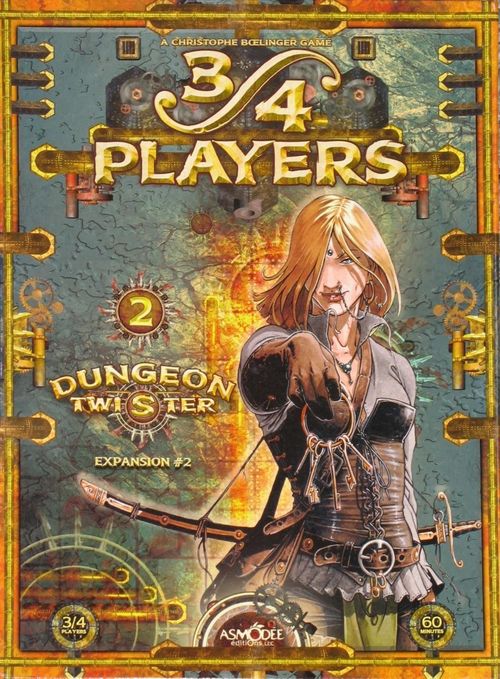
Dungeon Twister: 3/4 Players Expansion
Dungeon Twister: 3/4 Players Expansion Rulebook
Table of Contents
Table of Contents
- Contents
- Rules for 3 and 4 Players
- Scenario: Crossing (Traversée)
- Scenario: The Pyramid (La Pyramide)
- Scenario: Rush Out!
- Scenario: And the Engineers Invented... the Translation (Et les ingénieurs inventèrent... la translation)
- Scenario: Where Is the Exit? (Où est la sortie ?)
- Scenario: Little Murders Between Friends (Petits meurtres entre amis)
- Scenario: A Surprise Team! (Une équipe surprise !)
- Player Aid
Contents
- 8 square rooms.
- 2 starting zones (one per player).
- 2 screens / player aids.
- 2 sets of tokens (one per player), each with 8 characters and 6 objects.
- 2 sets of 8 cardboard figures and their 16 plastic bases.
- 1 scenario booklet.
- 2 sets of cards (16 per player), each with 9 Combat cards, 3 Jump cards and 4 Action cards.
- Several Portcullis markers, open and broken.
- Several markers for counting the actions taken.
- 4 small starting zones in 4 different colours.
Rules for 3 and 4 Players
With a base game box and this expansion you can play with 3 or 4 players.
The rules for 3 and 4 players are identical to the 2-player rules, with the following exceptions:
- The game is played to a minimum of 6 VP.
- You may bring your characters out on any opposing starting zone.
- Setup is different (see the two setup diagrams below). You must choose 6 pairs of 2 rooms.
- Turn order follows clockwise.
- When a player reveals a room, the player to his right places the objects of his colour.
- A wounded character may be killed before the player who controls it plays again. For example, if a player 3 character is wounded during player 1's turn, it may be finished off during player 2's turn, that is, before player 3 has been able to heal or regenerate it.
- Group combats involving 3 or 4 colours are not allowed.
- When a player reveals a central room, he chooses one edge, lifts that edge, and turns the room over from that edge.
The 3 and 4 player version does not stop there: a whole series of new scenarios follows.
Setup for 3 Players
The number in each room is the number of tokens that room can hold.
  2  3  3  2
  2  3  3  2
     3  3
     2  2
Setup for 4 Players
The number in each room is the number of tokens that room can hold.
     3  3
  3  4  4  3
  3  4  4  3
     3  3
Scenario: Crossing (Traversée)
Players: 4. Required components: the base game and this expansion.
Board
All rooms of the base game and of this expansion are used. Shuffle all the rooms and place them face down as shown below.
  3  2  2  3
  2  3  3  2
  2  3  3  2
  3  2  2  3
Starting Teams
Each player starts the game with the 8 characters and 6 objects included in the base game of Dungeon Twister.
Setup
Each player places 4 characters face down on his starting zone.
Players then place the rest of their tokens face down in the rooms, respecting each room's maximum capacity as shown in the board diagram above. However, on rooms with a capacity of 2, players may place only characters. On rooms with a capacity of 3, players may place only objects.
Special Rules
When a room is revealed, if a player has made a mistake (for example, placed a character on a room that may hold only objects, or vice versa), the token concerned is discarded without scoring VP for anyone.
Victory Conditions
- The game is played to 6 VP.
- Players score VP each time they eliminate an enemy character.
- Players also score VP when they bring characters out: 1 VP per character, 2 VP for the Goblin, and +1 VP for the Treasure.
- However, each player's characters may leave the labyrinth only through the zone opposite their own starting zone.
Scenario: The Pyramid (La Pyramide)
Players: 4 (with a 3-player variant). Required components: the base game and this expansion.
Starting Teams
Each player starts the game with 6 characters of his choice from those in the base game, and the 6 objects of the base game.
Board
The pyramid has 5 levels. The first level consists of the starting zones. The second level has 6 rooms, the third level has 5, the fourth level has 4, and the fifth level has only one.
Place the room marked A face down at the top of the pyramid, as shown in the diagram below. Shuffle the other 15 rooms and place them face down following the structure shown in the diagram. The colour of the starting zones does not matter in this scenario.
Board for 4 players (the number in each room is its capacity):
            1                level 5
      2  2  2  2             level 4
   3  3  3  3  3             level 3
 2  2  2  2  2  2           level 2
 [ starting zones ]         level 1
Board for 3 players (the number in each room is its capacity):
            0                level 5
      2  2  2  2             level 4
   2  2  2  2  2             level 3
 1  1  1  1  1  1           level 2
 [ starting zones ]         level 1
The diagrams mark the offsets of 2 squares and of 3 squares (see the arrows on the printed diagram).
Setup
Determine the first player by lot. He begins placing a character, and play then continues clockwise.
Starting with the first player, each player places one character on any free glowing circle of any starting zone (regardless of colour), until each player has placed 3 characters. Thus 12 characters in total are placed on the starting zones, and characters of different colours may end up on the same zone regardless of colour. All characters are placed face down. The first level is then complete.
Players then place the rest of their tokens face down in the rooms, respecting each room's maximum capacity, and progressing level by level.
- On all rooms of the second level, players may place only characters.
- Once the second level is complete, players may start placing tokens on the third level.
- On all rooms of levels 3, 4 and 5, players may place only objects.
The levels are completed one after the other, always moving upward and keeping the clockwise order, until the last player places an object in the single room of the fifth level.
Special Rules
When a room is revealed, if a player has made a mistake (for example, placed a character on a room that may hold only objects, or vice versa), the token concerned is discarded without scoring VP for anyone.
When rooms are revealed, respect the offset in number of squares to the right and left of the rooms (see the diagram above).
A character on a starting zone cannot be attacked in melee (a fireball can certainly clear the way!). On starting zones, a character may pass over an enemy but may not stop there.
Victory Conditions
- The first player to reach at least 4 VP is declared the winner.
- The game may end in a tie, if nobody reaches 4 VP.
- Players do not score VP for eliminated characters.
- To leave the labyrinth, a character must reach the rotation mechanism of the room on the 5th level. For 1 AP, once on the mechanism, it activates the elevation. The room is removed from the structure. Detach it momentarily from level 4. All characters of the active player that are present on this room may leave for 1 AP, regardless of their position in the room.
- At the end of the active player's turn, turn this room a quarter turn in its direction of rotation, and place it back in contact with level 4, respecting the offsets shown on the plan (2 squares to the left and 3 squares to the right).
3-Player Variant
All the rules given for the 4-player version apply to the 3-player version of this scenario, except for the following points:
- The maximum capacity of each room is given by the 3-player diagram above.
- Rooms on level 2 may hold only characters.
- Rooms on levels 3 and 4 may hold only objects.
- During the initial placement of characters on level 1 (starting zones), each player places 4 characters.
Scenario: Rush Out!
Players: 3. Required components: the base game and this expansion.
Starting Teams
Each player starts the game with the 8 characters and 6 objects included in the base game of Dungeon Twister.
Board
Shuffle the 14 rooms and place them face down as shown below. In this scenario the colours of the starting zones (and arrival zones) do not matter.
        0  0
        0  0
        2  2
     3  3  3  3
     3  3  3  3
Setup
Determine the first player by lot. He begins the placement, and play then continues clockwise.
Starting with the first player, each player places one character in turn on any free glowing circle of any large starting zone (regardless of colour), until each player has placed 5 characters (so one place remains empty).
Players then place the rest of their tokens face down in the rooms, respecting each room's maximum capacity. In addition, rooms marked with a 2 may hold only objects.
Special Rules
When a room is revealed, if a player has made a mistake (for example, placed a character on a room that may hold only objects, or vice versa), the token concerned is discarded without scoring VP for anyone.
A character on a large starting zone cannot be attacked in melee (a fireball can certainly clear the way!). On starting zones, a character may pass over an enemy but may not stop there.
Victory Conditions
- The game lasts 4 complete cycles of Action cards (that is, 48 turns).
- When the game starts, after the first player has been determined, place an action marker in front of the 4th player (the one seated to the right of the first player). Each time the 4th player recycles his Action cards, he places a new action marker in front of him. As soon as the 4th player places the 5th action marker in front of him, the game ends. Four complete cycles (48 turns) will have elapsed.
- Translator's note: the source text refers to a "4th player" in this 3-player scenario and does not say how the marker count applies with three players. It is transcribed as printed.
- During the game, players score 1 VP for each character they bring out on one of the two small starting zones. The Goblin always scores 2 VP if it leaves this way, and the Treasure adds +1 VP.
- Eliminated characters score no VP. The winner is the player who has accumulated the most VP at the end of the 4 cycles of play.
Scenario: And the Engineers Invented... the Translation (Et les ingénieurs inventèrent... la translation)
Players: 4. Required components: the base game and this expansion.
Starting Teams
Each player starts the game with the 8 characters and the 6 objects included in the base game of Dungeon Twister.
Board
The 2 rooms with rotation mechanisms, marked 3, and the room numbered 1 (the elevator, see below) are placed on the positions indicated by the arrows on the printed diagram, in a random orientation. All the other rooms are shuffled and placed at random on the remaining positions. All 13 rooms are placed face down.
The printed layout is as follows; the number on each position is that room's maximum number of tokens (the centre position, 4, is the elevator):
  3  3     3  3
  3  3  4  3  3
  3  3     3  3
Setup
The room numbered "1" is called the elevator. During the placement phase, players may place only objects there, up to 4 tokens.
The rest of the setup follows the usual rules: 4 characters on each player's starting zone, and 3 tokens per room (other than the elevator), characters and/or objects combined.
Special Rules
For 1 AP, a character standing on the Rotation Gear of room "1" or room "3" may move the elevator one room vertically, up or down. The room does not rotate on itself during this sliding movement. The three Rotation Gears therefore control the elevator.
All rooms in this scenario (including the elevator) may also rotate as usual.
Victory Conditions
- The game is played to 6 VP.
- Players score VP as usual, but to score VP by bringing out characters, blue must exit on the yellow zone, and yellow on the blue zone. Likewise, green must exit on the red zone, and red on the green zone.
Scenario: Where Is the Exit? (Où est la sortie ?)
Players: 4 (with a 3-player variant). Required components: the base game and this expansion.
Starting Teams
Each player starts the game with the 8 characters and 6 objects included in the base game of Dungeon Twister.
Board
All the rooms of the base game and of the 3/4-player expansion are used. Shuffle all the rooms and place them face down following the structure shown below.
The small starting zones are shuffled and placed face down on the positions indicated. They are revealed only at the end of the setup phase. During this scenario, the colours of the large starting zones do not matter.
Board for 4 players (the number on each room is its capacity):
     2  2
  2  3  3  2
     3  3
     3  3
  2  3  3  2
     2  2
Setup
Determine the first player by lot. He begins the placement, and play then continues clockwise.
Starting with the first player, each player places one character in turn on any free glowing circle of any large starting zone (regardless of colour), until each player has placed 4 characters. Thus 16 characters in total are placed on the large starting zones, and characters of different colours may end up on the same zone regardless of colour. All characters are placed face down.
When the 4 large starting zones are full, each holding 4 characters, the same clockwise placement order is used, but the players now begin placing their remaining tokens (face down) on the different rooms, respecting each room's maximum capacity.
When each player has placed all of his tokens, the small starting zones are revealed and placed face up at the respective positions where they were placed. Each player then reveals his characters on the large starting zones.
Special Rules
Characters may move across the large starting zones regardless of their colour. A character on a large starting zone cannot be attacked in melee (a fireball can certainly clear the way!). On starting zones, a character may pass over an enemy but may not stop there.
Victory Conditions
- The game is played to 5 VP.
- Players score VP only when they bring out their own characters on the small starting zone of their own colour: 1 VP per character brought out, 2 VP for the Goblin, and +1 VP for the Treasure, as usual.
- Enemy characters that are eliminated score no VP.
3-Player Variant
The 3-player variant of this scenario follows all the rules above, except for the following points:
- During the initial placement on the large starting zones, players place 5 characters instead of 4. One place remains empty.
- The 4 small zones are still placed face down, but one of them (the colour not used by the 3 players) is a decoy, since no character can leave by that zone.
- The maximum capacity of each room is different (see the diagram below). A room will not reach its maximum capacity.
Board for 3 players (the number on each room is its capacity):
        2  2
  1  2  2  1
        2  2
        2  2
  1  2  2  1
        2  2
Scenario: Little Murders Between Friends (Petits meurtres entre amis)
Players: 4. Required components: the base game and this expansion.
Starting Teams
Each player starts the game with the 8 base characters and 4 objects. Each player removes his Fireball Wand and his Treasure.
Board
Shuffle all the rooms and place them face down as shown below.
     2  2
  2  4  4  2
  2  4  4  2
     2  2
Setup
Each player places 4 characters face down on his starting zone.
Players then place the rest of their tokens face down in the rooms, respecting each room's maximum capacity as shown in the board diagram above. However, on rooms with a capacity of 2, players may place only objects. On rooms with a capacity of 4, players may place only characters.
Special Rules
When a room is revealed, if a player has made a mistake (for example, placed a character on a room that may hold only objects, or vice versa), the token concerned is discarded without scoring VP for anyone.
Players may not start a combat until all the rooms have been revealed.
Victory Conditions
- The game is played to 12 VP.
- You score 1 VP each time one of your characters leaves on an enemy zone, whatever its colour (2 VP for the Goblin).
- You score 1 VP each time you wound or eliminate an opponent, even when you take part in a group combat by alliance.
- For example, if you wound the Troll, you score 1 VP even if it regenerates on the following turn. If it does not, you may kill it and score a new VP.
- Do not use the tokens of eliminated characters to count the VP each player has earned, as you would run out. Use a sheet of paper or any markers instead.
Group Combat by Alliance
When the active player declares a melee combat, all characters adjacent to the attacking characters or to the targeted characters (that is, of the defender) may take part in the group combat, whatever their colour.
A combat declaration still concerns only two colours, the attacker and the defender. Each character of a third or fourth colour that is adjacent to attacking and/or defending characters may decide whether to take part in the combat or not. If it decides to take part, the player must choose which side it joins: the attacking or the defending side.
Next, all players taking part in the combat place one Combat card of their choice face down. The cards are all revealed, and allied players add together all the combat values of the characters involved and all the Combat cards played by the alliance.
A grand total is obtained for the defending side and likewise for the attacking side. The highest final score wins the combat, and all characters of the opposing alliance are wounded.
If a character is adjacent but does not take part in the group combat, it is not affected by the results of the combat. However, if a player decides to get involved in a combat in which he is neither the defender nor the attacker from the outset, he must make all his characters in contact take part (except wounded ones). He may not make some take part and not others.
The question does not arise for the attacking and defending players, who in any case must always make all adjacent characters take part (except wounded ones).
The winners of a group combat by alliance score +1 VP for each enemy character wounded or killed. This applies to each player taking part in the combat on the winning side.
Example from the source (the active player is red, and it is his turn). He spends one action and declares that the red Warrior attacks the blue Troll. The red Magician is diagonal to the Warrior, so it cannot take part (for now). Starting from the red Warrior and the blue Troll, look at all adjacent characters who may take part in the combat. No character is adjacent to the red Warrior. So start with the green Warrior and the green Goblin: they are adjacent to the defender (the blue Troll) but not to the attacker (the red Warrior). They may therefore join the red side, but not the reverse. Green decides to join red (against blue), since it is always good to scrape a few VP from a collective massacre.
The yellow Goblin is adjacent to the blue Troll and to the red Magician, so it decides to take part and sides with blue. Because of this decision, the red Magician is now adjacent to an enemy, so it joins the combat.
If green and yellow had stayed neutral, the combat could only have involved the red Warrior and the blue Troll. But since green sided with red, the blue Thief is adjacent to an enemy involved in the group combat, so it takes part by adding its combat value to that of the blue Troll.
The yellow Mekanork is adjacent only to the blue Thief, who is an ally, so it does not take part in the combat.
In the end: red and green players against blue and yellow players. Red Warrior (3) + red Magician (1) + green Warrior (+3) and green Goblin (+1) + Combat cards of red and green, against blue Troll (+4) + blue Thief (+2) + yellow Goblin (+1) + Combat cards of blue and yellow.
The Combat cards are all played simultaneously and face down by all players, then revealed, and the combat is resolved as usual. All Combat cards are then discarded.
On the losing side, all characters are wounded. On the winning side, each player gains 1 VP for each enemy character wounded. So if red and green win, each gains 3 VP. If yellow and blue win, each gains 4 VP.
Scenario: A Surprise Team! (Une équipe surprise !)
Players: 4. Required components: the base game and this expansion.
Starting Teams
Each player starts the game with the 8 characters and 6 objects included in the base game of Dungeon Twister.
Board
Shuffle the 10 rooms and place them face down following the structure shown below.
        4  4
     4  4  4
  4  4  4
  4  4
Setup
Each player places 4 characters face down on his starting zone.
Players then place the rest of their tokens face down in the rooms, respecting each room's maximum capacity as shown in the board diagram above.
Special Rules
When a room is revealed, the player seated opposite you places the objects of your colour.
Red and green are allies. Yellow and blue are allies.
- Two allied players may not attack each other.
- Characters of two allied players may pass through each other.
- Characters of two allied players may carry each other's wounded characters.
However, the two teams have not been trained to fight together, at least not in real harmony. For this reason, there is no group combat between allies. In other words, group combats may only ever include 2 colours of tokens (necessarily two enemy colours, such as red and blue, or green and yellow).
Victory Conditions
- The allied players' scores are added together. An allied team wins if it totals 10 VP or more.
Optional Rules
To simulate the discovery of the two teams, it is advised to play with the following conventions:
- Allied players may not talk to each other to exchange tactical or strategic advice. No discreet messages or other tricks to draw an ally's attention to a particular interesting action are allowed either.
- However, as soon as a character passes through an allied character, or ends its movement next to an ally, its player may take one minute at the end of his turn to discuss strategy with the ally. Start the timer; this matters. The discussion may take place in front of the game board or aside.
Player Aid
This is the reference sheet printed on the last page of the booklet.
Goal of the Game
- You gain 1 VP when you eliminate an enemy character.
- You gain 1 VP when you bring one of your characters out of the labyrinth.
- The Treasure adds 1 extra VP if one of your characters leaves the labyrinth carrying it.
- The Goblin is worth 2 VP when it leaves the labyrinth (instead of 1 for the other characters).
Sequence of Play
On his turn, a player must resolve the following 3 phases in this order:
- Play an Action card.
- Use all or part of his actions.
- Take back his 4 Action cards in hand if he has none left.
Using 1 AP allows you to:
- Reveal a room.
- Rotate a room.
- Move a character.
- Engage in combat.
- Use a character's special ability.
- Use an object's special ability.
First Golden Rule: An action must be fully resolved before another one is begun.
Second Golden Rule: There can never be more than two tokens on a square at the end of an action.
Moving a Character
During its movement, a character may:
- Move to any adjacent square (including returning to a square it has just left).
- Pass over objects and wounded characters (friendly or enemy), and even stop on objects and on friendly wounded characters (but not on an enemy wounded character).
- Pass over characters of its own colour, but not stop on them.
- Pass over or stop on a Rotation Gear.
- Pass through an open or broken Portcullis.
However, it may not:
- Move diagonally.
- Pass over or stop on a Pit Trap.
- Pass over or stop on an enemy character.
- Pass through a closed Portcullis.
- Pass through a wall.
At the end of its movement, a character may not:
- Be on the same square as a character that is not wounded (whatever its colour).
- Be on the same square as an enemy wounded character.
- Be on a Pit Trap.
- Be on the same square as two other tokens (whatever they are).
Special Abilities (Icon Legend)
The icons on the aid sheet correspond to these abilities:
- Object must be discarded after use.
- Lock-picking (Crocheter les herses).
- Magic User (Jeteur de sorts).
- Flying (Volant).
- Breaks Portcullis (Briser les herses).
- Regeneration (Régénération).
- Craftsmanship (Bricolage).
- Acrobatics (Acrobatie).