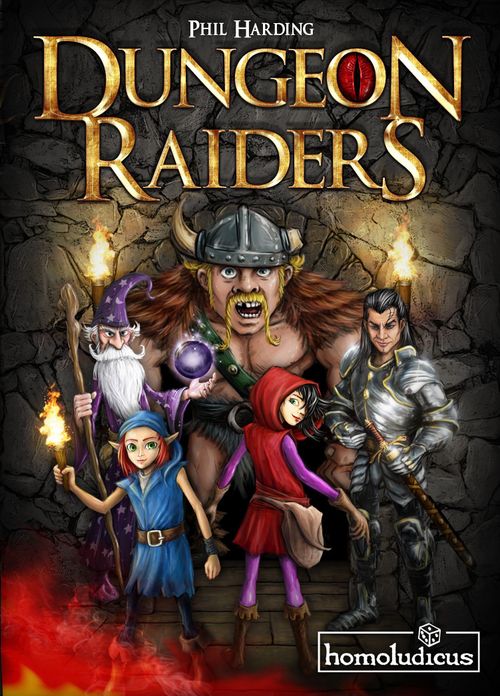
Dungeon Raiders
Dungeon Raiders Rulebook
Table of Contents
Table of Contents
- Rules of Play
- Contents of the Game
- Setting Up the Game
- Keeping Track of Treasure and Wounds
- Setting Up a New Level
- Playing the Game
- Using Item Cards
- Completing a Level
- Dying
- Ending the Game
- Rules for 2 Players - Dungeon Duel
- Rules for 1 Player - Dungeon Solitaire
- Game Variant - Speed Dungeon Raiders
Rules of Play
Recommended for ages 8 and up. A game takes around 20 minutes to play.
The main rules are for 3-5 players. Special rules for 1-2 players are found at the end of this rules sheet.
Contents of the Game
- 30 dungeon cards: 10 monster rooms, 10 treasure rooms, 5 trap rooms, 5 vaults
- 25 power cards: 5 sets of cards valued 1-5
- 5 treasure tracker cards
- 5 bag cards
- 20 item cards: 5 torches, 5 crystal balls, 5 keys, 5 swords
- 5 character cards: Explorer, Knight, Thief, Warrior, Wizard
- 5 wound tracker cards
- 5 door cards
Setting Up the Game
-
Prepare the dungeon cards. Take all 30 dungeon cards and shuffle them into a face down pile. Randomly remove 5 cards from the game face-down, these will not be used. Flip the top 12 dungeon cards face up and put them back on top of the pile. Shuffle the whole pile well, making sure the cards remain in their face-up or face-down orientation.
-
Prepare the dungeon row. Put a door card on top of the shuffled pile of dungeon cards, and then place the top 6 cards of the pile on the table (5 dungeon cards with a door card on top). Do this 4 more times to create 5 piles of 5 dungeon cards, each with a door card on top. Place these piles in a row in the middle of the table. This is called the dungeon row. Each pile represents one level of the dungeon. Note: Brave players may want to shuffle and prepare the dungeon cards under the table so they do not catch a glimpse of any of the rooms they will face!
-
Prepare the supply. Sort the item cards by type. Place them in 4 face-up piles on the table above the dungeon row.
-
Assign characters. Take the 5 character cards and shuffle them face down. Deal 1 to each player. The card you receive is the character you will play as. Remove any unused character cards from the game.
-
Set up tracker cards. Each player takes a wound tracker card and a money tracker card and places them on the table in front of them. Place your character card face-up on top of your wound tracker card so the highest number visible equals the number of red crosses in the bottom-right corner of your character card. Each player takes a bag card. Place it on your treasure tracker card so the highest number visible equals the number of coins in the bottom-left corner of your character card. Bag cards start on the side without the +10 face-up.
-
Take power cards and item cards. Each player takes a set of power cards valued 1 to 5 into their hand. Each player takes item cards from the supply, as indicated at the bottom of their character card, also into their hand. Players keep their hands secret from other players throughout the game.
Keeping Track of Treasure and Wounds
During the game, each player uses the tracker cards to track their treasure and wounds. Whenever you gain or lose wounds or treasure, indicate the change by moving your character card or bag card respectively. Do this so the highest value visible on your tracker card represents your current number of wounds or treasure. To represent zero treasure or wounds, completely cover the tracker card. If you gain more than 10 treasure, flip over your bag card to the +10 side and continue counting from space 1 on your treasure tracker card (which now represents 11 treasure). A player may never have more then 20 treasure.
Setting Up a New Level
At the start of the game, and each time a level is completed, the next level of the dungeon must be set up. Take the left-most pile of dungeon cards from the dungeon row and discard the door card from the top, removing it from the game. Deal the 5 dungeon cards out in a row from left to right, below the dungeon row. The orientation of the face-up and face-down cards is not changed. This is called the level row.
Playing the Game
The following steps are followed in each room of the dungeon:
- Enter room
- Each player plays a power card
- Resolve room
- Discard room and determine start player
1. Enter Room
The players enter the next room of the dungeon, which is the left-most card in the level row. This card is flipped over if it is face-down. The start player reads the card aloud so that everyone knows what they have discovered!
2. Each Player Plays a Power Card
Each player must choose a power card from their hand to play in the current room. The higher the number, the more power your character will use. You only get your power cards back at the end of the level, so choose wisely! The start player goes first and places their chosen card face-up on the table, in view of all players. Then, moving clockwise around the table, each other player plays a power card face-up.
3. Resolve Room
Once all players have played a power card, the room must be resolved. Depending on the type of room it is, the following rules are carried out:
Treasure room: The highest power cards played will gain treasure!
Compare the numbers on the power cards that have been played. Whoever has the highest gains treasure equal to the number listed on the most valuable chest. If multiple players tie with the highest power card, then they share the chest, dividing its value equally between them (any remainder is ignored). If there is less treasure in the chest than the number of players who have tied for it, they all receive nothing. There may also be a second, less-valuable chest in the room. If so, whoever played the second-highest power card gains treasure equal to the number listed on the second chest. If multiple players tie with the second-highest power card then they share the treasure, as described above. Depending on how the chests are divided, it is possible for a player to receive more treasure in second place than in first!
Example: The current room contains 2 chests, valued 4 and 2. Players A, B and C play a value 4 power card. Player D plays a 2, and player E plays a 1. Players A, B and C tie for the highest power card, and so share the value 4 chest. They receive 1 treasure each (the remainder of 1 treasure is ignored). Player D has the second highest power card, and so receives the 2 treasure in the second chest. Player E receives nothing.
Monster room: All players' power cards must add up to the monster's strength to defeat him. Otherwise, the player with the lowest power card will gain wounds!
First, the players check the monster's strength. It is listed at the bottom of the dungeon card, in the shield that has dots equal to the number of players who started the game. Next, the players add up the value of all the power cards played. If the number is equal to or greater than the monster's strength, the players have defeated the monster and the room is resolved. If the total is less than the monster's strength, then it survives. It attacks the player who played the lowest power card. This player receives wounds equal to the number of red crosses in the bottom-right of the dungeon card. If multiple players tie with the lowest power card, they all receive the full amount of wounds.
Example: The current room contains a dragon. It is a 4 player game, so its strength is 18. Player A plays a value 5 power card, player B plays a 4 and players C and D each play a 3. The total of all the power cards is only 15, so the dragon attacks! Both players C and D receive 3 wounds, because they played the lowest card.
Trap room: Read the text on the dungeon card to see if the trap is triggered! If it is, 1 or more players will gain wounds or lose treasure. Trap rooms with 1 skull affect players who are doing well. Traps with 2 skulls affect everyone! If the trap is not triggered, nothing happens and the room is resolved.
- Magnet trap: The player with the most treasure loses 1, 2 or 3 treasure if the highest power card played is a 3, 4 or 5 respectively. If multiple players are tied for the most treasure, they each lose the treasure.
- Boulder trap: The player with the least wounds gains 1, 2 or 3 wounds if the highest power card played is a 3, 4 or 5 respectively. If multiple players are tied for the least wounds, they each gain the wounds.
- Lava trap: If the lowest power card played is a 3, everyone loses 1 treasure. If the lowest card is a 2, everyone loses 2 treasure. If the lowest card is a 1, everyone loses half of their treasure, rounded down. Example: A player with 5 treasure would lose 2 treasure, and be reduced to 3.
- Spike trap: If the lowest power card played is a 3, everyone gains 1 wound. If the lowest card is a 2, everyone gains 2 wounds. If the lowest card is a 1, everyone receives wounds equal to half the number of remaining spaces on their wound tracker card, rounded down. Or to put it another way, they are crushed halfway to death! Example: A player with 3 wounds, has 7 spaces left on their wound tracker card. Half of 7 rounded down is 3, so the player would gain 3 wounds for a total of 6.
In all trap rooms, only the value of the lowest or highest power card played is considered, regardless of who played it, or how many people played it. Therefore, you may end up triggering a trap on yourself!
Vault: Each player receives the benefit depicted above the number of the power card they played.
- Torch/Crystal Ball/Key/Sword: Take a copy of the corresponding item card from the supply and add it to your hand. If multiple players want to take the same item card and there are not enough left in the supply for everyone, then no one takes the item. There is no limit to the number of cards you can hold.
- Pile of 1/2/3 coins: Gain 1/2/3 treasure. If multiple players take coins, they all receive the full amount.
- Potion: Lose wounds equal to the number listed on the potion label. If multiple players take a potion, they all lose the full amount of wounds. You may have less wounds than you started the game with.
All players leave their played power cards face-up in a splayed pile in front of them until the end of the level. This means that everyone can see which power cards have already been played when making their decisions.
Using Item Cards
- Torch: A torch card can be played at any time (but it is best to play it at the start of a level with lots of dark rooms). When you play a torch, secretly look at the front of each face-down dungeon card in the level row, and then return it face-down to its place. This will give you valuable information about what rooms are on this level. The torch is then returned to the supply.
- Crystal ball: A crystal ball is played instead of a power card. It allows you to pass, and see what cards everyone else will play before playing yours. After the other players have played their cards, you must play your power card as normal, and then return the crystal ball to the supply. If multiple players use a crystal ball in the same room, they must play their second card in turn order (clockwise, from the start player). You may follow a crystal ball with a key, sword or another crystal ball.
- Key: A key is played instead of a power card. It functions exactly as a value 5 power card. However, it may only be played in a treasure room. After completing step 4, the key is returned to the supply.
- Sword: A sword is played instead of a power card. It functions exactly as a value 5 power card. However, it may only be played in a monster room. After completing step 4, the sword is returned to the supply.
4. Discard Room and Determine Start Player
After the dungeon card is resolved, it is discarded from the game. Whoever just played the highest power card will be the start player for the next room, and takes the game box in front of them. Keys and swords count as a value 5 power cards. If multiple players tie for the highest card, then the next player in clockwise order from the current start player takes the box and is the new start player. If there are cards left in the level row, then play returns to step 1 and the adventurers enter the next room. Otherwise, the level is complete.
Completing a Level
A level is complete when all 5 dungeon cards in the level row have been played through. First, everyone takes a rest! Each player takes all 5 of their power cards back into their hand. If there are piles left in the dungeon row, then set up the next level and continue playing. If not, the dungeon has been fully explored and the game is over!
Dying
If at any point in the game you have 10 or more wounds, then you are instantly eliminated from the game and cannot win! Flip over your character card to show you are dead and return any item cards you have to the supply.
Ending the Game
When the fifth level of the dungeon is complete, the game is over. The surviving players check their wound tracker cards. Whoever has the most wounds collapses, and is out of the game! If multiple players tie with the most wounds, they are all out of the game. However, if all players have the same amount of wounds, then no one collapses. Out of the remaining players, whoever has the most treasure wins! If multiple players tie with the most treasure, then the player with the least wounds wins. If the players are still tied, then they share victory. If only 1 player survives to complete the fifth level, then they win the game. If no player survives to complete the fifth level, then no one wins.
Rules for 2 Players - Dungeon Duel
All rules are the same in a 2 player game, except:
- If a player reaches 10 or more wounds, the other player instantly wins the game.
- If both players survive the dungeon, it does not matter how many wounds they have. The player with the most money always wins. If the players tie, then whoever has the least wounds wins. If they are still tied, then they share victory.
- Monsters cannot be defeated! They always attack whoever plays the lowest power card. However, if both players play the same value card, then the monster is confused and neither player is wounded!
Rules for 1 Player - Dungeon Solitaire
All rules are the same in a 1 player game, except:
- In each room, you choose which power card to play, and will resolve the room for just your character.
- Wounds do not matter at the end of the game. Your aim is simply to survive the dungeon with the most treasure possible. A good goal is 20 treasure. (You may collect over 20 treasure in a solitaire game, just keep note.)
- There are no item cards in the game, so the supply is not set up. When preparing the dungeon, remove the 3 vaults that contain items, and 2 other random cards face-down from the game (instead of the usual 5 random cards).
- Choose any character card to play with, but regardless, you will always start with 2 treasure and no items.
- Choose how many wounds you would like to start with from 2-5, based on the level of challenge you want. For an easy game, start with 2 wounds. For a near-impossible game, start with 5!
- When setting up the game, you must also prepare the monster attack deck, made from the power cards you are not using. This is done by taking 2 value 5 power cards, 4 value 4 power cards and 4 value 3 power cards and shuffling them together. The monster attack deck is placed face-down on the table.
- When you enter a monster room, the next card in the monster attack deck is flipped over to reveal the strength of the monster. You must play a power card greater than the monster's strength to defeat it. If not, you gain wounds equal to the number of red crosses on the dungeon card. Monsters with a strength of 5 cannot be defeated, regardless of which power card is played. Used cards from the monster attack deck remain face-up.
- In a treasure room, you may take any chest by playing a power card at least 1 greater than the value of the chest.
- In a trap room, you are affected by every trap if it is triggered.
Game Variant - Speed Dungeon Raiders
If you want a quicker game, or are playing with younger players, try this variant. All rules are the same, except that in each room, the players (in any order) play their power cards face-down. Then they are all flipped face-up simultaneously, and the room is resolved as normal.
If a player uses a crystal ball, they play their second card face-up after the other cards are revealed. If multiple players use a crystal ball, they reveal their second cards simultaneously. There is no need to keep track of the start player when playing this variant.