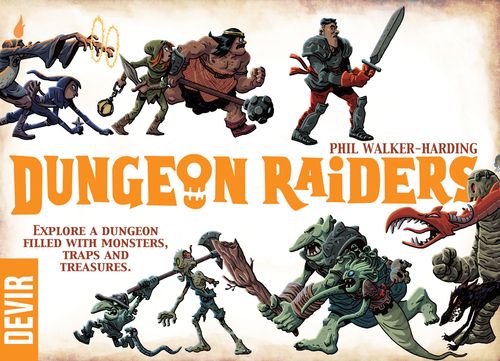
Dungeon Raiders (2018)
Dungeon Raiders Rulebook
Table of Contents
Table of Contents
Game Overview
For 3 to 5 players • Ages 8 and up • 20 minutes' duration
Contents
- A. 7 level cards — 7 different level-row diagrams.
- B. 30 room cards — 11 monster rooms, 10 treasure rooms, 5 chambers, and 4 trap rooms.
- C. 25 power cards — 5 sets with values 1-5.
- D. 24 item cards — 6 torches, 6 crystal balls, 6 keys, and 6 swords.
- E. 10 boss monster cards — 10 different final monsters.
- F. 5 character cards — Scout, Knight, Rogue, Warrior, and Sorcerer.
- G. 38 coin tokens — 24 of value 1 and 14 of value 5.
- H. 26 wound tokens — 20 of value 1 and 6 of value 5.
- I. 1 map card — Only used in the Tactical Variant, to indicate the starting player.
Game Setup
A - Create the room deck: Shuffle all room cards face down. Remove 6 random cards from the game without looking at them: they will not be used during the game. Take a random boss monster card without looking at it and place it face down at the bottom of the deck. Place the deck in the center of the table.
B - Create the level deck: Shuffle all level cards face down. Remove 2 random cards from the game without looking at them: they will not be used during the game. Place this deck next to the room deck.
C - Prepare the item reserve: Separate the item cards by type, forming 4 decks, and place them above the room deck.
D - Prepare the coin and wound reserve: Place the coin tokens and wound tokens on the table in separate piles, within reach of all players.
E - Assign characters: Shuffle the 5 character cards face down and deal one to each player. Remove the remaining character cards: they will not be used during the game. Players place their character card face up in front of them, showing the character they will play. Each player forms their hand with a set of power cards valued 1 to 5. They also take from the reserve the item cards indicated on their character card, and add them to their hand, which must always be kept hidden.
Creating a Level
The game unfolds over 5 levels of the dungeon, represented by a row of 5 room cards called the level row. To create a level, one player reveals the top card of the level deck. Then, cards are drawn from the room deck and lined up in the center of the table according to the diagram shown on the level card. A green symbol indicates that the card should be placed face up, and a red symbol indicates that the card should be placed face down, where no one can see it. Once the level row has been created, the level card is removed from the game.
Using a torch: at any time during the game, even right after finishing the level setup, any player may declare that they are playing a torch from their hand. This lets them secretly look at each face-down card in the level row, then place them face down again in their spot. Several players may use a torch on the same level. Used torch cards are immediately returned to the reserve.
Playing the Game
Each level is worked through by entering the successive rooms, one at a time, following these steps:
1. Enter the room Players enter the next room of the dungeon (the leftmost card in the level row). If the card is face down, it is flipped to reveal it.
2. Play cards Each player chooses a power card or an item card from their hand and plays it face down in front of them. When all players have played their card, all cards are flipped simultaneously.
Using a crystal ball: when revealing a crystal ball card, the player may play another card from their hand face up, having already seen what their opponents played. If several players play a crystal ball at the same time, they must reveal their next card simultaneously. Used crystal ball cards are immediately returned to the reserve.
3. Resolve the room Each type of room is resolved differently, depending on the cards that were played.
- Treasure room: the highest power card wins the coins.
- Monster room: the lowest power card receives wounds, unless the players defeat the monster.
- Chamber: each player gets a special benefit.
- Trap: the player with the most coins or the most wounds may lose coins or receive wounds.
- Boss monster: the last room of the game contains a boss monster, which is resolved similarly to any other monster. See the full room-resolution rules below.
4. Discard the room After resolving the room card, remove it from the game.
Players leave the power cards they played face up in front of them, forming a discard pile that they will not pick back up until the level ends. This way, everyone can see which power cards have been played so far.
End of level: a level is completed once all of its rooms have been resolved. All players take back into their hand the power cards they played, and the next level is created. Once all 5 levels have been completed, the game ends.
Resolving a Treasure Room
Compare the values of the power cards that were played. Whoever played the highest card receives a number of coins equal to the value printed on the most valuable chest on the treasure room card. In case of a tie, the loot is shared, divided equally among the players with the highest card, rounding down and ignoring any remainder. If the number of coins is fewer than the number of tied players with the highest card, they receive nothing.
The room may contain a second, lower-value chest. In that case, whoever played the second-highest power card receives a number of coins equal to the value printed on the second chest. If there is a tie, the loot is split as described above among the players with the second-highest card. Depending on how the chests are split, it is sometimes possible to get more coins by coming in second rather than first.
A player can accumulate a maximum of 20 coins.
Example: the room contains 2 chests, worth 4 and 2 respectively. A, B, and C play power cards of value 4; player D, value 2; and player E, value 1. A, B, and C are tied. So they split the contents of the larger chest and receive 1 coin each (the remainder is ignored). D played the second-highest card, so they receive the 2 coins from the second chest. Finally, E receives nothing.
Using a key: a key card can only be used on a treasure room card and counts as a power card of value 5. Once the room is resolved, the used key is returned to the reserve.
Resolving a Monster Room
First, check the monster's strength, indicated at the bottom of the monster room card, specifically in the shield that corresponds to the number of players in the game. Next, add up the value of all the power cards played in the room. If the total is equal to or greater than the monster's strength, the players have defeated the monster and the room is resolved.
If the total is less than its strength, the monster attacks the player who played the lowest power card. That player receives the number of wound tokens indicated in the bottom-right corner of the monster room card. In case of a tie, each player with the lowest power card receives the indicated number of wound tokens.
There is no limit to the number of wounds a player can accumulate.
Example: this room contains a dragon with 18 strength points, since there are 4 players. Player A uses a power card of value 5; player B, value 4; and players C and D, value 3. The sum of the cards is 15, so the dragon attacks! Since they played the lowest card, players C and D each receive 3 wound tokens.
Using a sword: a sword card can only be used on a monster room and counts as a power card of value 5. Once the room is resolved, the used sword is returned to the reserve.
Resolving a Chamber
Each player receives the item or benefit whose value matches the power card they played.
Torch, crystal ball, key, and sword: the player takes a copy of the corresponding item from the reserve and adds it to their hand. If several players want the same item and there aren't enough for everyone in the reserve, no one gets that item. There is no limit to the number of cards a player can hold in hand.
Coins (1, 2, or 3): the player gets the corresponding number of coins. If several players want the same coin loot, they all get the full amount. A player can accumulate a maximum of 20 coins.
Potion (value 1 or 2): the player discards as many wound tokens as the potion's value. If several players want the same potion, they all discard the full number of wound tokens. Wound tokens are returned to the reserve.
Resolving a Trap
To resolve traps, use the highest-value power card played by any player:
- Lava cauldron: the player (or players) with the most coins loses 3/2/1 coins if the highest card played is a 5/4/3.
- Coin trap: the player (or players) with the most coins loses 2/2/1/1 coins if the highest card played is a 5/4/3/2.
- Spike trap: the player (or players) with the fewest wounds receives 2/2/1 wound tokens if the highest card played is a 5/4/3.
- Giant boulder: the player (or players) with the fewest wounds receives 2/1/1/1 wound tokens if the highest card played is a 5/4/3/2.
If several players are tied for the most coins or the fewest wounds, they all suffer the trap's full penalty.
Resolving a Boss Monster
A boss monster is resolved the same way as a monster room, with the following exceptions:
- Tax Collector: instead of receiving wound tokens, any player who is attacked loses 3 coins.
- Medusa: instead of receiving wound tokens, any player who is attacked is eliminated from the game and cannot win. If all players are attacked, everyone loses the game! Surviving players proceed to the final count, where more players may be eliminated.
- Vampire: any player who is attacked receives 1 wound token and also loses 2 coins.
- Sphinx: any player who is attacked receives 2 wound tokens. In addition, the player who played the highest card gains 2 coins. If several players are tied for the highest card, they all get 2 coins. If all players play the same card and fail to defeat the sphinx, no one gets coins.
- Minotaur: any player who is attacked receives 1 wound token. In addition, the player who played the highest card gains 1 coin. If several players are tied for the highest card, they all get 1 coin. If all players play the same card and fail to defeat the minotaur, no one gets coins.
- Wolf Pack: if any player plays a torch, they escape the room. This means they do not take part in the fight against the monster, and are therefore ignored when determining who is attacked.
- Necromancer: if any player plays a crystal ball, they escape the room. This means they do not take part in the fight against the monster, and are therefore ignored when determining who is attacked.
- Mega Dragon: this boss monster cannot be defeated, so it always attacks. If any player plays a key, they escape the room. This means they are ignored when determining who is attacked.
- Golem: this boss monster cannot be defeated, so it always attacks. Any power card of value 5 and any sword played in this room count as a power card of value 1.
End of the Game
Once the fifth level is completed, the game ends, and it is time for the final count.
The player with the most wound tokens faints from their wounds and is eliminated, with no chance of winning the game. In games with 4 or 5 players, if several players are tied for the most wound tokens, they are all eliminated. In games with 3 players, a player only faints if they have accumulated a majority of the wounds. Regardless of the number of players, if everyone has the same number of wound tokens at the end of the game, no one is eliminated.
Among the remaining players, whoever has accumulated the most coins wins! If several players are tied for the most coins, whoever among them has fewer wounds wins. If the tie persists, victory is shared.
Tactical Variant
Players who want a more tactical game can play using the following rule changes:
After setup is finished, the starting player is chosen at random, and takes the map card, placing it in front of them to indicate this.
When playing cards, the player with the map card plays first, placing their chosen card face up on the table. Then, turn order proceeds clockwise, and each player plays their chosen card face up. The room is then resolved as usual.
If a player uses a crystal ball, the turn passes to the next player. Then, once all players have played a card, the players who played a crystal ball play a second card, again proceeding clockwise from the starting player. The crystal ball cards played are then returned to the reserve.
Once a room is resolved, the new starting player is determined. Whoever played the highest power card takes the map card and plays first in the next room. Keys and swords count as a power card of value 5. If several players are tied for the highest card, the tied player closest to the current starting player in clockwise order takes the map card. The player holding the map card after the last room of a level is the starting player for the first room of the next level.