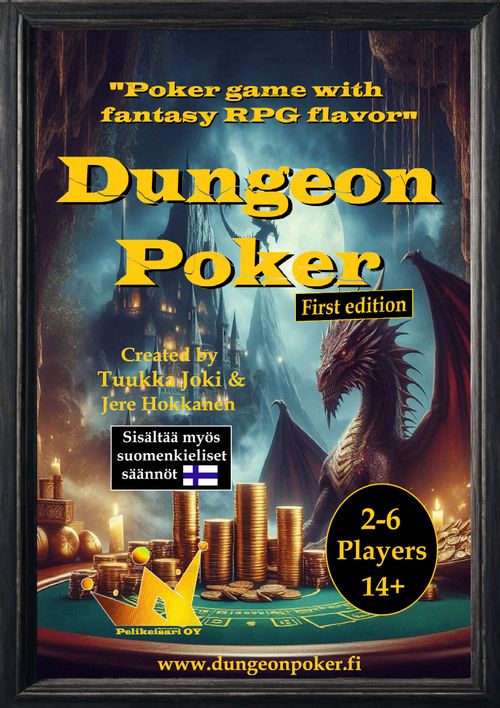
Dungeon Poker
Dungeon Poker Rulebook
Table of Contents
Table of Contents
- Contents of the package
- Foreword
- Choosing between No-Limit or Pot-Limit
- Preparing the game
- Abbreviated rules and terms
- The progression of the game
- The player characters and special actions
- Blind bet levels (levels)
- Encounter cards
- Treasures
- Monsters
- Winning the game
- Character death and re-entering the game
- Tournament style play
- Two player game
- Simplified rules
- Shorter game
- Other changes and variations
- Appendix A: Characters
- Appendix B: Monsters
- Appendix C: Treasures
- Appendix D: Encounter cards
- Appendix E: First Edition extra cards
- Appendix F: Texas Hold'em easy rules
- Appendix G: Some rule clarifications
Contents of the package
- 205 Dungeon Poker cards
- 53 card main deck
- 14 character cards
- 24 monster cards
- 22 encounter cards
- 55 treasure cards
- 10 level cards
- 8 skull cards
- 19 extra cards
- 200 gold coins
- 70 diamonds
- 40 Soul Gems
- 2 rulebooks (English / Finnish)
- 1 Dungeon Poker mat
Foreword
If the mechanics and rules of Texas Hold'em poker are familiar to even one player amongst your playing group, the rules of Dungeon Poker will be easy for you to learn. The rules of Dungeon Poker for a large part follow the rules of traditional Texas Hold'em, while blending in classic elements of fantasy role playing games, such as treasures, monsters, and unique player characters with their special abilities.
Players need to continuously adapt to changing conditions when the blind levels get higher. In this game, the players aim to win the Dungeon Poker tournament. You may attain victory by amassing enough gold or treasures, or by being the last original player character alive.
Knowledge of Texas Hold'em is not a requirement, because the rules are explained in this rulebook. If you are unfamiliar with it, we recommend reading the rules of Texas Hold'em from appendix F.
Choosing between No-Limit or Pot-Limit
You can play Dungeon Poker either with No-Limit or Pot-Limit rules. The only difference is whether the maximum bet is limited, or not. In No-Limit, there is never an upper limit for the maximum bet or raise, except the gold in the player's stack. No-Limit is the most brutal way to play Dungeon Poker.
With Pot-Limit rules, the maximum bet or raise the player may do in their turn is the amount of gold currently in the pot. Note that the amount of gold the player has themselves paid is also counted to the pot, if someone else has raised before.
The Pot-Limit rule limits the maximum raise especially in the beginning, when the pot does not have that much gold. Using this rule limits the most aggressive raises right in the beginning. In Dungeon Poker, you will also, due to the Encounter cards, play many different variations of Texas Hold'em, where Pot-Limit is commonly used. There are also more random factors in Dungeon Poker than in normal Texas Hold'em poker.
You may play Dungeon Poker with whichever limit rules you choose, and it does not affect the other rules. The option is always chosen before beginning the game.
Preparing the game
- Choose, together with the other players, whether you want to play with No-Limit or Pot-Limit rules.
- Put aside the skull cards, the Golem, and the extra Fire Dragon.
- Put the gold coins, diamonds, and Soul Gems on the table / to the box where they are easily available.
- Shuffle the player character deck.
- Shuffle the treasure deck.
- Shuffle the encounter deck.
- Shuffle the monster deck.
- Shuffle the Dungeon Poker main deck.
- Place the playing board in the middle of the table.
- Place the level deck from 100 to 1500 on the playing board picture side up.
- Place the encounter, monster, and treasure decks on their places on the playing board picture side down.
- Decide the location of the graveyard on the table, where the folded, burned, and destroyed main deck cards go.
- Choose the places at the table (randomly).
- Choose the dealer (randomly). Give them the Dealer and the First Dealer cards.
- Distribute 2 player character cards to each player picture side down.
- All the players check their character cards and secretly choose one.
- When all the choices have been made, the characters are revealed.
- All the players take 5000 gold from the bank, and Soul Gems according to their character card.
- There are gold coins worth 100, and diamonds worth 500, in the game.
- The amount of Soul Gems the character gets in the beginning is shown as the red number in the upper left corner of the character card.
Abbreviated rules and terms
In the beginning of the game, all players choose a player character to play with, each of whom has their own special abilities. These special abilities are used with the valuable Soul Gems given to each character in the beginning of the game. You may also acquire these Soul Gems during the game, for example from treasure cards.
As poker chips, Dungeon Poker uses gold coins worth 100, and diamonds worth 500. In Dungeon Poker, the blind level rises as the game progresses just like in a normal poker tournament. The blind level is simply known as the level. The level rises every 5 deals. The blind bet refers to the amount of gold that the two players left of the dealer must place in the pot before dealing the hand cards.
At the beginning of each level, you must also flip open a new encounter card. The encounter card determines the game rules for the next 5 deals. As a result of the encounter card, the game mode may change. In the encounter cards, there are in-built mechanics of the most famous poker variants such as Omaha. There are also many completely unique game modes specific only to Dungeon Poker.
One deal refers to one round of poker play. There are always four stages in the deal - preflop, flop, turn, and river - like in normal Texas Hold'em. The best five card poker hand wins the deal. In Dungeon Poker, the winner of each deal may also draw a treasure card from the deck. You may find more gold, Soul Gems, or magical artifacts from the treasure cards.
During the game, the players may also encounter monsters. The monster card (M) is an extra card in the main deck of Dungeon Poker. When it shows up, a random monster is drawn to the game. The monster functions as an extra player, whose cards are looked at in the end of the deal.
There are 5 decks in Dungeon Poker. The level deck, the encounter deck, the treasure deck, the monster deck, and the Dungeon Poker main deck, which is used to play poker deals.
The burned and the destroyed cards from the main deck as well as the players' folded cards are placed in the graveyard. Cards in the graveyard are always shuffled back to the main deck at the beginning of the next deal. If, on the other hand, an effect states that a card should be removed entirely from the game, it is placed in the box for the remainder of the game - it is no longer used.
In Dungeon Poker, you may win the game in three different ways: By amassing enough gold, treasures, or by being the last original character remaining alive.
Now you know the basics of what Dungeon Poker is all about. In the next chapters, the progress of the game and the special rules of Dungeon Poker are explained in detail.
The progression of the game
Levels
The blind levels, levels for short, give rhythm to Dungeon Poker. Each time the level changes, the dealer opens up the next blind level card, and a new encounter card, face up. The blind bets grow, and the game rules change a bit due to the encounter card. The used encounter cards and blind levels are removed from the game. The first level (100) is always played without an encounter card.
One level lasts five deals, and after that, a new level begins. Use the "first dealer" card as an aid to keep track of the level - it is given to the player who is the dealer in the first deal of the level. This way it is easy to keep count when five deals have progressed, and the next level begins.
A single round of the game, also known as the deal
- The two players left to the dealer place the blind bets. They are the same for both players - the amount indicated by the level card.
- Deal the hand cards clockwise to all the players one card at a time, until all the players have two hand cards. The players may look at the cards, but not show them to others.
- Play the preflop betting round. The player to the left of the blind bets begins. They decide whether to pay (place the amount required by the bet to the pot, meaning the blind amount), raise (the limit of the raise depends on the game mode, No-Limit / Pot-Limit and the lowest amount is the blind bet indicated by the level card), or fold the cards to the graveyard, and not participate in this deal. The turn goes clockwise to the next player, and they make their own decision on the betting. This is repeated player after player until all the players have acted (also the players with blind bets) and put the same amount of gold to the pot, folded, or gone "ALL IN", with all their remaining gold being in the pot. The first betting round has concluded.
- Deal the flop. Burn the first card from the top of the deck by placing it in the graveyard without showing it to anyone. Then deal three shared cards to the table face up.
- Play a betting round just like in the preflop, except that now the round begins from the player left to the dealer. The players must now evaluate the strength of their hand based on their two hand cards and the three shared cards.
- Deal the turn, the fourth shared card on the table face up. Remember to burn one card from the top of the deck. The card is always burned before dealing the shared cards.
- Play a betting round just like at the flop. The players now evaluate the strength of their hand based on the two hand cards and the four shared cards.
- Deal the river, the last shared card. Remember to burn a card. There will be no more cards, the players' hands are now complete.
- Play the last betting round.
- When the river betting round is complete and all the players still in the game have the same amount of gold in the pot or they are all-in, you may begin the showdown stage.
- In the showdown stage the players no longer have actions left. The player to the left of the dealer starts showing their cards. A player may also fold their cards to the graveyard, but naturally, then the player cannot win the pot.
Strategy tip! Betting a large amount at one time is even more risky in Dungeon Poker than in normal Texas Hold'em poker. In Dungeon Poker, the players' special abilities, encounters, and the possible monsters appearing in the game may change the situation of the game drastically.
The player characters and special actions
All the players in Dungeon Poker have their own player characters, which have their own special abilities. Special abilities are used with Soul Gems. The amount of Soul Gems a player gets in the beginning is marked as the red number in the upper left corner of the character card. You may get more Soul Gems from treasures, encounters, monsters, as well as some levels.
In Dungeon Poker, the player always has two possible actions on their turn of action: the normal poker action (for example bet) and the special action. With the special action, you may use the character's special ability, activated abilities of artifacts, or one-use artifacts. The player may also sell artifacts, or cash any gold or Soul Gem treasures as a special action, if they opted to store those treasure cards instead of selling them immediately after winning the pot.
The cost of the special ability is always written in the character card where the special ability is, as "cost". Most abilities cost one Soul Gem. Some stronger abilities may cost two Soul Gems, or even more. The encounter card of the level may also affect the cost of the special ability. For example, during the "Low magic" encounter, all special abilities cost one Soul Gem more, so that two Soul Gem abilities cost three Soul Gems. The player activating the special ability pays the required number of Soul Gems to the bank.
You may only use one special action in your turn of action. If the player gets another turn of action, they may use the special action again - unless it is somehow limited in the card. For example, if another player raises after a player's action, the player gets another chance to respond to the raise. Then they also have another special action. The player can always choose the order of the poker action and the special action on their turn of action.
During some encounters, special abilities may not be used. Other special abilities are passive. They are always on and need not to be activated specifically (for example the Cave Troll's "Regeneration" ability).
Standard abilities must always be used on the character's own turn of action. Therefore, you cannot use them, if you have no turn of action, such as when you go ALL-IN. Of course, at the same time you have announced you are going ALL-IN, you may use your special action normally. Later on, however, you do not have a turn of action, and thus you cannot use your character's special abilities, nor artifact activated abilities that require the use of a special action.
Strategy tip! Often, it is better to use the special action first to see its effects, and only then decide the poker action.
Blind bet levels (levels)
One level lasts five deals. In Dungeon Poker, one blind bet level is known as a level.
The blind bet refers to the bet that the next two players clockwise from the dealer must place on the game round even before seeing the cards. The turn of placing the blind bets circulates with the dealer card clockwise. The blind bet is the same for both players.
The number on the level card tells the amount of gold you must pay as a blind bet. For example, 100 means one gold coin. The players also gain one Soul Gem from some levels. This Soul Gem is gained in the beginning of the first deal of the new level.
In Dungeon Poker, the levels are as follows: 100, 200, 300, 500 (+1 Soul Gem), 600, 700, 800 (+1 Soul Gem), 900, 1000, and 1500 (+1 Soul Gem). In the basic game, there are 10 level cards. After level 10, the blind bets rise by 500 / level. However, with the basic rules, the game rarely lasts longer than level 10.
Strategy tip! The levels, and thus, the blind bets rise in Dungeon Poker relatively fast. It might not be worth it to use special abilities to win a small pot, but on the other hand, you should track the amount of gold you have left in relation to the blind bet. When the blind bet is close to the amount of gold you have, it might be the last time to act!
Encounter cards
The first blind bet level (100) is always played without an encounter card. After that, you must draw one encounter card at the beginning of each level. This card along with the level card determines the rules for the next five deals, meaning the duration of this level.
The dealer reads the encounter card out loud and places it on the top of the encounter deck face up. You must follow the rules stated in the encounter card for the next five deals, or until it is replaced by another encounter card.
Some situations may end the current level before the fifth deal. If this happens, the current level ends immediately (even in the middle of a deal), and a new level begins from the beginning and lasts another five deals. Naturally, then you must also draw a new encounter card. If the encounter card happens to change during a deal, for example with the Scroll of Teleport artifact, the rules change immediately, and they are followed from now on, even during the ongoing deal. If the encounter card changes in the midst of a deal and, for example, the new card states that something special happens in the beginning of the deal, it is of course not happening in the ongoing deal, because that stage has already passed. But if something according to the rules of the encounter card occurs during a later stage, such as at the river, and this stage is yet to come, the rules are followed normally.
Every time the encounter card states that the players are dealt an extra card, this card is dealt at the beginning of the deal, unless the card states otherwise. So, for example in the card on the right, players are dealt three cards at the beginning of the deal.
If the encounter deck ever runs out, no new encounter cards are drawn anymore. From then on, the levels will be played without an encounter card.
Treasures
When a player wins a pot in Dungeon Poker, they get to draw the topmost card from the treasure deck, unless otherwise specified. In the situation of a draw, the treasure card remains for the next deal. Then, in the next deal, the winner draws two treasure cards. You must reveal the treasure card to the other players immediately. From treasures, the players may find gold, artifacts, Soul Gems, and even Empty Chests. A small part of treasure cards also contains sudden effects such as traps.
One of the victory conditions of the game is related to treasures. If a player manages to collect enough (13 - the original number of players) treasures, they win the entire game. For example, in a five player game you win with 8 treasures. You should keep this in mind when hunting for treasures. Note! Only the treasures still in the player's possession count for the victory condition. Cashed treasures or used one-use artifacts do not count.
Sudden effects
Some treasure cards contain sudden effects that are solved immediately. In these cases, the player does not get the treasure card, but it is removed from the game after solving the effect. Sudden effects are either positive, neutral, or even traps, where the player suffers a smaller or a greater harm. Sudden effects and especially traps are relatively rare - so hunting for treasures pays off.
Empty Chests
An Empty Chest is, as the name suggests, an empty treasure. It remains in the possession of the player, because even the Empty Chests count for one victory condition.
Artifacts
Artifacts are either permanent, or one-use. One-use artifacts are used with the special action just like the characters' special abilities. After that, they are removed from the game. Remember, you may only use one special action per turn of action. One-use artifacts always specifically mention that you must sacrifice the artifact when using it. When the player uses a one-use artifact, sells an artifact, or the bank claims an artifact, it is removed from the game permanently and does not count for the win condition.
The gold and Soul Gem treasure cards can be cashed from the bank without an action right after winning the pot. If you do not want to cash them right away, you must later use a special action on your turn of action normally to sell them to the bank. For example, you cannot sell the Big Pile of Gold when you have no actions left, such as in the showdown. The player may possess an unlimited amount of major, ordinary, or minor artifacts.
There are also few "legendary artifacts" in the game. They are so powerful that you cannot have more than one minor artifact with them. If the player decides to keep the legendary artifact, they must give up all their other artifacts except one minor one. In this case, the bank claims all other artifacts, except the chosen minor one. If, on the other hand, the player decides not to keep the legendary artifact, the bank claims it for the salvage price of 1000 gold. If you have a legendary artifact and you ever get more than one minor artifact, you must immediately give it to the bank, which claims it for the salvage price of the artifact.
A player may at their own action decide to sell an artifact to the bank. The salvage price for legendary artifacts is 1000 gold, and the salvage price for major artifacts is 500 gold. Normal and minor artifacts are worth 0, unless otherwise specified. Remember that when the bank claims an artifact, it claims it for its salvage price, which may be lower than the special selling price. For example, the Big Pile of Gold can be sold for 1000 gold, but if bank claims it, it is a minor artifact, for which the salvage price is zero gold.
Strategy tip! When a player finds a legendary artifact, they must think carefully whether to sacrifice their other artifacts, or to sell the legendary artifact. If the player has, for example, collected so many artifacts that they are close to one of the win conditions (collected treasures 13 - number of players), they naturally should not sacrifice them. When collecting artifacts, you should always weigh the benefits of collecting them for the win condition against using their magical powers to win pots and reaching other win conditions.
Monsters
There is one monster card (M) in the Dungeon Poker main deck. If the player receives this card in their hand, it must be revealed immediately. When this card is drawn to the hand or to the table, the dealer replaces it with another card and then draws one monster from the monster deck into the play. The monster card (M) is always first replaced with a normal card from the main deck - only then is the monster drawn from the monster deck. After this, the dealer draws the cards that the monster plays with from the main deck. The monster card (M) goes to the graveyard and will be shuffled back to the main deck at the beginning of the next deal.
Monsters always play ALL IN, and they have no turn of action. The monsters' cards are revealed last at the showdown. When the monster wins, the whole pot is removed from the game, and a treasure card is not drawn - unless otherwise specified. If a monster and a player play a draw, the monster's part is removed from the game, and the treasure remains for the next deal. The winner of the next deal then draws two treasure cards.
Monsters usually have 1-4 cards. They can use 0-2 of them, just like the players. A portion of some monsters' cards are open. In this case, the players will find it easier to estimate the strength of the monsters' hands. If the monster does not win the deal, it is removed from the game completely - the monster dies. When the monster wins the side pot, the monster, and the side pot are removed from the game. If the monster wins the deal, or there is a draw, the monster will be shuffled back to the monster deck. Some monsters also have other special abilities that are always explained in the card, and in the appendix part of the rulebook. Some monsters are special King Monsters, which never give their winnings to anyone else.
The game also has some friendly monsters, such as the "Tree of Life", which grants 1000 gold to all the players still in the pot. The friendly monsters do not participate in the pot, and they are always one-use. The friendly monster is removed from the game after its effect has been resolved. If the monster deck ever happens to be empty, no new monsters are drawn to the game anymore. All the monsters from the dungeon have been slain!
Winning the game
There are three ways to win the game in Dungeon Poker:
- By amassing the required amount of gold: in a 3-4 player game, this amount is 15000 and in a 5-6 player game it is 20000.
- Note that when a character dies and the player re-enters the game with a new character, they get a skull card (see character death and re-entering the game). This player must now earn 5000 gold more to win the game.
- By collecting treasures: (13 - the original number of players).
- All treasures that the player owns are counted here - even Empty Chests.
- Used treasures are not counted. For example, one-use artifacts are removed from the game after use, so they do not count.
- The player does not have to sell their gold and Soul Gem treasures immediately, they can save them as treasures for the win condition.
- By being the last character without a skull card.
- The player is playing with the last original character, all the others have died at least once, and had to change characters. (When a character dies the player gets a skull card).
Character death and re-entering the game
The player character always dies when they run out of gold. All the remaining Soul Gems go to the bank, and the player who has eliminated the character (the player, who has won the said deal where a player runs out of gold) may take a treasure card of their choice from the remainings of the dead character, if the player had treasure cards. If more than one characters die in the same deal, the winner may choose a treasure card from each of them. The rest of the treasure cards are removed from the game.
The player may now return to the game with a new character. In this case the player is dealt two random characters again, from which the player chooses one to use. The new character starts with the normal 5000 gold starting stack, and the amount of Soul Gems indicated by the character card.
The player returning to the game gets one skull card. The skull card indicates that the player must amass additional 5000 gold for the gold win condition. If there are two cards, the player needs additional 10 000 gold to win. If the player should ever have three cards - the player's game is finished, and they may no longer participate in the game.
Tournament style play
Here, you play just as in a normal poker tournament. The players always drop out of the game when they run out of gold. The last remaining player wins the game. You can also play the tournament mode game with either Pot-Limit or No-Limit rules. In this mode, the levels also rise regularly every five deals.
In this version, you may not win the game with treasures or by amassing a certain amount of gold. The game is won by the last character alive.
We recommend that if there are many players in the tournament, you should aim to play the game in tables of 4-7 players and combine the tables, if the number of players goes below four. Note that there are playing tokens for six players in the basic version of the game. In the tournament style play the game might last longer due to the number of players. In this case, if the monster, treasure, or encounter card deck runs out, the removed cards are shuffled to form new decks of each.
Two player game
Dungeon Poker First Edition is originally designed for 3-6 players. You can nevertheless play Dungeon Poker with just two players, like normal poker (heads up). In a two player game, the player who runs out of gold loses the game. In this style of play, both players always pay the blinds at the beginning of a deal. You cannot win the two player game with treasures. Otherwise, the rules are the same as in 3-6 player Dungeon Poker.
Simplified rules
If you wish to make your first game of Dungeon Poker a bit simpler, we recommend leaving the encounter cards out of the game. For beginners, we recommend the following four characters with simple, but still powerful, special abilities: Fighter, Paladin, Rogue, and Sir Nobble.
Shorter game
If you want the game to progress and end faster, we recommend removing the blind bet levels of 200, 600, 800, and 900 from the level deck. Thus, the levels progress quickly, and the game ends faster. The levels are then 100 - 300 - 500 - 700 - 1000 and 1500. After this, the blind bet rises by 500 every five deals, and a new encounter card is also drawn every five deals.
Other changes and variations
Dungeon Poker is an ingeniously flexible game. The players can, on a shared understanding, modify the game as they wish.
In Dungeon Poker, you may easily modify for example the encounter, treasure, or monster decks, the choice of player characters, win conditions, the starting stack of gold and/or Soul Gems, if the players so decide together. With the changes, you may also either shorten or lengthen the playing time easily.
The variations are nearly endless even in the basic game, and new expansion sets for the game are coming in the future.
Appendix A: Characters
Barbarian
Soul Gems 5♥. The Barbarian is a fierce warrior, who can strengthen himself by invoking a primal berserker rage.
Barbarian rage. Standard ability. Cost: ♥. Bet or raise at the minimum of two blind bets' worth. If you do not have enough gold, you cannot use this ability. Draw two cards from the main deck, and then fold two cards. The Barbarian is also immune to all special abilities used by other characters during this deal. You can only use the ability once per deal. You may not use it at the river.
Cave Troll
Soul Gems 4♥. The Cave Troll is a stubborn, powerful, and warlike monster, with the unique ability to heal her wounds. "Everyone has a plan, until the troll swings her club" like one famous barbarian said.
Regeneration. Passive ability. If you have less than 5000 gold at the beginning of a deal, and you are still in the game at flop, you may take the blind bet's worth, or a maximum of 500, of gold from the bank.
Giant club. Standard ability. Cost: ♥♥. All players, including the Troll herself, and the monsters in the game, lose all their hand cards to the graveyard, and draw two new cards from the main deck to replace them. As an exception, if a monster or a character has only one card, they may only draw one. You may not use the ability at the river.
Druid
Soul Gems 4♥. The Druid is the mythic defender of the forest, who can make plants grow wherever she goes. Sometimes she assumes the form of a giant bear, and traverses the forest unnoticed and strong, without even fully understanding her own strength.
Feral growth. Standard ability. Cost: ♥. Draw two new cards from the main deck to the table. These cards are shared cards usable by anyone.
Totemic transformation. Standard ability. Cost: ♥. Discard your hand cards and draw three new cards from the main deck as your hand cards without looking at them. They are revealed only at the showdown.
Fighter
Soul Gems 5♥. The versatile Fighter is the straightforward sovereign master of martial arts.
Melee mastery. Standard ability. Cost: ♥. Draw an extra hand card from the main deck. You may only use the ability once per deal, and you may not use it at the river.
Gnome Artificer
Soul Gems 3♥. The Gnome Artificer is a slightly crazed builder, who never goes without his trusted companion - the Golem he has built himself.
Golem. Passive ability. Place the Golem card next to the Gnome Artificer in the beginning of the game. The Golem is dealt one card face down at every deal (the player may not look at the card). The Golem otherwise plays as a monster does, but it folds whenever the Gnome Artificer folds. The Golem's winnings always go to the Gnome Artificer.
Tinkery. Standard ability. Cost: ♥. Deal one extra card to the Golem. The Gnome Artificer may now look at the Golem's cards.
Night Ogre
Soul Gems 5♥. The terrifying Night Ogre with its horrifying gaze hails from the darkest nights. Stories about this horrifying monster appearing in the darkest moments are shared among the families and over the years. Everything the Night Ogre stares at long enough will disappear into the darkness forever.
Spooky gaze. Standard ability. Cost: ♥. Other players may not use their special abilities during this deal. Passive abilities, like the Gnome Artificer's Golem, are unaffected.
Obliterating darkness. Standard ability. Cost: ♥♥. Choose any one card on the table, except the players' hand cards or skull cards, and remove it from the game. No new card will be drawn to replace it. If the removed card is a main deck card or the Golem, it is only out of the game for the remainder of the deal.
Paladin
Soul Gems 3♥. The Paladin is a holy warrior who can call upon mystical, but definitely holy powers. The Paladin is especially strong when he calls upon the Holy Avenger early to gain its full power.
Holy avenger. Standard ability. Cost: ♥. For the remainder of this deal, you may take all the cards burned from the main deck before dealing the shared cards to your hand. You may receive at the maximum three extra cards: the burnt card at the flop, the turn, and the river. You may not take the cards burned before the use of this ability nor other folded or discarded cards.
Healing prayer. Standard ability. Cost: ♥. If you have less than 5000 gold at the beginning of the deal, you may take 600 gold from the bank.
Priestess
Soul Gems 6♥. The elegant and divine Priestess is gifted in protection and healing magic. She can defend herself from evil cards and heal herself.
Divine protection. Standard ability. Cost: ♥. Name one number or a suit. The next shared card dealt to the table that corresponds with this is discarded to the graveyard. No new card will be drawn to replace it. The ability lasts until the end of the deal but only the first card of the named type is discarded. The monster card (M) can also be named.
Prophet
Soul Gems 4♥. The old and wise Prophet has consulted various soothsaying tools and gained foreknowledge of things not known to others. He has seen his destiny beforehand and may even alter it.
Prophecy. Standard ability. Cost: ♥. You may look at the top two cards of any one deck. You may change their order if you so choose.
Ancestral knowledge. Standard ability. Cost: ♥♥. You may look at the top five cards of any one deck. You may change their order if you so choose.
Rogue
Soul Gems 4♥. The cunning Rogue can find out even the best hidden secrets. The Rogue also possesses a nearly supernatural ability to understand when the time is right to grab everything valuable and bail out.
Spy. Standard ability. Cost: ♥. Look at any one hidden card in the game, the treasure, the next encounter, or even another player's hand card. The Rogue can also look at the Golem's card.
Ambush & run. Standard ability. Cost: ♥♥. Fold your cards, draw the topmost treasure card, and take half of the gold in the pot rounded down, however, at the maximum 3000 gold. The winner of this pot does not draw a treasure card, because the Rogue stole it. You may not steal the dragon's treasure.
Sir Nobble
Soul Gems 2♥. Sir Nobble is one of the most famous characters in Dungeon Poker. He knows neither mighty magics nor possesses the strength of the warriors, but instead, he has a "bigger pouch" than the others.
Bigger pouch. Passive ability. Take 2000 gold from the bank in the beginning - after all, you are richer than the others.
Gift of Scrooge. Standard ability. Cost: ♥. During this one stage, you may choose not to pay the bets or raises, but still continue in the pot. After all, you are more careful with your money than the others.
Undead King
Soul Gems 3♥. The freezingly terrifying Undead King has the ability to raise the dead as his minions, and can conjure a deadly wind to bring misery and suffering to the game.
Raise dead. Standard ability. Cost: ♥. Raise three random cards from the graveyard to your hand. Fold three cards to the graveyard.
Wind of the dead. Standard ability. Cost: ♥♥. Each player must fold a random card from their hand to the graveyard. They do not get to draw a replacement. The Undead King also loses a card but may choose which card to fold.
Witch
Soul Gems 4♥. In the middle of an impenetrable swamp lives the wicked Witch. The Witch's curse is one of the most feared sorceries in Dungeon Poker, which may, if it hits the mark, derail even the strongest games. You should not play too predictably against the Witch.
Witch curse. Standard ability. Cost: ♥. Curse any number you choose. At the showdown, all hand cards from players and monsters of the said number are destroyed and placed in the graveyard. You may not use this ability at the river.
Spoil the treasure. Standard ability. Cost: ♥. If any other player wins this deal, do not draw a treasure card(s). Does not apply to the dragon's treasure possibly in the deal.
Wizard
Soul Gems 4♥. The Wizard is the master of arcane knowledge. He can distort reality with his mystical powers. And of course - the Wizard can conjure powerful fire, when he needs to burn multiple things at once.
Sleight of hand. Standard ability. Cost: ♥. Discard the last card dealt to the table to the graveyard, and deal a new card from the main deck to replace it. You may only use this ability once per stage (one stage is for example the flop).
Conjure fire. Standard ability. Cost: ♥♥. Discard the cards dealt in the flop to the graveyard and deal new cards from the main deck to replace them. You may not use this ability at the river.
Appendix B: Monsters
King Monsters
If a monster counts as a King Monster, it can never be controlled by a player by any means. It also never gives gold or treasures it has won to anyone else.
Ancient Evil
One of the cruelest monsters in the game is the Ancient Evil. You should not even try to play against it with weak cards. When the Ancient Evil is in the game, all players' hand cards below the number 8 (2-7) are discarded to the graveyard at the showdown. Ace (A) is considered a high card and is not discarded. The Ancient Evil plays with three cards.
Astral Warlock
The Astral Warlock endlessly travels between different extradimensional spaces and realities, from where he occasionally appears to bully the player characters. When the Astral Warlock wins the deal, he displaces the player party to the next level. The new level starts from the beginning, and lasts the normal 5 deals. The Astral Warlock plays with three cards.
Baron
The legendary, mean, and rotund robber Baron keeps a roadblock in Dungeon Poker, too. When he enters the table, all players must pay 1 x blind bet's worth of gold for the road toll (in the pot) or fold. When the Baron is in the play, players who fold, must sit out the next deal as a punishment. (They must pay the possible blind bets normally anyway). The Baron plays with three cards. The Baron always counts as a King Monster.
Earth Elemental
The lumbering, but massively powerful Earth Elemental is, in theory, as strong as a dragon, but clumsier and more predictable. This means that the Earth Elemental plays with four open cards (face up) - all the players know exactly what they are up against.
Fire Dragon
The majestic Fire Dragon is the strongest monster in the game. The Fire Dragon plays with four cards. All dragons love treasures, so every time there is a dragon in play, there is also an extra treasure. The player who wins the deal against the dragon gets to draw an extra treasure from the treasure deck. A player may also get this dragon's treasure card by only killing it. The player does not necessarily need to win the deal.
Forlorn Giant
The Forlorn Giant, laying still for aeons, has returned from the twilight world. Even if it is slow and predictable in its movements, it is still a powerful opponent, especially when encountered in a dark graveyard. This undead abomination plays with three cards, two of which are open.
Genie
Genies are powerful combatants. They play with three cards. However, they are more thankful opponents than some equally powerful monsters, since the player who has slain the Genie gets one Soul Gem (the player does not necessarily have to win the pot to get the Soul Gem, only to kill the Genie).
Giant
Big and bulky, but a tad slow and simple, Giants are predictable in their greed and nastiness. They play with three cards, of which one is open - the players may predict its strength to an extent.
Gnome Lunatic
The Gnome Lunatic loves blowing up things. His desire for explosions clearly exceeds his self-preservation instinct. After the showdown, the Gnome Lunatic explodes. If the Gnome Lunatic wins the deal, all the gold and the treasure card is naturally gone. If the Gnome Lunatic loses the deal, 2 x blind gold from the main pot, and the Gnome Lunatic are gone with the explosion. The Gnome Lunatic plays with two cards.
Goblin
The wretched Goblins are the weakest of all monsters. They play with just one hidden card. Even though Goblins are weak, no one wants to lose to them - whenever a Goblin wins the deal, they steal one Soul Gem from all the players. These Soul Gems always go to the bank.
Goblin Hexer
Goblin Hexers are nastier than their ordinary cousins, they play with two cards. The Goblin Hexers are one of the most hated monsters in the game, because they also use mystical, chaotic magic, which often ruins the plans of all others. When the Goblin Hexer enters the game, all the players must fold one random card to the graveyard and draw one card to replace it from the main deck. The magic is very unpredictable, repulsive, and random.
Happy the Clown
"Happy", the not so joyful and inhuman clown, brings chaos to the deal. When Happy enters the game, all players must draw one card from the main deck. Then, players must give one card to Happy, and one card to the player on their left. After this circus, the game resumes normally. Happy may have a maximum of four cards. Remove the extra cards randomly to the graveyard.
Ice Giant
Ice Giants are proud and strong warriors from the Frozen Wastes of North. They play with three cards. If the Ice Giant wins the deal, it robs all players of one blind bet's worth of gold, which goes to the bank. (This extra gold goes to the bank even when the Ice Giant has been summoned to the game with an artifact or a special ability).
Orc
The mean and slow-witted Orc living in forests and caves is one of the most common monsters the players might encounter. It plays with two cards and is evenly matched with most adventurers.
Skeleton Warrior
The Skeleton Warrior, raised from the silence of the grave, is roughly as strong as an Orc, but weaker in practice due to its predictability. It plays with one hidden and one open card.
Undead Maiden
The Undead Maiden dazzles the players when she enters the game. She forces the players to reveal one of their hand cards. The players may choose the card they reveal, and that card remains open. Otherwise, the Undead Maiden is a normal monster that plays with two cards.
Zombie
The Zombie is a slow but clumsy creature from the realms of the dead. It is one of the weakest monsters from the undead clan. It plays with two open cards.
Friendly monsters
Friendly monsters do not participate in the pot, and they are always one-use. The friendly monster is removed from the game after its effect has been resolved.
Lucky Elf. It is always a pleasure to meet the Lucky Elf, who tells the characters of their adventures and grants them experience. All the players still in the pot get one Soul Gem.
Tree of Life. The Tree of Life heals wounded adventurers, and gives them a place of relief under its strong branches. The Tree of Life grants 1000 gold from the bank to all the players still in the pot.
Appendix C: Treasures
Sudden effects
No salvage price. Execute sudden effect cards immediately, and then remove them from the game.
Chest Monster. The Chest Monster eats three blind bets worth of gold from the player who wins this treasure. (Remove the gold to the bank). The card is removed from the game.
Pit Trap. The player who gets this treasure is out of the game for the next deal. They must still pay the possible blinds normally, but they cannot participate in the game, and they are not dealt any cards. Special abilities of monsters and players do not affect a player whose character is in the pit. The card is removed from the game.
Soul Cave. The player gets two Soul Gems from the bank. The card is removed from the game.
Teleport Trap. The Teleport Trap transfers the party away from the situation, ending the current blind level. Open up a new level and draw a new encounter card from the encounter deck. The new encounter and level rules take effect immediately. The card is removed from the game.
Minor artifacts
Salvage price: 0 gold coins.
Empty Chest. The player character finds nothing. You should still keep the chest for the win condition.
Big Pile of Gold. Sacrifice the Big Pile of Gold. Gain 1000 gold from the bank. You can also cash this treasure right after winning the pot without using a special action, to gain 1000 gold.
Elixir of Might. Sacrifice the Elixir of Might. Draw two cards from the main deck. Then immediately fold two of your hand cards to the graveyard.
Explosive Potion. Sacrifice the Explosive Potion. Destroy 1000 gold from the pot.
Crystal Dagger. Sacrifice the Crystal Dagger. Immediately kill one monster on the table. Remove the monster from the game. If the killed monster is the Golem, it is only removed for this ongoing deal.
Giant's Blood. Sacrifice the Giant's Blood. Draw one extra card from the main deck to your hand. Then turn open one of your hand cards.
Rune of Acid. Sacrifice the Rune of Acid. Destroy any one artifact on the table, from legendary artifacts to Empty Chests.
Scroll of Teleport. Sacrifice the Scroll of Teleport. The player party is instantly teleported far away from the situation, ending the current level. Open a new level and draw a new encounter card from the encounter deck. The new encounter and level rules take effect immediately, even during the current deal.
Soul Chest. Sacrifice the Soul Chest. Gain one Soul Gem from the bank. You can also cash this treasure right after winning the pot without using a special action, to gain one Soul Gem.
Summon Monster Scroll. Sacrifice the Summon Monster Scroll. Draw one monster from the monster deck to fight on your side. If this monster wins, you get the gold and the treasure from the pot. The monster stays in the game even if you fold. If the drawn monster happens to be a King Monster, it will not give its winnings to you.
Treant's Roots. Sacrifice the Treant's Roots. Draw two cards from the main deck. Then turn open three of your hand cards. You grow immense roots of a living tree, becoming strong but predictable. You can only play this card at the preflop stage.
Treasure Map. Sacrifice the Treasure Map. Look at the five top cards of the main deck. Then shuffle them and put the cards back on the top of the deck.
Wild Berries. Sacrifice the Wild Berries. You may fold one of your hand cards and draw a new card from the main deck to replace it.
Artifacts
Salvage price: 0 gold coins.
Antimagic Cage. Sacrifice the Antimagic Cage. Special abilities and artifacts cannot be used during this deal. Passive abilities like the Golem and the Full Plate are not affected.
Light of Truth. Sacrifice the Light of Truth. All the other players and monsters must turn one of their hand cards open.
Owl of Fortune. Sacrifice the Owl of Fortune. Fold your hand cards to the graveyard and draw three new cards from the main deck.
Royal Chest. Sacrifice the Royal Chest. Gain 1500 gold from the bank. You can also cash this treasure right after winning the pot without using a special action, to gain 1500 gold.
Major artifacts
Salvage price: 500 gold coins, unless the card states otherwise.
Full Plate. Your hand is always valued at least 88 at the showdown. These 88 are virtual, and they cannot be combined with the cards on the table, or in the hand. It just means that you always have at least a small (88) pair.
Spyglass. Pay 100 gold to the pot to look at one card in the game (the top card of any deck, for example). You may not look at the players' hand cards, not even your own. The cards held by monsters, and hence also the Golem, can be looked at with the Spyglass. Activated with a special action. The Spyglass remains with the player.
Undeath Amulet. When your character dies (you lose all your gold), you come back to the game in the next deal with three blind bets' worth of gold. You may keep the artifacts and the Soul Gems you have accumulated. This effect triggers automatically. Remove the amulet from the game. The Undeath Amulet's ability is not affected by encounters, artifacts, or special abilities.
Legendary artifacts
Salvage price: 1000 gold coins, unless the card states otherwise.
Amulet of Luck. At the preflop stage on your own turn of action, you may change your cards once - fold the cards to the graveyard and draw new cards from the main deck. You must keep the new cards.
Sword of Power. At the preflop stage on your own turn of action, you may draw an extra card from the main deck once. After this, you must choose and fold one card to the graveyard.
Appendix D: Encounter cards
Anti-magic zone. Special abilities do not work, nor do the artifacts. Passive abilities are also nullified. During this encounter, the game is played entirely using the rules of standard Texas Hold'em poker without the special abilities of characters or artifacts. Of course, the players might still encounter monsters, and cash treasures from the bank. The Golem is not in the game, as it is also a special ability. The Undeath Amulet is unaffected by this encounter.
Armory. All the players are dealt one extra open hand card at the beginning of the deal.
Coward's debt. If a player folds, they must pay 200 gold to the pot.
Dense fog. Players receive their second card face down, and they are not allowed to look at it until the showdown, unless it is revealed or replaced during the deal. If, for example, the player is allowed to change their hand cards during the deal, they may also discard their hidden card. If replaced, the new card can be viewed normally unless otherwise stated. Only the initially hidden card remains face down. If the player accidentally looks at their hidden card, they must immediately pay 500 gold to the bank. If this mistake is repeated, the player must pay 500 gold to the bank, discard their cards to the graveyard, and sit out of the game for the remainder of this encounter as a punishment.
Dragon age. Place one Fire Dragon to the game in every deal. The Fire Dragon comes with a treasure. When someone slays the Fire Dragon, they get this treasure from the treasure deck. This extra Fire Dragon always counts as a King Monster.
Eastern bazaar. The players may buy one extra hand card by paying 200 gold to the pot on their turn of action in the preflop. This counts as using a special action.
High magic. All the players receive two Soul Gems for the duration of the High magic. If the players do not use them during this encounter, the remaining one or two extra Soul Gems must be removed to the bank at the end of the encounter.
King's cave. The winner of the deal may draw two treasure cards from the treasure deck. However, the pot is harder to win, because in every showdown stage one monster is drawn to the table from the monster deck. It counts as a King Monster and plays with one extra card. This monster may not be killed with, for example, a Crystal Dagger, because the player no longer has an action / a special action available. Note that if the showdown is not played, then neither is the monster drawn to the table.
Long night. The players are dealt only one card in the beginning. No character special abilities or artifacts function. Not even the passive ones. Notice that the monsters are relatively potent and dangerous during the Long night. Monsters' special abilities function normally. The Golem, being a special ability, is not in the game. The Undeath Amulet is unaffected by this encounter.
Low magic. All special abilities cost one Soul Gem more (does not affect passive abilities).
Mystical storm. The players are dealt four hand cards in the beginning of the deal. The players must always use exactly two of them at the showdown. You play the game during this encounter like the poker variant Omaha. If an effect forces the players to discard cards or to draw a different number of cards, it applies. The monsters must also use exactly two cards from their hands. The Goblin may not win during the Mystical storm, because it has only one hand card.
Normal times. Play the game using the normal rules of Dungeon Poker.
Open funeral. All the cards that go to the graveyard are placed there open. All the burn cards are also open, including the ones that go to the Paladin. The Undead King may also utilize the openly buried cards with his ability, but still chooses them randomly.
Paranoia. Deal all the players' cards first on the table face up. Then collect all these cards to a separate pile, shuffle them, and deal them to the players face down. The game resumes normally. In other words, the players now know what cards are in the game. Note that in a two player game, or when there are only two players left in a tournament mode play, this card should be discarded, and a new encounter must be drawn.
Plague. During the Plague, players and monsters may only use one of their hand cards.
Plentiful harvest. All the players are dealt one extra hand card in the beginning of the deal. (The Golem and monsters are not dealt extra cards).
Reckless charge. Check is not a valid action during the Reckless charge. The players may only bet, raise, call, or fold.
Time of justice. The players must always play with one card open. They can, on their own turn of action, choose which card to keep open. If it happens so that the player for example draws new cards and discards their open card, they must, on their turn of action, reveal a new card, so that they always have at least one hand card open. If, for some reason, the player only has one card, it must be kept open.
Trench warfare. The maximum bet or raise equals the blind bet. The player may not bet or raise more. Naturally, the player may raise or bet again, if they get another turn of action. The Barbarian rage cannot be used.
Treasure ship. In every deal, one blind bet's worth of gold is added to the pot from the bank.
True seeing. Turn open the topmost card of the treasure deck, the monster deck, and the main deck. When the card is used, turn the new topmost card open. The topmost card of all decks is always open.
Utter Horror. The player with the weakest hand wins. You may build the weakest five card hand you possibly can with the cards on the table or in your hand. Note that the ace may also be used as a number one and the lowest card. The players must use exactly 5 cards.
Appendix E: First Edition extra cards
The Dungeon Poker package contains some extra cards that can be used to spice up the game. Such as, an extra level card to slightly slow down the blinds, and an extra monster (M) card, to make monsters appear more frequently. There are also some extra cards, which have been less playtested and therefore are not included in the regular game. They nevertheless have some kind of stories behind them, which is why we wanted to include them. All the extra cards are marked with a "First Edition Exclusive" logo.
Player characters
Fey Teratologist. Soul Gems 4♥. The Fey Teratologist has entered into a dark pact with the monsters. Monsters worship the Fey Teratologist. They deliver their treasures to her, provided she is around to receive them.
- Beast mastery. Passive ability. When a monster wins the deal, the pot and the treasure card go to the Fey Teratologist, provided she is still in the deal. However, if the monster is summoned or controlled by another player, the monster remains loyal to that player, and the Fey Teratologist does not get that pot. Also, King Monsters do not deliver their loot to the Fey Teratologist.
- Summon beast. Standard ability - cost 1♥. Draw one monster from the monster deck into the play.
Dwarven Stalwart. Soul Gems 4♥. The Dwarven Stalwart is a stubborn and powerful warrior. His mind is so unflappable that the special abilities of other players and monsters do not affect him. The Dwarven Stalwart may decide to defend particularly stubbornly. When he does so, he becomes as predictable and strong as a stone wall.
- Dwarven resistance. Passive ability. The Dwarven Stalwart is immune to all special abilities of monsters and other players, not even the abilities of friendly monsters affect him. The ability does not affect abilities that are used on the shared cards or the pot.
- Stubborn stand. Standard ability - cost 1♥. Draw an extra card from the main deck to your hand. It must be kept open. You may not raise or bet anymore during this deal.
Encounter cards
Two front war. During this encounter, two separate tables (flop, turn, river) are dealt next to each other at the same time. The winner of either table gets half of the pot and a treasure. If the player wins both tables, they get the whole pot and two treasure cards. Always burn only one card before the table cards. Special abilities that affect the table cards work on both tables simultaneously.
War mongering. Add an extra monster card (M) to the Dungeon Poker main deck. Hence, monsters appear twice as frequently. The extra monster card (M) is in the deck only for the duration of this encounter. All monsters count as King Monsters.
Treasures
Demon's Bargain, artifact. Sacrifice the Demon's Bargain. You gain 1500 gold and a Soul Gem from the bank. However, there is a price to pay. The next time you win a pot, draw one monster from the monster deck into the play. It counts as a King Monster and plays with one extra card. You must defeat this monster to keep the pot you have just won.
Mushroooms, minor artifact. Sacrifice the Mushroooms. You must play next deal with one card hidden. (You may look at it only at the showdown). After this, you get an extra hand card in the following two deals.
Appendix F: Texas Hold'em easy rules
In Texas Hold'em, the goal is to form the best possible five card hand from your own hand cards (2) and the shared cards on the table (5), or to get the other players to quit before the revelation of the cards, meaning the showdown. The winner of the deal gets the whole pot.
1. The blind bets. Before any cards are dealt, two players make mandatory bets. The player to the dealer's left posts the small blind, then the player to their left posts the big blind. Small & big blinds are equal in Dungeon Poker, which is why the rules only talk about the blinds.
2. The dealer deals each player two cards. After the blinds, the dealer deals two cards (in Dungeon Poker this can vary) face down to each player, beginning with the player immediately to their left (the one who posted the small blind). Keep them to yourself. These are called hand cards and are only revealed to other players during the showdown (see below) if at all.
3. First round of betting (pre-flop). The first player who must decide on whether to bet based on the quality of their hand cards is the one to the left of the player who posted the big blind. This player isn't allowed to check because the big blind counts as a bet in the first round of betting. They can fold, call, or raise. Following this, each player takes their turn to call, raise, or fold until the turn comes back round to the player who posted the big blind.
The big blind already counts as their opening bet, so this player can now either fold, raise, or check. Betting continues until all players have either folded, put in all their chips, or matched the amount other players have put into the pot.
4. The flop - the first three shared cards. First the dealer burns one card (puts it on the graveyard in Dungeon Poker), then deals the flop - three cards, face up.
The player to the left of the dealer starts betting on this round and all the betting rounds from now on. The players always have the option of checking, paying, raising, or folding. (Of course, if someone has raised, it is naturally not possible to stay in the game with check, instead you must pay at least the amount of the raise).
Once again, the round continues until all have had their turn of action and all have bet the same amount or gone "all in", meaning they have placed all their remaining chips (gold) to the table. If the player is "all in" and does not match the amount others have bet they still stay in the game - create a side pot where the player may win at maximum the amount they have bet from each other player, and others may still exceed that player's bets.
5. Turn - the fourth shared card. First the dealer burns a card (graveyard), then adds the next one from the deck to the three cards from the flop.
Once again, the round continues until all have had their turn of action and all have bet the same amount or gone "all in" meaning they have placed all their remaining chips (gold) to the table.
6. River - the last shared card. First the dealer burns a card (graveyard), then adds the last card from the deck to the cards from the flop and the turn, completing the possibilities of creating a hand.
Once again, the round continues until all have had their turn of action and all have bet the same amount or gone "all in" meaning they have placed all their remaining chips (gold) to the table. After this, it is not possible to complete actions in this deal.
7. The showdown - revealing the cards. At the showdown, the player no longer has any actions. Each player must show their cards, and make the best 5 card poker hand with their 2 hand cards and the shared cards. The player can also use only one hand card and four shared ones or no hand cards and only the five shared ones - but of course, in this case, the best possible result is a draw. The player in the game with the best poker hand wins the pot. The player may use fewer than 5 cards if they want to.
8. Ties and kickers. If more than one player shares the best hand with five cards, the pot is shared between the players, the odd chips remain in the table for the next deal. In Dungeon Poker, the Treasure remains on the table for the next deal. (Then there will be 2 Treasures). If many players share the same poker hand, then the biggest card naturally wins. If all cards are the same value, then there really is a draw. Remember that only the best 5 cards are counted. Cards outside the hand of five do not count to the result.
Appendix G: Some rule clarifications
Is the Gnome Artificer's Golem a monster or a player character? The Golem is like a monster and mostly follows the rules of monsters. Meaning, it can be, among others, destroyed with the Crystal Dagger or the Night Ogre's Obliterating darkness ability. The Golem is only destroyed for the duration of the current deal and returns to the game in the next deal. Whatever the reason, if the Golem is defeated, it always returns to play in the next deal. Abilities that affect player characters do not affect the Golem.
What if the Gnome Artificer's Golem must draw new cards? If the Golem for some reason loses its cards and draws new ones (for example, when the Cave Troll has used her Giant club), the Golem only draws one card, if it had one card. But, if it instead had two or more cards, it draws two new cards.
Can the Golem win the entire pot, even if the Gnome Artificer did not have enough gold to win the whole pot? No, it cannot. The Golem may only win the same amount of gold that the Gnome Artificer theoretically can.
Can you play Dungeon Poker with more than six players? Theoretically, you can. However, the game only has playing tokens to cover six players in all situations. In addition, the game is optimized to work the best with 3-6 players. If there are more players, some of the special abilities and their relative strength might change. Also, monsters will appear more often. You might also have to add playing tokens from outside the game. But in theory, playing with more players is possible.
What happens, if the Undead King raises the monster card (M) from the graveyard to his hand? If the Undead King happens to raise the monster card (M) with his Raise dead ability, he may decide to keep it, if he so chooses. The monster card (M) will be then revealed normally, and he gets to draw a new card from the main deck to replace it. The monster is then drawn from the monster deck as per normal rules for monsters. Naturally, if the Undead King decides not to keep the monster card, nothing happens. This same rule is true for all the other effects that make a player draw and discard cards at the same action.
What if none of the players or the monsters can win the pot? If none of the players can legally win the pot, the pot and the treasure remain for the next deal. This is an exceptionally rare situation. Theoretically, such a situation might occur for example during the encounter "Mystical storm", if all the players lose their cards so that none of the players have two hand cards to use during the showdown.
Can a player win with treasures, if they have skull cards? Yes. The skull card does not affect the number of treasures required to win. But do note that all the treasures a player has go to the bank and one to the player winning the deal when the character dies.
Can the Witch curse the ace, because it is both number 1 and 14? She may curse the ace. The Witch's curse also applies to the ace - as does the Priestess' Protection from evil.
What happens if an effect tells a player to reveal one of their hand cards and they already have an open hand card? The player must reveal a card from their hand that is not yet open, if they have one. An open card may not be revealed again.
What does it mean if a character is immune? The immunity covers the character's actions, their stack, hand cards, and Soul Gems. But not artifacts. Note, that if the immunity is only against for example characters' special abilities, the special abilities of monsters and artifacts may still affect that character.