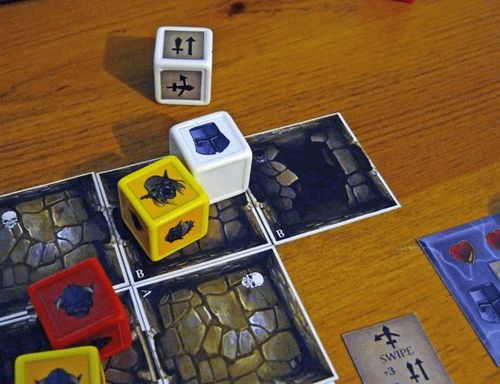
Dungeon in a Tin
Dungeon in a Tin Rulebook
Table of Contents
Table of Contents
Construction
You Will Need
- A printout of the label sheet.
- Almost a whole sheet of cardboard.
- 7 (preferrably blank) 6-sided dice for stickers.
- 1 regular 6-sided die.
- A red token ('Heart Marker'), three black tokens ('Locked Door Markers'), ten yellow tokens ('Experience Tokens') and four blue tokens ('Level Tokens'). Little wooden cubes of glass beads are ideal for these, and obviously colours are only suggestions.
- Optionally, an Altoids tin or similar to keep everything in.
Cutting and Pasting
The label sheet is divided into a number of different components:
- The dungeon tiles – these are the twelve squares with room pictures and skull icons.
- The fight cards – these are the twelve parchment-graphic rectangles with words like 'Thrust' and 'Swipe'.
- The treasure tokens – these are the smaller rectangles with pictures of coins, potions etc.
- The player status card – the large rectangle with five hearts.
- The dice labels – the 3x10 grid of squares with faces (yellow and red in the colour version), the six squares with fight symbols, and the white square with a knight helmet.
The dice labels are sized to fit the sides of a 19mm indented dice, the biggest dice generally available for such purposes; if your dice are smaller, you may have to trim the labels a little – if you do so, be sure that the presence or lack of treasure chests or horns is still obvious. Cut the dice labels and apply to the dice as follows:
- 1 die with the single square knight helmet on one face; all others blank. This is your player pawn.
- 2 dice with the yellow orc and goblin faces on. Each 2x3 block holds the sides for a single dice; each yellow die should have one side with a horned face and a treasure chest, and five sides with non-horned faces and no treasure chests. These are your yellow monster dice.
- 3 dice with the red orc and goblin faces on. Each dice should have three regular non-horned, no-treasure sides, one horned side with no treasure, one horned side with treasure, and one non-horned side with treasure. These are your red monster dice.
- 1 dice with the six fight icons; three sets of two identical icons. This is your monster attack dice.
Stick all the remaining stickers to the cardboard sheet; if you generally use thicker cardboard, it would be wise to use thinner card for the fight cards, as these will need to be shuffled. Cut all of the other components apart.
Game Setup
Separate out the dungeon tile with stairs on, the treasure token for the Maiden, and one Potion treasure token; keep these to one side.
Place the final dungeon tile with the Maiden outline, five skulls and five treasure chests face down at the bottom of the stack. Shuffle all the dungeon tiles with a 'B' marking together and then place them face down on the stack. Then shuffle all the tiles with an 'A' marking and place them face-down on top of the stack to finish it.
Place the Heart Marker on the right-most (5th) heart on the player status card. Place the potion you set aside earlier on one of the item slots.
The player starts at level one, so place one Level Token under their player status card.
Shuffle the battle cards and deal two to the player; place the remainder face down in a stack for future draws.
Place the treasure chits in a container for random drawing; if you use a tin to keep the game in, this is ideal – this is your treasure pool.
Set aside some space to discard used items and spent treasure – this will be your treasure discard pile.
Place the remaining dungeon tile with the steps on the table – this is the starting tile.
Place the player's knight pawn on the starting tile.
Ending the Game
The player's objective is to rescue the Maiden from the end of the dungeon and return with her; if the player can find the Maiden and bring her back to the starting tile, they win. The amount of treasure carried back is the player's 'score', and can serve as how successful the expedition was compared to previous games.
Conversely, if the player dies before they rescue the Maiden, the game ends and they lose. If the player leaves the dungeon before rescuing the Maiden, it is considered a draw: the player has survived, and possibly retrieved some treasure, but doesn't win the favour of the local lord and cannot show their face in Harthenholm ever again.
Playing the Game
The game is comprised of a continuous series of turns, until the player either dies or succeeds in rescuing the maiden.
A Game Turn
A turn follows these steps:
- † The player refreshes their hand of fight cards.
- † The player optionally picks up or drops treasure in their current room, or purchases items if possible.
- † The player optionally drinks a potion.
- The player optionally moves to a different room.
- The player fights any monsters in the current room.
Steps marked with a dagger ( † ) can only be performed if there are no monsters in the same room as the player.
Refreshing your Fight Cards
At the beginning of the turn, if no monsters are in the same room as a player, that player may refresh their fight cards. To do this, draw new fight cards from the deck until the player has a number of cards in their hand equal to their level (the number of level tokens they have), plus one. For example, if the player is at level two – has two level tokens – they should have a hand of three cards.
Do not discard cards, and do not draw more cards than the maximum. If you already have the maximum number of cards, do not draw any. If the fight card stack runs out of cards, shuffle the discard pile and place it face-down to become the new fight card deck.
Taking Treasure
If no monsters are in the same room as a player, that player may take any treasure from the room the player is in, and/or drop any items they are carrying, placing them in the room. The player may pick up any amount of treasure at once, but may only carry a maximum of three special items, which are placed on the item spots on the player's status card. Special items are:
- Potions – these can be consumed to bring the player back to full health.
- Bombs – these can be used in combat to add +3 to the player's combat roll.
- Rope – this can be used to bridge the chasm.
- Keys – these can be used to open locked door.
- The Maiden – not strictly an item, but while the player is escorting the Maiden all combat rolls suffer a -1 penalty, and she does still occupy an item slot.
The player can carry any number of coins – simply place these to one side of the player's status card.
The player will find treasure in rooms for various reasons – sometimes there is treasure to be found just lying around, and sometimes monsters drop treasure when they are killed – these situations will be covered later in the rules.
Buying Items
If a player returns to the dungeon stairs, they may exchange treasure they have gathered to buy items that could be useful in the dungeon. The player may buy as many items at once as they wish, so long as they have free slots to hold them and gold to pay for them. When buying items, discard the relevant number of gold tokens from the player's collection, placing them directly back into the treasure pool – not into the treasure discard pile! If the player has more than the required amount but cannot produce it exactly, they must over-pay or do without.
If the player wants to buy an item, first examine all items in the treasure discard pile to see if an appropriate token can be found there, and if one has not yet been discarded, search through the treasure pool until you find an appropriate token. If you cannot find such a token in either place, then the item is not available to purchase. (There are 4 potions, 3 bombs, 3 keys and 1 rope token in the game – if these are already in play, no more may be bought.)
- A potion, key or rope item will cost the player 10 gold.
- A bomb item will cost the player 5 gold.
Drinking Potions
If no monsters are in the same room as a player, and the player has a potion in one of their item slots, that player may consume the potion to restore their health. Discard the potion token to the treasure discard pile, and move the Heart Marker back to the right-most heart on the player's status card.
Moving
If no monsters are in the same room as a player, then the player may move through any exit from the current room (these are marked on the dungeon tiles as a gap in the border). If there are monsters in the room, the player may only exit through the exit from which they entered the room. The player does not have to move, so – for example – if there are monsters in the room and the player is in combat, they may choose to stay and finish the combat or flee.
Unless the room moved towards is locked, the player token is then placed in the room the other side of the exit.
New Tiles
If the player moves through an exit which doesn't already have a tile on the other side, then a new tile is drawn from the top of the dungeon tile stack, and is placed onto the table. When placing tiles, you must obey the following rules:
- At least one exit from the new tile must align with the exit on the old tile that the player moved through.
- Counting from the stairs, if a path is traced directly to the new tile and out of any of its exits, then no two successive turns may be in the same direction. If the player took a left turn to enter the new tile, then the new tile may not allow them to make another left turn.
If the rules cannot be followed, then do not place the new tile, and use the next tile down in the stack. Once you have finished placing, replace any skipped tile/s on top of the stack, face down in the same order they were in before.
Locked Rooms
If the exit on a room is locked – that is, the exit has a keyhole symbol over it – then as soon as the tile is placed on the table, place a Locked Door marker on that exit. While the Locked Door marker remains on the tile, that exit cannot be used in either direction – so the player cannot leave the tile through that exit, and also cannot enter the tile through an exit which adjoins the locked exit. If the player encounters a lock on the exit they are using to move to a room, the move cannot be made and the player remains in the room they started the move from.
When in to a room that adjoins or contains a locked exit before moving, the player may use a key token, if they possess one, to unlock the exit. Discard the key token to the treasure discard pile and remove the Locked Door marker from the tile.
The Chasm
The Chasm is a special tile with a large, deep gap in the floor between the two exits. Unlike normal tiles, the player can only exit back to the room he came from in this room, until the chasm is bridged.
If the player is in the Chasm room and has the rope special item token, he may use the rope to bridge the chasm. When moving, leave the rope item on the floor of the room, and both exits from the room may be used as normal. Unlike most items dropped in rooms, the rope cannot be picked up again when it is left in the Chasm room.
Monsters encountered in the Chasm room must be fought as normal, regardless of which exit was used to enter the room.
Entering Rooms
The first time a player enters a room – when it is first placed and moved into, or first unlocked and moved into – the room will contain a number of monsters in the room equal to the number of skulls on the dungeon tile for that room, and a number of treasure tokens equal to the number of treasure chests on the dungeon tile for that room.
For each skull, roll a monster die; for a white skull, roll a yellow die, and for a red skull (black on the black-and-white version), roll a red die. The monster faces that you roll will be the opponents found in this room; place the dice in the room with the same sides facing upward.
For each treasure chest, randomly draw a treasure token and place it on the floor of the room.
If the room in question is the final room, the maiden will also be present; place the maiden treasure token that you set aside earlier in this room along with the other treasure.
The second and subsequent times that a player enters a room, then half as many monsters are placed and no treasure is placed. Divide the number of skulls in two, rounding down, and roll that many monster dice for the room; if the skulls for the room are mixed, pick red dice first until the number of red skulls in the room is met, and then pick yellow dice to reach the required number of dice. For example, if a room has three white skulls and one red skull you will need two monster dice the second and subsequent times the player enters – pick one red die first, because there's only one red skull on the tile, and then a yellow die to make the total to two.
If you don't have enough monster dice available to place the required new monsters, then remove monster dice as required from other rooms; start with the room furthest from the player.
(Depending on the size of the dice used, you may sometimes have trouble fitting them all on the tile. If this is the case, then either place them next to the tile or stack them up – the important thing is just that it's obvious which tile they're associated with.)
Combat
If the player finishes their turn in the same room as any monsters, combat occurs. The player must fight every monster in turn, but he may choose which order to fight the enemies in. For each monster, follow these steps to resolve combat:
- Roll the monster attack dice; this determines the type of attack (thrust, swipe or overhead) that the monster uses.
- The player must respond with a fight card of his own. He may choose to play a card from his hand, or he may choose to draw one from the top of the deck. If he has no cards remaining in his hand, he must draw from the deck. If he draws from the deck, he must accept the card drawn and may not change his mind and play from his hand instead. Place this card on the table.
- Having played a card, the player may also choose to use a bomb if he has one in one of his item spots. Add the bomb to the fight card on the table.
- Next, the player rolls a single die. If the monster's attack roll is mentioned on the fight card the player used, then add or subtract the amount listed from value of the player's roll. If the player used a bomb, add +3 to the value of the roll. If the monster the player is fighting has horns, then subtract 1 from the value of the roll. If the player has the maiden with him, subtract 1 from the value of the roll.
- If the player's original roll was a 1, then the player fumbled and loses the combat automatically.
- If the player's original roll was a 6, then the player scored a perfect hit and automatically wins the combat.
- Otherwise, if the value of the player's roll after all modifiers is 4 or more, the player wins; if the value is 3 or less, the player loses.
- If the player lost the combat, move the player's Heart Marker one space to the left. If there isn't a heart to move to, the player has been killed, and the game is over.
- If the player won the combat, then the monster is killed. The player takes an Experience Token. Remove the die from the room, and if a treasure chest was showing, randomly draw a treasure token and leave it on the floor of the room. Finally, discard the fight card to the fight card discard pile, and if the player used a bomb, discard the bomb token to the treasure discard pile.
Experience and Levels
As mentioned in the section on combat, every time the player kills an enemy, he gains an Experience Token. The player may at any time swap ten experience tokens for one Level Token, which is placed next to his player status card and permanently increases his level, allowing him to draw more fight cards when he next refreshes his hand. The player may not draw any new cards immediately upon gaining a level, only when he is alone in a room and refreshes his hand normally.
When the player's level is increased, restore the player's health to the maximum. This can happen even in the middle of combat – however, bear in mind that level 4 is the maximum, so after the player has killed thirty enemies they will not be able to increase their level any further.
Multiplayer
To play in multiplayer, each player will need an entire copy of the game. The game supports any number of players in cooperative play, although obviously more than two or three may become unwieldy and have problems fitting on your table!
Multiplayer Setup
Firstly, from each game set other than the first, discard the final (maiden) room and the maiden treasure. Otherwise, combine all the treasure tokens, fight cards, monster dice and dungeon tiles together. Do not attempt to ration any of the components on a player-by-player basis.
It is advised that each player colour in the background of the label for their knight in a different colour, in order to tell them apart. Otherwise, you may use different coloured dice, or come up with some other way of differentiating player tokens.
In multiplayer, no player starts with a potion item; simply leave all the potion item tokens in the treasure pool.
Turns in Multiplayer
At the beginning of each turn, each player first rolls a single die to determine the order of action – the player with the highest result goes first for this turn, and the other players proceed clockwise around the table; re-roll any ties.
Proceed with the steps of the turn as normal, but on each step, each player takes that action in turn, with some caveats:
- When moving, each player declares the direction of their move before the new tiles are drawn from the stack. If no tiles remain and a player has attempted to move into a new area, then treat the exit they tried to move through as permanently blocked.
- When it comes to taking treasure, if more than one player is in the same room, each player takes it in turns (in the usual order of play for this turn) to pick one item from the floor of the room. (Remember on this note that combat occurs at the end of the turn and treasure-taking at the beginning of the next one, so the player who went first during combat will not necessarily be the player who gets the first pick of treasure.)
- In combat, again, players in the same room take it in turns to fight one monster at a time. Both players must still fight all the monsters in the room, but obviously will not fight against monsters which have already been killed. This gives multiple players moving together an advantage in combat, as they can potentially each kill monsters before the other player/s have to fight them, preserving their hands of fight cards.
- If a player dies, place any special items he was carrying – including the maiden - on the floor of the room he died in, and remove his player token from the game.
Ending the Game in Multiplayer
The objective in multiplayer is the same as the solo game – to rescue the maiden and bring her to the dungeon stairs. If both players die, this is obviously a loss. If one or more players die, but the maiden is still rescued, this is a victory for the surviving players, and a loss for the dead ones. If multiple players survive and the maiden is rescued (the game may continue for this reason after the maiden has already reached the stairs), then the players all win, and are ranked in order of how much treasure they managed to bring with them – the player with the most treasure wins the hand in marriage of the fair maiden, and the others must return to their homes and wait for another tournament, another rainy journey home and another maiden kidnapped by orcs and goblins...