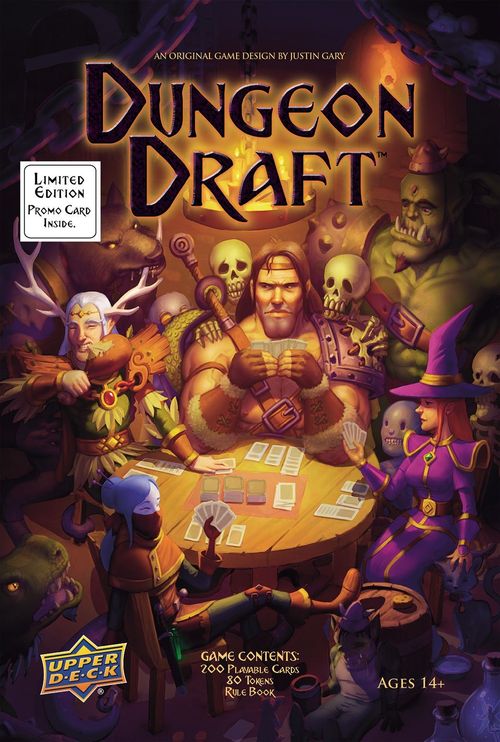
Dungeon Draft
Dungeon Draft Rulebook
Table of Contents
Table of Contents
Components
- 40 Gold Tokens
- 26 – 1 Gold Tokens
- 8 – 5 Gold Tokens
- 6 – 10 Gold Tokens
- 40 XP Tokens
- 26 – 1 XP Tokens
- 8 – 5 XP Tokens
- 6 – 10 XP Tokens
- 25 Quest Cards
- 173 Draft Cards
- 1 Rulebook
Start of Game
Shuffle the Quest and Draft Cards and put them in two separate decks. Give each player 9 Gold and set the remaining Gold off to the side.
Deal 5 Quest Cards face-down to each player. Then, each player selects 3 of their Quests to keep and returns the remainder face-down to the bottom of the Quest Deck. NOTE: For a simpler introductory game, do not use the Quest Cards.
Randomly determine which player will play first during the Play Phase. The starting player will alternate in a clockwise fashion during each of the four rounds.
Here is the setup for a 2-player game: each player has a Play Area, an Earned XP space, 3 Quest Cards, and a starting pool of Gold. The Draft Deck, Draft Deck Discard, and Quest Deck sit in the middle of the table alongside the shared Gold and XP token pools.
Gameplay
The game will be played in a series of four rounds.
Each round includes:
- Draft Phase
- Play Phase
- End Phase
Draft Phase
Deal 7 Draft Cards face-down to each player.
Each player then looks at their cards and selects one Draft Card from their hand and places it face-down in front of them, passing the remaining cards to the next player.
- In rounds 1 and 3, cards are passed to the left (clockwise)
- In rounds 2 and 4, cards are passed to the right (counterclockwise)
After all cards are drafted, move into the Play Phase.
Play Phase
Beginning with the starting player, each player will take turns playing Draft and Quest Cards.
Players may play any number of cards during their turn, provided they have sufficient resources to do so.
Playing Cards
Heroes and Weapons
Each Hero and Weapon card shows: Card Name, Gold Cost, Hero Icon or Weapon Icon, Card Class Icon, XP, Attack (Heroes only), Gold Production, and Special Ability Text.
To play Heroes and Weapons, players must spend Gold equal to the Gold Cost in the upper left corner of the card. Spent Gold is returned to the common pool of available Gold.
Heroes and Weapons remain in front of you when played. Some Heroes and Weapons have special text abilities that take effect when played.
All Heroes and Weapons will only have effects that last for the remainder of the round, with the exception of providing Attack, Gold, and XP (i.e. ignore everything but the numbers and symbols on the left side of the card during future rounds).
Class Icons
Each Hero and Weapon has a class. Classes are indicated by card color and icon as indicated in the chart below. Class is very important! Many powers on Heroes and Weapons can only be used if you control enough cards of the appropriate class.
Example: Cadoc the Martyr requires you to have 3 Druid cards when you play him in order to Gain 3 Gold. Since Cadoc himself is a Druid, you must have at least 2 other Druid cards in your Play Area from this round and/or previous rounds in order to get this effect when playing Cadoc.
The classes are: Druid, Warrior, Mage, Rogue, and Monster.
Monsters
To defeat Monsters, players must have Attack equal to or greater than the Monster Attack Cost in the upper left corner of the card.
Attack is not "spent" like Gold, so a player can defeat any number of Monsters whose Attack Cost is lower than or equal to the combined Attack of all cards you control.
For example, the Red Dragon has an Attack Cost of 5. If you have Arminus the Barbarian with an Attack of 2 and the Longsword with an Attack of 3, you could defeat the Red Dragon as well as any other Monsters in your hand with an Attack Cost of 5 or less.
Some Monsters have a text box with special effects on the card. After you defeat one of these Monsters, follow the instructions and then put the Monster into the Draft Deck Discard Pile.
Some Monsters have XP or Gold values on the card. After you defeat one of these Monsters, take the corresponding XP and/or Gold from the corresponding pool and then put the Monster into the Draft Deck Discard Pile.
Monster cards show: Card Name, Attack Cost, Monster Icon, XP, and Gold Production.
Quests
To play Quests, players must have Heroes and Weapons of the appropriate class. Quests have no cost other than this requirement.
For example, if a Quest's cost is three Mage icons and three Rogue icons, then it may be played as soon as a player has at least 3 Mage and 3 Rogue cards played (this includes cards played in all draft rounds).
Unlike Heroes and Weapons, Quest Cards may have abilities that can be used over multiple rounds.
Quest cards show: Quest Icon, Card Name, XP, Quest Requirements, and Special Ability Text.
End of Turn
Once a player has finished playing any cards they wish to play (and has the resources to play), they must:
- Discard all unplayed Draft Cards to the Draft Deck Discard Pile (do not discard Quest Cards OR played Heroes and Weapons).
- Gain 5 Gold plus additional Gold equal to the total Gold Production on all cards in front of you.
- Play passes to the next player.
End Phase
End of Round
Once all players have completed the Play Phase, the next round will begin.
In each round, the starting player will rotate clockwise (i.e. the player who played second in the previous round will start the next round).
TIP: At the end of each round, it is helpful to stack all of your played Heroes and Weapons so that only their icons are visible. This clears room for the next round's cards and helps to avoid confusion since only the icon powers remain in effect for future rounds.
End of Game
After four rounds have been completed, players tally up XP to determine the winner.
- Add up any XP on Heroes, Weapons and Quests you have in play.
- Add up any XP Tokens earned.
- Reveal and add up any END OF GAME Quest XP.
The player with the most XP at the end of the game is the winner! If the scores are tied, the player who has the most cards in front of them is the winner. If the game is still tied, then those players share victory! Huzzah!