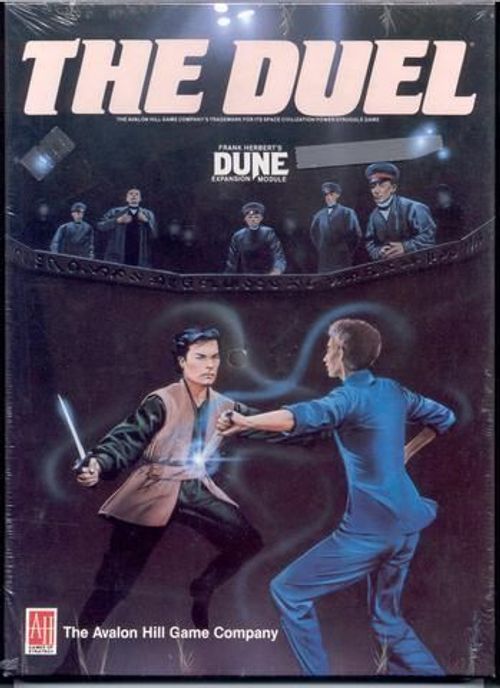
Dune: The Duel
Dune: The Duel Rulebook
Table of Contents
Table of Contents
I. Introduction
This expansion set introduces the intrigue and suspense of a Dueling Arena to the struggle for control of DUNE. During the game, players may threaten Kanly against each other. To threaten Kanly, a player names a specific action and a specific player. If the player who has been named in the Kanly threat takes the action specified in the Kanly threat, Kanly is called. Kanly is a formal blood feud between two major houses and results in a duel to the death between two leaders. Leaders from the other players must attend the duel as seconds and will gain spice or lose their lives according to the results.
And when Shai'Halud appears, a Nexus occurs and each player must send a leader to the arena as a negotiator. If no alliances are formed, a War of Assassins takes place among all the leaders. Only one leader can leave the arena alive.
In addition, this expansion kit includes a set of Main Character Leader Discs which may be used in battles on DUNE and in Kanly Duels or Wars of Assassins. These Main Character Leaders are more powerful than any other leader token; however, if a Main Character loses his or her life, the player who is playing that Main Character is eliminated from the game.
II. Object
This expansion set supplements the play of the basic DUNE game. Players use their Main Character Leaders, Kanly Duels, and the War of Assassins to strengthen themselves and weaken their opponents.
III. Equipment
-
Main Character Leader Discs, one for each of the six main characters. Every leader has a value of 10.
-
The Dueling Arena Playing Board
-
Dueling Cards:
| Card | Type | # of Cards |
|---|---|---|
| Attack In | Attack | 3 |
| Attack Out | Attack | 3 |
| Attack Right | Attack | 3 |
| Attack Left | Attack | 3 |
| Throwing Knife (Attack from Two Spaces Away) | Attack | 1 |
| Poison Attacker from Out | Defense | 1 |
| Poison Attacker from In | Defense | 1 |
| Poison Attacker from Right | Defense | 1 |
| Poison Attacker from Left |
[Editor's note: the Equipment table lists this card as "Pick Up Block", while section 10 (Blocking) refers to a "Remove Block card". The source is printed this way; it has not been changed.]
-
Six Block Tokens—to inhibit movement in the arena.
-
Five additional Treachery Cards for the main treachery deck.
IV. Set-Up
Add these steps to the normal set-up for the main game:
-
Shuffle the additional Treachery Cards into the main treachery deck.
-
Set the Dueling Arena to one side.
-
Shuffle the Dueling Cards, deal to each player one card face down, and set the rest of the Dueling Cards face down to one side. Players must keep their Dueling Cards secret. Dueling Cards may never be traded.
-
Set the Block Tokens to one side.
-
Each player takes his or her Main Character Leader disc. During play, Main Character Leader discs are treated the same as the regular leader discs except that they are not to be included when traitors are selected during the main game set-up.
V. The Play—Kanly
- Threatening Kanly
During the game you may threaten that a state of Kanly will exist between you and another player if that player takes a certain action which you name. To threaten Kanly, you name a specific action and a specific player. If the player named takes the action you named, a Kanly Duel is fought. Note! You may threaten Kanly only once per turn and you are bound to duel in only one Kanly which has been threatened against you during a turn. The threat of Kanly for the action you name remains in effect only for the duration of that turn. You may not threaten Kanly against an ally. Threats may not be repeated by other players in the same turn.
Example: "I threaten Kanly against the Atreides if they move a single troop token into Arrakeen this turn."
If the Atreides don't move into Arrakeen, then there will be no Kanly. If the Atreides do move into Arrakeen against your wishes, you must declare "Kanly" and regular play is suspended while a Kanly Duel is fought in the arena.
- The Arena
The Dueling Arena is now set out and each of the two players involved in the Kanly Duel secretly chooses a leader to enter the arena. At the beginning of the Duel, the identity of each player's leader disc is kept secret. The leader discs are placed face down on the outer edge of the Dueling Arena.
First, the player who threatened Kanly places his or her leader disc, still face down, into any outer sector of the arena; then, the other player places his or her leader disc face down onto any other available outer sector in the arena. Each player now may set out in front of his or her shield from 1 to 10 spice from his or her personal spice to "back up" his or her leader.
- Supporters
Every other player must now choose sides. Players place one of their leaders face down next to the player shield of the side they are supporting. If the side you support wins, you regain your leader and collect the value of your leader in any combination of spice from the spice reserves in the box, troop tokens from the Tanks, or leaders from the Tanks. If the side you support loses, your leader is killed and goes to the Tanks. You do not have to send a supporter if you have only your main character left.
- The Duel
The player who threatened Kanly moves first. Turns alternate between players. A player may make one or two moves during a turn. A move may be either physically moving your leader across a line from one sector of the arena to an adjacent sector or playing a Dueling Card and taking the action described on the card. Thus, you may move your leader twice, or play two cards, or move and play a card or play a card and move. You may not move your leader into a sector already occupied by another leader.
Whenever you move your leader in toward the center of the arena, you collect a Dueling Card from the top of the deck. However, no players may have more than four Dueling Cards at one time. So, if you have four, you may not collect another card until you have spent one. A leader can be moved out and then moved back in again just so you can collect another Dueling Card.
Concerning orientation, leaders in the arena are always considered to be facing in towards the center. This allows players to always know the right and left side of each leader in the arena. To make this orientation even simpler to visualize, each sector has its sides identified Left (L), Right (R), In, and Out.
- The Dueling Cards
There are four types of Dueling Cards: Attack Cards, Defense Cards, Block Cards, and General (Purpose) Cards.
- Attack and Defense
Attack cards allow you to attack a leader who is in a sector of the arena which is adjacent to you; in, out, right, or left. The throwing knife allows you to attack a leader who is anywhere one or two sectors away from you.
Note! The "Move or Attack Three" card allows you to make, as one of your two normal moves, up to 3 additional moves in your turn—that is, 3 physical moves, 3 attacks, or a combination of 3 physical moves and attacks.
Defense cards are played only in response to an attack and must be played from the correct relative position. For example, remembering that each leader is facing the center of the arena, if your leader is attacked by a leader to your leader's left, you may play "Poison Attacker From Left". The attacking leader would have played "Attack Right", since your leader would have been to his or her right.
- The Outcome of an Attack
When you make an attack, you must reveal your leader. Your leader's value determines the strength of your attack. The value of your leader is deducted from any spice backing your opponent and then from the value of your opponent's leader and that amount of spice comes to you.
Example: You attacked with Lady Jessica (5). Your opponent had 2 spice "backing up" her leader. The 2 spice go to you, but there are 3 more spice to pay on the debt. This forces your opponent to reveal her leader as Stilgar (7). Stilgar's worth must be decreased by the 3 that is owed to you. Your opponent takes Stilgar's spice-worth (7 spice) from the box and pays you 3 spice. The remaining 4 spice are placed on the Stilgar disc to show Stilgar's new value. Stilgar now has a value of only 4. Any attack where the attacker's value is equal to or greater than 4 will mean the end of Stilgar and, when Stilgar attacks, his opponent will lose only 4 spice.
The spice which you win in an attack is placed behind your shield as part of your personal spice reserves. It is not counted as part of the spice you have "backing up" your leader in the duel.
When an attack has a value equal to or greater than the worth of the leader plus any backing spice, then the attacked leader is killed and removed to the Tanks. The attacking player collects whatever backing spice is available and any spice-worth the leader has. In the example above; if Lady Jessica attacked again, Stilgar would be killed and the Atreides player would get the last 4 spice from Stilgar.
- Defending
When you are attacked, you may play a defense card from the appropriate position. The value of your leader is then deducted from the attacker's backing spice and spice-worth. The process of showing the diminishing value of the attacker is the same as in the above example. When you play a defense, you receive the value of your defender from the attacker in spice, first from any backing spice and then from the leader as described above.
Attacks and defenses are presumed to occur simultaneously. The outcome could be the simultaneous demise of both leaders. For example, if Stilgar has lost 2 (is worth 5) and attacks Jessica at her full value and Jessica plays the appropriate poison attacker card, Stilgar will lose 5 and so will Jessica. Both will be dead. The spice will still go to both players. The seconds get nothing but, then, they don't forfeit their lives, either. When you play a defense card, you must reveal your leader if still face down.
- Survivors
Leaders surviving a Kanly Duel once again regain their full face value.
- Blocking
As one of the moves on your turn you may play a "Place Block" card. Discard the card and select a block counter. Place the block on any vertical border (straight line) in the arena. Consider your cards and anything you know about your opponent and place blocks where you can use them to your strategic advantage. Players can not attack or move across a border with a block token on it. You may use the Jump Block card to go over a block in your way or a Remove Block card to take a block out of the arena. You may never have more than six block tokens in the arena at any one time.
- General
Flee Arena With Honor. Play this card to escape the arena with no loss to yourself or your seconds. The opponents seconds can't collect spice. It ends your participation in the Kanly Duel or the War of Assassins. This card may not be played by players acting as seconds.
- Duel Deck
Once you have used a Duel Card, you must discard it. Whenever the Duel Deck becomes depleted, immediately collect and re-shuffle the discards to start a new deck.
VI. War of Assassins
If a Nexus occurs (because a Worm comes up in the spice deck), every player must place a leader in an outer sector of the arena face down while alliance discussions are taking place. The player who plays first in the turn places first and so on to the right (a sixth player places on a second level sector). If no alliance is achieved, a War of Assassins is declared and proceeds following the rules for a duel except that all of the players have leaders in the arena participating in a free-for-all duel. Again the player who plays first in the turn moves first, then the player to the right. There are no spice backing the leaders and there are no supporters. Only one leader will leave the arena alive. A player who can neither play a card or move a leader must forfeit his remaining move(s) for that turn.
Cheap heroes or heroines cannot be substituted for leaders in either Kanly Duels or Wars of Assassins.
At the end of a Kanly Duel or a War of Assassins, all Duel Cards remain in the combatants' hands.
VII. Losing Your Main Leader
If your Main Character Leader is killed in a battle on DUNE, a Kanly Duel, or a War of Assassins, you are out of the game. All of your holdings are vacated and all of your spice is returned to the spice reserves in the box.
VIII. Treachery Cards
-
Elacca Drug—Used as a poison weapon.
-
Poison Snooper—Used as a poison defense.
-
Cone of Silence—Prevents any player(s) within its scope from buying cards, threatening Kanly or making an alliance. It may be played at any time upon any named player(s) and stays in effect until the end of the turn. You may direct it against as many of your opponents (not allies) as you desire.
-
Residual Poison—played face down in front of a player's character shield. That player must pay you a bribe of 1-4 spice (you name the amount) on every turn it remains there. If the player fails to pay, then you reveal the residual poison card and that player loses any one leader of your choice (except a main leader). You collect the leader's value in spice from the box. The leader may not be the player's main character. You may also bluff playing residual poison by playing a worthless card. If you are found to be bluffing about residual poison before you can remove the card, then you must pay the offended player 3 times the amount of the bribe you are demanding. (If you do not have enough spice, you owe that amount and must pay it when you get it.) You may retract the residual poison or bluff card during any of your moves whereupon it is discarded unseen in all cases.
-
Kull Wahad—Worthless