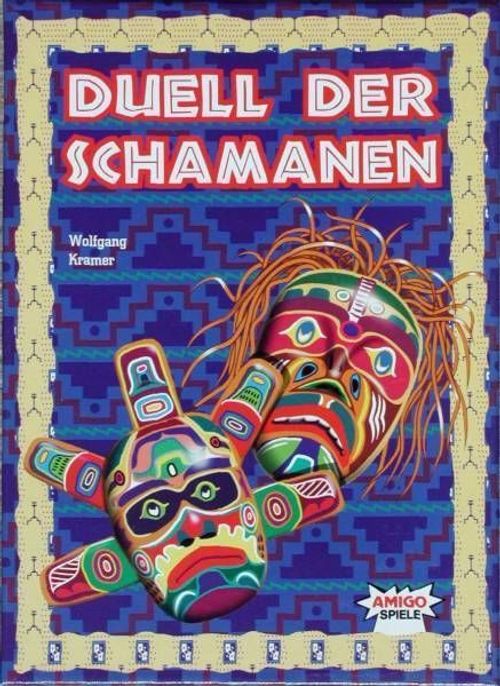
Duell der Schamanen
Duell der Schamanen Rulebook
Table of Contents
Table of Contents
Components
- 18 duel stones (wooden stones with values 1 to 9), 9 in each colour: Bison and Wolf
- 18 Migis (mussel chips)
- 6 mask cards: 3 Bison cards and 3 Wolf cards
- 1 game board
- 1 rulebook
Before the first game, the 9 duel stones of each colour must be labelled with the numbers 1 to 9.
Setup
Each player receives:
- 9 duel stones (Wolf or Bison colour, values 1 to 9)
- 9 Migis
- 3 mask cards (Wolf or Bison)
The stones lie face up in front of each player. The 3 mask cards are taken into hand face down.
Object of the Game
The game board shows 9 places where duels are fought. The winner of a duel is paid his prize in Migis by the loser. The goal of the game is to bring all the Migis into one's possession.
Game Play (Basic Game)
First Phase: Distributing the Powers
In the first phase, the players distribute their duel stones over the 9 spaces of the game board. By doing so they bind the powers of the nature spirits associated with their animal symbol to that place. Each player tries, as far as possible, to place a higher-value stone than the other player. Care must be taken that each place receives stones with different values.
The Bison player begins. He places one of his duel stones on one of the nine spaces of the game board. Then the Wolf player places one duel stone each on two places of the game board.
From then on, the players place two stones each in turn. At the end, the Wolf player may only place one more duel stone. When this is done, every place must hold one stone from each player.
Second Phase: The Duels
First, the place where a duel is to take place is determined. Each player lays one of his 3 mask cards face down on the table. The Bison cards determine the horizontal rows, the Wolf cards the vertical rows. Both cards are turned face up by the players at the same time.
Note on the diagram: the printed example shows the Bison arrow running down the right-hand column and the Wolf arrow pointing along the bottom row. The printed text above assigns the Bison cards to the horizontal rows and the Wolf cards to the vertical rows; the text is transcribed as printed.
The player who has committed the stronger powers at the duel place, i.e. who holds the stone with the higher number there, wins the duel. The loser pays the winner the difference between the number values of the two stones, in Migis.
Example: 1 Bison against 3 Wolves. The Bison player wins the duel and receives 2 Migis from the Wolf player.
After the first duel, the Bison player may swap two of his own duel stones with each other, i.e. both exchange their places. Care must be taken that each place holds two duel stones with different number values.
Then the next duel takes place. Again each player selects one of his mask cards face down, the duel place is determined, and the difference between the values of the duel stones is paid in Migis to the winner.
Now the Wolf player may swap two of his stones with each other, and another duel takes place. Play continues in this alternating manner. After each duel, one player swaps two stones.
End of the Game
The game ends when a player has won all the Migis. He is the winner.
If the two players are nearly equally strong, the game ends after a fixed length of time (for example 15 minutes). The player who then possesses the most Migis is the winner.
Variants
Memory Variant
In this variant the duel stones are played face down. The same rules apply as described above, with the following exceptions:
- In the placement phase, the stones are placed face down on the game board. Only the player who places a stone knows its value.
- At the duel, the stones at the duel place are turned face up so that one can see who won the duel. Afterwards the stones are turned face down again.
- If in the face-down game two equally high stones lie at one place, the duel there is a tie.
- Swapping is done without looking at the stones.
Pro Variant
The own and the opponent's duel stones lie face up on the table. In the placement phase, a player may place both his own and the opponent's stones. Apart from the first and the last move, two stones are always placed face up. These can be two own stones, two opponent's stones, or one own and one opponent's stone. After placement is complete, each place must hold one own and one opponent's stone.
In the swapping phase, a player may swap two of his own or two of the opponent's stones with each other. Alternatively, he may move a single stone. In this case it is permissible for several stones of the same colour to lie on one place. Their values are then added together. This means there are places on which a player has no stone; that player has the value "zero" (null) on those places.
If equally high values are represented at one place, the duel there is a tie.