Duelists
Duelists Rulebook
Table of Contents
Table of Contents
Introduction
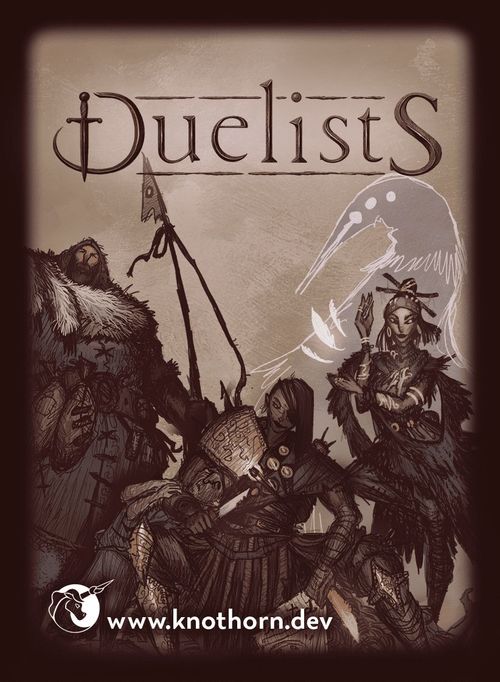
In the city-state of Cyra, champions gather once a year from all over the known lands to prove their strength and prowess in combat. Three contestants stand out this year in particular:
From the Western Kingdoms comes the bounty huntress Isdra. Bored of chasing down criminals, she seeks to prove herself against the most legendary fighters in combat, wielding only her heavily enchanted pair of long daggers and relying on her natural speed and dexterity. Isdra's fighting style is very aggressive, using fast flurries of attacks in an attempt to blindside her opponents. Using twin daggers makes her somewhat predictable, as her daggers are rarely used for anything but stabbing.
Nathrax the Fisherman is a fearsome fighter from the far North. Armored in thick furs, his heavy bulk belies his mastery with the fishing spear. In battle, he is known for his stoic patience, always waiting for the opponent to make their first mistake. Nathrax's spear is fast and deadly, but his most powerful attacks are easily predictable and need to be timed precisely to catch his opponents off-guard. He has no means of lowering the defenses of his opponents, but tripping or disarming them at a crucial point can scramble their offensive plans.
The young witch Harys brings with her the spiritual magic and martial arts of her people. Traveling through Cyra on her ritual pilgrimage, Harys decides to test herself in battle against other competitors. With a few noticeable maneuvers, neither Harys' attacks nor her defenses are very powerful. The young witch relies on timing and combining her few powerful cards in interesting ways to overpower and outsmart her opponent.
Who will win the fame and the glory? Who will become the champion of the Duelists?
Overview
Duelists is a two-player game of tactical planning and strategic bluffing. Players choose one of three champions, each with their own strengths, weaknesses and cards. They take turns attacking each other by revealing planned cards and bluffing about how powerful. Their opponent then has the chance to block the attack by correctly guessing their intent, or exhaust cards in defense - if they fail to anticipate and parry the danger.
A winner is declared once their opponent is too exhausted to continue to fight.
Components
- Cards: The cards represent the skill and maneuvers of each of the contestants. Every character comes with 20 maneuvers and 10 armor cards.
- Player boards: The player boards provide an overview of the rules and indicate where to place the cards. Each character has their own player board.
- Dice: The dice are used to set the damage of an attack, not rolled (this is explained later). Each character has their own die.
- Tokens: Several tokens are used to keep track of various special effects evoked by maneuvers. "Defended!"-tokens indicate that a card has already been used to defend with.
Each box also contains a printed version of these rules.
Victory
In Duelists, your goal is to force your opponent to surrender. A player becomes too tired, and surrenders, as soon as they are no longer able to draw a card when instructed to do so. Usually, this happens during the player's own turn when refilling their hand, but sometimes certain maneuvers force a card draw in your opponent's turn, which may also trigger victory!
Setup
First of all, determine who goes first any way you wish. If you cannot decide between you, roll a die. The player who rolls the highest number becomes the starting player.
The other player has the first choice of character. Take all cards, the die and the player board associated with your character and place them in front of you. Take a "Defended!" token and place it next to your player board.
The starting player then chooses their character from the remaining ones. As the starting player has a minor advantage, remove two armor cards from the character's deck and put them back into the box. You will start slightly weaker, but have the advantage of the first attack.
Shuffle your decks, and draw a hand of seven cards each.
Pick three cards from your hand and arrange them face down on your player board, in the area indicated, in any order you believe is tactically sound. Once both players are satisfied with their choices, refill your hands to seven cards.
Place the rest of your deck in front of you: this is now the Draw Deck.
The space next to the Draw Deck is for the Discard Pile, where you place Exhausted cards. (This should be empty at this point!)
Now the game begins! The starting player goes first.
Terminology
Duelists features different ways of doing things with cards: you can Reveal a card, Play a card, Discard a card or Exhaust a card. There is an important distinction between discarding a card or exhausting it.
Revealing a card means flipping a card that is face-down on your Player Board face-up. Usually, all cards are played face-down. Revealing a card sometimes has a special effect as indicated on the card itself. Due to some special abilities, or revealing an Armor card, it may be that a new card is drawn randomly and placed face-up. In this case, this also counts as Revealing it for the purpose of the rules.
Playing a card means choosing a card from your hand and placing it face down in the appropriate place on the player board.
Discarding a card means putting a card on your discard pile. Once your draw pile is empty at any point (including when you are in the process of drawing new cards), shuffle your discard pile. This becomes your new draw pile.
Exhausting a card means removing it from play entirely. You exhaust cards when taking wounds, exchanging armor cards, or through special effects. Exhausted cards will not be shuffled back into your deck, so make sure your Exhausted cards do not mix with the discard pile. Place them face up in their own Exhausted pile. Allow your opponent to see them.
Card Types
Each player has their own deck of 30 cards representing their Duelist's possible maneuvers, resilience and techniques. The cards also represent the health of your Duelist: Every time you take a wound, you Exhaust a card and discard it from your hand, and so reduce the amount of cards you have available for the match. If you run out of cards and are asked to draw another, you have lost the game. There are two types of cards: Maneuver cards and Armor cards.
Armor Cards
Armor cards serve as a bolster to your deck. There are two uses for Armor cards. You can safely exhaust them when taking wounds without impeding your ability to defend or attack. Additionally, at any time, you can choose to Exhaust as many as you wish to draw a new card for each Armor card exhausted this way. You may even Play them - in this case, as soon as an Armor card is revealed, it is Exhausted and immediately replaced with a card randomly drawn from your deck.
Maneuver Cards
Maneuver cards are what makes your Duelist unique - each character has a different combination of cards, representing their particular dueling style. Every maneuver card has a defensive value, but only some of them also show an attacking formula.
Defensive values range from 0 to 4 for each of the three different types of attacks: Slash, Stab or Blunt. The defensive value is the number of guesses you have to attempt to block an incoming attack.
Most, but not all, Maneuver cards also have an attack formula on them. This describes the type of attack and its damage potential. These are explained in the "Attacking" step of the Turn Order section, below. Sometimes, Maneuver cards have a special property. These are always explained on the cards themselves.
Turn Order
When it is your turn, you perform each of the following steps in order. After completing your attack, your opponent takes their turn. If you are the Starting Player, skip Preparation and Planning on your first turn.
- Preparation/Check for Loss
- Planning
- Attack!
1. Preparation
Remember: if you are the starting player, skip Preparation and Planning on your first turn.
Discard the left-most card of your placed Maneuver cards. If there were any counters or tokens on it, put them back into your reserve. Now, fill up your hand to seven cards from the Draw pile. If the deck does not contain enough cards for this, first draw all the available cards. Then shuffle your Discard pile. All these shuffled cards now become your Draw Deck - place it in the Draw Deck space. Your Discard Pile should now be empty. Then continue to draw from the new pile until you have seven cards in your hand.
If there are not enough cards for you to draw, you surrender this duel and your opponent is declared the winner of the match.
2. Planning
Remember: if you are the starting player, skip Preparation and Planning on your first turn.
Shift both of your remaining maneuver cards one space to the left on your player board. Now, select a card from your hand and place it face down to the right of your maneuver queue.
If your left-most card is not revealed, reveal it now. If it is an Armor card, Exhaust it and draw a new card from your deck to replace it. Keep doing this until you draw a Maneuver card, exhausting more Armor cards as necessary. If there are no cards left in your deck, shuffle your Discard pile and build a new deck.
3. Attack!
If the left-most card has no attack formula, you cannot attack this turn. Play passes to the next player.
Most maneuver cards have an attack formula printed on them, consisting of a range, a modifier, and a single attack type (either Slash, Stab or Blunt). Some rare maneuver cards have two attack formulas printed on them. In those cases, the attacker may perform these two attacks, in the order shown, in the same turn.
If your opponent's left-most card does not have a "Defended!" token, they may choose to defend either with the currently revealed left-most card, or reveal their second card to defend against the attack with. In this case, place a "Defended!" token on the second card, to indicate that this card may not be used to defend within later turns.
If opponent's left-most card already has a "Defended!" token on it, they must choose their second card to defend with, moving the "Defended!" token to it.
After your opponent has chosen which card to defend with, take your duelist's die and set it secretly to a number in the attack formula's range. For example: If the attack formula reads (1-3)+2, you may now set the die to a number from 1 to 3.
Your opponent's defense value corresponds to the attack type on the card you have chosen. Remember, the slash defense value defends against Slash attacks, the stab defense value defends against Stab attacks, the blunt defense value defends against Blunt attacks.
The defense value indicates how many guesses your opponent has to correctly guess the number you set on your die. They should make all of their choices at once. After they have announced their guesses, reveal the number you have set. If one of the guesses is correct, the attack is successfully blocked and misses. It deals no damage and does not count as a successful attack.
If your opponent failed to guess the number you have set, add the attack's modifier to the number on your die. This is the amount of damage you have done. Note: your attack might trigger special effects, as indicated on some cards.
A successful attack will always deal at least one point of damage, even if the actual damage may be reduced by the effects of tokens or revealed cards.
For each point of damage you have done, your opponent must Exhaust one card, and place it out of the game and into the Exhausted pile. They must first Exhaust as many cards as they desire from their own hand, and then Exhaust the top cards of their Draw Deck for the rest of the damage. For example: When taking six points of damage, you may Exhaust two cards from your hand, and then four from the top of your Draw Deck.
All Exhausted cards are public knowledge and may be reviewed by either player at any time.
Remember! If a card has been played that forces either player to draw a card, and none are available, then that player has Surrendered and the game is over!
If this has not happened, play now proceeds to the next player, and they return to Step 1.
Special Cards
Follow Up Attack
If the card that you discarded this turn included at least one STAB attack (it may contain other attacks, too), your opponent's guesses against the current attack are reduced by one. This may bring the guesses down to zero and has no effect if the opponent has no guesses anyway.
Feint
If the card you discarded this turn did not contain any STAB attack, your opponent's guesses against the current attack are reduced by one. This may bring the guesses down to zero and has no effect if the opponent has no guesses anyway.
Power Up Daggers
After executing this card, take a +3 token. This indicates the additional bonus damage added to the next successful attack. You hold onto the token until you manage to deal damage to your opponent.
Spear Charge
If this attack deals damage, your opponent may not exhaust cards from their hand. They have to exhaust damage directly from their deck. If the damage exceeds the remains of their remaining deck (including their discard pile), you have won this round.
Disarming Strike
If you defend with this card and correctly guess your opponent's attack, give them a Disarmed! token. They keep this token until they successfully deal damage to you, reducing the damage by 3. Keep in mind that a successful attack always deals at least one point of damage.
Tripping Attack
If you deal damage with this card, your opponent must discard their right-most card (this is the last card they played) and replace it with a random one from the top of their deck. They may look at the card planned this way. Keep in mind the card is merely discarded, not exhausted.
Second Sight
If you use this card in defense and correctly guess your opponent's attacks, they have to flip all currently face-down cards in their maneuver queue face up. Later cards will be played face-down again.
Blinding Light
If you use this card in defense and correctly guess your opponent's attacks, give them a Blinded! token. The next time you attack them, their guesses against the first attack this round are reduced by 2. If you attack them with Magical Barrage, the second attack will be resolved normally without reducing their guesses.
Spiritual Guardian
As long as this card is face-up anywhere in your maneuver queue, you reduce all damage received by 2. This effect stacks, so if you have both Spiritual Guardian cards face-up in your maneuver queue, you reduce all damage received by a total of 4. Keep in mind that a successful attack deals at least one point of damage, even if your Spiritual Guardian would reduce the damage to zero or below.
Spirit Twin
When you attack with this card, treat it as if the next card in your maneuver queue would attack. You may need to reveal the following card, if it is not face-up yet. If the next card does not contain an attack, you may not attack with Spirit Twin. If the next card features two attacks, attack with both.