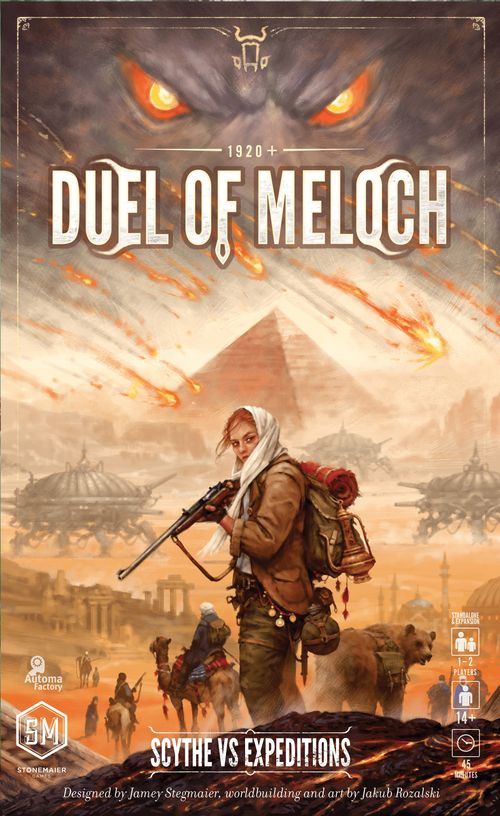
Duel of Meloch
Duel of Meloch Rulebook
Table of Contents
Table of Contents
Overview and Goal
Duel of Meloch combines two existing games, Scythe and Expeditions. One player uses the Scythe rules and components (including a new faction and player mat found here); the other player uses the Expedition rules (including a new mech, character, and companion found here). The duel takes place in a tight space on a new double-sided map—only 10 locations and 2 lakes—so every turn is crucial.
All existing Scythe factions and player mats (along with most encounter cards) plus all existing Expeditions mechs, characters, and companions (along with most discovery cards) are compatible with Duel of Meloch. Likewise, the components in Duel of Meloch are compatible with Scythe and Expeditions.
From Nikte's journal: With great effort—and not without great losses—we stopped Dr. Tarkovsky from permanently opening the portal. Since then, however, I have felt the lurking presence of something sinister and ancient. I try not to think about it, but the anxiety does not disappear. At night I'm tormented by nightmares of a powerful being called Meloch. In every dream, Meloch promises I will find peace if I simply touch the cosmic artifact that we found in Tarkovsky's camp. I don't know how much longer I can resist…
Components
Scythe Player
- 1 rule summary guide
- 20 resource tokens (5 each of food, oil, metal, and wood)
- 3 Factory cards
- 60 combat cards (new design)
- 6 encounter cards
- 5 miniatures (4 mechs and 1 character)
- 31 wooden tokens (6 stars, 1 action token, 1 popularity token, 1 power token, 4 structures, 4 recruits, 8 workers, and 6 technology cubes)
- 1 faction mat
- 1 player mat
- 1 Power Dial
- 1 alliance token and 1 home base tile (these are not used in Duel of Meloch)
Expeditions Player
- 1 rule summary guide
- 1 Power Dial (a new addition just for Duel of Meloch)
- 12 corruption tokens (guile: 4 each of 2-value and 3-value; power: 2 each of 2-value and 3-value). There are more guile tokens (teal) than power tokens (orange) because power is also used for combat in Duel of Meloch.
- 15 workers (3 each of purple, green, red, yellow, and blue)
- 30 discovery cards (10 each of items, meteorites, and quests)
- 3 starting cards (1 each of mech, character, and companion)
- 1 mech miniature and 1 base snap
- 8 wooden tokens (4 stars [aka glory], 1 hero worker, 1 power token, 1 guile token, and 1 action token)
- 1 mech mat
Global Components
- 1 double-sided rubber playmat (aka the "board")
- 20 cardboard coins ($1 ×10, $3 ×4, $5 ×3, $10 ×2, and $20 ×1)
- 9 map tokens (aka encounter tokens)
- 1 double-sided Triumph Track (see Placing Stars, Meloch Cards, and End of Game for its categories)
- 10 Meloch cards
- 1 Tournament of Meloch sheet
- 1 Appendix
The solo mode components are listed in the Automa rulebook. Replacement parts can be requested on the form at stonemaiergames.com/replacement-parts.
If you own Scythe and/or Expeditions, there are dozens of combinations of factions & player mats and mechs & characters/companions. With those combinations, you can play one or more "Tournaments of Meloch" with Scythe vs. Expeditions in the first round and winners competing in the duel format in subsequent rounds (this may result in some games of Scythe vs. Scythe or Expeditions vs. Expeditions).
Setup
Shared Components
- Place the playmat (either side) on the table so the popularity/power track is facing the Scythe player.
- Place the resources, coins, and workers in a supply near the board. It is fine to include additional coins and resource tokens from Scythe and Expeditions.
- Randomize the 9 map tokens and place 1 face down on each of the 6 indicated locations (icon overlapping with the location number). Set the remaining map tokens aside face down.
- Randomize the 12 corruption tokens and stack 2 face up on each of the 6 locations that have a dotted square box.
- Place the Triumph Track (either side) near the board, with the star-badge edge facing the Scythe player.
- Shuffle the combat cards and set the deck face down near the board. Do not use the original combat cards from Scythe when playing Duel of Meloch.
- Shuffle the Factory cards and place 2 face down next to the board. Return the rest to the box. You may include Factory cards from Scythe.
- Shuffle the encounter cards and place the deck face down near the board. You may include encounter cards from Scythe. There may be a few encounters that don't make sense in the context of the Duel; if one is drawn, discard it and redraw.
- Shuffle the discovery cards and place 1 card face up on each lake and place the deck face down near the board. You may include discovery cards from Expeditions; if you do, whenever a quest for locations 11–20 is drawn, discard it and redraw.
- Shuffle the Meloch cards and place the deck face down nearby. Reveal a card and place it between the players with a random orientation. Neither player gains anything yet.
Duel of Meloch is not designed for Scythe's airships or the Expeditions corrupted mech. Leave these components in their respective boxes.
Player Components
If you are the Scythe player, sit on the side of the board with the popularity/power track oriented toward you. Select and set up any faction mat and any player mat with their corresponding tokens (including all 6 stars) and miniatures, Power Dial, and all starting components indicated on those mats (except objective cards). As always, start with 2 workers on the locations adjacent to your home base (1 on each location). Reference the included Rule Summary for the full Scythe: Duel of Meloch setup instructions.
If you are the Expeditions player, sit on the other side of the board. Select and set up any mech with its corresponding mat and card (from Gears of Corruption), any character/companion pair with their corresponding tokens, and a Power Dial. Gain all starting resources as indicated on the matching mech card (if you're playing with a mech originally from Expeditions but you don't have the mech cards from Gears of Corruption, start with 3 guile, 3 power, and 1 hero worker). The Expeditions player takes the first turn. Reference the included Rule Summary for the full Expeditions: Duel of Meloch setup instructions.
It is possible for the same character to duel against themselves. Why would Scythe's Anna fight Expedition's Anna? Meloch's scheme to teleport them across space and time has left them angry, confused, and in survival mode.
Gameplay Overview
Duel of Meloch is a clash of Scythe versus Expeditions, just on a smaller map, with multiple ways to disrupt the other player, and without end-of-game scoring. The winner is the first player to place 4 stars on the new Triumph Track, where only 1 star can be placed on each category.
Experience Disparity Variant: If there is a significant experience disparity between players (i.e., if one player has played dozens of games of Scythe and the other has never played Expeditions), the less experienced player can decrease their victory condition to 3 or 2 stars.
How to Play
Aside from the following differences, the rules of Scythe and Expeditions apply to their respective players. Summary guides for each game that omit inapplicable rules are included in Duel of Meloch. Full rulebooks and rule videos are available at stonemaiergames.com.
Expeditions Special Notes
- There are no locations to reveal; instead, unexplored locations—at which the Expeditions player must stop—are indicated by map tokens. Whenever you gain a map token from a location (by moving there or via card abilities), first gain its secret bonus (your mech is considered to be on that new location when you gain the bonus). Do not add corruption to newly explored locations.
- Combat cards are a new Gather benefit and map token bonus. The function of these cards is described in the next section. Combat cards are kept face down near your mech mat, separated from your discovery cards (i.e., your hand and active row).
- A new icon indicates that you can draw a combination of any 2 cards—combat or discovery—from their respective decks. Keep 1 and discard the other.
- A few of the original discovery cards (items, meteorites, and quests) mention directions (e.g., card 56 reads, "If every opponent is south of you, gain 2 power"). For these, compare your mech's location to the Scythe character's location. A location is south/north if any part of it is lower/higher than your location. North is up from your perspective.
- Some new discovery cards include one of two new phrases:
- Peek at the top 2 cards of any deck: Choose either the combat deck or the discovery deck (not 1 from each). Only you see these cards.
- All opponents first decrease each token on tracks by 1: The Scythe player must reduce their power and popularity by 1 each (if possible).
- If an ability says to trash a card, you may choose either a discovery card or a combat card. If an ability says to discard a card, it only applies to discovery cards (transfer a discovery card in hand to your active row without activating it).
- Each quest card has 2 locations where it can be solved.
- Your mech cannot move through tunnels or onto lakes, but may move across rivers. Ignore Factory and terrain icons on locations (they are for the Scythe player).
- You begin with a hero worker. It is all worker colors for all situations and abilities, and it counts toward the "6 workers" category on the Triumph Track. You cannot gain more hero workers, and if you trash your hero worker, you cannot regain it.
Scythe Special Notes
- Do not use objective cards or structure bonus tiles.
- Recruit Ongoing Bonuses cannot be triggered by the Expeditions player.
- Ignore Gather benefits and corruption on locations (they are for the Expeditions player).
- Map tokens are the same as encounter tokens. If your character gains a map, it results in an encounter card (ignore the bonus on the map token). If fully depleted, shuffle the encounter deck.
- Two benefits originally associated with Expeditions now apply to you when noted on combat cards, encounters, and the new faction.
- Refresh: Remove your action token from its current section on your player mat and place it on a different section. If this benefit is gained before taking a bottom-row action on your turn, you may proceed to take the bottom-row action of the new section.
- Sweep: Remove any number of face-up Expeditions cards from the board and place them in the sweep pile, then replace the chosen cards with new cards dealt face up from the deck. These cards do not benefit you, but sweeping will prevent the Expeditions player from gaining them. If the deck is ever empty, shuffle the sweep pile to form a new deck.
- Some new encounter cards include adjusting the opponent's tokens on tracks (i.e., power and guile on the Expeditions mech mat).
- If playing on the desert side of the map, note the rivers between locations 9/6 and 3/1.
Faction-Specific Notes
- Albion: There is no end-of-game scoring for area control in Duel of Meloch, so Flag tokens only help Albion for their Rally ability.
- Constantinople (new faction): See Appendix.
- Fenris: Influence tokens do cause the Expeditions mech's movement to end. Each player's coin total is continually reduced (for the coin goal on the Triumph Track) by the number of unplaced influence tokens in their supply.
- Polania: You cannot force Expeditions workers to retreat, so the Camaraderie ability doesn't apply to Duel of Meloch.
- Saxony: Saxony can feasibly place all 4 stars for winning combat; they are all placed on combat victory categories of the Triumph Track (first open categories, then stack on categories claimed by either player).
- Togawa: Most of Togawa's traps work as normal, except for the popularity trap, which has no effect on the Expeditions player.
- Vesna: On the Jungle side of the map, we recommend that Vesna choose either Seaworthy or Submerge so she can access the area blocked by rivers.
After the war, the Great Sultanate, known mainly as Constantinople in the West, divided into the Southern and Northern Sultanate and lost its international imperial position. However, the Great Sultanate still has significant territories and influence, mainly in Asia and Africa. Trying to regain his former prestige and power, the Sultan sent a military expedition to the Balkans, near the Factory, to join the great race for Tesla's technology and wonders of this new era. The expedition is led by the Sultan's nephew, the renowned inventor and commander Admiral Evren Uthman.
Evren, even from his youngest years, was distinguished by his sharp mind and fascination with technology, engineering, and exploration. He watched the first walking machines presented by Tesla a few years ago in Constantinople with great fascination and envy. As the Commander-in-Chief of the Army and Admiral of the Air Fleet of Constantinople, Evren convinced the Sultan to reform the army and to invest in new prototypes and blueprints from the Factory. His adventuring companion is the powerful Anatolian Shepherd, Acar, from a long line of highly intelligent and loyal canines that have accompanied his family for generations.
Interactions, Combat, and Combat Cards
The level of direct interaction in Duel of Meloch is much higher than in the original Scythe or Expeditions games due to the smaller board, the race to 4 stars (and only 1 star per category), and the increased emphasis on combat and disruption.
The Scythe player has the advantage in combat due to their ability to play 1 combat card for each of their combat units (character and mechs), which makes the Expeditions player wary of getting too close. There are a limited number of map tokens on the board, and some options on the new encounter cards will disrupt the Expedition player's plans.
The order of operations (when applicable) is combat, encounters/maps, then the Factory (if the Scythe player is on the Factory location).
For Scythe, if your combat unit (mech/character) moves into a territory containing the opposing mech, your movement ends. Workers may not move into a territory containing the opposing mech.
For Expeditions, if your mech moves into a territory containing an opposing combat unit, your movement ends. If there are only opposing workers on the territory, the workers remain and your movement may continue.
In Duel of Meloch, units sharing a location does not trigger combat. The Expeditions player controls the location (the Scythe player's workers cannot trade, produce, build, deploy, or spend/gain resources there).
Combat
To initiate combat, either (a) the Expeditions player gains the Vanquish benefit on a location with a Scythe mech/character and chooses to Vanquish them instead of corruption or (b) the Scythe player ends a movement action with at least 1 mech/character on the Expeditions mech's location (whether or not that Scythe unit moved this turn) and chooses to engage in combat.
Combat proceeds as follows.
- Select Power: Combating players each select on their Power Dials the amount of their power they will spend (max 7). Optionally (secretly) add up to 1 combat card for your character and each of your mechs involved in the combat (i.e., max 1 for Expeditions).
- Reveal: Reveal Power Dials and combat cards, adding totals. The attacker applies the effects and adds the values of their combat card(s) first, followed by the defender.
- Resolve: The player with higher total wins (the attacker wins ties, unless a combat card specifies otherwise). Discard combat cards and pay the power shown on your dial.
- Winner: Place a star on the Triumph Track (if the category is available; the Expeditions player places the combat star without needing to Boast.
- Loser: Retreat all units on that location to home base (if the Scythe player retreats, they leave resources behind). If the retreating player spent at least 1 power (on their dial or via a combat card), they draw 1 combat card.
Combat Cards
Duel of Meloch features 8 different types of combat cards in a deck of 60; do not use the original Scythe combat cards.
Each of the new combat cards has multiple uses.
-
Discard during your turn to gain a benefit: You may discard any number of combat cards during your turn (except during combat) to gain the benefit shown at the upper right.
Example: If the Scythe player discards Element of Surprise, they refresh their action token by moving it to a different section of their player mat. If the Expeditions player discards Swarm Tactics, they gain any worker (red, green, blue, yellow, or purple); if the Scythe player gained this benefit, they would place the worker (if one is available on their player mat) on any territory they control or on their home base.
-
Play during combat: You may play up to 1 combat card per combat unit, tucking it secretly behind your Power Dial. When revealed, apply the effects and add the values shown at the upper left of each tucked combat card to your combat total.
Example: If either player plays Swarm Tactics and there are a total of 4 units in combat—1 character, 2 workers, and 1 Expeditions mech—the total value of the card is 6. If either player plays Element of Surprise, they draw a combat card from the deck, add its upper-left value to the 1-value of Element of Surprise and their Power Dial value, and discard it without applying its effect.
Placing Stars, Meloch Cards, and End of Game
The Triumph Track is double-sided (Side A and Side B); use either side. It has 8 category spaces, each shown with an icon and a target quantity. Because the track sits between the two players, each edge of the strip is printed with its own row of icon/quantity requirements, read right-side up from that player's seat — so the two players are racing toward different numbers (and sometimes different resources) in each of the 8 category columns. One column is always the "control 7+ locations" category (called out explicitly on Side B). Other columns cover things such as popularity, power, coins, and workers, each requiring a specific quantity as printed on the physical track for whichever side (A or B) you're using.
As printed on the two long edges of the physical track piece, the 8 category requirements read (left to right):
- Side A — one edge: popularity heart ×10, a small structure icon ×4, a blue gem icon ×3, a black emblem icon ×8, coin ×12, a gear icon ×2, a crossed-tools icon ×1, a winged emblem icon ×13. The opposite edge: power fist ×10, a crossed-tools icon ×1, a gear icon ×4, coin ×9, worker ×6, a teal gem icon ×7, a wrench icon ×3, popularity heart ×3.
- Side B — one edge: popularity heart ×10, a gear icon ×4, a helmet icon ×3, control-locations hex ×7, coin ×12, a yellow card icon ×7, a crossed-tools icon ×1, a crossed-tools icon ×1. The opposite edge: a crossed-tools icon ×1, a crossed-tools icon ×1, a yellow card icon ×7, coin ×9, a teal swirl icon ×7, a blue swirl icon ×10, a small purple structure icon ×3, popularity heart ×3.
The Scythe player places a star on an empty space on the Triumph Track immediately when they meet its requirement printed on their side of the track. The Expeditions player must gain a Boast benefit in order to place a star on one completed requirement (except when winning combat, they place that star immediately without needing to Boast).
Whenever your opponent places their first, second, or third star, you draw a Meloch card. Orient it either way, then place it to cover half of the most recently placed card. You may gain all benefits facing you (on multiple cards); your opponent doesn't gain anything. In the example shown, you gain 1 power and 1 coin. If the Scythe player gains a worker as a Meloch card benefit, they would place the worker (if one is available on their player mat) on any territory they control or on their home base.
When a player places their 4th star on the Triumph Track, they instantly win.
Edge Case: On side B of the Triumph Track, there is a very rare scenario in which a player could cause a stalemate by keeping all combat units on their home base (preventing the other player from getting their 4th star via combat). If this specific situation arises—if both players have 3 stars, only combat stars remain, and a player's combat units are all on their home base and have not moved onto territories for at least 2 turns—players may attack units on home bases for the rest of the game, by treating home bases as locations.
Variants
These Duel of Meloch variants require components from Scythe or Expeditions.
- Scythe vs. Scythe: Each player uses a Scythe faction and player mat (and a randomly assigned home base and starting player), ignoring setup and rules for Expeditions. Both players compete for the same Triumph Track categories.
- Sharing Locations: As in normal Scythe, if your combat unit (mech/character) moves into a territory containing an enemy combat unit, your movement ends and combat commences. If your combat unit moves into a territory containing only opposing workers, the workers retreat to their home base and you lose 1 popularity (if able) per retreated worker, then your movement ends.
- New benefits in standard Scythe games:
- "All opponents decrease each token on tracks by 1": Each opponent must reduce their popularity and power by 1 each (if possible).
- Sweep has no effect in Scythe-only games.
- Expeditions vs. Expeditions: Each player uses an Expeditions mech and a randomly assigned home base, ignoring setup and rules for Scythe. Use all available discovery cards, discarding quests for locations 11–20 when drawn/revealed. Both players compete for the same Triumph Track categories. Note that it is more difficult in this variant for a player to gain a star for 4 maps, but there are some discovery cards in Expeditions that provide a map token, so it isn't impossible.
- Sharing Locations and Combat: You may only end your mech's movement on the same location as the opponent if you are initiating combat that turn (i.e., Vanquish). Otherwise mechs cannot share locations.
- New discovery cards in standard Expeditions games:
- "Peek at the top 2 cards of any deck": This refers to the discovery deck.
- "All opponents first decrease each token on tracks by 1": Each opponent must reduce their power and guile by 1 each (if possible).
The components in Duel of Meloch can also be used to expand Scythe (faction, player mat, encounter cards, Factory cards, and combat cards) and Expeditions (mech, character, companion, and discovery cards; we recommend keeping the new corruption tokens and workers separate). However, the new board is designed only for the duel format (e.g., it lacks Scythe's full popularity track and locations 11–20 for Expeditions).
Tournament of Meloch Sheet: If you own Scythe and/or Expeditions, there are dozens of combinations of factions & player mats and mechs & characters/companions. With those combinations, you can play one or more "Tournaments of Meloch" with Scythe vs. Expeditions in the first round and winners competing in the duel format in subsequent rounds (this may result in some games of Scythe vs. Scythe or Expeditions vs. Expeditions). We'll offer the tournament sheet on our website for downloading and printing.
Appendix
Scythe Faction: Constantinople (Evren & Acar)
Leverage: Once per turn, you may either discard one unplaced star to gain any 1 resource or pay any 1 resource to regain one discarded star. A resource gained from this ability is placed on any territory you control; you may spend it immediately if applicable. If you would complete a Triumph Track category but you don't have a star to place, you must wait to place it until you have paid to regain the star (and you must still meet the condition; if it was a combat star, the game does not remember past events, so you would not place the star).
Riverwalk: Move across rivers to farms and forests. Your character and mechs can move across rivers onto farms and forests (without this ability, units cannot move across rivers).
Warp: Move from a territory to any territory of the same terrain type (opponent-unoccupied). For example, if your character is on a tundra and you have this ability, with a single movement you may move your character to any other tundra. The destination location cannot be occupied by an opposing unit (it's fine if your units are there).
Veer: After combat, you may refresh your action token. When all other steps of combat are complete, remove your action token from its current section on your player mat and place it on a different section. If this benefit is gained before taking a bottom-row action on your turn, you may proceed to take the new bottom-row action.
Speed: +1 hex per movement. Your character and mechs may move one additional territory when moving. If any of those units move into a territory containing an opponent's character, mech, or worker, their movement ends and they cannot move again this turn. Moving from one tunnel to another still counts as 1 move, so with this ability you could move an additional territory before or after moving through a tunnel. Your mechs can pick up and drop off resources and workers in the middle of a move action when they have the Speed ability.
Important: The move action on the Scythe player mat allows different units to move, not the same unit multiple times. The standard movement range for a unit is 1 location.
Expeditions Mech, Character, and Companion: Voyager, Nikte, and Nohoch
Voyager: Once per turn, you may trash 1 corruption to Upgrade, Meld, or Boast. You can use this ability anywhere (it is not limited to locations with revealed benefits for Upgrade, Meld, or Boast).
Nikte: Refresh all other workers (on cards in your active row—other than the worker on this character; refresh them to your mech mat) OR Solve; if you Solve, gain the core value of all your solved quests.
Important: Whenever you play a card, gain the core value (guile/power in the upper left). You may also place a worker on the card to activate its ability.
Nohoch: Pay $1 to gain your location's top corruption OR Vanquish. If this Vanquish removes the location's final corruption, you may gain the revealed benefit.
Nikte is one of the last members of an ancient tribe that has fought the Cult of Meloch and its corruption for centuries. Fearless and highly knowledgeable about the jungle, Nikte is an excellent tracker and guide. Armed with the cosmic stone blade of her ancestors, she has devoted her life and knowledge to investigating and combating all signs of Meloch's devoted followers. Her faithful companion, the maned wolf Nohoch, is an extraordinary creature. Even if not as physically powerful as jaguars, maned wolves are revered as magical creatures and are able to sense and even block Meloch's corruption.
Designer's Note
While brainstorming expansion ideas for Expeditions in the summer of 2024, I was fascinated by the newly revealed 7 Wonders spinoff, Duel for Middle-Earth (and reminded, as a result, of our annual demographic survey that 33% of our audience are primarily 2-player gamers). A tight 2-player duel with asymmetry and direct interaction; how cool would it be to have something like that in the 1920+ world? After all, we know from our annual demographic survey that 33% of our audience are primarily 2-player gamers.
On a whim, I had the idea that Meloch—a devious fictional deity that Jakub had already shared with me as the main antagonist of Expeditions—would force the adventurers of Expeditions to fight against the heroes of Scythe, forming a new bridge between the two games (and also breaking my word that Scythe was complete; this is as big of a surprise to me as it is to you!). I couldn't stop thinking about the idea, and within a few days, I had it at the table. The initial test went surprisingly well. I discussed it with Jakub and my coworkers, and then the real work began. This is most likely our last visit to the 1920+ world, and I'm forever grateful that you've joined us for the journey over the last 10+ years.
Special thanks to Gheorghe Orbesteanu for designing some of the discovery cards, Thomas Tamblyn for the guile, corruption, meteor, and meld icon designs, and Skoll for the power icon. The original works have been modified and are licensed under creativecommons.org/licenses/by/3.0/legalcode.
Want to Watch a How-to-Play Video or Read the FAQ?
Go to stonemaiergames.com/games/duel-of-meloch/rules-faq
Have a Question While Playing or a Story to Share?
Post it on the Duel of Meloch Facebook group (or the Scythe/Expeditions group), on BoardGameGeek, or in the Duel of Meloch channel of the Stonemaier Games Discord server: stonemaiergames.com/discord
Need a Replacement Part?
Request it at stonemaiergames.com/replacement-parts
Want to Stay in Touch?
Subscribe to monthly updates at stonemaiergames.com/e-newsletter
© 2026 Stonemaier LLC. Duel of Meloch, Scythe, and Expeditions are trademarks of Stonemaier LLC. All Rights Reserved.