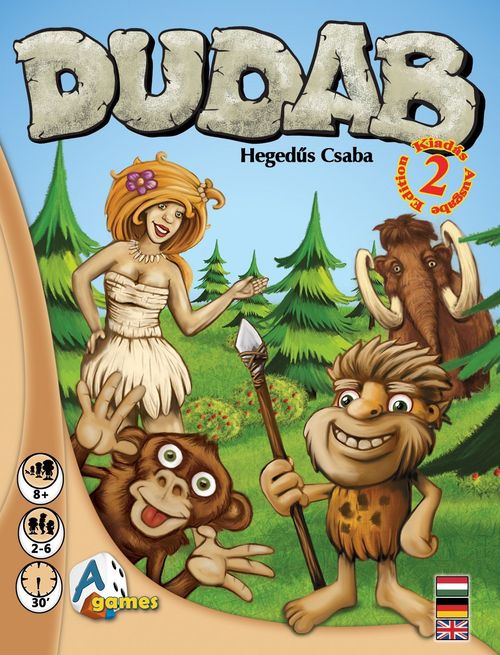
Dudab
Dudab Rulebook
Table of Contents
Table of Contents
Objective of the Game
Players need to collect as few cards and as few points as possible. For this aim, they have to be very tactical, and say Dudab with proper timing. The player who can lead everybody else by the nose, and collects the fewest points is the winner.
Contents
- 64 number cards. Each number card has 3 attributes:
- Color: red, yellow, green, blue
- Symbol: palm, mammoth, club, hides
- Value: 1, 2, 3, 4
- 8 shaman cards, 2 in each color: red, yellow, green, blue
- 8 Dudab cards
Game Setup
The game is played during as many rounds as the number of players.
At the beginning of each round, shuffle the cards, and deal 3 cards to each player. Reveal 2 cards in case of 2-4 players, 3 cards in case of 5-6 players. Place these cards face up in the middle of the table, where every player can see and reach them. These cards will be the first cards of the columns. Place the remaining cards face down next to the face up cards as draw pile. Leave some space next to it for the discard pile, in which you will collect the discarded cards face up. Every player will need some space in front of them for their own pile, in which they collect the cards worth points at the end of the game.
The first player in the first round is the one with shaggiest hair. In the latter rounds, the first player is the one on the left side of the previous first player.
How to Play
When it's your turn, you can choose one of the two possibilities: lay a card down or draw a card. Then the next player's turn in clockwise order starts. You can never have less than 2 or more than 5 cards in your hand. If you have less than 2 cards in your hand at the end of your turn, you have to draw a card; if you have more than 5, you have to put card(s) from your hand to your own pile.
Lay a Card Down
You lay one of your cards down from your hand to the top of one of the columns on the table. You can lay a number card down on another number card, which has different symbol, different color, and its value is greater or smaller by exactly one. You can lay a number card down on a shaman card played earlier, if it has the same color. You can lay a shaman or a Dudab card down, according to the rules (see below).
If the laid down card is the 6th one in a column, you have to take the first 5 cards of that column, and put those to your own pile. You will score these cards at the end of the round. The 6th card will be the new first card of that column. Then you discard as many cards from your hand that are needed to leave only 2 cards in your hand. You can discard these cards to the discard pile, or to your own pile. All the discarded cards have to be placed to the same location (you cannot put e.g. half of the discarded cards to your own pile, and the other half to the discard pile).
Draw a Card
If you don't want or cannot lay a card down, you have to draw a card.
If you have 5 cards in your hand at the beginning of your turn, you can choose card drawing only if you are not able to lay a card down. In this case, you have to reveal your cards to the other players in order for them to see that you cannot lay a card down. Then you have to put one of your chosen card to your pile, and draw a new card from the draw pile.
Important: If you have more than 5 cards in your hand after drawing a card, you have to choose as many as are needed to leave only 5 cards in your hand, and put the rest to your own pile.
End of the Game
The round ends immediately, if a player draws the last card of the draw pile. Then you have to score your cards.
Scoring
All the players reveal the cards in their hand. You have to score +5 points for each of the Dudab cards in your hand, and then have to throw them to the discard pile. You put the remaining cards in your hands to your own pile.
Before scoring your own pile, you have to set pairs including 1 Dudab, and 1 shaman cards. You have to throw these pairs to the discard pile without scoring them. Then you have to attach each of the remaining Dudab cards to a number card from your own pile. If you have more Dudab cards than number cards, throw the surplus Dudab cards to the discard pile without scoring them.
- You score the same number of minus points as the total value of the number cards attached to Dudab cards.
- You score +5 points for each of your shaman cards.
- You score as many positive points, as the total value of the remaining number cards (between +1 and +4 each).
Example for scoring: Gabi has 2 Dudab cards in her own pile. She attaches a Shaman card and 1 number card with value 4 to these cards. These are worth -4 points. The total value of her remaining number cards, +7 points are added to it. Her result is +3 point.
You record your points received in this round, and a new round starts. If that was the last round, you have to summarize your points of all the rounds. The winner is the player with least number of points. In case of a tie they share the victory.
Description of the Cards
Number cards: Each number card has 3 attributes: color (blue, red, yellow, green), symbol (palm, mammoth, club, hides), and value (1, 2, 3, 4). You can lay a number card down on another number card which has different symbol, different color, and its value is greater or smaller by exactly one. You can lay only a value 2 down on a value 1 card, and only a value 3 on a value 4 card. You can lay a number card down on a shaman card played earlier or at the beginning of the round, if it has the same color; or on a Dudab card played at the beginning of the round; or on a Dudab card, if the number card has the called attribute.
Shaman cards: Each shaman card has 1 attribute, its color (blue, red, yellow, green). You can lay a shaman card down on a number card with the same color; or on a Dudab card, if the color of the shaman card was called. If you lay a shaman card down, the next player has to react to it. She can lay another shaman card with any color down on it; or she can lay a Dudab card down on it – and then she can call for an attribute; or she reveals the top card from the draw pile, puts it on the discard pile, and draws as many cards to her hand as the value of the revealed card. If a non-number card was revealed, she continues it until a number card is revealed. After drawing the cards, her round is over.
Important: If you have more than 5 cards in your hand after drawing, you have to put as many cards from your hand to your own pile as needed to have only 5 cards in your hand.
Dudab cards: Dudab is a special card, which can be laid down any time, even if the previous player laid a Dudab card down, and she called for an attribute. When you lay a Dudab card down, you can call for a card, and you define one of its attributes: its color, its symbol, or its value. Other players cannot lay any other card down, until somebody fulfill the called request. The called card has to be laid down on the caller's Dudab card. It can happen that you called for a card, and you have to lay the called card down, because the others couldn't fulfills the request. In this case, also you have to lay the called card down. If a player fulfilled the called request, the game continues in the normal way. If you cannot lay a card with the called attribute down, you have to reveal your cards to prove it, and then draw a card. If you lay the Dudab card down as the 5th card in a column, the player laying the card with the called attribute down has to put the 5 cards in the column to her own pile, and the called card will be the new first card of that column.
Important: If you have more than 5 cards in your hand after drawing, you have to put as many cards from your hand to your own pile as needed to have only 5 cards in your hand.
Important Rules
If you lay a shaman card down, the next player:
- draws as many cards as the value of a number card revealed from the draw pile, or
- lays a shaman card with any color down, or
- lays a Dudab card down.
If you lay a Dudab card down, the next player:
- lays a number card down based on your call, or
- lays a Dudab card down, or
- draws 1 card.
If the laid down card is the 6th one in a column, you have to take the first 5 cards of that column, and put those to your own pile. Then you discard as many cards from your hand as needed to have only 2 cards in your hand, to the discard pile, or to your own pile.
If you have 5 cards in your hand, you can choose card drawing only if you are not able to lay a card down.
You can never have less than 2 or more than 5 cards in your hand.
- If you have more than 5 cards, you have put as many cards from your hand to your own pile as needed to have only 5 cards in your hand.
- If you have less than 2 cards in your hand at the end of your turn, you have to draw a card.