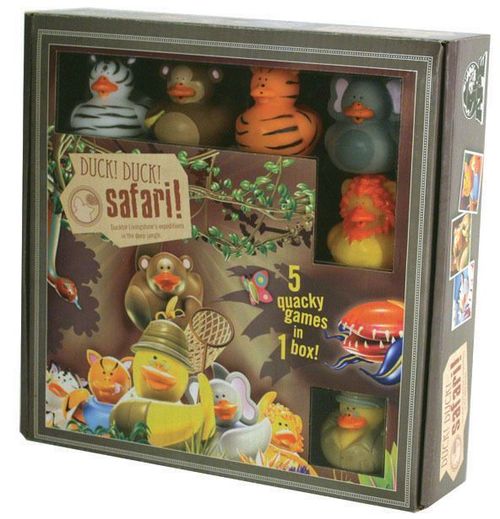
duck! duck! SAFARI!
duck! duck! SAFARI! Rulebook
Table of Contents
Table of Contents
Components
The box contains the following. Each game uses the components listed for it in its own section.
- Game cards: 66 total. There are 5 animals (elephant, lion, monkey, tiger, zebra), each with two sets of cards numbered 1-6, plus a single set of Ducktor Livingstone explorer cards numbered 1-6. These cards are used in every game. Ducktor Livingstone cards are sometimes called "explorer cards".
- Safari Sprint racing cards: 12 different racing cards that tell you how far to move the duckies in Safari Sprint.
- Lap cards: 10 lap cards. One is taken each time your ducky crosses over the 20 space on the point board. This card is used in games where point total is tracked with duckies on the point board, such as Savannah and Herds. Each lap card tells you to add 20 points to your score.
- Animal marker cards: 5 animal marker cards and 1 Ducktor Livingstone marker card. Players put these cards in front of them to indicate the ducky they control on the board, such as in Safari Sprint.
- Two-sided game board: The game board side with the numbers 1-19 is used for the games Safari Sprint, Savannah, and Herds. The other side is used for the game Hi-Lo Hijinks. Animal Hunt doesn't use the game board.
- Duckies: Each game comes with an elephant, lion, monkey, tiger, and zebra ducky, in addition to Ducktor Livingstone, the explorer. The Ducktor Livingstone ducky is often referred to as the explorer ducky in the rules.
Example icons
Throughout the game rules, you will find gray boxes with examples of the rules in action. Many of the examples include icons representing the various duckies in the game. These same icons also appear on the animal cards.
- Elephant
- Lion
- Tiger
- Explorer
- Monkey
- Zebra
Safari Sprint
3-5 Players, Ages 6+. Play your cards so your favorite animal is in the lead at the end of three races!
Setup
First, choose which animals are going to be in the race. You need one animal for each player, plus Ducktor Livingstone, so in a five player game you will use all the animals. In a four player game, you will use all but one, and in a three player game you will use any three animals. Take out the ducky, game cards and marker card for the duckys you're using, plus Ducktor Livingstone. Leave the rest of the animals and their cards in the box.
Put the Ducktor Livingstone "1" card back in the box, along with one of the "1" cards for each animal you're using.
Choose a dealer. The dealer shuffles the five Ducktor Livingstone cards and deals one face down to each player. If any Ducktor Livingstone cards remain, set them aside without looking at them. They aren't used in this race.
Put one of the "6" cards for each animal face up by the board, along with the matching ducky and marker card.
Place the game board in the center of the table, number side up. Place Ducktor Livingstone on space 11.
The dealer now shuffles the rest of the game cards and deals them all out to the players face down. This gives each player a hand of eleven cards, including the Ducktor Livingstone card. You are free to look at your cards any time you wish.
The dealer shuffles the racing cards and places them face down next to the game board.
Choosing Your Animal
It's time to pick your animal for the race!
The dealer begins by choosing an animal, putting its ducky on the game board in any empty space behind Ducktor Livingstone, and showing his claim by moving the marker card for that animal face-up in front of himself.
Now going around the table, each player chooses an animal.
If you choose an unclaimed animal, put its ducky in any empty space behind Ducktor Livingstone and show your claim by placing its marker card face up in front of you.
If you want, you can instead take an animal that another player has already claimed! First, you must move that ducky to a NEW empty space lower than the one it's already in. The 1 space is the lowest space that you can choose. If there is no lower empty space, then you cannot take that animal. Then, take the marker card for that animal and put it in front of you.
Keep going around the table, choosing and claiming animals. Skip over any players who have a marker card in front of them, until everyone has one animal.
Add your animal's extra "6" card to your hand. Leave the animal marker card face-up in front of you to show which animal you are rooting for.
The race is on!
During Each Race
Each race is eleven rounds long. After the eleventh round, the race is over and you score points for your animal's position.
Each round has four steps:
- Step A: Reveal a racing card
- Step B: Play cards
- Step C: Move animals
- Step D: End of round
Step A: Reveal a Racing Card
The dealer draws the top racing card and puts it face up next to the game board. This card shows the speed for the round.
Step B: Play Cards
The player with the animal that's furthest ahead plays first. The other players play in order of their animals' position, until everyone has played one card.
The first player chooses a card and places it next to the game board at the spot labeled "1st."
All the cards will be placed in order of the number on the card.
If you play a card that is smaller than all the others, place it in the empty slot farthest to the right.
If you play a card that is not smaller than the others, find the card farthest to the right that is equal to or smaller than your card. Shift the other cards down one spot to make room for your card.
Example A: In the figure above, the elephant player (on space 8) will play the first card, followed by the zebra player (on space 7), monkey (space 4), and tiger (space 3).
After everyone has played a card, there will only be one card in each spot, and the cards will be in numeric order.
Example B: The tiger player is the last to play. She chooses to play the 3 Tiger card (although she could have played any card from her hand). The 3 Tiger pushes the 3 Zebra and 2 Tiger cards to the left.
Step C: Move Animals
The racing card gives each spot a value for movement.
Begin with the ducky whose card is at the 1st spot. Move this ducky forward by the value shown for 1st on the racing card.
Next move the ducky whose card is at the 2nd spot by the value shown for 2nd on the racing card.
Keep going like this until a ducky has been moved for every game card.
Example C: With all four players having played a card, movement begins. The card at the 1st spot is Ducktor Livingstone. The 1st spot on the racing card is 4, so the Ducktor Livingstone ducky is moved four spaces since his card is in the 1st position on the board.
Even though he belongs to no one player, each player has one of Ducktor Livingstone's cards for moving the Ducktor Livingstone ducky.
Each space on the track can have only one ducky. If a ducky lands on another ducky, move the ducky it landed on back one space. If this space is occupied, move the other ducky back one space to make room and so on until the move is resolved.
Example D: The card at the 2nd spot is a tiger. The tiger ducky moves 4 spaces, causing the zebra and Ducktor Livingstone duckies to each be pushed back one space.
Example E: The card at the 3rd spot is a zebra. The zebra ducky moves 3 spaces, into the lead.
Example F: Finally the tiger moves another single space, pushing the elephant one space back.
Step D: End of Round
If Ducktor Livingstone has fallen behind the pack, he catches up by moving to the space directly behind the rearmost ducky.
The race is over after eleven rounds. At this time, you will be holding exactly one card.
If all players still hold two or more cards, the race is still on! Discard the racing card and game cards played this round. Proceed with the next round of play, starting with Step A: Reveal a Racing Card.
Scoring Each Race
Safari Sprint is played in a three-race series. Each player earns series points for their animal's position at the end of each race.
| Position | Points |
|---|---|
| First | 6 |
| Second | 4 |
| Third | 3 |
| Fourth | 2 |
| Fifth | 1 |
| Sixth | 0 |
Track score on a separate sheet. Include Ducktor Livingstone when figuring out your position—be careful that he doesn't beat you!
After the first and second races, the game deck and game board reset. Return to Setup at the step "Place Ducktor Livingstone's ducky on space 11."
The new dealer is the player who ended up in the lead at the end of the last race.
Winning the Game
The winner of the series is the player with the highest total series points over the course of all three races. In case of a tie, all tying players share the victory!
Hi-Lo Hijinks
2-4 Players, ages 8+. Collect the most of each animal to avoid counting those cards. The player with the fewest cards wins!
Setup
Set the game board on its "Hi-Lo" side in the center of the table.
The game board has a space for each of the animals in the game and for Ducktor Livingstone. Place Ducktor Livingstone's ducky on the explorer spot on the board. Place the other five duckies on the board, either on the higher side or the lower side as described below:
To decide how to place the duckies, draw cards at random from the deck. Keep the first card you draw for each animal type and place it on that animal's spot in the center of the game board. Ignore Ducktor Livingstone cards. These five cards are the starters for the animal stacks. As the game goes on, you will be playing cards from your hand onto these stacks.
The value of each animal's starter shows where to place its ducky:
- If a card is rank 1-3, place the ducky on the spot next to the word Higher.
- If a card is rank 4-6, place the ducky next to the word Lower.
Once you have a starter for each animal, shuffle all the rest of the game cards and deal four cards to each player to form their starting hand.
Place the remaining cards alongside the game board to form a draw deck.
The game begins with the player to the left of the dealer and proceeds to the left.
Example A: First, the explorer ducky is placed on the left. Since 2-Elephant and 3-Zebra are low numbers, their duckys are placed on the Higher side, since higher cards are desired. The other duckies are placed on the Lower side because lower numbers are desired.
On Your Turn
Play one card, then draw one card.
Each card must be played on its stack on the game board. Explorer cards may be played on any stack, but when you play one you must also put Ducktor Livingstone's ducky in front of you.
Each stack wants certain cards. The location of that animal's ducky tells you what kind of card that stack wants:
- If the ducky is next to the word Higher, the stack wants cards with numbers GREATER THAN OR EQUAL TO the top card.
- If the ducky is next to the word Lower, the stack wants cards with numbers LESS THAN OR EQUAL TO the top card.
Compare your card to the card on top of the stack.
If the stack wants the card you played (for example: playing a card of higher value when the ducky is next to the word Higher), put your card on top of the stack. When you play a card onto a stack, place it so that it covers all cards beneath it. You should be able to read the top card only.
If the number on your card exactly matches the top card, put your card on top of the stack. You may reverse the stack's direction by moving the ducky to the other side of the stack if you wish. You may also choose a card from your hand and force another player to add it to their hand before drawing your new card.
If the stack does not want your card (in other words, your card is higher than the top card on the stack and the ducky is next to the word Lower) you must put all of the cards in the stack face-down in front of you, leaving behind only the card you played face-up to start a new stack. Do not move the ducky. If you have already taken any cards, add these new cards to your pile. You may not look through this pile until the end of the game. End your turn by drawing a card.
Ending the Game
When there are no cards left in the draw deck, continue playing with the cards you still have in your hand. Some players may run out before others. Skip any player who has no cards in hand, and continue taking turns until the last card is played.
You may run out of cards and later receive a card from another player. If this happens, then you must play a card on your turn until you run out of cards again.
Scoring and Winning
Turn your pile of cards face up, and sort them by ducky type.
If you have the most cards of a type than any other player, discard those cards.
Then count any cards you still have left. If Ducktor Livingstone is in front of you at the end of the game, add four to your total. The player with the lowest total is the winner!
Printing note: the source reads "have the most cards of a type than any other player"; this is transcribed as printed.
For Younger Players
For younger or beginning players, leave out Ducktor Livingstone and his cards. Also do not use the rule allowing you to give cards away when playing a card with a matching number.
Animal Hunt
2-4 Players, ages 6+. Use your memory and your knowledge of other players to collect as many cards as you can.
Setup
Leave the six Ducktor Livingstone cards and his ducky in the box, along with the animal marker cards. They are not needed.
The other 60 cards show five different animals, and the numbers 1 through 6. There are two copies of each card. Split the cards into two identical decks of 30 cards each—both decks will have exactly one of each different card.
Shuffle one deck and deal a hand of cards to each player face down:
| Number of Players | Hand Size |
|---|---|
| 2 | 10 |
| 3 | 7 |
| 4 | 5 |
Add any cards that are left to the other deck of 30. Shuffle all these cards together and lay them out on the table face-down like the picture below. This is the hunting ground! If you are playing a three-player game, the circled card below will be missing.
Put the five duckies down next to the cards and you're ready to start!
On Your Turn
Flip any card in the hunting ground face up. Then pick only one of these choices:
- Choice A: Show a card
- Choice B: Ask a player
- Choice C: Flip another card
Choice A: Show a Card
Show a card from your hand that matches the card you flipped—it must show the same animal and number. Take both cards and play them face-down in front of you to make a score pile. Then, take the ducky that matches those cards and place it in front you. Now you get to take another turn!
Choice B: Ask a Player
Pick any player, and ask if they have the card that matches the one you just flipped over.
If they have the matching card, they must give it to you. Take both cards and play them face-down in your score pile. Also, take the ducky that matches those cards and place it in front you, then take another turn.
If they don't have the matching card, you must turn the card you flipped back face-down. Your turn is over.
Choice C: Flip Another Card
Flip another card in the hunting ground face-up.
If this card matches the first card you flipped, place both cards face-down in your score pile, put the ducky matching these cards in front of you, and take another turn.
If the two cards do not match, turn both face-down. Your turn is over.
Catching Duckies
When you complete a pair of cards and add them to your score pile, you get to take the matching ducky. You can even take the ducky from another player! If you can hold on to the ducky until the end of the game, you will score two extra points!
Ending the Game
When any player runs out of cards in their hand, the game ends immediately.
Winning
All players discard any cards still in their hand.
Count all the cards in your score pile. Add two to your total for each ducky you have in front of you. The player with the highest score is the winner!
Savannah
2-3 Players, ages 8+. Score points by finding and building patterns on the table with cards.
Setup
Put the game board on the edge of the table with the number side up. Each player chooses a ducky and places it next to the game board near the 1 space. Your ducky will be used to track your score.
Choose a dealer. The dealer shuffles the 66 game cards and deals five to each player face down.
Now divide the deck into two roughly equal piles. Place one pile on the edge of the game board in front of the space labeled 1st. Put the other pile in front of the space labeled 2nd.
The Playing Space
This game is played on an imaginary grid of squares—the savannah, which holds all the cards as they get played. The grid has no borders, and extends as far as is needed in every direction.
Beginning the First Phase
The dealer chooses a card from her hand and places it onto the playing space. Now each other player in turn chooses one card and places it onto the grid so that it is touching one other card on one corner.
The game now begins with the dealer and proceeds to the left.
On Your Turn
When it's your turn, carry out the following steps, in order:
- Step A: Play a card
- Step B: Score your play
- Step C: Find unplayable spaces
- Step D: Draw a card
Each of these steps is explained below. After finishing your turn, play goes clockwise to the player on your left.
Example A: The beginning of a 3-player game may look something like this.
Step A: Play a Card
Play a card from your hand to the savannah. This card must touch at least one card already on the table—either on a corner or on a side.
If your card touches any other cards along a side, it becomes part of one or two lines—a horizontal row and/or a vertical column. Every line must obey one of these rules:
- A. Every card in the line has the same animal but a different number.
- B. Every card in the line has the same number but a different animal.
- C. Every card in the line has a different number and a different animal.
If your card does not match one of these rules, you cannot play it in that line.
Step B: Score Your Play
Count the number of cards in the connected line. If these cards match one feature (as in A or B above) advance your ducky on the scoring track one point for each card in the line.
Animal or number are the same: score one point for each card in line.
If the cards in the line are different in every way (as in C above) score one point less.
Animal and number are different: score length of line - 1.
If the card you played is in two lines, score both lines. Advance your ducky forward on the game board to keep track of your score. Any time you complete a lap around the board, take a +20 lap card to show it.
Step C: Find Unplayable Spaces
A card space on the grid is unplayable if there is no card that can be played in that space legally, or if the only cards that can be played there are already on the table.
If you find an unplayable space on your turn, you immediately score one point and draw two cards—one from the first deck and one from the second deck. Look at these two cards without showing them to the other players. Put one of them on top of the first deck, and put the other one face-down in the unplayable space.
Step D: Draw a Card
Draw a card from the top of the first deck and add it to your hand.
Ending the First Phase
If you draw the last card from the first deck, the first phase is over.
Pick up any cards marking unplayable spaces. These spaces will be playable again during the second phase. Shuffle these cards into the second deck and put this new deck on the edge of the game board in front of the space labeled 1st.
Beginning the Second Phase
Play continues with the next player in turn. In the second phase, play cards the same way. What's different is how you score. In the second phase, you will score by removing cards from the board and returning them to the box.
If you play a card in a single connected line that matches in number or animal (rule A or B), remove the entire connected line.
If you play a card in a single connected line with no features the same (rule C), remove all the cards in that line except the card you just played.
If you play a card on a crossing of a row and a column, and at least one of them is a matching line (rule A or B), remove all cards from both lines.
If you play a card in a crossing of a row and a column, and both rows have no matching features (rule C), then remove all cards from both lines except the card you just played.
You may also play a card touching another card only on a corner.
On your turn you score points equal to the number of cards you remove from the table.
Draw a card to end your turn.
Ending the Second Phase
Phase two almost always ends when no face-up cards remain on the table.
In a few rare cases, the second deck runs out before the table has been cleared. If this happens, players continue with the cards in their hand. The game is then over when the table has been cleared or when everyone runs out of cards.
Example B: This series will provide examples of scoring in the first phase.
On her turn, Debra plays the 3-Elephant and scores 4 points: 2 points for the row of elephants and 2 points for the column of elephants.
Kevin follows with 2-Zebra and scores 3 points for the row of 2s.
Amy plays the 2-Elephant and scores 5 points: 2 points for the row of 2's, and 3 points for the column of elephants.
Now, back to Debra: she plays 2-Monkey and scores 4 points: 3 points for the column of 2's, and 1 point for the all-different row of 5-Elephant and 2-Monkey.
Amy follows with 6-Lion and scores 4 points; 2 points for the column of lions and 2 points for extending the all-different row.
Amy also points out that the space in the top left is no longer playable—neither a lion nor elephant will fit there. She scores one point, draws two cards, places one card in the unplayable space and the other card on the top of the 1st deck.
Example C: Now let's look at how scoring works for the second phase.
Kevin plays 2-Tiger and removes the bottom row for 4 points.
Debra plays 4-Zebra and removes every card from the bottom row except the one she just played. She scores 3 points.
Amy plays 4-Elephant and removes all the cards on its row and column for 4 points.
The board is now empty. Amy, Debra, and Kevin check their scores to find out who won!
Winning
The player with the highest score wins.
Herds
2-4 Players, ages 10+. Create herds of three or more matching animals to score the most points.
Setup
Put the game board on the edge of the table. Leave the center of the table empty to make space for the grassland. Each player chooses a ducky and places it on the table, next to the "1" space on the game board. This ducky will be used to track your score. If there are four players, then you must make two teams of two players. You only need to use one ducky for each team.
Choose a starting dealer.
Beginning the Hand
The game is played over a series of hands. During each hand, you will try to collect the best animal herds as you can.
The dealer shuffles the deck of game cards and deals a starting hand to each player. The number of cards dealt depends on the number of players:
| Number of Players | Hand Size |
|---|---|
| 2 | 6 |
| 3 | 5 |
| 4 | 4 |
Now the dealer creates the grassland by dealing four cards face-up on the table. Spread out the cards so all four can be seen easily. Place the rest of the deck next to the grassland. This is the draw pile.
The player to the left of the dealer plays first.
On Your Turn
When it's your turn, do the following steps in order:
- Step One: Draw one card
- Step Two: Select from one of the following choices:
- a. draw one more card; or
- b. trade cards
- Step Three: Create and grow herds
- Step Four: Pass one card
- Step Five: Flip one card
After you finish your turn, the player to your left plays next.
Step One: Draw One Card
Draw one card from the deck and add it to your hand.
If you draw the last card of the deck, the hand ends after you finish Step Four: Pass one card.
Step Two A: Draw One More Card
Draw one card and add it to your hand. You may choose any card in the grassland or take the top card of the draw deck.
If you draw the last card from the draw deck, the hand ends when you complete Step Four: Pass one card.
Step Two B: Trade Cards
You may trade cards in your hand for cards in the grassland. To make a trade, play one or more cards from your hand and add up the value of the cards you play. Then, take into your hand any number of cards from the grassland that have the exact same total value.
You may only choose to trade cards if you can find a combination of cards in the grassland that add up exactly to the value of the cards you play from your hand.
After trading, the cards you played go face-up into the grassland.
Examples: James plays the 6-Lion card. He takes 1-Monkey, 1-Elephant, 2-Elephant and 2-Ducktor Livingstone from the grassland.
Gene plays the 2-Lion and 4-Tiger cards. He takes 6-Elephant from the grassland.
Debra plays the 5-Tiger and 4-Monkey cards. She takes 2-Elephant, 3-Elephant, 4-Elephant from the grassland.
Step Three: Create and Grow Herds
To score points, you create "herds" by playing cards from your hand face-up in front of you or your teammate. A herd is three or more cards that show the same animal and whose numbers are in sequence (e.g. 3, 4, 5).
After you create a herd, you may grow it on a future turn. You may add cards to your herd if they show the same animal, and they continue the series of numbers (e.g. add a 2 or 6 to a 3, 4, 5 sequence).
You may not grow herds belonging to your opponents.
In a four player game, you may also add cards to your teammate's herds.
Playing Ducktor Livingstone Cards into Herds
Ducktor Livingstone's explorer cards are special in this game. Like any other type of card, they may be formed into a herd with other cards showing the good Ducktor. His cards also have a second purpose. You can play them as "wild cards," using them instead of any other type of animal with the same number.
If one of the Ducktor Livingstone cards is standing in for another card that you hold in your hand, you may put your card in its place and take the Ducktor Livingstone card into your hand. If you do this, the Ducktor Livingstone card must be used to create or expand a herd before the end of your turn.
If you draw a Ducktor Livingstone card from the deck, you may hold it to play whenever you wish. But, if you take one from the grassland in Step Two: Trade Cards, you cannot keep it. You must play that card before the end of your turn.
Step Four: Pass One Card
Pass a card from your hand to an opponent who adds this card to their hand.
This step is not optional. You must pass one card! You must have at least one card left in your hand after Step Three: Create and Grow Herds, so you will have a card to pass during this step.
Step Five: Flip One Card
Draw the top card from the draw deck and add it face up to the grassland.
This ends your turn. The player on your left now starts their turn.
Ending the Hand
The hand ends if either of the following occurs:
- A. The draw deck runs out of cards.
- B. A player (or team) has completed at least one full herd—1 through 6—and this player's card pass is the last card in their hand, having nothing left.
Scoring the Hand
At the end of the hand, any cards you still hold have no value and may be discarded.
You score points for all the herds you (or your team) have on the table. Larger herds are worth more points. Herds made up of all Ducktor Livingstone cards are the most valuable!
Dr. Livingstone Herds
| Cards in Herd | 3 | 4 | 5 | 6 |
|---|---|---|---|---|
| Points | 3 | 5 | 7 | 10 |
Herds made from animals are less valuable. Also, Ducktor Livingstone cards in an animal herd are not counted in the size of the herd.
Animal Herds
| Cards in Herd | 1 or 2 | 3 | 4 | 5 | 6 |
|---|---|---|---|---|---|
| Points | 1* | 2 | 3 | 5 | 7 |
* A herd must have at least three cards to be played but will score as only one or two cards if some of the cards are from Ducktor Livingstone.
Advance your ducky one space for every point you (or your team) earned during the hand. If your ducky crosses 20, take a +20 lap card and continue.
Continuing the Game
A new hand begins by passing the deal to the player to the left of the last dealer. The new dealer shuffles and deals the same way as the start of the game.
Winning
The game ends if any player or team has at least 60 points.
The winner is the player or team with the highest score.
Add-on: Deducktion
This is the free promotional game included with duck! duck! SAFARI! It is not one of the five box games above. Its rules are printed in the same booklet set and use the game cards from the box. 3-5 Players, ages 8+. Be clever... ask questions and make deductions to collect matched cards and identify the missing cards!
Setup
Begin by dividing all the cards up into sets of 1-6 by suit. You should have 11 sets—one set of explorers and two sets of each other animal.
Make the question deck first by combining one set of each of the six suits—explorer, tiger, elephant, lion, zebra and monkey. Then shuffle them together.
Randomly remove one card from each of the other five sets and put these five cards in the box without looking at them. Your goal is to determine the identity of these five cards.
Shuffle the remaining 25 cards together and deal these cards out to the players.
| Number of Players | Hand Size |
|---|---|
| 3 | 8 |
| 4 | 6 |
| 5 | 5 |
If there are three players or four players in the game, you will have one card left. Place this card face-up on the table where everyone can see it.
On Your Turn
- Meld and Score Sets
- Ask Your Question
Melding and Scoring Sets
If you hold three or more cards of the same rank, you may choose to place them on the table in front of you, face up. Such sets will earn you bonus points at the end of the game.
Asking Your Question
Flip the top three cards from the question deck. You will first choose another player to question. Then you will choose two of the three cards to use in your question. See the following examples for more details.
- If the two cards you choose have the same number, you are asking how many cards the player holds of that number.
- If the two cards are of the same animal, you are asking about a sequence of cards for that animal. You may make this sequence either from the lower card up to the higher card. Alternately, begin with the higher card, count up to 6, then begin again at 1 and count up to the lower card.
- If both cards you select have both different number and animal, you are asking about the cards of either of the animals that show either number.
- Explorer cards are wild. If one of the three cards you turn over is an explorer, the animal type of the explorer card can be changed to the animal on either of the other cards (See examples on the next page.) If two of the three cards you turn over are explorers, then both explorer cards become the animal type of the third card. If all three cards are explorers, then select two of the explorers to use, and pick any other animal suit.
Your opponent must answer by announcing how many cards they hold which satisfy your question and must also pass them to you, face down. Before looking at these cards, you must pass back an equal number of cards. After the pass, each of you adds these new cards to your hand.
In some cases, it may happen that the number of cards you are receiving is greater than the number of cards you hold. In this case, you must pass your entire hand and, after looking at the cards you were passed, pass back to your opponent enough cards to make up the difference. So if you receive 3 cards, but only have 2 cards in your hand, then you would give your opponent both your cards, look at the three cards he gave you, and then select one and give it back to your opponent.
Examples
Example 1: With these three cards, you could ask any of these questions—
- Select the 5 Elephant and 5 Tiger: How many 5s do you have?
- Select the 2 Tiger and 5 Tiger: How many Tiger cards 2, 3, 4 or 5 do you have?
- Select the same 2 Tiger and 5 Tiger: How many Tiger cards 5, 6, 1, 2 do you have?
- Select the 2 Tiger and 5 Elephant: How many 2s and 5s do you have on Tiger or Elephant cards?
Example 2: With these three cards, you could ask any of these questions—
- Select the 2 Tiger and 4 Lion: How many 2s and 4s do you have on Tiger or Lion cards?
- Select the 1 Explorer (as Lion) and 2 Tiger: How many 1s and 2s do you have on Lion or Tiger cards?
- Select the 1 Explorer (as Tiger) and 4 Lion: How many 1s and 4s do you have on Lion or Tiger cards?
- Select the 1 Explorer (as Tiger) and 2 Tiger: How many Tiger 1 or 2 cards do you have?
- Select the 1 Explorer (as Tiger) and 2 Tiger: How many Tiger 2, 3, 4, 5, 6 or 1 cards do you have?
- Select the 1 Explorer (as Lion) and 4 Lion: How many Lion 1, 2, 3 or 4 cards do you have?
- Select the 1 Explorer (as Lion) and 4 Lion: How many Lion cards 4, 5, 6 or 1 cards do you have?
Example 3: If you select both explorers, then they will both become Tigers, and you could ask the following questions:
- How many Tiger 1, 2 or 3 cards do you have?
- How many Tiger 3, 4, 5, 6, or 1 cards do you have?
Example 4: In this example you select the same 1 and 3 explorers, but in this case you can decide which animal they become (EXCEPT explorer). Let's say you select Tiger again. In this case the questions are the same as above.
Ending the Game and Winning
Value of Melds:
| 3 Cards | 4 Cards | 5 Cards |
|---|---|---|
| 3 pts. | 5 pts. | 7 pts. |
Value of Guesses:
| Correct Guess | Incorrect Guess |
|---|---|
| 5 pts. | -3 pts. |
The winner is the player with the highest score.
Two-Player Variant
Deal as if for three players. Each player gets one hand while the third hand is set aside to form a draw pile.
Any time you ask a question and your opponent replies with "zero," draw a card from the reserve and add it to your hand. If the reserve is empty, this step is skipped.