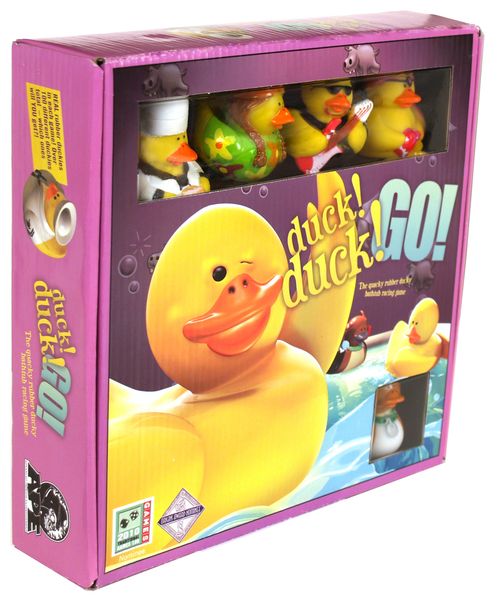
duck! duck! Go!
duck! duck! Go! Rulebook
Table of Contents
Table of Contents
Contents
- 4 rubber duckies
- 1 bird dog
- 1 bird dog control token
- 10 two-sided game board tiles
- 12 buoy tokens (4 of each in 3 colors)
- 54 ducky movement cards
- 17 circular action tokens
Note: Each game contains a random assortment of duckies. Visit apegames.com for more information on all of the duckies, additional game board ideas, puzzles and more!
Beginner Rules
Setting Up
The bird dog and the circular action tokens are not needed in the beginner's game. Leave them in the box.
- Players agree on a game board from those shown at the end of these rules and use the tiles to make the board. It is suggested that players select a beginner's board for the first race.
- Place the hex-shaped buoy tokens beside the board by the respectively-colored buoys on the board.
- Shuffle the ducky movement cards and deal three to each player.
- Each player draws one more card and shows it to everyone. Beginning with the player who drew the highest number and proceeding around the table clockwise, everyone selects a rubber ducky that they will use for the race and places it on an empty starting space. When you place your ducky, be sure that it is clearly facing one of the sides of the space, not one of the corners.
- Once everyone has placed their ducky, they discard the fourth card they picked up to place their ducks. The race begins!
The Race
The race is played over a series of rounds. Your goal is to be the first to visit all three of the buoys and then reach the drain.
Ducky Movement
At the beginning of each round, players choose a card from their hand to move their duckies.
Take a look at your cards. The cards show a number in the top left corner. It also shows a purple arrow and a group of hexagons with red arrows and green arrows.
The number on each card is the order in which duckies move, from lowest to highest. The purple arrow represents the direction your ducky is facing at the beginning of its move. You must move your ducky all of the spaces indicated on the card you chose, if possible. As you'll see later, it's possible that movement can be halted by hitting another ducky, or the board's edge.
The blue hexagon represents the space where your ducky starts its turn. Red arrows show the moves your ducky makes from space to space.
Green arrows show the possible directions your ducky may face when it finishes moving.
Secretly pick a card from your hand and place it face down in front of you. Once everyone has selected a card, simultaneously flip and reveal them.
Begin with the player that selected the lowest numbered card. That player moves their ducky by following the picture on their card.
If your ducky finishes its movement on a buoy space, you get to play another card and keep going! (See the Buoy Spaces section for details). Note that you don't get this bonus if your ducky moves over the buoy but does not end its turn there.
Once the ducky with the lowest number finishes moving, the player with the next lowest number moves his ducky. Continue in this way until everyone has moved their ducky.
Players then draw enough cards to refill their hand back up to three cards.
Keep playing rounds, selecting cards, revealing them and using them to move your ducky until someone wins the race!
Movement Tip: At first it can be difficult looking at the movement card to figure out how your ducky should move. It's okay to put your card on the table facing the same direction as your ducky, with the purple arrow facing away from your ducky. With the card on the table, facing in the direction of your ducky, you'll find that movement is a snap!
Example 1: In the picture above, Sparky (the fireman ducky) wishes to go around Cookie (the sailor ducky). He plays card 36. The red arrows on this card indicate Sparky should move forward one space, turn to the left and go one space, and then turn to the right and go one space. At the end of this movement, the green arrows indicate that Sparky may face either to the right or to the left. He chooses to face right and ends his turn.
Movement Cards with Two Paths
Some movement cards show two or more paths. If you play one of these cards, you may follow any one of the paths shown on the card – it's your choice!
Example 2: Sparky is again facing Cookie and wishes to go around him. He plays card 42. This time, the red arrows indicate Sparky should go forward one space, turn to the left or to the right and go one space. Sparky chooses to turn to the right and go one space. Next, the green arrow gives him no choice but to turn left and end his turn.
Ducky Bonking
Sometimes, your ducky's path will make it collide with the edge of the board, another ducky or the drain before you have all three buoy tokens. When this happens, the move ends immediately.
Leave your ducky in the space it was in when it bonked another duck or ran off the board. Spin your ducky around, with its back to whatever it bonked.
Example: Yikes! This time, Cookie moved first and got in Sparky's way! Sparky played card 52 which would have led him down the path shown by the red arrows. But this path runs him straight into Cookie! Sparky stops when he tries to move into Cookie's space, turns around in place and ends his turn.
Buoy Spaces
There are three buoy spaces every ducky must touch before heading for the drain.
The first time your ducky passes over or ends its movement on any one of the three target buoy spaces, take a matching buoy token and put it in front of you.
If your ducky finishes its movement on a buoy space, you get to keep going! Immediately play another card from your hand and follow its movement diagram. You may continue moving as long as your ducky finishes movement on a buoy space. If you should happen to run out of cards doing this, draw the top card from the deck.
Note: Your duck must touch all three buoys, in any order. You only get a buoy token when you touch the buoy for the first time.
Moving Into a Start Space
Once the game begins, the start spaces on the board become short-cuts, teleporting your ducky from one to another.
If your ducky moves into one of these spaces, pick it up and place it in any empty start space you wish; you may even choose to put it back in the same space. Choose which way it faces.
Once you've chosen a start space and facing for your ducky, its move is over, even if it hadn't completed the movement on its card.
Note: If you move onto a start space, immediately jump to an empty start space, facing whichever direction you choose. Your ducky's move stops there.
The Drain
The drain is the finishing space. You win the race when your ducky moves into that space after touching the three buoy spaces.
If your ducky has not touched all three buoy spaces, it may not enter the finish drain space. Your ducky will be bonked just as if it had run into the edge of the board if it tries to enter the drain space (see Ducky Bonking above for details).
Note: Duckies may not enter the drain space until it first touches all three buoys.
Winning the Game
The first ducky to reach the drain space after touching all three buoy spaces wins. It is not necessary that your ducky end its turn on the drain space – the game ends as soon as the ducky moves into the space.
Advanced Rules
Uh-oh! Here comes the bird dog! Watch out for him – he chases the other duckies around because he hates to see them having fun! If he runs into your ducky, the bird dog will knock it for a loop!
What can a ducky do to fight back against this rascal? Well, for starters you get a special token every time you reach a new buoy!
The sections below detail differences from the Beginner Rules.
Advanced Game Setup
- Several advanced board designs are shown at the end of these rules. Assemble the tiles into any board you wish or make up a new board that is all your own.
- Each player takes one round blue action token. Any remaining blue tokens will not be needed. Return them to the box.
- Shuffle the other round bonus action tokens face down and place them on the table next to the game board.
- Place the hex-shaped buoy tokens beside the board by the respectively-colored buoys on the board.
- Place the bird dog on the table next to the game board.
- Shuffle the deck of ducky movement cards and deal four to each player.
- Each player secretly selects a card from their hand and simultaneously reveals it. Beginning with the highest number and working around the table in decreasing order, everyone selects a ducky that they will use for the race and places it on any empty starting space. Once everyone has done so, discard these cards and begin the race.
Like the basic game, players draw enough cards at the end of the round to refill their hand back up to three cards.
Note: Selecting a starting player in the advanced game is slightly different than the basic game. In the advanced game, players are dealt four cards and must select one from the four to use for initial ducky placement. This allows you some degree of strategy, as you can decide which card in your hand will be least useful for your ducky's movement. You can also select your card to give you the best initial ducky placement.
Here Comes the Bird Dog!
In the advanced game, the bird dog moves after all of the other duckies move.
The bird dog is controlled by the player who is furthest behind in the race. This is the player who has collected the fewest buoy tokens. If there is a tie, it is the player among these who played the movement card with the highest number that round.
The player controlling the bird dog places the bird dog control token in front of himself.
Controlling and Moving the Bird Dog
If the bird dog is not on the board, put him in the finish drain space and face him any direction you wish.
There are two different ways to move the bird dog. You may move him with a card from your hand or by drawing two cards from the top of the deck. If you move him with a card from your hand, simply play a card, move the bird dog according to the card and draw a new card to replace the card used.
If you draw two cards from the deck, reveal them to all players. Then move the bird dog according to the instructions on the cards. You may choose either card to move first.
If the bird dog ends movement on a buoy, it remains there. It does, however, teleport off preservers.
Bird Dog Bonking
The bird dog does not bonk off the finish drain space. If he moves into it, pick him up and put him next to the game board. He'll come back next round.
The bird dog chases away any duckies that bonk into him.
The bird dog does not bonk off other duckies, but instead continues moving through them.
If the bird dog moves into (or through) your ducky, the player moving the bird dog gets to put your ducky in any empty lifesaver start space.
When your ducky bonks into the bird dog while moving, your turn ends immediately. The player with the bird dog control token puts your ducky in any empty lifesaver start space.
Whether you bonk into the bird dog or the bird dog bonks into you, it is your decision which way to face your ducky once he has been placed in a lifesaver start space.
Action Tokens
Each time your ducky reaches a buoy for the first time, draw one of the face down action tokens in addition to the matching buoy marker.
Keep each of your action tokens face down until you are ready to use it. When you use an action token, show it to everyone and put it in the box. It is not used again during this game.
The action tokens are:
- Draw 3 cards, then discard 3 cards. Every player begins the game with one of these tokens. Play at any time.
- +1: Play one additional card immediately after you finish moving your ducky.
- Move one space forward, then face forward or one facing to either side. Play on your turn before or after moving your duck.
- Rotate your ducky to face any direction you wish. Play just before you play your movement card.
- Your ducky and the bird dog trade places – both position and facing. The bird dog must be on the board. Play just before you play your movement card.
Advanced Game for 2-3 Players
When two or three players play the advanced game, each player controls two duckies.
Players are dealt five cards and select one of the cards to determine their starting spot, like in the Advanced Rules. When placing ducks, go around the table twice, starting with the player with the highest card and placing one duck each turn. Players then play the game with a four-card hand, selecting a card for each duck and replenishing to 4 cards at the end of the turn.
Keep track of each ducky's progress separately. Also, action tokens are pooled by the player and can be used on either duck. The Draw3/Discard3 token rules do not change.
The winner is the owner of the first ducky to reach all three buoys and get to the finish drain space.
Variant Rule
Bonking off an unexpected duck can be brutal in this game. It can take two or even three turns to get back on track, particularly if you're on an advanced board. Here is a rule variant we suggest for players who'd like a more forgiving experience: immediately after revealing their cards for the round, any player who wishes to do so may immediately discard his or her card to turn their ducky to face any direction they wish rather than moving this round.