Duck & Cover
Duck & Cover Rulebook
Table of Contents
Table of Contents
Contents
- A draw deck of 26 Cards (2 sets of Captain Cards numbered from 1 to 12, 1 Max card, and 1 Repeat card)
- 84 Duck Cards (7 families of 12 Cards numbered from 1 to 12)
- 1 scorepad
- Rules
Objective of the Game
In Duck & Cover, your objective is to have the lowest total score at the end of the 3 rounds! (Points are represented by the number of splashes.)
Set Up
A. Starting cards layout Each player chooses 1 of the 7 Duck Families, shuffles the 12 cards, and randomly places them face up in a 4x3 grid. Unused Duck family cards are placed back in the box.
B. The Draw deck The Draw deck is shuffled and placed face down in the center of the table.
C. The Captain pile / D. The Discard Area Once a card has been drawn and announced, it is placed in the Captain pile or in the Discard Area.
Choose one player to be the Captain. The Captain will play the same way as the other players, but they will also have to draw cards, read them aloud, and keep track of the card piles.
Draw Deck Cards
The draw deck contains 26 cards: two full sets of Captain Cards numbered 1 to 12, plus 1 Max card and 1 Repeat card.
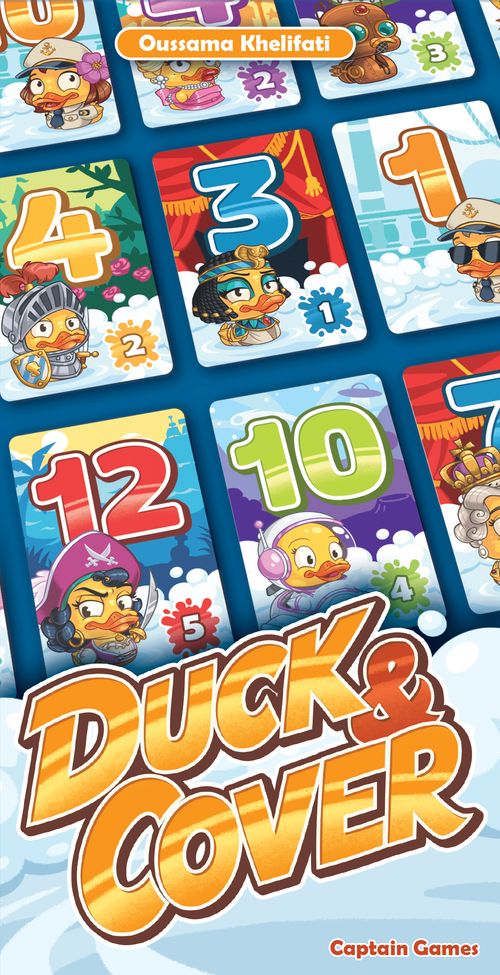
Duck Cards are organized into 7 families of 12 cards each, numbered 1 to 12. Each Duck Card shows a card number and a number of duck splashes (the value used for scoring).
Game Round
At the beginning of every turn the Captain reads aloud the top card of the Draw deck.
All players must simultaneously move their card corresponding to the card read by the Captain in one of two ways:
Cover — The card is moved orthogonally (NOT diagonally) onto another card directly adjacent to it. The card covers the card onto which it is placed.
OR, OTHERWISE — Duck: The card is moved to any empty space, without covering any other card.
- The card must be placed directly beside another card.
- The card can be moved outside of the original 4x3 grid, or it can fill an empty space of the grid.
Quack If a player has already covered the card announced by the Captain, they cannot play, and each player that cannot move their card must say "quack".
If all players "quack", the Captain places the card that was just read face up into the Discard area. The Captain ensures that all cards in the Discard area remain visible throughout the round. The Captain must say how many cards are in the Discard Area and how many cards can still be discarded before causing the end of the round (see the table under End of the Round).
Otherwise, if at least 1 player can play the card announced by the Captain, it is placed face up onto the Captain pile instead of in the Discard area. The cards added to the Captain pile will stack on top of each other, with only the last announced card remaining visible to all.
Special Cards
Some cards in the Draw deck do not have a number, but they have a special effect:
- Max: Every player plays their highest visible card.
- Repeat: Every player replays the same card as the last card that was just drawn.
Details
- When moving a card (either to duck, or to cover), move the whole stack of cards that is underneath it.
- If the first card announced is the Repeat card, place it in the Discard area.
- If the Repeat card follows a card that was placed in the Discard area, it is also placed in the Discard area.
- If the Repeat card follows the Max card, then the Max card is played again.
- The Captain pile is kept in a stack so that only the top card is visible, while the Discard area is kept so all cards are visible.
- If the Draw deck is empty, all the cards in the Captain Pile are shuffled again and form a new Draw deck to continue the round. However, the cards in the Discard area remain in place.
- It is forbidden to look through the Captain pile, the Draw deck, or any player's covered cards, to see what cards have already been played during the game.
Example of a Game Round
Connie is the captain. She draws the card number 5 from the deck. She reads 5 aloud and all players must move their 5 card.
- Connie uses her 5 to cover her 7 card.
- Jackson decides to duck his card and moves it next to his 6 card. The card is placed outside of the starting grid, but that is okay because it is moved beside another card (card number 6).
- Dan decides to cover his 8 card which sits right above his 5 card.
- Gwen, on the other hand, is forced to say "quack" because her 5 card has already been covered earlier in the game.
End of the Round
A round ends when one of the following two conditions is met:
- One or more players have managed to stack all of their cards into a single deck.
- A specific number of cards have been placed in the Discard area, depending on the number of players.
| Number of players | 2 | 3 | 4 | 5 | 6 | 7 |
|---|---|---|---|---|---|---|
| The number of discarded cards causing the end of a round | 9 | 8 | 7 | 6 | 5 | 4 |
Note: Number of players + number of cards in the Discard area = 11.
Scoring
At the end of each round, the total score of each player is totalled and written on the scorepad.
The score of each player is determined by adding up the value of all the splashes still visible on the player's non-covered cards.
- If a player finishes the round with more than one stack of cards, then their score is positive.
- If a player finishes the round with one stack of cards, then their score is negative.
Reminder: The objective of the game is to have the lowest score at the end of the game!
Note: It is possible to finish the game with a score below zero.
Example of Round End
In a game with 4 players, 6 cards have been placed in the Discard area. If none of the players can play the next card drawn by the Captain, then the round ends because 7 cards have been placed in the Discard area.
Connie draws a 10 and everyone says "quack", except for Jackson who covers his 6. Jackson only has one stack of cards remaining, so the round ends.
All players add the number of the splashes on their cards to determine their score for this round.
- Connie ends the round with the 6 and 2 cards. For this round, she has a score of +3.
- Jackson finishes with the 10 card, which gives him a score of -4.
- Dan has kept his 1, 4, and 6 cards, and his score is +4.
- Gwen finishes with the 12 and 6 cards, so she gets a score of +7 points.
The players' scores for this round are written on the scorepad.
New Game Round
The captain shuffles the 26 cards and forms a new Draw deck.
Each player shuffles their cards, and creates a new 4x3 grid.
End of the Game
At the end of the third round, the score of each player is added up.
The player with the lowest score wins the game.
In case of a tie, the player with the smallest number of visible cards at the end of the third round wins the game.
If there is still a tie, all tied players win.
Rules Summary
We draw a card.
Each player moves the corresponding card or covers a directly adjacent card.
If a player no longer has the corresponding card available, they must say "quack".
If everyone says "quack", the card is placed in the Discard area.
A round ends when a player has only one stack of cards remaining or when a specific number of cards are in the Discard area (see the table under End of the Round).
Each player totals the splashes of their ducks and adds it to their score. However, players who finish the round with only one stack of cards score negative points.
The player with the lowest score at the end of 3 rounds wins the game!