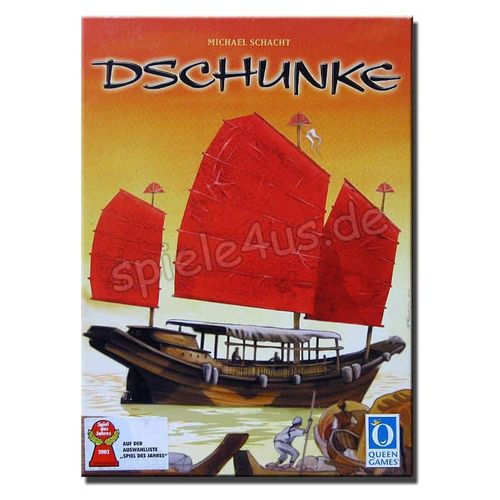
Dschunke
Dschunke Rulebook
Table of Contents
Table of Contents
Components
- 1 game board
- If playing with four, both assistants are in play – one on each path.
- With three players, only the assistant on the lower path is in play.
- This is where the current market card and the market card deck go.
- When a merchant is on the junk, he moves to the front.
- In the middle, the cargo strips are stacked up.
- This is where the goods cards are placed.
- Merchants move from junk to junk across these footbridges.
- Action possibilities of the assistants.
- At S and Y, events take place.
- No goods cards come onto the grey junk, since here you may choose the type of goods yourself.
- This is where the special cards go.
- 80 cargo strips in four colors — each cargo strip consists of three crates, which are not always all visible.
- 10 market cards — the market cards state how many yüan you can get per set of identical goods, and for which types of goods there is a special card instead.
- 3 marker stones — the square wooden blocks are used to cover the completed colors on the market cards.
- 30 special cards — special cards can open up particular options for action, or provide a bonus at the end of the game.
- 8 resupply cards — each player receives two resupply cards at the start, which he lays in front of himself. (More can be found among the special cards.)
- 72 goods cards — of the four types of goods — rice (white), fish (brown), vegetables (purple/lilac), and spices (orange) — there are 18 cards each.
Object of the Game
Each player tries to rise to become the most respected merchant lord of Asia by making bigger profits than his competitors. Important for this are skillful positioning of his cargo on the ships – since resupply of goods and income depend on this – as well as clever handling of merchants and assistants.
Setup
Setup and game preparation for three or four players are described on the front of the supplementary sheet. On the back you will find an explanation of the special cards.
Note: The rules are so simple that after one or two games you will only need to pick up the supplementary sheet.
Before your very first game, you must fit the three large round wooden discs with one each of the three large round stickers (merchants). On the two small round wooden discs, apply one each of the two identical small stickers (assistants). The backs remain blank in each case.
Sequence of Play
The game runs over 10 rounds. Each round consists of the following six phases:
- Market Card and Events
- Player Actions
- Goods Resupply
- Goods Poker
- Advancing the Figures
- Change of Starting Player
Note: The focus of play lies in the player actions of Phase 2 and the goods poker of Phase 4.
Phase 1: Market Card and Events
The starting player turns over the top card of the market card deck. It states how much money can be earned in Phase 4 with which type of goods.
Directly after revealing the market card, the special card "Trade Goods" may be played. If both cards are in circulation, player order applies when trading.
If the assistants are on a space with an S (choose special card) or a Y (state yüan), the corresponding event takes place. The meaning of the events is explained on page 6 under "Events."
Example: With the market card shown alongside, it is worth 2 yüan for brown (fish), 1 yüan for white (rice), 4 yüan for orange (spices), and a special card for lilac (vegetables).
Phase 2: Player Actions
Beginning with the starting player and then in turn clockwise, each player carries out exactly one action.
For an action, a player has available either a merchant or an assistant, with the options shown on it.
Once a player has carried out an action, the corresponding merchant or assistant is turned over. No other player may carry out this action any longer.
Note: To make it clear that the next phase is coming up, the last player should also turn over the last open merchant or assistant once he has finished his action. This also makes it easier to keep track of things when, in Phase 5, the merchants and assistants are moved on by one position.
Action Options of the Merchants
Each merchant can only become active on the ship on which he currently stands.
Loading cargo strips: If you choose this action, you may load 2 cargo strips onto the junk. If 3 cargo strips already lie side by side, a further "layer" is begun crosswise to the preceding one. The same procedure is followed for each new "layer."
Cargo strips are never removed again. However, they can be covered, or shifted through the use of special cards.
Important for the later scoring: only the visible crates count.
Note: Anyone who already has all their cargo strips aboard junks can load no more.
Selling cargo for silver: If you choose this action, you collect 1 yüan per visible crate of your own. When selling your cargo for silver, you always get at least 3 yüan, even if you have not a single visible crate on the junk, or not even one cargo strip.
Example: Here Green receives 7 yüan from the bank.
Taking goods cards: If you choose this action, you take one goods card from the junk per visible crate of your own. In doing so, you always get at least 3 goods cards, even if you have not a single visible crate on the junk, or not even one cargo strip.
If you carry out the action on the grey junk, you may take goods cards from any junk of your choice.
If a type of goods you want to draw is used up, you may take a different type instead.
Note: The quantity then depends on the number of your own crates that are visible on the grey junk.
Action Options of the Assistants
The assistants always stand directly below the action space to which they belong. The action space indicates which action the assistant in question may currently carry out (and, where applicable, to what extent). An assistant action is only possible on one of the two junks on which no merchant stands.
Example: In the illustration on the left, the assistant stands beneath the "Load 2 goods" space. The player decides on this action and chooses for it a junk on which no merchant stands.
Phase 3: Goods Resupply
Each player has, from the start, two resupply cards; more can be added later. During Phase 3, each player may take one goods card per resupply card lying in front of him. The goods may all come from the same junk, or from various different junks, as desired.
Note: The starting player begins and takes all the cards to which he is entitled; the others follow in clockwise order. In order to gauge the strengths of your fellow players for the goods poker that follows, you should pay attention to which goods the others take.
Phase 4: Goods Poker
Each player chooses as many goods cards of one type as he likes (even none) and lays them face down on the table with his hand. All reveal simultaneously. Each type of goods is then settled separately.
Only whoever has bid the most cards of one color receives money from the bank, namely the amount stated by the current market card. The others go empty-handed in this color, but still lose the goods cards they staked! All staked cards go back onto the corresponding junks.
The colors for which payment has been made are covered with the square marker stones. Should one or more colors still be open, bidding takes place again as described above, until no color remains open or no player has played a card.
Note: In this phase everyone acts at the same time. This is more of an auction than a poker game, since the players offer goods cards and hope to receive money or special cards for them in return. As in poker, however, it comes down to bluffing successfully and correctly judging your fellow players.
If a player accidentally, or as a bluff, lays out goods cards in more than one color (or goods cards in a color that has already been settled), this counts as if he had laid out no card at all. He takes back all the cards he staked in doing so.
Note: If several players have bid the highest number, the amount is split between them, rounding to the players' disadvantage. In the case of a tie on an S (special card, see below), everyone goes empty-handed.
If a color on the market card shows not a number but an S, the winner may take a special card instead (in round 10, 3 yüan instead). He chooses one of the four stacks and picks out one of its cards. He then places the stack back in its place.
Example: The market card shown alongside is face up. Player A bids 1x white, Players B and C each bid 3x orange, and Player D bids 4x brown. Player A gets 4 yüan. Players B and C go empty-handed (because the amount is rounded down), and Player D looks for a special card from one of the stacks. The brown, white, and orange spaces are covered. A further (necessarily final) round follows, in which only the 2 yüan for lilac is at stake.
Phase 5: Advancing the Figures
Now the starting player moves each merchant onto the junk that follows it clockwise. The assistants are pushed one space further from their starting space. When pushing the figures on, they are turned so that the picture side faces up again.
Phase 6: Change of Starting Player
The red junk (marker) is passed clockwise to the next player. The next round follows, beginning with Phase 1.
Events
If, in Phase 1, one or both assistants are on a space with an S or a Y, an event occurs.
On an S, each player, beginning with the starting player, chooses a (different, in each case) special-card stack and picks out one special card for himself. Afterward, each player places the stack back face down on the space from which he took it.
On a Y, each player counts his money and announces the total.
Note: Apart from this announcement, which happens twice per game, you may otherwise keep your cash on hand secret.
End of Game and Scoring
The game ends after 10 rounds. The market cards are then used up, and the assistants have reached the end of the track.
Each player's final result is made up of:
- his cash on hand,
- bonus amounts from special cards, and
- the end-of-game bonus.
As an end-of-game bonus, you receive 4 yüan per ship on which you have at least one visible crate. Whoever is represented by at least one visible crate on all five ships receives 25 yüan instead.
The player with the largest overall total has made it to the most respected merchant lord and is the winner. In case of a tie, whoever has kept more goods cards left over wins.
Setup Variant
Instead of using the standard setup, you may proceed as follows:
Shuffle the three merchants face down, and place them face down on three junks of your choice.
Each player takes 3 of his cargo strips and hands them to his left-hand neighbor.
Beginning with the starting player, each player places one strip on a junk until all strips have been distributed. No more than three cargo strips may be placed on any one junk in doing so.
Afterward, the merchants are turned face up, and the game begins.