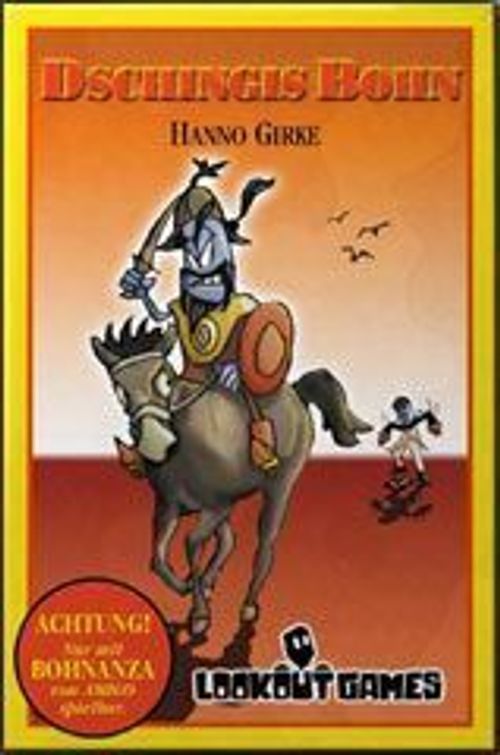
Dschingis Bohn
Dschingis Bohn Rulebook
Table of Contents
Table of Contents
Components
- 32 landscape cards: 5 each of Camp (Feldlager) and Cart (Karren); 3 each of Town (Stadt), Village (Dorf), Plantation (Plantage), Steppe (in different colours to match each steppe), Riders (Reiterschar, in the colour of the matching steppe) and Forest (Wald); 2 each of Gemstone Field (Edelsteinfeld) and River (Fluss).
- 4 punch-out sheets with 60 tokens in total, in 5 colours.
- 1 rulebook.
Object of the Game
To play Dschingis Bohn, the game Bohnanza by Uwe Rosenberg is required, published by Amigo Spiel+Freizeit. The original rules apply, with one change: at the end of the game the hard-earned bean coins are worth nothing. The bean coins are used to finance the raids of the Mongol bean hordes. The players try to bring as large a part of the bean realm as possible under their control. Victory points are gained for controlling landscapes. Unless stated otherwise, each landscape is worth 1 victory point (the flag marker on the card).
Setup
There is no "3rd bean field". The corresponding cards go back into the Bohnanza box. Not all landscape cards are needed for the game. Depending on the number of players, the following cards are taken out of the game and put back into the Bohnaparte box:
- 3 players: 2 Camps of your choice, 2 Rivers, 1 Town.
- 4 players: 1 Camp of your choice, 1 Forest, 1 Village, 1 Plantation and 1 Town.
- 5 players: 1 River, 1 Forest, 1 Town, 1 Village and 1 Plantation.
The 3 Riders and the 5 Carts are set aside, ready to hand, to the side.
Next, the board is laid out. The Camps are placed, depending on the number of players, on the white-marked spaces:
- 3 players: spaces 02, 13 and 16.
- 4 players: spaces 02, 08, 12 and 18.
- 5 players: spaces 01, 03, 10, 17 and 19.
The remaining landscape cards are shuffled and placed face-up at random on the grey spaces.
At the end of the rules, in the section "Variants", there are ideas for different starting layouts and for playing with more than 5 players.
A starting player is determined. After the layout, the player to the right of the starting player chooses a Camp as their starting space, takes the 12 tokens in the colour of that Camp and marks the Camp with one of their tokens. The other players follow counter-clockwise. The starting player takes the Camp that is left over.
(Board layouts for 3, 4 and 5 players, as printed: the numbered grey spaces are 01 to 19 in each case, with the Camps on the white spaces listed above.)
Combat
The bean coins earned are used to finance the raids of the Mongol bean hordes. Each bean coin is worth one attack.
Only the active player may attack, and only towards the end of their turn, directly before drawing cards.
Combat follows this sequence:
- Pay 1 bean coin (back onto the discard pile).
- Determine the attacked landscape. It must be directly adjacent to a landscape that the attacking player controls.
- The attacker decides how to attack (Riders, Hand or Stack) and places the card face down in front of them, or face up in the case of the Riders.
- The defender decides how to defend (Hand or Stack) and places the card face down in front of them.
Both sides reveal their card. The number printed on the card is the combat value (which may be modified by certain landscapes).
If the attacker's combat value is higher than the defender's, the attack succeeds. The attacker removes the opposing token from the landscape, if there is one, and places one of their own. If the values are equal or the attacker's value is lower, the attack fails.
Regardless of the outcome of the combat, the attacker may now decide to make further attacks, as long as they have enough bean coins to motivate their troops.
When determining the combat cards, the attacker has up to three options:
- Hand: the player may use any card held in their hand as the combat card.
- Stack: the player may use the top card of the draw pile as the combat card.
- Riders: if a player controls a Steppe and therefore a Riders card, they may attack in two waves. In the first combat round the Riders attack with a fixed attack value of 17. More on attacking with Riders is described below.
The defender only has the options Hand and Stack.
Neutral landscapes, which are not yet occupied by any player, always defend from the Stack.
After use, all bean cards used as combat cards go onto the discard pile.
Attack with Riders
The Mongol beans could hardly be stopped on their wild rides. A player who controls a Riders card that has not yet been defeated in this turn may (but does not have to) use that Riders card when attacking.
If a player attacks with Riders, the attack goes over up to two combat rounds.
In the first combat round the Riders card is used as the combat card. Riders always have an attack value of 17; the defender defends as normal.
If the Riders win the combat, there is no second combat round, and the attacker places the Riders card back in front of them normally. They may continue to use it in combat.
If the Riders are defeated, the "regular" troops move up and the attack goes into the second combat round. Here, however, the attacker only has the choice between Hand and Stack. The defender must play a new combat card and again has the choice between Hand and Stack.
Defeated Riders are placed by the attacking player in front of them, turned 90 degrees. They may only be used again in their next turn.
If a player has more than one Riders card, they must announce which of their Riders they are using for the attack. Only one Riders card may be used per attack. If one of a player's Riders has been defeated, they may still use other Riders in this turn that have not yet been defeated for the double attack.
An undefeated Riders card may be used in several successive attacks during the same turn, as long as it remains victorious.
Riders cannot be used against Forests and Towns.
If a player conquers a Steppe, they receive the Riders card in its current state. If it is undefeated, they may use it for further attacks from then on. If it has been defeated, they may only use it in their next turn.
At the start of their turn, each player turns all defeated Riders they control back to their original state, to show that they can be used for an attack again.
Carts
For 3 bean coins, the players may buy a Cart once during the game, when they currently control a Forest. It does not matter later whether the player still controls a Forest; only the moment of purchase is important.
When a Cart is bought, the top two cards of the draw pile are placed face down into it.
Instead of drawing cards normally from the draw pile, a player with a Cart places the same number of cards from the top of the draw pile into their Cart, looks at the cards in their Cart, and takes the same number of cards from their Cart in an order of their choice and tucks them behind their hand. Two cards therefore always remain in the Cart.
Landscapes
Most landscapes have special properties:
- Town (Stadt): A Town is worth 3 victory points. If a Town is attacked, the combat value of the defender is automatically raised to 18, if it is lower.
- Village (Dorf): A Village provides improved supplies. For each Village the player controls, they draw one more card in the last phase of their turn. If a Village is attacked, the combat value of the defender is automatically raised to 16, if it is lower.
- Plantation (Plantage): Plantations provide a richer harvest. For each Plantation the player controls, they turn over one additional card from the draw pile in phase 2 of their turn.
- Steppe: A player who controls a Steppe gains control of the corresponding Riders card. To distinguish which Riders belong to which Steppe, the horses have different colours. More on Riders is described in the section on Combat.
- Forest (Wald): Forests stop galloping Riders. If a Forest is attacked, the combat value of the defender is automatically raised to 17, if it is lower. Only a player who controls a Forest may cross Rivers and build Carts.
- River (Fluss): A River space cannot be controlled, and therefore it is worth no victory point. A River space cannot be entered. If a player controls a Forest, they may however cross the River space and move onto each space adjacent to the River.
- Example: If space 10 is a River, a player who has a Forest (and with it the timber for rafts) may move from space 09 onto spaces 06, 11 and 15. If spaces 10 and 06 are Rivers, the player could even move onto spaces 02, 03 and 07.
- Gemstone Field (Edelsteinfeld): A player who controls a Gemstone Field turns over the top card of the draw pile at the start of their turn (before playing any cards). If its value is between 6 and 12, they take it directly as bean coins into their money. If the value is between 14 and 20, they place the card on the discard pile.
End of the Game
The game ends as in the Bohnanza base game, when the draw pile has been gone through three times. The game also ends early if a player loses their last landscape. The player with the most victory points (flag markers on controlled landscapes) wins the game.
Special cases: as in Bohnanza, a tie is also not excluded here! If the last card of the last draw pile is used during an attack, and further cards must be drawn to resolve the combat, an auxiliary draw pile is formed from the discard pile, from which the necessary cards are drawn. In this case the game ends as soon as the attack is over. Further attacks by the player are then no longer possible.
Variants
Dschingis Bohn is fully compatible with Bohnaparte, which was also published by Lookout Games. The landscapes can be combined with each other to lay out bean realms of a size never seen before. There are no limits to creativity here. The more players there are, however, the more often the draw pile should be gone through.
Plundering: Mongol beans have an extreme aversion to towns. Their wild devastations are legendary. In this variant, a player whose hordes have taken a Town may burn it down. The Town card is turned over to its reverse side, to be treated for the rest of the game as a normal landscape without special properties (such as a Camp). It is worth only 1 victory point. In return, the plunderer gains one victory point. The player takes one of the landscape cards that were removed from the game during setup and places it face down in front of them as a point.
Starting layouts for beginners: The starting layouts for 3, 4 and 5 players are shown below. Each is a hexagonal layout of 19 landscape cards, in rows from top to bottom. The Camps are placed on the spaces listed in the Setup section.
- 3 players (rows, 3 - 4 - 5 - 4 - 3):
- Steppe, Camp, Gemstone Field
- Forest, Plantation, Village, Forest
- Camp, Village, Forest, Plantation, Camp
- Steppe, Plantation, Village, Steppe
- Town, Gemstone Field, Town
- 4 players (rows, 3 - 4 - 5 - 4 - 3):
- Steppe, Town, Camp
- Gemstone Field, Forest, Village, River
- Camp, Village, Steppe, Plantation, Camp
- River, Plantation, Forest, Gemstone Field
- Camp, Town, Steppe
- 5 players (rows, 3 - 4 - 5 - 4 - 3):
- Camp, Town, Camp
- Steppe, Village, Plantation, Forest
- Gemstone Field, Forest, Camp, Steppe, Gemstone Field
- Steppe, Plantation, Village, Forest
- Camp, Town, Camp