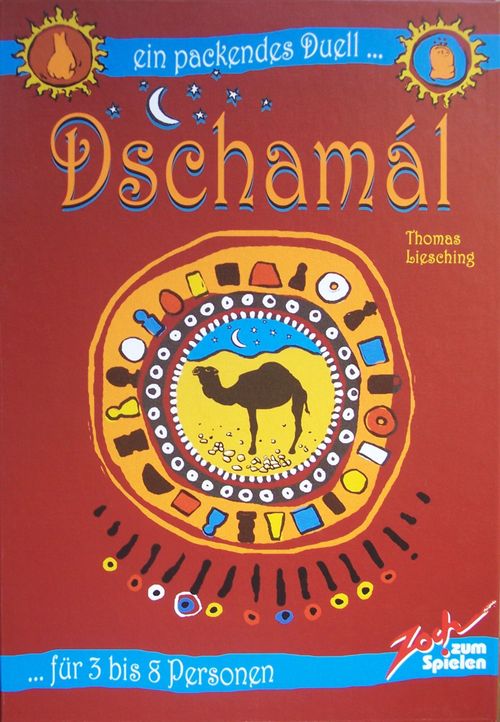
Dschamál
Dschamál Rulebook
Table of Contents
Table of Contents
Game Material
- 1 black woolen bag
- 48 brightly coloured wooden playing stones in 4 colours and 12 shapes
- 11 black wooden playing stones (one of the stones is the camel)
- 1 manual
Before the game can begin, all players must remove their rings, necklaces, watches and other jewellery from their hands and wrists.
Because nobody may see what happens inside the "grab bag of Dschamál", honesty is the highest commandment.
Do not play too wildly and hurt neither yourself nor the others.
It is obviously forbidden to snatch stones out of fellow players' hands, to hinder each other or to hold each other fast. What is asked for is never "brute force" but "delicate touch".
The manual contains four sets of rules:
- Duel for Dschamál.
- The Dschamál Tower.
- The Dschamál Trio.
- The Dschamál Quartet for children.
Duel for Dschamál
Can be played with 3 - 8 persons, ages 8 and up.
Object of the Game
The game is played in duels. Each time, two players simultaneously reach into the bag and try to take a stone of a certain shape out of the bag.
The collected stones become winning stones as soon as all four stones of the same shape have been fished out of the bag. Whoever can collect seven winning stones in this way wins the game.
Game Preparation
Each player places one arbitrary blue stone in front of him or her. The camel and the remaining stones are put into the bag.
Game Play
The Duel
The player with the shortest fingers puts the bag down for the first duel between him or her and his or her left-hand neighbour. Both players hold the bag by the hem with one hand.
Another player calls: "Dschamál". Then both duellists reach into the bag with their free hand and try, by feeling and groping carefully, to take one stone out of the bag.
This stone must:
- already be in the same shape in front of one of the two duellists, or
- be the camel. In that case the player calls: "I am the camel".
The player who believes he or she has one of these stones in his or her hand pulls the hand out of the bag and quickly places the hand (unopened) on the table. If both players do this almost simultaneously, the other players decide which of them was the fastest. The slowest throws his or her stone, without looking, back into the bag. If both players were equally fast, the duel is repeated (both stones are first put back into the bag without being looked at). Whoever has already taken a stone out of the bag may not reach into the bag again to look for another stone.
The Result of the Duel
Now it all depends on the SHAPE of the stone that the fastest player took out of the bag. There are eight possibilities.
In these three cases the faster player wins the duel:
-
He or she owns the drawn shape himself or herself. Marc is faster than Anne and draws a ball. He wins this duel because he already owns a ball. He now also places this ball in front of himself. That Anne also owns a ball plays no role.
-
Not he or she, but his or her opponent in the duel owns the drawn shape. Marc is faster than Herman and draws a narrow roof. Although he does not yet own any narrow roofs, Marc wins this duel because Herman already owned narrow roofs. Marc receives the drawn narrow roof and a narrow roof from Herman.
-
He or she has drawn the camel out of the bag and calls "I am the camel!" before placing it on the table. Carl is faster than Marc. He draws the camel and calls: "I am the camel!". Therefore he wins the duel. He takes away a stone of his choice from Marc.
In these five cases the slower player wins the duel:
-
The drawn stone is black (but not the camel). Werner is indeed faster than Carl, but he has drawn a black stone. Therefore Carl wins the duel. He may take away a stone of his choice from Werner.
-
Neither of the two duellists owns the drawn shape. Carl is faster than Marc. He has fished the yellow egg out of the bag. Neither of them owns an egg. Marc receives the egg.
-
The camel is drawn, but the faster player does not call "I am the camel!" before placing it on the table. Marc is faster than Anne and draws the camel. He forgets, however, to call "I am the camel". Anne may take away a stone of her choice from Marc.
-
The player who calls "I am the camel!" although he or she did not draw the camel must give the drawn stone to his or her duel partner. If the "camel caller" has drawn a black stone, his or her opponent takes an already collected stone away from him or her. If both players wrongly call "I am the camel!", the duel is repeated. Anne draws a multicoloured stone and calls: "I am the camel!". Herman receives the drawn stone.
-
Whoever, as the faster player, has (by mistake) drawn two or more stones out of the bag has lost the duel. The drawn black stones go back into the bag, the coloured stones are given to the duel opponent. Herman is indeed faster than Carl, but he draws two stones out of the bag. Carl receives the coloured stone, the black stone goes back into the bag.
The stones that a winner of the duel receives may not be winning stones (see further under the chapter "The Winning Stones" on page 9).
As long as a camel or a black stone is drawn, this object is put back into the bag.
The Loser of the Duel Owns No Playing Stones
It can happen that a loser of a duel, who has to hand a stone to the winner of the duel, owns no playing stones. In this case the winner of the duel may reach into the bag again to try to find a coloured (not black) stone of a shape that no player owns yet. If that succeeds, he or she may keep this stone (otherwise the stone must be put back into the bag).
The Next Duel
In a game with three players, play always proceeds in turn. This can also be done in larger groups. Because everybody could play against everybody, from a group of four players onward the following order of duels is observed:
- The player who wins a duel becomes the "lord of the stones".
- Whoever defeats the "lord of the stones" duels with his or her left-hand neighbour.
- If the "lord of the stones" wins the duel, the next duel is fought against the left-hand neighbour of the loser.
Anne wins in succession against Marc (1) and Herman (2). She therefore remains "lord of the stones". Then Anne loses against Carl (3). Carl becomes the new "lord of the stones". Next Carl wins the duel against his left-hand neighbour Werner (4). His next opponent is Marc. In the illustrations the colour of the arrow always shows the winner of the duel.
The player who succeeds in winning once a complete round against all fellow players may not take part in the next duel. Instead, his or her left-hand neighbour now becomes the new "lord of the stones". He or she duels with his or her left-hand neighbour.
Carl has first won his duel against Werner (1), then in succession against Marc (2), Anne (3) and Herman (4). Therefore his left-hand neighbour Werner now becomes the new "lord of the stones". He now duels with Marc (5).
The loser of a duel never takes part in the next duel. If necessary he or she is skipped (meaning that his or her left-hand neighbour takes part in the duel). This rule does not apply in a game with three players.
After Werner has won his duels in succession against Marc (1), Anne (2) and Herman (3), he loses against his right-hand neighbour Carl (4). Because Carl now becomes the new "lord of the stones", he should actually duel with his left-hand neighbour Werner (5). Because Werner, however, lost the previous duel, he is skipped and Carl now duels with Marc (6).
Neither of the Duellists Owns a Stone
If at the start of a duel there are no playing stones in front of either of the two players (or only winning stones), a coloured stone is taken out of the bag and placed in the middle of the table as the decision stone. The decision stone must (if possible) have a shape that no player owns yet.
The duel is won by the faster player if he or she can take a stone of this shape out of the bag. He or she then receives the drawn stone and the decision stone. The faster player also wins the duel if he or she draws the camel out of the bag and calls "I am the camel!". He or she then receives only the decision stone. The camel goes back into the bag.
If the faster player loses the duel, his or her opponent receives the decision stone. The drawn stone is put back into the bag.
The Winning Stones
As soon as all four stones of one shape lie in front of one player, these stones become winning stones. Every player who owns winning stones places them clearly separated from his or her other playing stones. Winning stones are safe and can no longer be lost when duelling.
End of the Game and Winner
The player who is the first to have gathered seven winning stones wins the game.
The Dschamál Tower
Can be played with 3 - 6 persons, ages 10 and up.
Object of the Game
The players fight duels to receive playing stones. The coloured (not black) stones are built into a tower and yield victory points. Black playing stones are collected and cause minus points if one has too few of them. They yield victory points if one has the most of them. Whoever succeeds in building a tower with seven playing stones ends the game. The player with the most victory points wins the game.
Game Preparation
The four eggs are sorted out. All other playing stones are in the bag at the start of the game.
Game Play
Duels are fought again. It is recommended to fight the duels next to the playing table, because the towers are built on the playing table. For that reason drawn playing stones are not placed on the table but on one's own head.
The player who in a duel was the first to take a playing stone out of the bag and has placed it on his or her head ...
- keeps this stone if no player yet owns a playing stone of this shape (this also holds for black playing stones)
- gives the playing stone to a player of his or her choice if he or she himself or herself owns a stone of this shape (the receiver of this stone may already own a playing stone of this shape)
- acts in the following way if he or she has drawn the camel: He or she may give an already collected black playing stone to a fellow player of his or her choice or take a black playing stone (if available) of his or her choice away from a fellow player.
The slower duellist of course throws his or her playing stone back into the bag.
Whoever, as the fastest player, has (by mistake) drawn two or more playing stones out of the bag has lost the duel. He or she throws all drawn black playing stones and the top stone of his or her tower back into the bag. His or her duel opponent now becomes the "lord of the stones".
Building the Tower
With the playing stones that one receives in the course of the game, every player builds a tower for himself or herself on the table. Every coloured (not black) playing stone must be built into one's own tower immediately after receipt. The first playing stone forms the foundation. Only this stone may touch the table. All other stones that are built into the tower from now on must be built in such a way that the tower does not collapse. Doing so, the playing stones that are already in the tower may no longer be touched. Only with the "new playing stone to be built in" may the already built-in playing stones be shifted.
Black playing stones are not built into a tower, but are laid down in front of the players (until the end of the game).
If a tower collapses, the affected player throws all coloured playing stones that have fallen off the foundation back into the bag. The foundation and the stones that still lie on the foundation (without touching the table) remain standing and form the start of the new tower on which one can continue to work. All black playing stones that one has collected up to the collapse of the tower may be kept.
If a tower collapses through no fault of one's own (because, for example, a fellow player bumped against the table), then the player may rebuild the tower in the same order and style.
Werner was faster than Marc. He has drawn a ball and in his tower there is already a ball. He gives the ball to Anne and she must immediately build this ball into her tower.
The Next Duel
The rules of the "Duel for Dschamál" apply. In this variant the winner of a duel is always the player who was the first to take a playing stone out of the bag.
End of the Game and Winner
The player who is the first to have built seven playing stones into his or her own tower ends the game. The game also ends when ten black playing stones lie on the table in front of the players.
Now the players receive victory points:
- For every playing stone that is in one's own tower at the end of the game, one receives 1 victory point.
- The player with the most black playing stones receives 3 victory points. If several players have the most black playing stones, each of them receives 2 victory points. In this case no victory points are awarded to the player with the second most black playing stones.
- The player with the second most black playing stones receives 1 victory point. This also holds if several players have the second most black playing stones.
- The players who do not have the most or the second most black stones must subtract 1 victory point for every black playing stone.
The player with the most victory points wins the game.
Example
Marc has ended the game because he was able to build seven playing stones into his tower. He owns one black playing stone. Werner owns two black playing stones and his tower consists of 6 coloured playing stones. Herman owns three black playing stones and his tower consists of 5 coloured playing stones. Anne has likewise collected three black playing stones and her tower consists of 4 coloured playing stones. The players score the following victory points:
- MARC receives 7 - 1 = 6 victory points. He receives 7 victory points for his tower and he must subtract 1 victory point because he has collected 1 black playing stone (not the most and not the second most).
- WERNER receives 6 - 2 = 4 victory points. He receives 6 victory points for his tower and he must subtract 2 victory points because he has collected 2 black playing stones (not the most and not the second most).
- HERMAN receives 5 + 2 = 7 victory points. He receives 5 victory points for his tower and he receives 2 victory points because he (like Anne) has collected the most black playing stones.
- ANNE receives 4 + 2 = 6 victory points. She receives 4 victory points for her tower and she receives 2 victory points because she (like Herman) has collected the most black playing stones.
The Dschamál Trio
Can be played with 3 - 8 persons, ages 10 and up.
Object of the Game
The players fight each other in a three-way contest. Three players reach into the bag simultaneously to find a certain playing stone. The playing stones collected in this way are, as in the "Duel for Dschamál", converted into winning stones as soon as all four stones of the same shape have been fished out of the bag.
The player who has collected seven winning stones wins the game.
Game Preparation
Each player places one arbitrary yellow playing stone in front of him or her. The remaining playing stones are put into the bag.
Game Play
Now no duels are fought, but three-way contests.
The player with the longest fingers fights out the first contest with his or her left-hand and right-hand neighbours. All three players reach into the bag simultaneously to take a playing stone out of the bag and place it on the table. The fastest player and the second fastest player place their drawn playing stone on the table. The slowest player throws his or her playing stone (without looking) back into the bag.
The three-way contest is won by the fastest player insofar as he or she fulfils condition A or condition B.
- Condition A: His or her drawn playing stone already lies in the same shape in front of one of the participants in the three-way contest.
- Condition B: He or she has drawn the camel and called "I am the camel!" while doing so.
If the fastest player has won the three-way contest, the second fastest player throws his or her drawn playing stone back into the bag.
If the fastest player, however, has fulfilled neither of the two conditions, it is checked whether the second fastest player has fulfilled one of the two conditions. If so, he or she wins this three-way contest. Otherwise the slowest player wins (although he or she has no stone).
In a three-way contest with Carl and Herman, Anne wins. Carl did draw, before Anne, a playing stone (a block) that none of the participants in the three-way contest owns. Anne has drawn a disc out of the bag faster than Herman. Because Carl already owns discs, Anne receives not only the drawn disc but also one disc from Carl.
Note: Because now all four discs have been drawn out of the bag, they become winning stones for Carl and Anne.
If the fastest or the second fastest player becomes the winner of the three-way contest, he or she receives:
- his or her drawn coloured playing stone;
- a playing stone of the drawn shape from each participant in the three-way contest who owns at least one such playing stone.
If the slowest player becomes the winner of the three-way contest, he or she receives the coloured playing stones that his or her two opponents have drawn.
If the winner of the three-way contest has drawn the camel and has called "I am the camel!" while doing so, he or she receives from both participants in the three-way contest a playing stone of his or her choice (not a winning stone).
Marc was faster than Anne. He has drawn the blue ball. Because neither he, nor Anne, nor Herman owns a ball, Marc has not won the three-way contest. As second fastest, Anne has drawn the camel. She becomes the winner of the three-way contest on condition that she did not forget to call "I am the camel!". If she nevertheless forgot this, Herman becomes the winner of the three-way contest. He then receives the ball that Marc has drawn.
No Participant in the Three-Way Contest Owns a Stone
Here the rules of the "Duel for Dschamál" apply. If the fastest player loses the three-way contest, the second fastest player receives the decision stone. The slowest player receives the drawn coloured playing stone of the fastest player.
The Next Three-Way Contest
Play proceeds in turn. Whoever sat next to both of his or her participants in the last three-way contest fights the next three-way contest with his or her two left-hand neighbours.
Marc, Anne and Herman took part in the last three-way contest. Anne, Herman and Carl fight out the next three-way contest, and afterwards follows the three-way contest with Herman, Carl and Werner.
End of the Game and Winner
The player who is the first to have collected seven winning stones wins the game.
The Dschamál Quartet for Children
Can be played with 3 - 6 persons, ages 5 and up.
Game Preparation
Each player places two arbitrary blue playing stones in front of him or her. The camel is taken out of the game. The remaining playing stones are put into the bag.
Game Play
In this variant too, play proceeds in duels. Play proceeds in turn. Whoever's turn it is duels with his or her left-hand neighbour.
The player who was the first to take a playing stone out of the bag waits until the second player has also drawn a stone. Then the result is checked.
The faster player ...
- ... keeps the drawn stone if he or she already owns this shape.
- ... throws the drawn stone back into the bag if he or she does not own this shape. Black stones are always thrown back into the bag. In that case it is checked which playing stone the slower player has drawn out of the bag. If he or she has drawn a stone that he or she already owns, he or she may keep this stone. Otherwise the stone is put back into the bag.
End of the Game
The player who is the first to have collected four playing stones of the same shape (a quartet) wins the game.