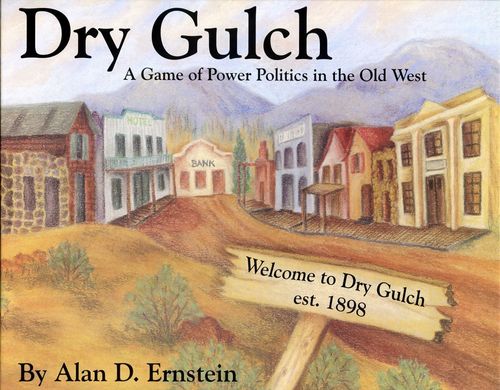
Dry Gulch
Dry Gulch Rulebook
Table of Contents
Table of Contents
Material
- 1 game board (6 pieces, with a map of the building sites of Dry Gulch)
- 81 resource cards (goods and abilities, on brown wood)
- 39 event cards (on red wood)
- 33 building permits
- 102 family member chips (18 each in 6 colors; the stickers belong on the chips)
- 6 damaged building markers (the additional red chips)
- 1 rulebook
Object of the Game
The 3 to 6 players try to gather enough influence points to be elected mayor. Influence points are earned by building different types of buildings and by upgrading them. The first player who has the required number of influence points during his building phase wins the game.
Setup
-
Spread out the game board and determine a starting player.
-
Starting with the starting player, each player chooses a color, takes the corresponding residence (Residence) and places it on a free building site on the board, so that the foot path points to a thick black line and to the outside edge of the board.
-
Each player takes the family member chips (chips) of his color:
- With 3 players: 17
- With 4 players: 15
- With 5 players: 13
- With 6 players: 11
One chip is placed on the residence.
-
Building permits, resource cards and event cards are kept separate. Each stack is shuffled and placed face down on the corresponding space on the board. Resource cards show their information on a brown grain. Event cards show their information on a red grain.
-
Each player is dealt, face down, 5 resources and 3 building permits.
Turn
Each turn of a player consists of the following phases:
- Draw event cards
- Either draw a resource card or draw building permits
- Build
- Receive rewards
- Discard cards
Draw Event Cards
In the first round the players do not draw event cards.
The top three event cards of the stack are turned face up and placed in front of the active player. The player must immediately discard one of these three cards. The remaining cards with a red or yellow triangle the player may take into his hand. All other cards remain face up. The player must play these cards during the course of his turn, before the reward phase. When exactly he plays them is his choice.
Some cards concern buildings that have not yet been built. If a player loses cards to a building that has not yet been built, he discards them instead. If he receives cards from a building that has not yet been built, he draws them from the resource stack.
Some event cards remain in effect until the end of a particular player's turn. As a reminder, such a card is placed in front of the relevant player and remains in effect until the discard phase of the affected player's turn.
Draw Resources or Building Permits
A player may draw either resource cards or one building permit:
- If he draws from the resource stack, he draws three cards. If the stack is empty, the discarded cards are reshuffled and used.
- If a player draws a building permit, he either takes one of the (face up) discarded permits, or he takes two from the face-down stack and discards one of them.
Note: Building permits are kept face down in front of each player. They cannot be traded and cannot be lost when random cards must be discarded.
Build
| English | German | Cards |
|---|---|---|
| Mason | Maurer | 3 |
| Blacksmith | Schmied | 2 |
| Carpenter | Zimmerleute | 2 |
| Brick | Ziegelsteine | 3 |
| Lumber | Holz | 2 |
| Whiskey | Whisky | 2 |
| Entertainment | Unterhaltung | 1 |
| Food | Nahrung | 1 |
| Labor | Arbeit |
In his turn a player may build as many buildings and play as many influence cards as he wants, as far as his resource cards allow him to afford them.
Buildings are built by playing the goods and ability cards that the building requires. If a player does not have all the required resources, he may replace missing ones with any other cards from his hand, according to the table. The table is also printed on the edge of the board. (Example: Otto tries to build the Pharmacist. He has: 1 Carpenter, 3 Lumber, 1 Labor, 1 I.O.U. and a Gold Strike. He uses 1 Carpenter as a Carpenter and one Lumber as Lumber. He uses 2 further Lumber as a Blacksmith. The I.O.U. and the Gold Strike are used as Whiskey, and the Labor card as Labor; the surplus point on Labor is lost unused.)
Once the cost of the building has been paid, the cards are sorted onto the matching discard spaces on the board. A building must be placed so that its sidewalks match the thick dark lines along the streets. A sidewalk may never lie between two buildings. A corner building may not be built in the middle of a block, and a building without a corner may only be played in the middle of a block or at the end of a street.
When the building is built, as many family member chips are played as the building has influence points.
Each property has a reward value (Reward). The corresponding number of resource cards is drawn from the stack in the reward phase.
A player may play influence cards during the build phase. When the conditions of a card are fulfilled, the player may play the card face up in front of himself on the table. It stays there until the end of the game. The player also places a family member on the board. During the reward phase, the players who own the buildings belonging to the card may draw three additional resource cards.
A player may also play a misfortune event (red triangle) from his hand.
Reward Phase
All event cards must be resolved before the reward phase ends.
Each player draws his resource cards from the corresponding stack.
Discard
The active player may discard any cards he wants. He also discards all event cards that other players have played against him.
All players with more than 15 cards must discard randomly selected cards.
Special Rules
Building permits are kept face down in front of each player. They do not count as cards in the sense of these rules. They cannot be stolen, traded or discarded.
All hand cards may be used for building costs, including event or influence cards.
Certain buildings have special functions, and these functions are in effect as soon as the building has been built:
- Bank: The owner of the bank may, during the resource and building permit draw phase, draw two resources and the top building permit from the stack. (If the stack of building permits is empty, this ability no longer applies.)
- General Store (Laden): The owner of the store may use any one of his hand cards as one good (not an ability) for building in each turn. If a player owns both general stores, he may use two hand cards in this way.
- Blacksmith (Schmiede): The owner of the blacksmith no longer needs Blacksmith resources for new buildings.
Event cards with a red triangle are misfortunes:
- A damaged building is marked by placing a corresponding marker on it.
- The event card is placed in front of the owner of the affected damaged building. (It is discarded in the discard phase of the affected player.)
- The affected player loses cards accordingly.
- Half of the influence points that belong to the damaged building do not count and are therefore not available to end the game.
- No player may have more than one Fire and one Vandalism card in front of him.
Cards with a yellow triangle may be kept and played at a suitable point.
All influence points, special abilities, rewards and penalties resulting from a building are suspended while that building is damaged.
When the misfortune event card is discarded, the marker is also removed from the building, and the building counts again as fully valid.
Cards that a player receives because of events he takes into his hand immediately. Cards a player receives as a reward he always receives only in the corresponding phase.
The players' family member chips remain visible on the table. This way it is possible to see at any time how many points each player still lacks for victory.
Winning the Game
If at any time during the build phase a player has enough influence points on the board, he wins.
(Reminder: influence from damaged buildings counts only half.)
Optional Rules
- Advanced setup: The building permits are not dealt at random at the start. Beginning with the last player and proceeding in reverse order, each player selects one building permit from the cards and then passes it to the next player. This continues until each player has two building permits.
- Damage to the City Hall: Vandalism and Fire may be played against the City Hall. If this happens, the City Hall is closed, and therefore no player may draw building permits until the active player is again on turn. The City Hall may be reopened by any player at the end of his event phase by discarding any two cards.
- Open building permits: If a player draws a building permit in the resource and building permit phase, he may look through the stack and take any permit he likes.
- Spreading fire: As long as no Firehouse is in play, fire spreads to neighboring houses at the start of each player's turn. Fire does not spread across the street or across open squares. The fire goes out when the originally affected player is allowed to discard the event card.
Board
- Only the Bank may be built on the single site lying alone in front of the town (Bank only).
Resource Cards
| English | German | Type |
|---|---|---|
| Labor | Arbeit | Ability |
| Carpenter | Zimmermann | Ability |
| Brick | Ziegelsteine | Good |
| Mason | Maurer | Ability |
| Blacksmith | Schmied | Ability |
| Lumber | Holz | Good |
| Whiskey | Whisky | Good |
| Entertainment | Unterhaltung | Good |
| Food |
Event Cards
Red Triangle (Misfortunes)
- Fire: Played against any building. The building is then damaged. If there is no Firehouse, the owner of the affected building must, for help in putting out the fire, have each fellow player draw one card from his own hand. If there is a Firehouse, its owner may draw 2 cards.
- Vandalism: Played against any building. The owner of the affected building must let one card be drawn from him, which is discarded.
Violet Triangle (Special Equipment)
- Gold Strike: Counts 1 influence point. Can only be played at the end of the game.
- Silk Lace: Counts 1 influence point. Can only be played if the General Store is already built. The owner of the General Store receives 3 reward cards.
- City Hall Clock: Counts 1 influence point. Playable after the Post Office has been built and the stagecoach (Wells Fargo Wagon) has arrived. The Post Office receives 3 reward cards.
- Printing Press: Counts 1 influence point. Playable after the Newspaper has been built. The Newspaper receives 3 reward cards.
- Fire Engine (water pump): Counts 1 influence point. Playable after the Firehouse has been built. The Firehouse receives 3 reward cards.
- Deputy (Vice Sheriff): Counts 1 influence point. Playable after the Sheriff's Office has been built. The Sheriff's Office receives 3 reward cards.
- Two Ton Safe (heavy safe): Counts 1 influence point. Playable when the Bank and the Blacksmith are built. The Bank and the Blacksmith each receive 3 reward cards.
- French Madam: Counts 1 influence point. Playable when the Bordello has been built. The Bordello receives 3 reward cards.
- Diploma: Counts 1 influence point. Playable after the Doctor's Office has been built. The Doctor's Office receives 3 reward cards.
Yellow Triangle (Special Abilities)
- Ace up your sleeve (clever little head): Whenever cards are to be drawn from you, you show this card and take it back again. Afterwards you may set aside one of your cards in order to protect it from being drawn.
- I.O.U.: Whenever (any number of) cards are to be drawn from you, you hand over this card and no cards are drawn this time.
- Fire Insurance: Whoever hands over these cards prevents the loss of cards in the event of a fire. The loss of influence points is not prevented.
- Handyman Brother (helper): May be played as any ability.
No Triangle (Other Events)
- Election Poll (2x): For each player, the influence points on the board are counted. Each player draws one card for every point by which he is behind the leader.
- Main Street Shootout (2x): The Undertaker receives one resource card.
- Doctor gets a new medicament: The Doctor loses two random cards to the Pharmacist.
- Headline about mayor-to-be: The leading player loses two random cards to the Newspaper. In case of a tie, each leader loses one card to the Newspaper.
- Doctor gets a close shave: The Doctor loses two random cards to the Barber.
- Banker gets a new pipe: The Bank loses two random cards to the Tobacconist.
- Gunfight in the Saloon: This card is played against any Saloon. The affected player loses cards at random to the Undertaker, the Sheriff and the Doctor, one each.
- Wells Fargo Wagon (stagecoach 1): Each player loses one random card to the Post Office. Afterwards each player draws 3 cards.
- Land Grant: Draw 1 building permit from the stack. If the stack is empty, the action is forfeited.
- Sheriff Shot: The Sheriff loses two random cards to the Doctor.
- Undertaker's horse is ill: The Undertaker loses two cards to the Stables.
Notes on event cards: Buildings here refer to their owners (who then gain or lose cards). Random card losses are carried out by having a fellow player draw the corresponding number from the affected player's own face-down cards.
Translator's Notes
Building Types (small square cards)
| English | German |
|---|---|
| Residence | Wohnsitz |
| Saloon | Saloon (bar, pub) |
| Saddlery | Sattlerei |
| Hotel | Hotel |
| Opera | Opernhaus |
| General Store | Laden (large store) |
| Hatmaker | Hutmacher |
| Sheriff's Office | Sheriffs Büro |
| Newspaper | Zeitung |
| Blacksmith | Schmied |
| Soup Kitchen | Suppenküche |
| Undertaker | Totengräber |
Remarks on the Translation
The German source contains several typographical slips and open questions that were read as intended and are kept as printed in meaning. The German translation of the Silk Lace card title reads "Seiden was??", which is the translator's own unresolved query; the English title Silk Lace is kept as printed, and the query is noted here rather than resolved.
The source component list gives 102 family member chips, while 18 chips in each of 6 colors would total 108. The printed figure of 102 is kept as printed.