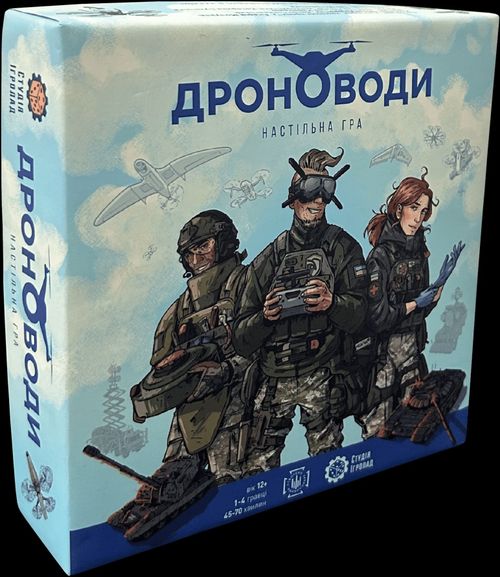
Дроноводи
Дроноводи Rulebook
Table of Contents
Table of Contents
Overview
Players recruit a unit, buy drones, develop technology projects, and try to hold out until the end of the game while protecting their Characters.
This is a cooperative game. All players may coordinate their actions and show their cards, but each player makes their own decisions.
Goal of the game: destroy as many enemy forces as possible without losing.
The game has four decks:
- Drones: reconnaissance and strike UAVs.
- Characters: pilots and specialists who form the unit (Crew / HQ, and the Trench).
- Support: Projects, Bonuses, Artillery, and Defence cards.
- Threats: enemy forces and Mishaps.
Game resources: Logistics, Reconnaissance, and Ammunition.
- Logistics (the track on the player board) is the currency of the game. Drones and Support cards are bought with it. Logistics is gained:
- from some Support cards during the Management phase;
- by exchanging trophies;
- +1 for each Character in the HQ during the Recovery phase.
- Reconnaissance is the resource needed to attack, both with Artillery Support cards and with drones. It is gained from reconnaissance drones and from Support cards.
- Ammunition is the resource needed to attack with drones, except Mavic. It is gained from the Engineer, from the Sapper, or from Support cards.
Winning and losing:
All players lose if at any moment of the game:
- any player has 4 wounded Characters, or
- the Trench has no Characters left.
Players win in one of two ways:
- ROTATION: play 4 rounds without losing; or
- TECHNOLOGIES: activate Projects with a total of 3 cards per player.
If the players have not lost, see "Determining the Winner" below.
Components
- 4 player boards
- 30 Character cards
- 21 Drone cards
- 35 Support cards
- 45 Threat cards
- 1 Defeat card
- 4 Reference cards
- 1 Operations Duty Officer token
- 1 D6 die
- 4 wooden Logistics markers
Setup
First game: remove from the Threat deck all cards marked with a red triangle, and give each player 1 Reference card.
The first player is the player who most recently held a real drone. That player takes the Operations Duty Officer token. Or choose the starting player in any other way.
1. Each player (see the illustration on page 4):
- places a player board in front of them, sets their Logistics marker on the Logistics track at 3, places their Mavic card on their Warehouse, and places the Universal Pilot card (with the icons of all drone types) in the Crew, at the top of the board;
- draws 5 random Support cards, looks at them, and discards one of them to the discard pile.
2. The Operations Duty Officer:
- thoroughly shuffles all decks, places the Defeat card face up, and on top of it places face down 3 randomly chosen Characters for each player. This is the shared Trench for all players;
- places 3 Drone cards face up in the centre of the table. This is the Drone Shop;
- places face up in the centre of the field 3 enemy cards with a distance-1 marker for each player;
- shuffles all other cards by deck and places them face down on the table.
The Operations Duty Officer takes the first turn.
At the start of the game, place on the field only enemy cards with a distance-1 marker. Mishaps, enemy cards with a distance-2 marker, and enemy drones are shuffled back into the Threat deck.
Table layout (the diagram on page 4 shows a two-player example and labels the following areas): Character deck; Support deck; Drone Shop; Threat deck; Trench; Field (first line and second line); Starting Pilot and Drone; Crew; Player's hand; Warehouse; Logistics track; HQ; and the space for trophies and wounded.
Card Markings
The illustration on page 5 explains the markings on cards:
- Pilot type restriction: a Pilot card with this marking can pilot only that type of drone.
- Character effects: the top half of the card applies only while the Character is in the Crew; the bottom half applies only while the Character is in the HQ.
- Effect description: the description explains the marking on the card.
- Drone card: the drone type is shown on the card; the number of attacks per sortie is shown in the upper right corner (for example, "attacks up to 2 times at distance 1").
- Resources and attack die result: the resources the drone needs, and the die result needed to hit.
- Card cost (Logistics): the cost to buy the card, shown in the upper left corner.
- Reconnaissance: the card gives Reconnaissance at the distance shown (for example, "gives Reconnaissance at distance up to 2").
- Artillery correction: the card lets the player re-roll the die.
Threat cards show the distance, the trophy value, the value that activates the card, the attack on the Trench, the description, and how many players the card affects.
Game Process
The game lasts 4 rounds. Each round has three phases (see the reminder on the player board).
1. Management Phase
Each player who begins their turn must either play or discard one of their Support cards from hand to the discard pile (see Support cards below), and then take one Action of their choice:
1.1 RECRUITING: take 2 Characters from the Character deck and place one of them in your Crew (A) or HQ (B), or in the Trench (C). Discard the other to the bottom of the Character deck.
A player may not have two identical Characters.
1.2 MOVEMENT of Characters between your own HQ and Crew, or into the Trench (but not out of the Trench).
1.3 EVACUATION: discard a wounded Character card to the bottom of the Character deck. This requires a Medic in your Crew, or an activated Aid Station Project.
1.4 BUYING A DRONE from the open cards of the Drone Shop, for Logistics (see page 10).
1.5 COMBAT SORTIE: attack with a strike drone, provided you have the matching Pilot and the Reconnaissance / Ammunition it needs (see page 12).
After this, the turn passes to the next player, and so on in turn order, four times around the table, until the players have no Support cards left in hand.
When the players have no Support cards left in hand, the Threat phase begins.
2. Threat Phase
Defence: each player rolls the die once and resolves the text of all enemy cards that have the same value as the die result.
If there are wounded Characters, move them from the Trench or Crew face down next to your player board, and check the defeat conditions (4 wounded Characters for one player, or an empty Trench).
Drones shot down during the Threat phase are discarded.
When all players have defended, the Operations Duty Officer draws 3 Threat cards for each player. Mishaps are dealt around the table, starting with the Operations Duty Officer, and enemy cards are placed on the field.
The Operations Duty Officer token passes to the player on the left, who begins the next round.
3. Recovery Phase
- Players discard any EW and Bunker cards that are in play, if any.
- Each player draws 5 Support cards from the deck into hand, and discards 1 of them to the discard pile.
- Each player gains +1 Logistics for each of their Characters in the HQ.
- If any Support cards marked "once per round" were used, turn them face up again. This restores the ability to use their Effects (see page 8).
After this, the Management phase of the next round begins.
Actions
Buying a Drone (Action 1.4)
When buying a drone, the player must reveal one more drone card in the Drone Shop, which increases the choice of drones. Then the player chooses:
a) if they cannot or do not wish to buy, pass the turn to the next player; or
b) choose a drone from the open cards in the Drone Shop, pay for it with Logistics, and place it in their Warehouse. Place another card face up in the empty space in the Drone Shop.
Warehouse limit: each player may have no more than 3 drones in their Warehouse at a time. If the player already has 3 drones in their Warehouse when buying, they must discard 1 drone to the discard pile.
Piloting: drones used for an operation (attack or reconnaissance) require a Pilot of the matching type in the Crew. Any Pilot may fly the Mavic. The Mavic can both provide Reconnaissance and attack. A Pilot is not required to buy a drone.
Characters
Characters have different Effects and Abilities depending on where they are placed.
For example, the Psychologist, when in the HQ and while Recruiting, lets the player choose one of four cards instead of two. The Pilot can operate a drone only while in the Crew; however, for each Character in the HQ, the player gains +1 Logistics at the end of the turn.
Source note: the Characters section says the +1 Logistics per Character in the HQ is gained "at the end of the turn"; the Recovery phase says the same +1 per Character in the HQ is gained during the Recovery phase. Both are transcribed as printed.
The Engineer in the Crew gives Ammunition, and in the HQ gives the ability to repair a drone.
Players, depending on their plans, use Recruiting and Movement to place Characters in the HQ, the Crew, or the Trench. Take care that the Trench does not become empty, and that no player has 4 wounded Characters. Either condition immediately causes defeat.
Note: in a single Action you may move as many Characters as you like. However, you may not take Characters out of the Trench with a MOVEMENT action. This is possible only with the Support card "Transfer Order".
EVACUATION (discarding your wounded Character to the deck) is possible as an Action only if the player has an activated Aid Station Project, or a Medic in the Crew. The Medic and the Aid Station cards also allow a wounded card to be discarded, but thanks to Evacuation it is possible to process more wounded Characters.
Drones and Combat Sorties
The Mavic or Valkyrie gives Reconnaissance at distance 1; the Fury or the activated Delta project gives Reconnaissance at distance up to 2.
The Support card "Counter-battery Reconnaissance" replaces the Reconnaissance resource, but only if the target is an enemy Artillery, MLRS, or TOS.
Kamikaze drones do not need Reconnaissance, only Ammunition.
Note: the flight of a reconnaissance drone is not played out in the game. Having such a drone and the matching Pilot in the Crew automatically gives the player Reconnaissance at the corresponding distance.
If an attack requires Reconnaissance at distance 2 and the player has only Reconnaissance at distance 1, that is not enough for the attack at distance 2.
A broken drone can be repaired by Characters and Projects.
Drones shot down during the Threat phase are discarded.
Some drones can correct Artillery: they allow the player to re-roll the die when attacking with Support cards.
Combat sortie is a set of 1 to 3 drone attacks, depending on the particular card. The number of attacks per sortie is shown in the upper right corner of the drone card (see the illustration).
To attack with a drone, the player must have a strike drone in their Warehouse, the matching type of Pilot in the Crew, and the Reconnaissance / Ammunition shown on the drone card.
In one turn, attacks may be made with only one drone, even if the player has several.
A drone attack is resolved as follows:
- Choose a drone, check that the matching Pilot is in the Crew, and check the resources shown on the drone card.
- Choose a target: an open enemy card. Read the description on that card, and roll the die.
- Add bonuses or penalties to the die result, if any (Pilots and Projects give bonuses; some enemy cards give penalties).
- If the total equals or exceeds the value on the drone card, the target is hit. The player takes the enemy card as their trophy.
If the attack result equals the value marked with a red die on reusable drones, turn the drone card face down. This drone is broken.
Source note: the printed icon key (page 15) gives this red-die marking as a result of 1 ("On a result of 1: drone breakdown"). The breakdown rule is transcribed as printed.
Example: A player has an FPV drone kit and an FPV Pilot. Their Ammunition comes from an Engineer in the Crew. Reconnaissance is not needed for this drone, since FPV drones can search for a target on their own.
The player makes a combat sortie to attack a tank. They roll a 5. The tank's armour gives a -1 penalty to the die, and the FPV Pilot gives +1. But there is an EW unit on the field which adds a -1 penalty. The total is 4, so the attack misses.
The FPV drone kit has three attacks, so the player attacks a second time. This also misses. One attempt remains.
Rolling a 6 on the die is quite hard, so the player uses the activated Project "AI module" instead. Rolling the die is not necessary, because the Project "guarantees a hit" (see the description on the card). The Project card is turned face down, because its Effect has been used.
The tank becomes the player's trophy. The drone is discarded to the discard pile, because the FPV is a kamikaze drone.
The player gains +1 Logistics, because there is a Blogger in the Crew. (Apparently the "video" appealed to the subscribers, who regularly donate for drones.)
Support Cards
At any time during the game, a player may, without spending an Action:
-
Use an Effect of a Character card or an activated Project, as described on the card. After using an Effect marked "once per round", turn the card face down.
-
Exchange a trophy: discard one of the enemy cards the player has hit to the discard pile, to gain:
- +1 Logistics for a card with trophy value 1;
- +2 Logistics for a card with trophy value 2, 3, or 4.
WARNING! Each player may exchange only one trophy per round.
-
Activate an open Project (see Support cards), to apply the Effect described on the Project card.
Support cards. To play a Support card from hand, the player pays the cost shown in the upper left corner of the card (see Logistics). Some cards, for example Bonuses, have a cost of "0", that is, they are free.
If the player cannot pay, or does not wish to play any of their Support cards, they discard one Support card to the discard pile. The card is considered played without the effect described on it.
Bonus cards give their described Effect when played, and are discarded at the end of the same turn.
Artillery cards allow an attack regardless of drones, without spending an Action, but they require Reconnaissance at the corresponding distance. The result of the attack is determined by a die roll: the player must roll at least the marking on the card. After the attack, the Artillery card is discarded. If the target is hit, it is taken as a trophy.
Defence cards (Bunker and EW, the electronic-warfare card) are placed to the right of the player board, face up, when played. They protect the player from certain threats until the end of the round (see the description on the cards). A player may not have two identical Defence cards at the same time.
In the Recovery phase, such cards are discarded to the discard pile even if they were not used.
Project cards require payment, and are then placed to the right of the player board. These are open Projects.
Open Projects are not discarded at the end of the round, but they do not allow their property to be used until the Project is activated.
To activate a Project, the player discards from their Crew or HQ, to the bottom of the Character deck, the Characters shown on the Project card. Activated Projects are moved from the right side of the board to the left side. Then the Effect described on the Project may be used (see the illustration on page 9).
WARNING! Activation is not an Action, and it can be done at any moment of the game.
Activating Projects is one of the victory options: you need to activate Projects in the number of 3 per player. What matters is the total number of activated Projects, not 3 Projects by each player.
If at the start of a round the Support deck is exhausted, form a new Support deck from the discard pile, shuffling the cards thoroughly.
Determining the Winner
If the players have not lost (there is at least 1 Character in the Trench, and each player has fewer than 4 unevacuated wounded Characters), count the victory points in this order:
- the sum of the numbers on the trophy flags: enemy cards the player has hit, which have not been exchanged for Logistics;
- the sum of the costs of all Projects the player has activated;
- minus 3 points for each wounded Character the player has that has not been evacuated.
The player who scores the most points wins.
In case of a tie, the winner is determined by the greatest number of Characters on the player's board at the end of the game.
Advanced Rules (optional)
Players may choose any of the following:
- Extended Rotation: the game lasts 6 rounds instead of 4 (or for a length agreed by the players).
- Random Start: at the start of the game, the players randomly choose a Character and a Drone each. They begin the game with them.
- Fog of War: change the order of the Threat phase. First, the new Threat cards are placed, and only after that each player in turn rolls the die to activate the enemies.
- Horde: in the Threat phase, place 4 Threat cards per player instead of 3.
- ISTAR: Support cards are distributed by draft.
Draft explanation (ISTAR): after the cards are dealt, each player chooses one card out of five and keeps it, and passes the other four to the player on the left. Then each player takes the four cards from the player on the right and again chooses one, passing three to the player on the left. In the same way, the players choose one of three cards, then one of two, and the last card is discarded to the discard pile.
Icon Key
The printed key on page 15 explains the icons used on cards. The icons are rendered here as words.
Drone types: FPV, Mavic, Wing, Multirotor.
Distance: distance 1 and distance 2 (on player cards and enemy cards).
Card cost: the cost of a drone or Support card, in Logistics.
Needs a resource: Reconnaissance or Ammunition.
Gives a resource: Reconnaissance or Ammunition.
Gives Logistics under certain conditions.
Attacks an enemy ground target up to 2 times.
Attacks enemy drones 1 time.
To hit: the total result must be 4 or more.
Red die marking (a result of 1): drone breakdown.
Kamikaze drone.
Re-roll the die when attacking with Artillery cards.
Project: must be activated before it is used.
Extra Action / operating Characters.
Choice of 4 cards instead of 2 when Recruiting.
Evacuation as an Effect and as an Action.
Effect: repair a drone.
Effect: more Logistics per trophy.
Decks (the four deck types: Character, Support, Threat, Drone).
Victory points / trophy (the number on the trophy flag).
Enemy drone.
Result of the die in the Threat phase that activates a card with that value.
Deactivation of some enemy cards for the next round.
Penalty to the drone attack (applied to the die result).
Hit on Characters in the Trench or in the Crew.
Hit or negative effect on the player's drones.
Hit or negative effect on Wing-type drones.
Permanent negative effect, even if the enemy card is not activated or attacked. (Shown with a red triangle.)