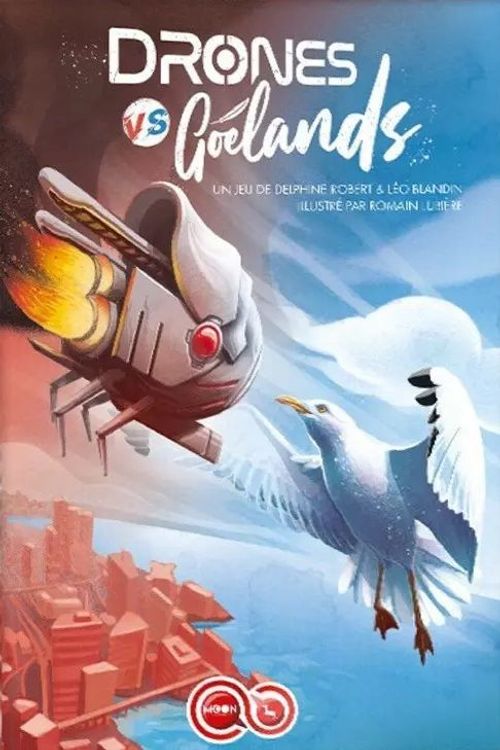
Drones VS Goélands
Drones VS Goélands Rulebook
Table of Contents
Table of Contents
Equipment
- 11 Seagulls cards.
- 11 Drones cards.
- 12 tokens Outposts.
- 1 rules booklet.
Distribution of cards (card strength : number of cards per player):
- 1 : 2
- 2 : 3
- 3 : 3
- 4 : 2
- 5 : 1
Goal of the Game
Perform combos and take advantage!
The game is played in two winning rounds. The objective is to simultaneously control all seven Outposts or the majority at the end of the game.
Players take turns placing cards of varying strength in front of the various Outposts. They benefit of the power of the Outpost if they take control of it from their opponent.
Solo Challenges
Improve your technique by taking on solo challenges: https://cutt.ly/1JkgxDw
Set Up
A. Each player takes the eleven cards of his side in his hand.
B. Pick seven Outposts tokens at random and arrange them in a line on the playing area, by alternating the Drone sides (red) and the Gull sides (blue).
C. The first player is the one with the fewest Outposts.
Turn of Play
1 - Play a card in front of an Outpost token on your playing area. Without a conquest, your turn ends here.
2 - Conquer an enemy Outpost: If your total strength on the targeted Outpost exceeds the opposing force, you take control of it. Turn it over on your color side and you must apply the indicated power.
3 - Combos: If the power allows the player to take control of another Outpost, step 2 is repeated until all combos are exhausted. It is possible to lose control of an outpost during your turn. In this case, the opponent takes control without activating the power.
Example: The "Seagull" player plays a card of strength 5, so he is stronger than the "Drone" of strength 3. He wins, then he must apply the power.
End of Round
If a player controls all seven outposts simultaneously, he wins the round immediately.
When a player puts down his last card without ending the game, he chooses one of the Outpost tokens he controls and sets it aside to prevent his opponent from regaining control. This one makes its last turn, then the controlled Outposts are counted; the one with the most Outposts wins the round.
Example: The "Drone" player plays his last card, he keeps aside an Outpost token to try to prevent his opponent from having the majority.
The winner of the previous round becomes the first player.
End of Game
Once a player has won two rounds, he is declared the winner.
FAQ
Adding Forces
If you have more than one card on an Outpost, the total strength is cumulative (example: if you have a card of value 2 and a card of value 3, your total strength is therefore 5). There is no limit to the number of cards on an Outpost.
Equalities on an Outpost
Except with this Outpost: (read the full effect on page 9)
You must exceed the total value of the opponent's Outpost to conquer it, otherwise it remains under the opponent's control.
You cannot conquer an Outpost if you do not have a card in front of it.
Powers of Conquest
Conquest powers only apply if the conquest takes place during your turn.
If your opponent loses one of his Outpost token during his turn, take control of it without explaining the conquest Power.
During your turn, the conquest powers apply immediately after conquering the Outpost. In general, Outposts are conquered sequentially, so the conquest powers are applied one after the other.
In case of simultaneous conquests, the order of resolution of the conquest powers is freely chosen by the active player.
PPlacing a card on an Outpost you already control is possible, but does not allow you to activate its power.
Theft of a Card
If you take control of an opponent's card through the effect of a power of conquest, the card passes into your play area and counts as your color.
Resolution of Losses and Conquests
The order of resolution is freely chosen by the active player.
Outpost Tokens
Equality Outpost (banner icon): The side that controls this token can conquer the opposing outposts by matching the opposing force in presence. Be careful, if the Outpost changes sides, all the Outposts where the forces were equal also change sides.
Weaken Outpost (card turned face-down, strength "1" icon): Turn any opponent's card face down, its strength becomes 1.
Destroy Outpost (crossed-out circle icon): If you destroy any enemy's card in play, it will be removed from the game.
Steal Outpost (card-swap icon): Take an opponent's card present on any Outpost token (it passes from your side to the same Outpost, its strength and color become yours). Example: Here, the Drone of strength 3 moves to the Seagull side.
Self-Destroy Outpost (crossed-out circle with "=?" icon): Destroy one of your cards on any Outpost to activate its power.
Move-Card Outpost (single-card-with-arrow icon):
- In your playing area, move a card from any Outpost to another.
- In the opponent's play area, move a card from any Outpost to another.
Extra-Turn Outpost (circular-arrows icon): Play one more round immediately.
Move-Set Outpost (double-card-with-arrow icon):
- In your playing area, move a set of at least two cards from any Outpost to another.
- In the opponent's play area, move a set of at least two cards from any one Outpost to another.
Example: Here, the Seagull player decides to move only his cards of strength and 3 to keep the majority.
Swap Outpost (double-headed-arrow icon):
- Swap two of your opponent's cards.
- Swap two of your cards.
Example: Here, the Drone player places a force 1 card to swap his force 4 and 2 cards, for winning the "Replay" Outpost and keeping the majority on the "Equality" Outpost.
Game Help
Quick reference for the Outpost token powers:
- Equality (banner icon): Conquest in case of a equality, valid for all other outposts.
- Weaken (card-turned-face-down "1" icon): Turn over an opponent's card face down, its strength becomes equal to 1.
- Destroy (crossed-out circle icon): Destroy an opponent's card.
- Steal (card-with-arrow icon): Take an opponent's card present in front of any Outpost. (It passes to your side and becomes yours.)
- Self-Destroy / Copy (crossed-out circle "=?" icon): Destroy one of your cards and then copy the power of the Outpost where it was.
- Move-Card (single-card, double-headed arrow icon): Move a card of the indicated color.
- Extra-Turn (circular-arrows icon): Play immediatly another turn.
- Move-Set (stacked-cards, double-headed arrow icon): Move a set of cards of the indicated color.
- Swap (double-headed horizontal-arrow icon): Swap two cards of the indicated color.
For your first few games, we recommend that you use this configuration in the order of your choice: Swap, Destroy, Move-Card, Extra-Turn, Move-Set, Equality, Weaken.