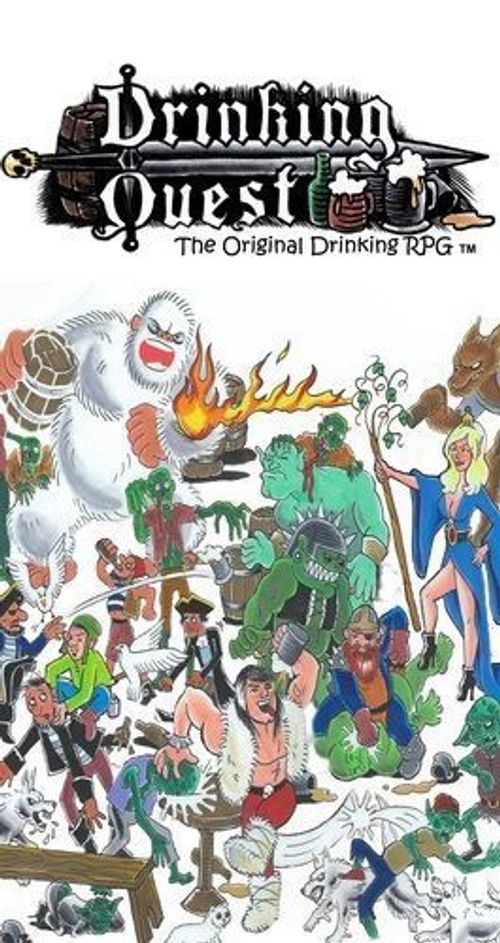
Drinking Quest
Drinking Quest Rulebook
Table of Contents
Table of Contents
Welcome to Drinking Quest
Drinking Quest has always strived to be the perfect 50-50 blend between a Role Playing and Drinking game. Over the years the series has developed a bit of a cult following and now all the games are together for the first time!
Drinking Quest: Six Pack includes the first six games of Drinking Quest, remastered and repackaged. Prepare to enter a world of magic, swords, sorcery, fancy drinks, failed sexual encounters, and (occasionally) being a hero.
In each game, you will play your way through four different quests. Defeat monsters and make saving throws to gain coins and XP! Visit the shop and spend your loot to buy new weapons, armor, and special items to help you on your quest.
Your hero might also die frequently along the way, but you simply chug your drink to revive them and continue your adventure!
Objective
Get the most XP by the end of the game and become the Drinking Quest Champion!
Setting Up
-
Each player chooses a hero and takes the matching hero card and signature drink card. Each player takes a character sheet and fills in the blanks with the character details and attributes listed on their hero card.
-
Each player announces their drink of choice. For players with alcoholic drinks, take a moment to discuss their plans for getting home safely after the game.
-
Choose one of the six card sets. We recommend starting with The Original Drinking RPG or Journey into Draught for a first game. Take the 48 matching quest cards and sort them by the quest numbers on the card backs into four decks of 12 cards each. Return the five unused card sets to the game box.
-
Shuffle all four quest decks separately. Place the quest decks face down within reach of all players. Leave enough space next to each deck for a discard pile.
-
Place the quest map, shop card, and all three dice in the center of the table.
Gameplay Flow
Play through the four quests, in order, one at a time. The starting player is whoever most recently described something as "hoppy". They take the first turn of each quest. Play then continues clockwise around the table.
At the start of your turn, you may visit the shop to buy weapons, armor, and special items at the prices listed on the shop card. If you have items that you no longer want or are no longer useful, including your starting weapon, you may sell them to the shop at half price (rounded down).
You must then draw the top card of the quest deck and deal with the consequences. Read the card aloud and then resolve it. Most quest cards represent either a monster that you must fight or an event that requires a saving throw.
After resolving the card, place it face up in the discard pile. Your turn is now over, and the player seated to your left takes the next turn.
Note: In a 2 player game, quests end after each player has drawn 4 cards.
Card Breakdown
Monster cards show a battle stat line along the bottom: Hit Points (HP), Attack Strength, Defense Strength, Coins, and Experience Points (XP).
Event cards present a situation, usually with a Saving Throw. A Success outcome means something good happens; a Fail outcome means something hilariously bad happens.
Combat
When you draw a monster card, you must fight a monster! Attack ratings determine which die is rolled for each attack: D4, D6, or D8. You will roll for your hero's attacks and the player seated to your right will roll for the monster's attacks.
At the start of the combat, the hero and monster each roll a single D6. Whoever rolls higher goes first, with the hero winning ties. The hero and monster take turns attacking each other until one of them is killed (i.e., has zero HP left).
Hero Attacks: The hero rolls the die indicated by their weapon's attack rating, then adds any modifiers to the result. Subtract the monster's defense rating from this result to get the damage total. The monster loses HP equal to the damage total.
Monster Attacks: The monster rolls the die indicated by their attack rating, then adds any modifiers to the result. Subtract your hero's defense rating from this result to get the damage total. The hero loses HP equal to the damage total.
If you kill the monster, you gain the coins and XP shown. If the monster kills you, you don't gain anything and you must chug the remainder of your drink to be restored to maximum HP. Without chugging, you are only restored halfway (rounded down).
Example: You have Draught Daggers, which offer a D6+1 attack rating. You roll "4" on the D6, so your attack is 5 (4+1=5). The monster, a Big Dumb Ogre, has a defense rating of 2, so your damage total is reduced to 3 (5-2=3). The monster loses 3 HP.
If you must chug more than once in a quest, only do 3 sips for the rest of that quest. It still counts as a "Chug" and the hero is still restored to maximum HP. This helps ensure that everyone can make it to the end of the game.
The Shop
Players can visit the shop at the start of their turn, or between quests, to buy and sell weapons, armor, and special items. Items are bought at the prices listed on the shop card. Items you no longer want or no longer find useful, including your starting weapon, may be sold to the shop at half price (rounded down).
Editor's note: the item names and prices are printed on the Shop Card (a component image in the rulebook); they are not reproduced in this transcription.
Saving Throw Events
When you draw an event card, you must perform a saving throw! Check the card to see which character attribute is being tested: Self Worth, Smarts, Tolerance, or Sexual Prowess. Your scores for all four types of saving throws are shown on your hero card.
Each event card has text that indicates the two possible outcomes. If successful, you get some benefit and something funny happens. If unsuccessful, you are penalized in some way and something really funny happens.
Roll all three dice and total the results. If the roll is equal to or lower than your score, the saving throw is successful! Otherwise, the saving throw fails.
Example: You draw the Shower Beer event card, which requires you to perform a saving throw for Tolerance. You roll the dice and get 2+6+4=12. You're playing as the Annoying Sidekick, so your Tolerance score is 13. The saving throw succeeds and maybe your hero finds some treasure in their beer or something.
Signature Drinks
Each hero has a special signature drink. Signature drinks offer unique abilities that the heroes can use. However, each signature drink has limited uses — some can only be used once per quest, others only once or twice per game.
Between Quests
When the current quest deck is empty or the set amount of cards drawn, the quest is over. Restore all heroes to their maximum HP between quests. Players can also visit the shop between quests to buy and sell weapons, armor, and special items. Once shop visits are complete, move to the next quest deck in numerical order and keep adventuring!
Final Boss (Optional)
After the end of the fourth quest, it's time for one more battle. Shuffle the final boss deck and draw the top card, place it face-up in the play area.
This battle will be different as the heroes will team up to defeat this boss.
Like other battles, the monster rolls initiative to see if the final boss or heroes attack first. A randomly determined player rolls for final boss initiative.
Play alternates back and forth between the Final Boss and all the heroes, meaning the final boss does not attack again until all heroes have had one turn against it.
Each final boss has 4 possible abilities, chosen randomly by rolling a D4.
This is where things can get vindictive, the hero who deals the killing blow hands out the loot to each player, choosing who gets which reward. Each hero can only receive one reward. Some rewards are very significant, others just useless joke rewards. Choose wisely!
Game End
When the fourth quest is over and the final boss defeated, the game ends. Any player who received coins on their final turn, earns one extra XP.
The player with the most XP wins!
Whoever has the least XP probably drank the most, and should have a glass of water maybe.
Variant Rules
Mashup Game (Up to 12 players): Combine all the quest 1's from each game, all the quest 2's from each game and so on. Shuffle and make four different mega-decks. These will allow a much larger and more unpredictable sequence of events. The story won't make any sense but did it really make much sense in the first place? Move on to the next quest after each player has drawn 3 cards from a quest.
Make it a Double (up to 12 players): To play with more than four players, simply have two players of roughly equal drinking tolerance team up to control a single hero. When their hero dies, those two players say "cheers!" and chug their drinks together.
Designated GM: To participate without drinking, a player can be the designated game master (DGM) instead. The DGM reads the cards aloud, rolls dice for the monsters, and keeps the game moving. This is particularly useful if you have a lot of players.
Bladder Busters: To play an alcohol-free game as a hero, give that player a glass of water instead. When a player goes to the bathroom, their hero must spend five coins (or borrow it from the shop at a 900% interest rate).