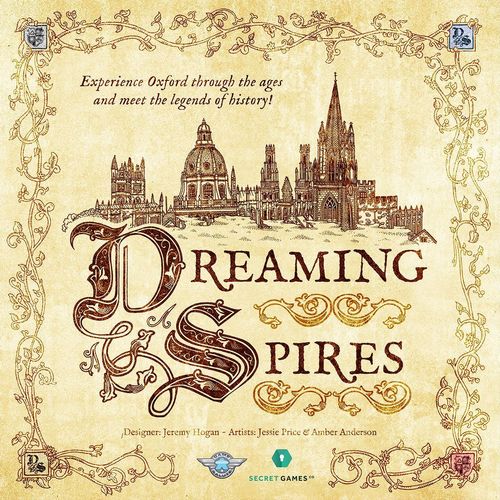
Dreaming Spires
Dreaming Spires Rulebook
Table of Contents
Table of Contents
Setup
Sort the Scholar and Event cards into eras and shuffle.
Begin using the Medieval cards, place the other cards out of the way nearby.
Take out all the Garden and Quad building tiles and then shuffle the rest face-down.
Place 10 Building tiles face-up to the left of the board.
Arrange remaining components as in the diagram overleaf.
Components
- Current event card and next event card (2 per era): Event cards are placed above the scoreboard.
- Unrevealed building tiles: the face-down building tiles.
- 10 revealed building tiles: the face-up building tiles to the left of the board.
- Gardens and Quads: basic buildings always available to players.
- Scoreboard: the College Reputation board.
- Remaining medieval scholars and 5 revealed medieval scholars: Scholar cards.
- Wooden cubes: 1 colour per player, used as reputation markers and scoring markers.
- Chancellor's Mace: place in front of Chancellor. At the start of the game, the player who most recently finished a good book can choose who is Chancellor (can pick themselves).
- Coins and Money Bag: place all of the coins into the money bag. Players can take change from the bag at any time.
- Component count: 120 wooden cubes, 88 building tiles, 27 Event cards (larger), 43 Scholar cards (smaller), 48 coins, 1 money bag, 1 scoreboard, 1 Chancellor's Mace.
Order of Play
Each game is divided into 4 eras: Medieval, Enlightenment, Imperial and Modern.
There are 2 turns per era — track them using the revealed Event cards.
- (1st turn of every era only) Set up new era:
- a. Each player draws 4 random coins from the money bag (money is kept secret).
- b. Remove all Event and Scholar cards from the last era (reputation markers and Buildings remain).
- c. Place 2 of the new era's Event cards face-down above the scoreboard.
- d. Reveal 5 Scholar cards from the new era and place the rest to the right of the scoreboard.
- Chancellor flips and reads a new Event (but resolves it later).
- Chancellor takes 4 actions followed by each player moving clockwise. Players can pick the same action multiple times:
- Build a Building (replace with new ones if possible after a player has taken all 4 actions)
- Admit a Scholar (replace with new ones if possible after a player has taken all 4 actions)
- Use a Scholar you haven't used yet this turn
- Draw a random coin
- Chancellor resolves the Event flipped in step 2.
- (2nd turn of every era only) Players score the era.
Buildings
Each player's first Building is placed anywhere in space in front of them. Future Buildings must be built next to previous ones.
Gardens and Quads are always available and can be built next to anything — your first Building must be a Garden or Quad.
All other Buildings must be built next to a Building of the same colour (on one side only). Buildings with two colours must have one colour touching the same colour on a neighbouring Building.
Buildings have partial or complete icons representing 4 benefits:
- Beauty (green)
- Academics (blue)
- Social (red)
- Status (gold)
Building anatomy:
- Name of the Building (printed at the top of the tile).
- Complete icon: e.g. a complete Academics icon counts as "1 Academics".
- Half icon: can be placed next to another half icon or two quarter icons to create "1 Social".
- Quarter icon: can be placed next to other partial icons to create "1 Status".
- Price: some Buildings are free, others have prices, which the player must pay into the bag to build them.
Example College
This college has 1 Beauty and 1 Status.
- The first tile is the Quad.
- Same colours touching: the Chapel and Church Tower are both yellow and touch.
- A Beauty icon is made up of 1 half and 2 quarter icons placed adjacently to form a complete icon.
- Gardens and Quads can be built next to anything.
- Tiles can be placed halfway down other tiles (but never diagonally).
- Tiles can be rotated 90/180/270 degrees.
- Different coloured Buildings may touch as long as each is separately touching a same-coloured Building.
- The price paid to build this is shown on the tile (the Church Tower costs 1).
Scholars
Players can admit a Scholar if they have all of the required benefit icons on the Buildings of their college (includes icons made by placing Buildings side by side).
Scholars can be used only once per turn to EITHER increase a college's reputation in one subject OR perform their ability.
Players track their college's reputation for each of the 7 subjects and for their Fellows, Students and Tradition on the scoreboard. When a player earns their first reputation in one of these areas, they add a cube of their colour to the '1' box in the relevant reputation track. Thereafter, they move this cube up and down or remove it if they return to '0' reputation.
At the end of each era, all Scholars from that era are removed.
Scholar card anatomy:
- Required benefit icons: the benefit icons a college must have to admit this Scholar.
- Portrait.
- Name.
- Ability text: this Scholar can be used to improve their college's reputation in either of their subjects by 1, or to perform their special ability.
- Special ability: printed on the card (e.g. the Philologist ability).
- Quote from scholar.
Example Scholar: J.R.R. Tolkien. Card text: "+1 Humanities or +1 Arts. Philologist: If -1 Humanities or -1 Arts, +1 Tradition."
The icon printed on Scholar cards with several colours means any benefit will do.
Abilities
- "+1" before a subject or college area means the player can increase their reputation in this area by 1 or add a cube of their colour to the board on the '1' space.
- "If -1 Arts" means the player must reduce their reputation in Arts by 1 (remove their cube if at '1'); if they have no reputation to reduce, they can't take the benefit.
- "If -1 money" means they must pay 1 money back into the bag to take the benefit (can take change).
- "Red/blue/&c. buildings" includes those that are half coloured.
- "Discard" the Scholar means remove their card from the game.
Events
At the start of each turn, the new Chancellor reads an Event and then places it in view. At the end of each turn, the Chancellor conducts the event type listed on the card.
Event card anatomy (example: Oxford English Dictionary, 1857, Contribution: +1 Tradition):
- Name.
- Date.
- Event type: event run by the Chancellor at the end of the turn.
- Event reward: won by the winner(s) of the event.
- Story.
Players follow the instructions for the type of Event and can bid any amount up to their total money or decline to bid (or bid 0). Usually, only player(s) who win an Event get the reward and pay what they bid into the bag (they can take change). However, in a Contribution, all players lose the money they bid and 1st and 2nd highest bids get the reward.
The player who wins the Event becomes Chancellor for the next turn. If the winners tie, the Chancellor chooses who wins from among the tied players (can pick themselves).
Events can also be triggered by Scholars' abilities, these are drawn from the unused cards of that era and occur immediately. They are conducted by the player triggering them and the winner does not take over the chancellorship (the planned event occurs as normal).
Event Types
- Auction: Chancellor opens bidding and then bidding passes clockwise until no one wishes to bid higher, players can pass and re-enter bidding if they wish. Highest bid wins the reward.
- Silent Auction: All players place an amount of money in their closed fist and reveal at once, highest bid wins the reward. Tied players all receive the reward.
- Dutch Auction: Chancellor slowly counts down from 12, players can say "bid" at any point and take the reward for a price equal to the last number said. Chancellor determines who spoke first. Chancellor can say "bid" instead of a number and receive the reward for the price of the number replaced with "bid".
- Contribution: All players place an amount of money in their closed fist and reveal at once, 1st and 2nd and highest bids both earn the reward (bidding 0 doesn't count). Tied players all receive the reward, however if players tie for 1st, no rewards are given for 2nd. All players lose the money they bid in a Contribution unlike in the other event types.
Scoring
Score the board after each era, reputation markers are NOT removed:
- Mark each active scoring box with a cube belonging to the player who has the highest total reputation for that box — this is the total of their reputations in the Subject above and Fellows, Students or Tradition to the left.
- Calculate which player has won the least scoring boxes and remove their scoring box marker cubes, they are out. Their scoring boxes are each re-scored and won by the player with the next highest total reputation for that box.
- Repeat step 2, ignoring the reputation markers of any players who are out, until only the winner remains.
In the first 3 eras, the winner draws a free coin. In the final era, their college is recognised as the greatest and they win the game!
Scoring box colours show what era they are first scored in:
- Medieval era: grey boxes are scored.
- Enlightenment era: grey and yellow boxes are scored.
- Imperial era: red, grey and yellow boxes are scored.
- Modern era: all boxes are scored.
Example Scoring Round
An example scoring round at the end of the Medieval era of a 3 person game:
- Blue wins here because reputation from subjects is worth more in ties.
- Blue and green tie here but blue has the larger college.
- Green and red won the least boxes but green has the larger college so red is eliminated and their boxes are re-scored.
- Green wins this round and draws a free coin. Scoring box marker cubes are removed, reputation markers are not.
Tiebreakers
If two players have the same total reputation for a scoring box, the player with higher reputation in the relevant subject wins.
If players are still tied for a scoring box or if players tie for the least number of scoring boxes, use the following tiebreakers to determine the winner:
- Largest College: Player with the most building tiles.
- Most Money: Each player must show their money.
- Chancellor's Choice: The Chancellor chooses who wins (can pick themselves).
Designer's Note: scoring is similar to 'instant-runoff voting'. It rewards breadth over specialisation as 2nd, 3rd or 4th highest total reputation in a scoring box can win it IF all the opponents with more reputation in that box have been eliminated. Like a real college, it's not enough to master one or two subjects but nor should you spread yourself too thin!