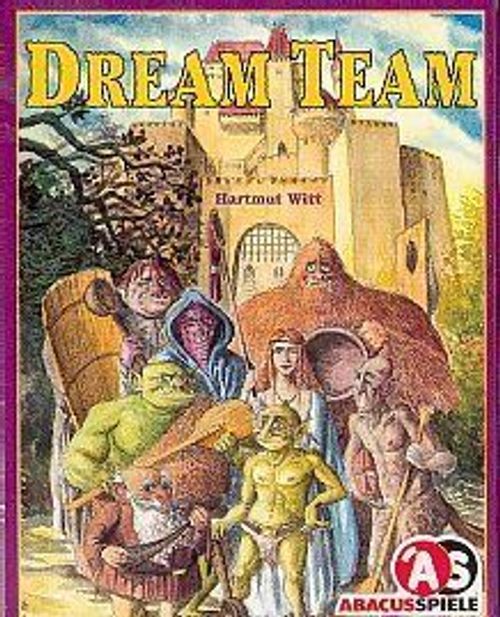
Dream Team (1997)
Dream Team (1997) Rulebook
Table of Contents
Table of Contents
Components
- 36 player cards
- 12 goalkeeper cards
- 6 special player cards
- 30 action cards
- 6 dice
Note: in Dream Team, the people playing the game are called "trainers", and most of the game cards are the "players".
Dream Team is a championship game, with two trainers pitting their teams against each other. With additional dice, up to 6 teams can play at once.
Before the play begins, the trainers must agree on the championship system. Suggestions are given at the end of this rulebook. These rules apply to every match, regardless of the number of trainers taking part.
The Cards
Player card:
- Defense value
- Player picture
- Player name
- Team name
- Action symbol
- Attack value
Goalkeeper card:
- Save value
Action card:
- Symbol of the action
- Title of the action (type of action)
- Text of the action (result of the card)
Special player card:
- Characteristics of the special player
- Player name, with a marking that identifies the player as a special player
Setup
Before play begins, the players, goalkeepers and special players are divided into 6 decks, as indicated on the back of the cards. A team consists of 2 goalkeepers and 6 players; these eight cards are the trainer's hand.
The 6 special player cards (thumbs-up symbol on the back) are shuffled, and 1 is dealt to each trainer. The 30 action cards are also shuffled, and 4 are dealt to each trainer. The "balanza" (the source's word, meaning "scale," is unclear here and is transcribed as printed) is placed face down on one side. 6 dice are assigned for each match being played.
Playing the Game
Home advantage
Roll a die to determine who plays at home and who plays away. The game is played over 3 periods, called "thirds" (as in ice hockey). The home team starts the first and third thirds. The visitors start only the second third.
Preparation
Each trainer chooses 5 players and 1 goalkeeper from his or her 9 cards. The remaining players are the reserves and are set aside.
When both trainers have chosen their starting team, the cards are turned face up. Leave enough space between the two teams for the combat. For now, the action cards are not used.
The first attack
(See the original diagram under "Der Zweikampf", the duel. It is not reproduced here.)
The home trainer chooses one of his players and moves him to the free space between the two teams. This player is the attacker. The visiting trainer places one of his players adjacent to the attacker. This player is the defender.
Simple duel
Compare the attacker's value (red triangle) with the defender's value (green circle). The following results are possible:
- The attacker's value is higher: the attacker dribbles past the defender and has a chance to score a goal. The difference between the two values is the number of dice to place. Example: the attacker's strength is 5 and the defender's is 3. 5 - 3 = 2 dice.
- The two players' values are equal: the attack is stopped, and the attacker's turn ends immediately.
- The defender's value is higher: the defender makes a counterattack and now has the chance to score a goal. The difference in the defender's favor is the number of dice to place, as before.
Shot at goal
The trainer secretly selects a number of dice equal to the strength of the scoring chance (see the example above). Example: the trainer places 2 dice, showing a "1" and a "3".
The save
In response, the defending trainer places the number of dice shown by the goalkeeper's symbol (blue rectangle). Example: a goalkeeper with a 4 places 4 dice, showing "1", "2", "3" and "4". The "1" and the "3" stop the attack in the example above.
Result
The attacker scores a goal if one or more of his selected numbers is not matched by the numbers the goalkeeper selected. (The source is terse here; this reading follows the worked example, in which the "1" and "3" are both matched and the shot is stopped.)
Goal
Record the goals as they are scored. The play then changes direction, and the visiting team begins.
Following turns
The procedure continues until all 5 players of each team have had their chance to shoot at goal.
A new third
At the start of each period, the trainers take back their eight cards in hand and select 5 new players and a goalkeeper, which are placed simultaneously.
End of the match
After 3 thirds, the winner is determined. In case of a draw, the players may agree to play extra time.
Sudden death
Instead of playing a full extra period, the first team to score wins.
Substitutions
During any third, a trainer may substitute a player, or the goalkeeper, with one from the reserves. A substitution may only be made before an attack. The trainer simply swaps one of his players for another from the reserves.
The game may be played without a goalkeeper, with 6 players on the field. In this case, any goal chance of the opponent is automatically converted into a goal.
Special players
In Dream Team there are 6 special players. Each player starts the match with one of them. They may be used according to the text on each card. They may also be used as normal players.
Action cards
The Wizards' Guild of Lemuria is very well known for its part in creating the rules of this sport, so it is no surprise that the wizards intervene in the game. These actions are detailed in the player aid.
Note: some cards can only be played with players who have the same symbol. Each action card may be used only once per match, and it takes effect for one third or for the whole match. Trainers may play a maximum of 4 cards per match, refilling their hand to 4 at the end of the match.
Fouls and injuries
The "Foul" action card must be used together with a field player or the goalkeeper. The foul is committed directly against the opposing player, whose value is reduced to 0.
A foul has further consequences if the player committing it has the corresponding symbol (the fist symbol, as shown on the Foul card). In that case the foul becomes a flagrant foul, and the opponent is considered injured. The injured player must be replaced at the end of the third. An injured player may not return to play for the rest of the match.
If the "Magic" action card is played, the Foul card has no effect.
Penalties
If a trainer plays "Morca's Curse" against a Foul card, the player who played the Foul card is punished immediately.
- With an ordinary foul, that player is sent to the penalty box until the end of the third. The player who was to receive the foul has a free shot at goal against the goalkeeper. If the foul was committed against the goalkeeper, the save succeeds.
- With a flagrant foul, the player who committed the foul is sent off, and his team plays the rest of the match with one player fewer. If the foul was committed against the goalkeeper, the same rules apply.
(The source spells the curse "Morea" in this section and "Morca" elsewhere; "Morca" is used throughout this rulebook.)
Special situations
- If both goalkeepers of a team have received a foul, the trainer may continue with 6 players for the remaining thirds.
- If a team does not have enough players because they have been injured or sent off, the trainer continues for the rest of the match with the maximum number he can field.
Tournament Schedules (Suggestions)
- 2 trainers: best of 7. Play continues until one trainer has won 4 matches. Home advantage changes from match to match.
- 3 trainers, "Hot Seat": the following schedule decides the winner. The team named first in each pairing plays at home: A vs B, B vs C, C vs A, B vs A, C vs B, A vs C.
- 4 trainers, knockout: A vs B and C vs D. The two winners go to a final, best of 7.
- 5 trainers, "Hot Seat": as for 3 trainers, with D, E and F added. All teams play both at home and away.
- 6 trainers, "Hot Seat": the schedule is "as for 3 and 5 trainers, but G is added."
Source note: the 6-trainer entry in the source says "as for 3 and 5 players, but G is added". The letter G implies a seventh team, which does not match six trainers. It is transcribed as printed and flagged here for review.
Economic Game (2 to 5 Players)
In this variant, each trainer needs paper and a pencil. The action card "Sponsor" is removed from the game.
Teams are formed in the same way as in the basic game. The remaining player cards are shuffled and form a face-down draw deck, the "player market". The trainers agree on the competition system to be played, and then form their teams. Each trainer writes a team value of 0 $ on paper.
- Starting capital: 5 $.
- Income per match: 3 $ for the home team and 1 $ for the visiting team. The winner of each match receives 1 $ extra.
- Draws: go to sudden death.
Buying players
After a match, a trainer may buy a player from the market:
- Drawing the top card of the market costs 3 $.
- Taking the top 3 cards to choose among them costs 5 $. The cards not chosen go to the bottom of the deck.
Write the player's name on the paper and subtract his price.
Selling players
Between matches, a trainer may sell one of his players to the market for 1 $. The sold player goes to the bottom of the market deck, placed face up. The market deck is shuffled when the first face-up player reaches the top of the deck.
Transfers
Trainers may also transfer players to one another.
- There is no maximum value for an offer, but the minimum is 1 $ more than the base price of the player.
- If a trainer does not want to sell a player, he must pay the difference between the player's current value and the offer made, in order to keep him. A player who is kept has his value increased to 1 $ above the offered amount.
- If a trainer does not have enough money to pay the difference, the player must be sold.
Restrictions
A maximum of 4 player transfers per competition is suggested, with a maximum of 13 players per team.
Solo Play
Dream Team can be played solo. Select the teams, shuffle them and form them at random. The goalkeepers must be placed face up. The action cards are not used in this variant. Any competition system may be used.
Action Cards
(The action cards are listed in the source with their symbol, title and text. The counts shown are the number of copies in the deck.)
Unheil (Disaster), x3. Place this spell on a goalkeeper or player of the opposing team before the start of a third. For the rest of the match, that player has a value of 1.
Tempo (Speed), x4. A player with the winged-boots symbol may, in this third, make a second play. Your team gains an additional play, which the opponent can only stop with a Speed card.
Energie (Energy), x3. Place this spell on one of your players or on your goalkeeper before the start of a third. For the rest of the match, that player has a value of 5.
Sponsor, x2. Played before the match begins. The opposing player who scores the first goal switches to your team at the end of the match. The opponent may take a player from your team of his choice.
NachSchuss (Second Chance), x3. If you miss a shot, you may try again using your current strength. The opposing player's value is not lost. The Disaster and Energy cards combine well with Second Chance.
Fortuna (Fortune), x3. Can only be used by a player with the clover symbol. You may choose one of the following:
- An opponent has strength 0 for this play.
- The goalkeeper cannot stop your shot.
- The Foul has no effect.
Magie (Magic), x3. Can only be played by a player with the star symbol. You may choose one of the following:
- An opponent has strength 0 for this play.
- The goalkeeper cannot stop your shot.
- The Foul has no effect.
Foul (Falta), x4. If you play this card, the opposing player or goalkeeper has value 0 for this play. If it is played by the player with the fist symbol, the opponent is injured and removed from the game, and must be replaced.
Morca's Curse (La Maldicion de Morca), x3. You may choose one of the following:
- The curse is kept.
- One goal is cancelled.
- Magic has no effect.
- A Foul has no effect. The player who committed the foul has value 0 for that play.
- A second chance fails.
Named Cards
Sankt Dusel. If played with "Fortuna", scores a goal immediately, regardless of the opponent's strength.
Detlef Darfdat. If the opponent scores a goal, he may draw a card at random from the opposing team.
Watschen Sepp. If played with a "Foul", he goes berserk and commits a foul against all opposing players with the fist symbol. During that third, the players who receive the foul have value 0.
Pflaumen August. If the opponent scores a goal, at the end of the play he receives a flagrant foul from August. He is considered injured and must be replaced. He may not play again in this match.
Balduin Scheibenkleister. If he gets a double with his shot at goal, he shoots into his own goal. The result of the dice is used as the defense of his own goalkeeper.
(The source says "a double" without defining it; it is transcribed as printed.)
Billiger Jakob. If Jakob is in play, he cancels an opposing Sponsor card. At the end of the match, Jakob and the Sponsor are exchanged for an opposing player of the choice of the affected trainer.
Source note: the source also contains a card table that repeats the action and named card texts in a scrambled layout. Its text duplicates the sections above, so it is not repeated here.