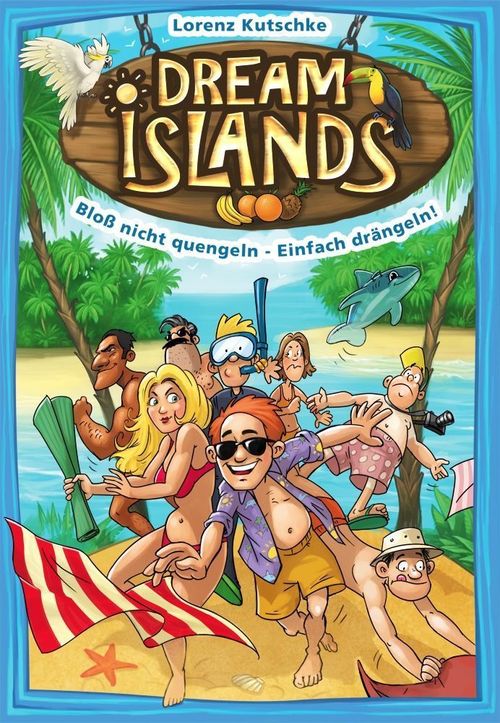
Dream Islands
Dream Islands Rulebook
Table of Contents
Table of Contents
Contents
- 1 game board
- 4 player boards (1 of each colour)
- 24 playing pieces (6 of each colour)
- 16 seashells (4 of each colour)
- 64 mission cards (16 of each colour)
Game setup
Lay down the game board in the middle of the table. Each player receives a player board, playing pieces, seashells and mission cards of the same colour. For games with fewer than 4 players, put the unused game materials back into the game box. Each player lays down his player board in front of him on the table and puts his seashells next to it.
Then each player puts 5 of his playing pieces on the airplane. The last person to be on an island is the start player who puts his sixth playing piece on the first island (in the direction of the arrow from the plane). The player to his left puts his sixth playing piece on the following island in the direction of the arrow. The next player then puts his sixth playing piece on the third island, and the fourth player puts his on the fourth island. If there are fewer than 4 players, then there will be fewer playing pieces on the board accordingly.
Then everyone shuffles his mission cards, lays them face down in a draw pile in front of him on the table and then picks up the uppermost 3 cards to form his hand.
How to play
Beginning with the start player, the game is played in turns. One turn consists of 3 actions that must be carried out in this order:
- A Cover a number with your shell and move your playing pieces
- B Complete missions
- C Draw or exchange cards
A Cover a number with your shell and move your playing pieces
Pick a number from your player board that is not already covered and cover it with a seashell. Numbers that are already covered cannot be selected. If all numbers are already covered, remove all the shells and choose one of the four numbers.
Move one or more of your own playing pieces according to the selected number, so that the entire number is used up, in a clockwise direction following the arrows from island to island or (at the beginning of the game) from the airplane to the next island in the direction of the arrow. Each island counts as one step of your movement. You can divide up and distribute the selected number from your player board however you like among your playing pieces.
Important: The selected number must be completely used up when moving your playing pieces. Your playing pieces must be moved the same number of steps in total according to the selected number - no steps may be forfeited.
Example: The yellow player selects the number 5 and moves 1 playing piece 1 space forward, and 2 other playing pieces 2 spaces each.
You cannot move your playing pieces backwards (in the opposite direction of the arrows)!
Middle islands
Playing pieces can be moved from the eighth island ("heart" island) to the middle islands (with the red borders) or in the direction of the arrows past the islands to the first island (after the airplane). Playing pieces that have been moved to these islands cannot be moved off of them again.
The first 3 playing pieces moved to the middle islands are moved, one after the other in order, to the small islands with the victory points 3 and 2. Only one playing piece can be on a small island. All playing pieces that arrive later are moved to the large main island, which is only worth 1 victory point each. Any number of playing pieces can be on the main island. At the end of the game, each player receives victory points for each of his playing pieces according to the value indicated on the signs.
B Complete missions
After moving your playing pieces see if you are able to complete one or more of your mission cards from your hand. Lay each completed mission card on a discard pile in front of you. You can always check at any time which mission cards you have already completed.
Mission cards:
-
On any one island you have exactly 2, 3, 4 or 5 of your own playing pieces. It doesn't matter how many of your opponent's playing pieces are on the same island, if any at all.
If you have 5 of your playing pieces on an island, the mission "3 playing pieces on an island" has not been completed! The number of your own playing pieces must match the given number of playing pieces in the mission exactly.
Example: Yellow has moved 3 playing pieces onto an island and has therefore completed the mission "3 playing pieces on an island". The mission "2 playing pieces on an island" was not completed by yellow.
-
On exactly 2, 3, 4, or 5 consecutive islands there is at least one of the player's playing pieces. It doesn't matter how many of your own playing pieces or those of your opponents are on the same islands, if any at all. More than one of your playing pieces can be on the islands. If your own playing pieces are on more consecutive islands than required by the mission, the mission has not been completed.
Example: After yellow has moved further playing pieces, the mission "on exactly 4 consecutive islands" can be completed. The mission "on exactly 2 consecutive islands" cannot be completed in this constellation. But, yellow could move his playing piece from the B island 1 or 2 spaces forward, for example, in the next round, creating a space between islands A and C, which means the playing pieces on islands C and D would then complete the mission "on exactly 2 consecutive islands".
-
There are more of your own playing pieces on an island than all other playing pieces of your opponents combined.
The mission only applies to the island depicted on the mission card. If there are more of your own playing pieces than those of your opponents combined, the mission has been completed. Even with a single playing piece on an otherwise empty island you have the majority of playing pieces on the island and therefore have completed the mission.
Example: Yellow (3 playing pieces) does not have more playing pieces on the A island than the opponents combined (1+1+1=3 playing pieces). That means the mission for the A island cannot be completed. Yellow has 3 playing pieces on the B island and the opponents have only 2 combined. That means yellow has completed his mission for the B island.
Special rule for a 2-player game: In a 2-player game, one player has to have 2 playing pieces more than the other player to be able to discard the corresponding mission card. That means one player needs at least 2 of his own playing pieces on an island to be able to complete such a mission.
As a general rule:
- The middle islands cannot be used to complete missions.
- It is however possible to use playing pieces to complete different missions.
Example: In the above example yellow would be able to complete the mission "exactly 3 playing pieces on an island" and the mission "on exactly 2 consecutive islands" in addition to the mission "more playing pieces on B island than your opponents'". In this example yellow would have completed 3 missions in a single turn.
C Draw or exchange cards
At the end of your turn, pick up as many cards from your draw pile as necessary until you again have 3 cards in your hand. If you want, you can slide as many cards from your hand as you want to the bottom of your draw pile before you draw new cards. You can choose the order yourself.
Note: Nearing the end of the game, you won't be able to draw enough cards to replenish your hand, until you again have 3 cards. Add the remaining card(s) to your hand and continue play with the cards you have left in your hand.
End of game
The end of the game is signaled when a player has completed his last mission or when at least 6 playing pieces in total are on the middle islands (main island plus small neighbouring islands). The round is played out until the player to the right of the start player has finished his turn. Any cards left in your hand are put off to the side and not counted.
Then count score to see who has won. Each player receives:
- 2 victory points for each completed mission.
- 3 or 2 victory points for each playing piece on the small middle islands according to the sign shown.
- 1 victory point for each playing piece on the large middle island.
- 3 bonus points if you have completed all your missions.
Example: Green managed to complete all 16 missions and receives 32 victory points for the mission cards (16 x 2), 3 bonus points for all completed missions and 1 victory point for having a playing piece on the large middle island. That makes a total of 36 victory points. Since green was the start player, all the other players took one more turn after green completed the last card. They have completed more mission cards or moved their playing pieces onto the middle island. In the end, the other players were able to complete 15 mission cards each (15 x 2 points = 30 points) for the following point totals: yellow has 33 victory points (30 + 2 +1), red has 31 victory points (30 + 1) and blue managed 37 victory points (30 + 3 + 2 +1 + 1) and wins the game. Once at least 6 playing pieces are on the middle island, the game would be over after this round, even if green hadn't completed all the missions.
The player with the most victory points wins the game. In the event of a tie, all involved players count their completed missions, and the player who has completed the most missions is the winner. If the game is still tied, it ends as a draw.