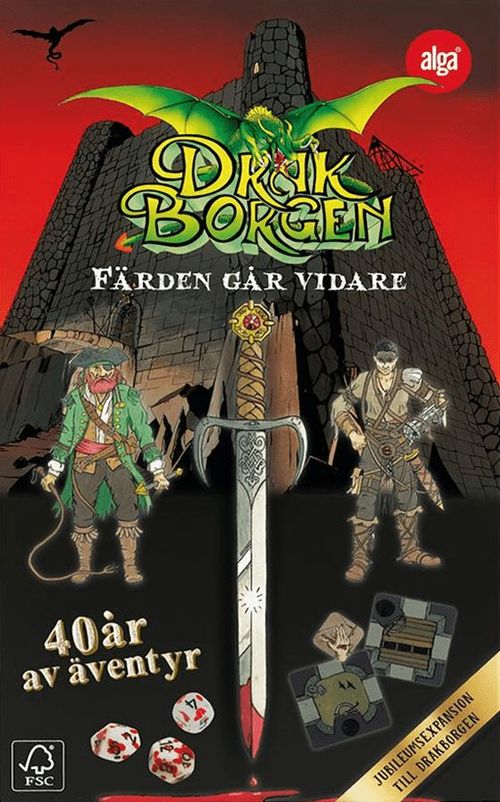
Drakborgen: Färden går vidare
Drakborgen: Färden går vidare Rulebook
Table of Contents
Table of Contents
14. Contents
This anniversary expansion contains the following things – mostly newly created for this set, but, as said, with some treats taken from the expansion Drakborgen II.
- 1 foldable dice tower in 6 parts
- 3 blood dice: T6, T10 and T12
- 4 treasure cards (troll staff, clay jar, Moonstone and Sunstone)
- 2 new hero figures
- 10 cards for the new heroes, five each
- 6 room cards (2 × corpse-eaters, 1 × spear trap, 1 × ambush and 2 × empty)
- 4 ring cards (dark elf's, mountain troll's, orc's and skeleton's ring)
- 6 square labyrinth tiles (4 × secret passage and 2 × large-room tiles)
- 2 extra large labyrinth tiles (one double and one triple)
- 12 corpse-eater tiles
- 3 "fallen hero" tiles
- 2 plastic feet for the new heroes
- 1 rulebook
15. Ödestornet
The Ödestornet (Fate Tower) is a foldable dice tower! When it is assembled – see the pictures below – you place it on the table beside the game board.
(Or you turn the lid upside down and place the Ödestornet inside it, so that the dice do not bounce off onto the floor.)
Use the dice tower so that you do not get dice that fly off or knock over any game piece. It also makes the dice rolls fairer: now Fate really decides!
You simply drop the die/dice from above into the Ödestornet, from where it/they roll out onto the table/lid.
When you have finished playing, you can either leave the tower assembled, ready for use next time, or take it apart and put it back in the box.
Assembly of the Ödestornet
- The tower lies flat in the box. Unfold the walls and place the 4 floors into the slots. The largest one goes at the bottom.
- Fold the tower together so that the flaps fit into the notches on both sides.
- Push the back wall in as shown in the picture.
- The tower is now ready to use.
16. Blodiga tärningar
Three blood dice have been made for this anniversary expansion. They consist of a six-sided, a ten-sided and a twelve-sided die, and are used like ordinary dice, entirely according to the rules... but the "blood splatter" also serves as a reminder that Drakborgen, after 40 years, is a brutal gaming experience!
17. Nya skattkammarkort
Shuffle them in with the earlier treasure chamber cards before the game begins.
Moonstone and Sunstone
If you find only the Moonstone, it has a value of 700 gm (gold coins). If you find only the Sunstone, it has a value of 1100 gm. If you manage to find both, however, together they are worth a whopping 10,000 gold coins – this pair of gemstones is thus the most valuable single treasure inside the whole of Drakborgen.
Troll Staff
Could it be T'siraman's own lost staff that you have unluckily stumbled over or brushed against? If you draw this card when you take the top two treasure chamber cards in your move, it must immediately be shown, and you must then draw two dragon cards, not just one as usual... whereupon the dragon either sleeps on, or wakes, and you follow the main rules of the game as usual. If you survive, you then set the card with the Troll Staff aside, out of the game.
Clay Jar
This card too must immediately be shown if you have the misfortune to draw it! You have accidentally knocked over a large clay jar inside the treasure chamber, and out pour nasty black-blue beetles whose bites are extremely painful! This frightens you so much that you drop some of the treasures you have already found. Immediately roll T6 to see how much damage you take, and deduct that many KP. Then immediately roll T6 once more, to see how many treasure chamber cards with treasure you manage to keep. The player to your right then randomly draws treasure chamber cards from your hand (holding them up with the backs facing you) until you have only as many treasure chamber cards left as the second dice roll showed. (These treasure chamber cards are set aside, out of the game. If you already had exactly that many or fewer cards in your hand, the other player of course does not draw any cards from you. And if you were playing solo, you must close your eyes, shuffle your treasure chamber cards and then draw at random and set aside as many as needed, and then open your eyes again.) After that you draw a dragon card as usual... and if you survive this, you then find a treasure inside the clay jar and get to end your move by drawing an extra treasure chamber card as consolation! Then set the card with the clay jar aside, out of the game.
18. Nya hjältar
These are the two new heroes: Eilonwy sai en Thraak and Darek Eldskägg. Each has a hero description card, a separate card for their special weapon, and three combat cards A–B–C.
Eilonwy sai en Thraak
You have a mechanical left arm, created by a thaumaturge after you lost your own arm in a gladiator fight in the great arena of Kadakith. Unfortunately it has been damaged since then, and is not always to be trusted.
Each time you show the winning combat card* in a duel (A against the monster's B, and so on), you must immediately roll T10: on 1–4 there is no damage to the monster; on 4–7 the monster is dealt 2 KP of damage; on 8–10 you deal the monster a whole 3 KP of damage!
* When fighting with the combat die, this must land entirely inside the outer circle.
In addition, thanks to your mechanical arm you are immune to all door traps and all chest card traps (but not to the centipede or the scorpion).
Darek Eldskägg
A special implement that you have learned to handle since you trod the decks as a youngster is a bullwhip, which works as both a ranged and a melee weapon! If and when you choose "Attack" to begin a fight against a monster, the monster is automatically and immediately dealt 1 KP of damage; the combat then continues according to the main rules. This applies even if you are using the combat-die system.
You are also immune to the labyrinth tile Bottomless Well, which you swing across smoothly with the help of the whip. Another potential advantage you have is that, as a true gold-hungry buccaneer – and only if you wish – in your move in the treasure chamber you may draw three treasure chamber cards instead of just the usual two, but in return you must in the same move draw two dragon cards, not just one!
19. Nya rumskort
Use all of them, or perhaps just a few of them, or whatever you prefer – just remember to shuffle them in among the earlier room cards before the game begins.
Likätare (corpse-eaters)
If you draw a room card with corpse-eaters, a stone slab in the floor is flung aside and out of the hole swarm corpse-eaters to get a hearty meal out of you! Take out the 12 corpse-eater tiles that come with the expansion, and do as follows:
Shake all 12 tiles thoroughly, and then drop them on the table. When you see how many of the tiles have landed face up, you must quickly decide on a strategy for beating down the face-up corpse-eaters and stamping them back under the stone slabs, before they overwhelm you! You can either (a) try to stamp down all of them at once (harder), or (b) only stamp down some of them for now (easier).
To stamp corpse-eaters into the floor, you say aloud how many you want to try to deal with right now, and then roll T10.
If the roll succeeds, i.e. the T10 roll shows at least as much as the number you called, you turn down ("stamp down") as many face-up corpse-eater tiles as the number you said (not what the die showed – note this).
If the roll fails, i.e. the T10 shows less than the number you called, you instead turn up one (1) more corpse-eater tile.
In addition, after that – whether your roll succeeded or not, and as long as there are face-up corpse-eater tiles left on the table – you must immediately turn up two more corpse-eater tiles. Then you again say a number and roll T10, and so on.
The fight ("stamping") continues in this way until either there are no more face-up corpse-eater tiles on the table (you win the fight!), or until all 12 corpse-eater tiles lie face up (you die...). Note that no KP are counted; this is a fight to the death!
Example of play:
Eilonwy draws a room card with corpse-eaters – and the fight begins! She shakes the 12 tiles, and 6 of them land face up on the table. She says "5" and rolls T10 – but the die shows only 2, so the attempt fails. She turns up one more corpse-eater tile for the failure, and then 2 more as above, so now there are 9 face-up corpse-eater tiles.
Eilonwy says "6" and rolls T10, which now shows 8. The roll succeeds! She turns down 6 corpse-eater tiles, but must, as above, turn up 2 tiles more, so that there are now 5 face-up tiles.
Now Eilonwy says "All!" and rolls T10 – which shows 6! Therefore she gets to turn down all the 5 face-up tiles, and has defeated the corpse-eaters, which are stamped down under the stone slab again. She has won the fight, and it is the next player's move.
Spjutfälla (spear trap)
This room card works as follows: as soon as you have drawn the card, you have triggered the trap, and the spear-tipped walls begin to close in on you! You do, however, have a small chance to survive. On the floor you see three stone slabs: one of these slabs halts the trap and disarms it, BUT you only have time to step on two of the three possible slabs...
Do as follows: when you have drawn the card, the player to your right takes the T6 die and holds it under their cupped hand, with either the 1, the 2 or the 3 on top. They choose secretly: 1 corresponds to the left slab, 2 to the middle one, and 3, of course, to the right slab. Then you say aloud which slab you step on first (= 1, 2 or 3), and if that was not right, you get one last attempt and step on another slab.
If you have succeeded in choosing the right slab on either the first or the second attempt, you have survived and the walls fall back. Your opponent then lifts their hand and shows you the die to confirm it. If, on the other hand, the slab you did not step on was the right one, the player to your right will of course, with a nasty little smile, lift their cupped hand and show you that number, whereupon the trap slams shut on your poor hero and you are out of the game.
Spear trap in solo play: Roll T6, but first say aloud two (of your choice) of the numbers on the die. If either of these comes up, you have lost to the spear trap and die.
Överrumpling (ambush)
If you draw this card you have been careless enough to let yourself be surprised by a skeleton, and must fight it with your strength alone. First roll T6 to determine how many KP the skeleton has. Leave the T6 die lying with that side up. Then roll the T10 die repeatedly in succession. For each time you roll lower than or equal to your strength factor (SF), you turn the T6 die so that the next lower number comes up. For each time you instead roll higher than your SF on the T10 die, you lose 1 KP and do not turn the T6 die. You continue until either the T6 die has "reached zero" (you have killed the skeleton) or until you yourself die, i.e. lose all your KP.
Tomma rumskort (empty room cards)
If you use the corpse-eaters and the spear trap, you should also include these two empty cards in the pile of room cards, for the sake of balance.
20. Monsterringar
Among the novelties there are also four cards with special rings: the dark elf's ring, the mountain troll's ring, the orc's ring and the skeleton's ring. When the game begins, these cards should be laid out on the table, clearly visible and accessible to everyone.
The various rings are won by the hero who first defeats a dark elf, a mountain troll, an orc or a skeleton respectively.
Won rings are placed in front of you on the table, and their magical properties are added to the hero's existing values.
If you are lucky you may win one more ring or several; you can wear them all, you have, after all, several fingers.
21. Nya labyrintbrickor
There are six new square labyrinth tiles in this expansion. If you want to use these, simply shuffle them in with all the other labyrinth tiles in the base game, and follow the rules below on when and if they are drawn. Also make sure you have the two extra large labyrinth tiles readily available: a double tile, which covers two squares in a row on the game board, and a triple tile, which covers three squares in an L-shape on the game board.
Secret-passage tiles (pink dot)
If you draw such a tile in your move, you place it out as usual on the game board so that you step over the dot into that room, and then draw a room card as usual and see what happens.
Note that all these tiles have a special feature on the wall: a lever that opens the door to a secret passage. If you already stand on such a tile when it is your move again, and there is at least one other labyrinth tile with a secret passage also placed somewhere on the game board, you may (but only if you want to) in your move step directly to the other tile with a secret passage, wherever it is on the game board! Then you draw a room card as usual.
If there are three or more labyrinth tiles with secret passages placed out, you yourself may choose which of these you want to step to in your move. But note that you may only go to another tile with a secret passage if no other player is currently there! You are, however, never obliged to go via any secret passage, even though you could; it may be that in that case you find yourself in a worse situation on the game board than the one you are in at that moment. You may therefore, in your move, choose to ignore the secret passage and instead make a completely ordinary movement according to the normal rules, to an adjacent square.
Anvisningsbrickor (large rooms)
These are the two almost entirely black square tiles, one with a figure of two squares in a row, and the other with three squares in an L-shape. If you draw such a tile, you have arrived at an extra large room.
The Anvisningsbrickan is removed from the game. Place the associated extra large labyrinth tile (two or three squares, respectively) on the game board. You may place and rotate this extra large tile as you wish, as long as you (a) step in through an (optional) opening into the extra large tile, and (b) the extra large tile is placed only on empty squares on the game board, and not on top of any other labyrinth tile already placed – and of course not on any tower room or any part of the treasure chamber either!
Once inside the extra large room with your game piece, you draw a room card as usual, and follow the normal rules for this.
If it is impossible to place the extra large labyrinth tile according to the above rules, put it back and draw a new labyrinth tile instead.
In such an extra large labyrinth tile, several players may stand at the same time! If you step into such a room where one (or more) fellow players already stand, you shall not draw any room card. If, however, you step in here when the room is empty, you shall always, and as usual, draw a room card.
If you are several players inside such a room at the same time, you may also take the opportunity to swap possessions with each other if you wish! Perhaps sacrifice some treasure to get a rope for yourself?
Movement from an extra large labyrinth tile
The whole tile counts as one and the same room. When it is your move again and you are standing on an extra large labyrinth tile, you simply move via any door opening to one of the adjacent squares as usual.
22. Fallen hero
If you happen to fall and die somewhere inside the castle, for one reason or another – a not too uncommon occurrence – you shall (a) place a tile symbolising a fallen hero in the room where you died. (The exceptions are the Bottomless Well and the treasure chamber; no such tile may be placed there.) Immediately after that you shall (b) lay all your cards with treasures in a small pile (treasure chamber cards as well as other cards with valuables) beside you on the table, with your hero figure lying on top. You then await the course of events for the rest of the game, including handling the combat cards for any monster when needed.
If any of the other players reaches the room (= the labyrinth tile!) where your hero fell and died and was left lying, that player shall immediately snatch up all your cards with treasures and valuables. But that player too must then try to get out of Drakborgen before the sun goes down – should that player also fall and die, they shall in the same way place out a "fallen hero" tile in that room, and stack up beside them all the treasure chamber cards and valuable cards (then including those that were just callously taken from your fallen hero). In this way, it may on rare occasions happen that an enormous pile of treasure is carried out of Drakborgen by one and the same lucky player.