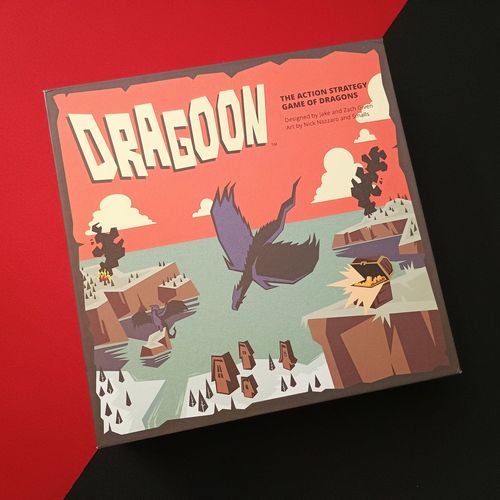
Dragoon
Dragoon Rulebook
Table of Contents
Table of Contents
Overview
DRAGOON is a 2–4 player game where you are the dragon. Your goal is to be the first dragon to fill your cave with 50 gold.
Gold is acquired in three ways:
- Claiming or destroying population tiles (villages and cities)
- Dragon-to-dragon combat
- Stealing from dragons' caves and from the Thief's Treasure
How to Win
The game is over if a player has 50 or more gold at the end of a round. If two or more players have over 50 gold at the end of a round, the player with the most gold wins. If two or more players are tied at 50 gold or higher, all players continue playing until only one player has the most gold at the end of a round.
Setting Up
-
Choose your color! Grab all pieces of that color. This includes 1x dragon, 1x cave, 1x dragon skull scorekeeper and 9x claiming totems.
-
Place your cave on the map with your dragon on it. See diagram below (the rulebook shows a grid diagram for each player count — 2P, 3P, and 4P — marking the starting square for each player's cave with a circle, spread across opposite corners and edges of the map so starting positions are as far apart as possible).
-
Place the dragon skull scorekeeper from each player on the scoreboard at zero. Place the human skull at zero as well. This is the scorekeeper for the Thief's Treasure which will be placed on the map during gameplay (see THIEF'S TREASURE).
Shuffle the deck of cards and distribute three (3) cards to each player. You may look at your cards right away, but do not reveal your cards to other players until you use them!
Playing the Game
DRAGOON uses a coordinate system to populate the map using two dice. Roll the RED die and BLACK die to determine the RED and BLACK coordinates. Then locate that position on the map using the RED and BLACK number icons along the edges of the map.
Each round takes place in three phases: POPULATE, ACTION and TRIBUTE. At the end of the TRIBUTE phase, if there is no winner, begin the next round, starting with the POPULATE phase.
- POPULATE: New population tiles appear
- ACTION: Players take their turns
- TRIBUTE: Collect gold from claimed populations
Populate!
Roll both dice to determine the coordinates where the humans will 'populate'. The number of population coordinates rolled is equal to the number of players plus one (1). For example, in a three (3) player game, roll to populate four (4) times.
There are three (3) possible outcomes of rolling population coordinates:
- If a map location is empty (no villages, cities or caves), place a dark village tile there – even if a dragon or the Thief's Treasure is already there
- If a dark village tile is already there, then the village is upgraded by flipping the tile over to the red city side
- If a city or cave location is rolled, or if no tiles remain, then the thief gains three (3) gold (see THIEF'S TREASURE)
Action!
At the beginning of the Action Phase, the player in last place determines who goes first. If players are tied, those players roll off to break the tie; turn order continues clockwise.
Start your turn by drawing one (1) card – there is no maximum hand size. During your turn, you have three (3) actions. You must use all three (3) actions.
You may do any combination of the following:
- 0 actions – play a card, all cards are free to play, you may play any number of cards per turn
- 1 action – move one space (up/down or side to side, you may not move diagonally)
- 1 action – claim a population tile you are currently standing on by placing a totem on it
- 1 action – destroy a population tile you are currently standing on for instant gold
- 1 action – roll one (1) die to steal gold from another dragon if you are standing in their cave
- 1 action – roll one (1) die to steal gold from the Thief's Treasure if you are standing on it
- 1 action – choose and discard one (1) card from your hand and draw one (1) new card
- 2 actions – draw one (1) new card
For example, a dragon can spend two actions by moving two spaces to stand on a village and spend their third action to claim it.
Claiming
You may claim any population tile (village/city) when you are standing on it and have an available action and totem...even those claimed by other players! When you claim a population tile, replace the current totem (if present) with a totem of your own. Every population tile you have claimed has a chance to pay you gold during the TRIBUTE phase (see TRIBUTE). Each population tile can only have one totem on it at a time.
If you have a totem on a population tile, you cannot spend an action to claim it again.
Destroying
You may destroy a population tile (village/city) when you are standing on it and have an available action to spend. When you destroy a population tile, remove it from the map (totems are returned to their owner) and gain instant gold. Villages are worth 2 gold and cities are worth 4 gold.
You may destroy population tiles that any player has claimed, including your own!
Combat
If two dragons ever occupy the same space (whether they used an action to step into that space or used a movement card like Fairwind or Creature Comfort), combat is automatically initiated. Combat does not cost an additional action. Each player rolls one (1) die. High roll wins; tie goes to the attacker. The winner takes three (3) gold from the loser and the loser is sent to their cave. If the loser has fewer than three (3) gold, the winner takes all of it. If the loser has zero (0) gold, the winner gains zero (0) gold.
Cards
Cards do not cost any actions to play, and there is no maximum hand size or limit to the number of cards you may play. White cards can only be used during your turn. Red cards can be used outside of your turn at specific times (see each card for details).
If all of the cards in the deck are drawn, reshuffle the discard pile.
Stealing from Dragons
If a dragon is standing in their own cave, it cannot be entered by other players for any reason until that dragon leaves their cave.
To steal from another dragon, first step into a vacant cave. Then, spend one (1) action to roll one (1) die. Take that much gold from that dragon and add it to your total. You cannot steal gold from a dragon if they have none.
If you end your turn in another dragon's cave, that dragon is returned to their cave automatically, you lose three (3) gold to them and you are instantly sent back to your own cave.
The Thief's Treasure
The Thief's Treasure is a collection of gold that is stolen by the thief throughout the game and is tracked by the human skull scorekeeper on the scoreboard.
The thief can obtain gold in two (2) ways:
- If a city or cave is rolled during the POPULATION phase, or if no tiles remain, the thief gains three (3) gold
- If a Thief card is played, a player may lose (3) gold to the thief (see Thief card)
Place the Thief's Treasure chest on the map as soon as the thief has more than zero (0) gold by rolling coordinates for its location. This may occur either during the POPULATION phase or during a player's turn. Reroll if it would be placed in a dragon's cave. If the Thief's Treasure is already on the map and gains gold, it does not relocate.
Any player may spend one (1) action to steal from the Thief's Treasure if they are standing on it. For each action spent, roll one (1) die, steal that much gold from the Thief's Treasure, and add it to your score. If the Thief's Treasure runs out of gold, it is removed from the map. The next time the thief gains gold, the treasure chest will return to the map. If a player ends their turn standing on the Thief's Treasure, instantly roll new coordinates and relocate the Thief's Treasure. Reroll if it would be placed in a dragon's cave, or its current location.
After all players have taken their turns, the TRIBUTE phase begins.
Tribute!
During the TRIBUTE phase, claimed population tiles have a chance to pay their owners gold.
There are three (3) categories to determine tribute:
-
If you are standing on a population tile you have claimed, it automatically pays tribute as if you rolled a 3/4/5 (1 gold for villages and 3 gold for cities; see table below).
Tribute Roll Village City 1 Lose 1 claim Lose 1 claim 2 0 Gold 0 Gold 3/4/5 1 Gold 3 Gold 6 2 Gold 4 Gold Destroy 2 Gold 4 Gold -
If another player is standing on a population tile you have claimed, it does not pay tribute. No exceptions!
-
For all other population tiles you have claimed, you roll one (1) die. The number you roll represents the strength of your dragon's roar and applies to all of your claimed populations that do not have any players standing on them. A roll of one (1) results in no tribute from those population tiles, and you must remove one (1) totem of your choice (you can only choose from population tiles that do not have any players standing on them). A roll of 2 results in no tribute from those population tiles. A roll of 3/4/5 results in regular tribute from those population tiles (1 gold for villages, 3 gold for cities). A roll of six (6) results in bonus tribute from those population tiles (2 gold for villages, 4 gold for cities). See reference table above for tribute payouts.
Players standing on population tiles supersede any tribute rolls and card interactions (like Intimidate). For example, if you roll a six (6), your claimed population tile that you're standing on will still only pay as if you rolled a 3/4/5. Additionally, if you play an Intimidate card, your claimed population tile that an opponent is standing on will still pay zero gold.
Contents
- 1x card box
- 1x cloth map
- 1x deck of 58 cards (54 DRAGOON cards + 4 Reference Cards)
- 1x human skull scorekeeper
- 1x instructions booklet
- 1x large cloth bag / scoreboard
- 1x treasure chest
- 2x dice (black and red)
- 4x small cloth bags
- 4x caves
- 4x dragons
- 4x dragon skull scorekeepers
- 20x population tiles (village/city)
- 36x claiming totems (9 of each color)