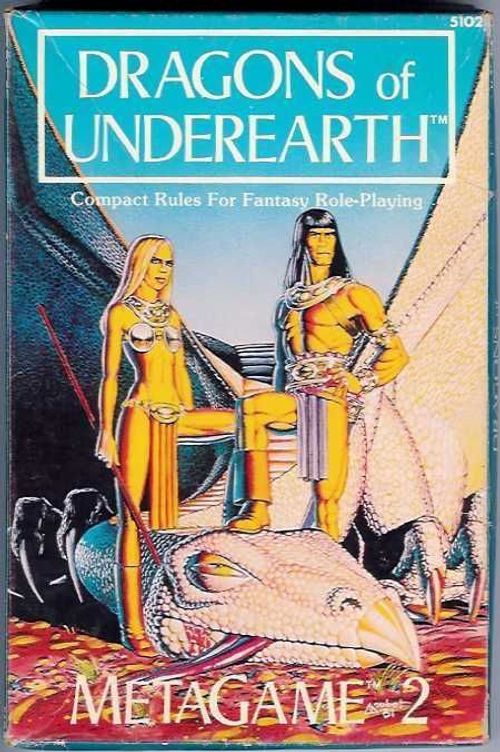
Dragons of Underearth
Dragons of Underearth Rulebook
Table of Contents
Table of Contents
- Character Generation Module
- 1.0 Introduction
- 2.0 Character Record Sheet
- 3.0 Character Type
- 4.0 Attributes
- 5.0 Spells
- 6.0 Talents
- 7.0 Choosing Armor
- 8.0 Choosing Weapons and Shields
- 9.0 Adjusted Dexterity (AdjDX)
- 10.0 Movement Allowance (MA)
- 11.0 Magic Items and Fine Weapons (Optional Rule)
- 12.0 Non-Human Characters (Optional Rule)
- 13.0 Experience Points (Optional Rule)
- 14.0 Creating Combat Scenarios
- Weapons Table
- Character Record Sheet
- Combat Module
- Introductory Rules
- Introductory Scenarios
- Intermediate Rules
- Intermediate Scenarios
- Advanced Rules (Magic)
- Advanced Scenarios
Character Generation Module
1.0 Introduction
This booklet describes a method of making up characters for fantasy role-playing games. It is designed especially for the DRAGONS OF UNDEREARTH™ Combat Module and for DRAGONS OF UNDEREARTH™ related Labyrinth Adventure Modules. However, characters generated by this system can easily be used for any of Metagaming's Micro-Quests™ or THE FANTASY TRIP: IN THE LABYRINTH, as well.
Either the Character Generation Module or the Combat Module can be read first.
2.0 Character Record Sheet
For each generated character, a Character Record Sheet (see back of booklet) must be filled out, or copied on scratch paper. At the top of the sheet, a name or other identification should be filled in.
3.0 Character Type
A character must be either a Wizard or a Hero (fighter).
4.0 Attributes
4.1 Strength (ST) governs:
(1) How many hits a figure can take. "Hits" represent injury. The hits a figure takes in combat are subtracted from its ST; each hit reduces ST by 1. When ST reaches 0 the character is dead.
(2) How many spells a wizard can cast. Each spell has a ST cost. This is the number of ST points a wizard expends casting the spell. This is fatigue loss, which is treated just like injury from hits.
(3) What weapons a figure can use. Each weapon (listed on the WEAPONS TABLE) has a ST which is needed for its use.
4.2 Dexterity (DX) governs:
(1) How likely a fighter is to hit an enemy with a weapon.
(2) How likely a wizard's spells are to succeed. Dexterity is adjusted for several factors, as will be explained later.
4.3 Intelligence (IQ) governs:
(1) How many spells a wizard knows.
(2) How many talents a Hero knows.
(3) How complex the spells or talents are.
4.4 Selecting Attributes: For a scenario, a character will have a pre-determined Attribute total, which the player can split up among the three Attribute totals as he sees fit. A human character cannot have any attributes of less than 8. EXAMPLE: A 32-point character could have ST 10, DX 14, and IQ 8; or ST 11, DX 10, and IQ 11; or some other combination totaling 32.
The "average" adult human has 10 for all attributes, though many DRAGONS OF UNDEREARTH heroes and wizards will be higher than average. A human cannot have a ST of more than 30.
5.0 Spells
5.1 Selecting Spells: Only wizard characters may know spells. He may know a number of spells equal to his IQ. None of these spells may be of an IQ level (see SPELL TABLE) which is higher than the wizard's IQ. EXAMPLE: A wizard with IQ 11 could know 11 spells, none higher than IQ level 11.
5.2 Types of Spells: Each of the spells is listed by IQ level. The detailed instructions for the use of each spell are given elsewhere, depending on the type of spell. Combat spells are described in the Combat Module, Magic Item Creation spells are described in 11.0 of this booklet, and Non-Combat spells are described in CONQUERORS OF UNDEREARTH™.
5.3 Spell List:
IQ 8
- STAFF: Magical Item Creation
- MAGIC FIST: Combat (Missile)
- BLUR: Combat (Thrown)
- SLOW MOVEMENT: Combat (Thrown)
- DROP WEAPON: Combat (Thrown)
IQ 9
- CLUMSINESS: Combat (Thrown)
- CONFUSION: Combat (Thrown)
- AID: Combat (Thrown) or Non-Combat
- SUMMON WOLF: Combat (Summoning Creatures)
- FIRE: Combat (Magic Barriers) or Non-Combat
IQ 10
- TRIP: Combat (Thrown)
- SPEED MOVEMENT: Combat (Thrown) or Non-Combat
- SUMMON MYRMIDON: Combat (Summoning Creatures)
- DAZZLE: Combat (Miscellaneous)
- SHADOW: Combat (Magic Barriers)
- LOCK/KNOCK: Non-Combat
IQ 11
- SLEEP: Combat (Thrown)
- SUMMON BEAR: Combat (Summoning Creatures)
- CREATE WALL: Combat (Magic Barriers) or Non-Combat
- REVERSE MISSILES: Combat (Thrown)
- DESTROY CREATION: Combat (Thrown) or Non-Combat
- SILENT MOVEMENT: Non-Combat
IQ 12
- FREEZE: Combat (Thrown)
- FIREBALL: Combat (Missile)
- INVISIBILITY: Combat (Thrown) or Non-Combat
- BLAST: Combat (Miscellaneous)
- MAGE SIGHT: Combat (Thrown)
- BREAK WEAPON: Combat (Thrown)
- 3-HEX FIRE: Combat (Magic Barrier) or Non-Combat
- 3-HEX SHADOW: Combat (Magic Barrier)
- REPAIR: Combat (Thrown) or Non-Combat
IQ 13
- SUMMON GARGOYLE: Combat (Summoning Creatures)
- FLIGHT: Non-Combat
- STONE FLESH: Combat (Thrown)
- SLIPPERY FLOOR: Combat (Thrown) or Non-Combat
- 3-HEX WALL: Combat (Magic Barriers) or Non-Combat
- FIREPROOFING: Combat (Thrown)
IQ 14
- LIGHTNING: Combat (Missile)
- SUMMON GIANT: Combat (Summoning Creatures)
- REMOVE THROWN SPELL: Combat (Thrown) or Non-Combat
- SPELL SHIELD: Combat (Thrown)
- WEAPON/ARMOR ENCHANTMENT: Magic Item Creation
- EXPLOSIVE GEM: Magic Item Creation
IQ 15
- IRON FLESH: Combat (Thrown Combat)
- TELEPORT: Combat (Miscellaneous)
- SUMMON SMALL DRAGON: Combat (Summoning Creatures)
- 7-HEX SHADOW: Combat (Magic Barriers)
IQ 16
- SUMMON DRAGON: Combat (Summoning Creatures)
- DEATH SPELL: Combat (Thrown)
- 7-HEX FIRE: Combat (Magic Barriers) or Non-Combat
- 7-HEX WALL: Combat (Magic Barriers) or Non-Combat
- MEGAHEX SLEEP: Combat (Thrown)
- STAFF OF POWER: Magic Item Creation
IQ 17
- (none)
IQ 18
- WIZARD'S WRATH: Combat (Missile)
- LESSER MAGIC ITEM CREATION: Magic Item Creation
- MEGAHEX FREEZE: Combat (Thrown)
IQ 19
- LONG-DISTANCE TELEPORT: Combat (Miscellaneous) or Non-Combat
IQ 20
- GREATER MAGIC ITEM CREATION: Magic Item Creation
6.0 Talents
6.1 Selecting Talents: Each talent has an IQ level, like spells do, and also an IQ cost. A character may know a number of talents whose total IQ cost is equal to his IQ. None of these talents may be of an IQ level which is higher than the character's. Wizards may know talents as well as spells, except for Weapons talents and Special Combat talents, but the IQ cost is doubled. EXAMPLE: A fighter with an IQ of 8 could know three talents that have a cost of 2 and two talents with a cost of 1, none of them higher than IQ 8.
6.2 Types of Talents: Each of the talents is listed with its IQ cost, by IQ level. Weapons talents are necessary for the character to later select weapons; see 8.0 of this module. Special Combat talents give advantages in the combat arena, as explained in the Combat Module. Other talents are fully explained in the Magic Item Creation section of this module or in CONQUERORS OF UNDEREARTH. Still other talents are not explained in the rules per se; they may or may not give advantages in non-combat encounters during adventures, but will give a character a personality.
6.3 Talent List:
IQ 7
- KNIFE (1): Weapons talent for the Dagger only
- SWORD (2): Weapons talent; includes Knife talent; for all swords
- AX/MACE (2): Weapons talent; for all axes and maces and hammers
- POLE WEAPONS (2): Weapons talent; for all pole weapons
- BOW (2): Weapons talent; for sling, small bow, horse bow, long bow
- CROSSBOW (1): Weapons talent; for heavy and light crossbow
- SHIELD (1): Weapons talent; for all shields
IQ 8
- GUNS (2)
- SEX APPEAL (1)
- THROWN WEAPONS (2): Special Combat Talent
- RUNNING (2): See 10.3
- HORSEMANSHIP (1)
- LITERACY (1)
- SWIMMING (1)
- LANGUAGES (1): See 6.4
IQ 9
- DIVING (1): Prerequisite: Swimming
- PRIEST (2)
- BARD (2)
- DETECT TRAPS (2)
- CHARISMA (2)
- ALERTNESS (2)
- ACUTE HEARING (3)
- SILENT MOVEMENT (2)
- ANIMAL HANDLER (2)
- RECOGNIZE VALUE (1)
- DRIVER (1)
- MISSILE WEAPONS (3): Special Combat talent
- CLIMBING (1):
- WARRIOR (2): Special Combat talent; Prerequisites: ST or 14 or better
- VETERAN (3): Special Combat talent; Prerequisites: ST of 16 or better, and Warrior talent
IQ 10
- REMOVE TRAPS (1): Prerequisite: Detect Traps
- NEW FOLLOWERS (2): Prerequisite: Charisma
- DIPLOMACY (1)
- NATURALIST (2)
- BUSINESS SENSE (2)
- ARMOURER (2)
- ENGINEER (2)
- THIEF (2)
IQ 11
- TWO WEAPONS: Special Combat talent; Prerequisite: DX of 13, after adjustment for armor.
- TACTICS (1): Special Combat talent
- PHYSICKER (1)
- DETECTION OF LIES (2)
- VET (2; 1 if character also has Physicker talent): Prerequisite: Animal Handler
- MECHANICIAN (2)
- EXPERT HORSEMANSHIP (2)
IQ 12
- SPYING (3): Prerequisite: Silent Movement
- MASTER THIEF (2)
- MASTER ARMOURER (2): See 11.2; Prerequisite: Armourer
IQ 13
- CHEMIST (3): See 11.2
- MASTER MECHANICIAN (2): Prerequisite: Mechanician
- SCHOLAR (3): Prerequisite: Literacy
- STRATEGIST (2): Special Combat talent; prerequisite: Tactics
- MATHEMATICIAN (2): Prerequisite: Literacy
IQ 14
- MASTER PHYSICKER (2): Prerequisite: Physicker
- THEOLOGIAN (2): Prerequisite: Priest
- ALCHEMY (3): See 11.2
- MASTER BARD (2): Prerequisite: Bard
6.4 Languages: A character automatically knows the language of his own race. To speak with characters of other intelligent races (enemy or friendly), he must have the Languages talent for that race. A character may have more than one Languages talent, using 1 IQ point for each. EXAMPLE: A human with the Dwarf and Goblin Languages talent could speak to Dwarves and Goblins and humans, but not Elves.
If the character has the Literacy talent, he may read and write all Languages that he knows.
An adventurer character with the Languages talent may speak to Goblins, and vice versa, in non-combat encounters in a Fortress adventure. Either may speak with the Dragon, and neither may speak with wolves and other animals, regardless of the Languages talent.
7.0 Choosing Armor
A wizard may be unarmored, or he may wear cloth or leather armor. A hero may be unarmored, or he may wear any type of armor shown on the ARMOR TABLE. Heavier armor protects the character more, but also encumbers the character more and makes him slower. The type of armor and "Hits Stopped" from the ARMOR TABLE should be written down on the Character Record Sheet.
8.0 Choosing Weapons and Shields
8.1 Choice of Weapon: Each weapon is of a particular class: Swords, Axes/Hammers/Maces, Pole Weapons, or Missile Weapons (Bows or Crossbows). Also, each weapon has a minimum Strength (ST), which a character needs to use it. A hero may select a weapon only if he has the Weapons talent (see 6.0) for that class of weapons, and if his ST is equal to or greater than the minimum needed for that weapon. EXAMPLE: A fighter with a ST of 11 and a Weapons talent only for Swords could select a Shortsword, but not a Mace or a Broadsword. (He may use the weapon even if wounds reduce his ST.)
8.2 Number of Weapons: A hero may have two weapons, or three weapons if none of them requires two hands (see WEAPONS TABLE). (For this purpose, Bastard Swords and Spears are considered one-handed weapons.)
8.3 Shields: A shield counts as a one-handed weapon. A character may select a small, large, or tower shield. Larger shields give more protection, but encumber the character.
8.4 Great Strength: If a character has a ST of at least 10 over the minimum ST for a two-handed weapon other than a missile weapon, he may use it one-handed.
8.5 Weapon Status: A weapon or shield may be Ready or Slung. A character may have a two-handed weapon, or a one-handed weapon and a shield, or just a one-handed weapon Ready. (EXCEPTION: A hero with the Two Weapons talent may have two one-handed weapons Ready.) Other weapons are Slung.
8.6 Arrows, Quarrels, and Pellets are not considered weapons, and are in unlimited supply to characters with missile weapons.
8.7 Wizards may not have any weapons (except Staffs; see 11.2) or shields.
9.0 Adjusted Dexterity (AdjDX)
9.1 Armor and Shields: Each type of armor has a "DX-" indicated on the ARMOR TABLE, which must be subtracted from the character's DX. If the character has a large shield or tower shield, this, too, has a "DX-", regardless of whether it is Ready or Slung. EXAMPLE: A character has a basic DX of 12, leather armor, and a large shield. His adjDX would be 9.
9.2 Great Strength:
- ST 18-21: Each DX- reduced by one.
- ST 22-25: Each DX- reduced by two.
- ST 26-30: Each DX- reduced by three.
EXAMPLE: A character with ST 21, DX 12, leather armor, and a large shield would have adjDX 11 (-1 for armor, -0 for shield).
9.3 Effect: A character with an adjDX of less than 9 will seldom hit an enemy, while adjDX of over 12 gives almost automatic hits.
10.0 Movement Allowance (MA)
10.1 Armor: A character's MA depends upon the type of armor he is wearing (see ARMOR TABLE). An unarmored character has an MA of 10.
10.2 Great Strength: A character with ST of 18 or more adds to his MA while he is wearing armor, as long as this does not give him a higher MA than he would have without armor:
- ST 18-21: Add 1 MA
- ST 22-25: Add 2 MA
- ST 26-30: Add 4 MA
10.3 Running Talent adds 2 to a character's MA, at all times.
11.0 Magic Items and Fine Weapons (Optional Rule)
11.1 Buying Magic Items: In some scenarios, the Adventurers will have a "budget" with which to buy magic items.
11.2 Making Magic Items: If a character has the indicated spell or talent, he receives the indicated items for free, before the game starts. Items other than staffs may be given to other characters. The items cannot be created during a combat or adventure.
- STAFF SPELL: One Staff, for the wizard himself
- WEAPON/ARMOR ENCHANTMENT: One +1 DX or +1 damage weapon, or one armor with an extra hit stopped
- EXPLOSIVE GEM SPELL: $550 worth of explosive gems
- STAFF OF POWER SPELL: One Staff of Power, for the wizard himself
- LESSER MAGIC ITEM CREATION SPELL: Any magic item or items except potions and explosive gems, worth up to $3000 total
- GREATER MAGIC ITEM CREATION SPELL: Any magic item or items except potions and explosive gems, worth up to $5000 total
- MASTER ARMOURER TALENT: One +1 DX or +1 damage weapon
- CHEMIST TALENT: $500 worth of chemical potions
- ALCHEMIST TALENT: $500 worth of alchemical potions
11.3 Enchanted Weapons and Fine Weapons either add to the DX of their user (making them easier to hit with), or add to the damage usually done by that weapon. Any weapon, including a missile weapon, can be enchanted or finely-made.
- +1 DX or +1 damage weapon: $1000
- +2 DX or +2 damage or +1 DX, +1 Damage Weapon: $2000
- +3 Weapon: $4000
- +4 Weapon: $8000
- +5 Weapon: $16000
11.4 Enchanted Armor: Stops additional hits; can be any type of armor or shield. Same cost as enchanted weapons.
11.5 Explosive Gems: These can be thrown (see Thrown Weapons or Thrown Spells) at an enemy. If they hit, they do a certain amount of damage. A gem can only be used once, regardless of whether or not it hits.
- 1-die explosive gem: $150
- 2-dice explosive gem: $250
- 3-dice explosive gem: $400
- 4-dice explosive gem: $550
- 5-dice explosive gem: $750
- 6-dice explosive gem: $1050
- 7-dice explosive gem: $1500
- 8-dice explosive gem: $2000
11.6 Gems of Summoning: When the gem is thrown to the floor in the character's megahex (see Combat Module), the indicated creature is summoned. (See Summoning Spells in Combat Module.) It stays for six rounds of combat. The gem may only be used once.
- Wolf or Myrmidon: $500
- Bear, Gargoyle, or Giant: $1000
- Small Dragon: $2000
- 7-hex Dragon: $4000
11.7 Magic Arrows: When the arrow hits an enemy, the enemy drops his weapon from one hand or is knocked down, in addition to the normal hits. The arrow may be used again in another combat by the side that wins. It may be fired from a short bow, horse bow, or longbow.
- Drop-Weapon Arrow: $500
- Trip Arrow: $1000
11.8 Dazzle Gem: When the gem is thrown down, the Dazzle spell (see Combat Module, Miscellaneous Spells) automatically goes off. Can only be used once. Cost: $250.
11.9 Magic Door Lock: A door on the labyrinth map may be locked at no MA cost. Can only be used once. Cost: $500.
11.10 Magic Key: Can open any locked door on the labyrinth map, during the Movement phase, at no movement penalty. Can only be used once. Cost: $1000.
11.11 Magic Rings: A ring gives its wearer the power to cast a particular spell on himself, regardless of whether or not the wearer is a wizard. See 21.1 in Combat Module. Some rings require the use of ST to cast the spells; some do not. All can be re-used indefinitely.
-
Blur ring: 1 ST per round: $3000; Self-powered: $30,000
-
Speed Movement Ring: 1 ST per round: $1500; Self-powered (MA permanently doubled): $20,000
-
Reverse Missile Ring: 1 ST per round: $5000; Self-powered: $50,000
-
Invisibility Ring: Normal ST cost: $6500; Self-powered: $65,000
-
Mage Sight: No ST cost: $6000
-
Flight: Normal ST cost: $10,000; Self-powered: $100,000
-
Stone Flesh Ring: No ST cost: $4000
-
Fireproofing Ring: No ST cost: $5000
-
Spell Shield: 1 ST per round: $6000; Self-powered: $60,000
-
Iron Flesh: No ST cost: $16,000
-
Teleport: 1 ST/Megahex: $15,000
-
Long-Distance Teleport: Normal ST cost (20 ST): $50,000; Self-powered: $600,000
Attribute-increasing Rings: Always increase the ST, DX, or IQ of their wearer.
- +1 ST, or +1 DX, or +1 IQ: $2000
- +2 attribute ring: $4000 (only one attribute)
- +3 attribute ring: $8000 (only one attribute)
- +4 attribute ring: $16,000 (only one attribute)
- +5 attribute ring: $32,000 (only one attribute)
11.12 Chemical Potions:
- WEAPON POISON: See 12.0 in Combat Module. Cost: $150 (good for one use on one weapon).
- REPTILE POISON (double dose): Does 6 dice of damage to a dragon that swallows it. Cost: $200.
- INCREASE ST: Adds 1 ST to the user for a single labyrinth adventure (or combat); a hero may take a bigger weapon. Up to 3 doses may be used. Cost: $450.
- INCREASE DX: Adds 1 to a user's DX for one labyrinth adventure (or combat). Up to 3 doses may be taken. Cost: $600/dose.
11.13 Alchemical Potions:
- FLIGHT: The user can fly (see CONQUERORS OF UNDEREARTH) for one labyrinth adventure, at the normal ST cost. Cost: $1200.
- HEALING: Each dose cures 1 hit of damage (or fatigue from spellcasting). Cost: $150 per dose.
- PYROTIC ABILITY: Gives the user the ability to set fires mentally, like a 1-hex Fire spell. Costs 1 ST each time it is attempted. User rolls 3 dice against IQ, rather than DX, to see if he succeeds. Ability lasts for one labyrinth adventure (or combat). Cost: $500.
- FIREPROOFING: User cannot be harmed by Fire spell, Fireballs, or dragonbreath for one labyrinth adventure (or combat scenario). Cost: $400.
- SPEED: Adds 4 to the user's MA for one labyrinth adventure or combat scenario. Cost: $1000.
12.0 Non-Human Characters (Optional Rule)
Elf, Dwarf, Halfling, Orc, Goblin, or Hobgoblin characters are created in the same way as human characters, with the following differences:
12.1 Beginning Characters, equivalent to a 32-point human (see 4.4) have the following minimum ST, DX, and IQ, and the following total attribute points:
| RACE | MIN. ST | MIN DX | MIN. IQ | Total Attribute Points--Start |
|---|---|---|---|---|
| Human | 8 | 8 | 8 | 32 |
| Elf | 6 | 10 | 8 | 32 |
| Dwarf | 10 | 6 | 8 | 32 |
| Halfling | 4 | 12 | 8 | 30 |
| Orc | 8 | 8 | 8 | 32 |
| Goblin |
12.2 Special Abilities:
- ELVES: MA of 12 unarmored; MA of 10 with cloth or leather armor (MA in heavier armor same as humans).
- DWARVES: +1 damage with Axe/Mace/Hammer weapons; double normal loads of coins and gems.
- HALFLING: +3 DX adjustment for missile weapons, missile spells, and thrown weapons (not cumulative with Missile Weapons or Thrown Weapons talents); +1 damage when hitting with any of the above.
13.0 Experience Points (Optional Rule)
13.1 General: If a player keeps a character for several arena combats, labyrinth adventures, and campaigns, the character will receive Experience Points, which are "traded in" for Attribute Points (ST, DX, or IQ).
13.2 How Experience Points (EP's) are Gained:
A. Putting hits on an enemy: 1 EP for each hit.
B. Delivering "killing blow" to an enemy: EP's equal to DX of enemy.
C. Casting Spells: 1 EP per ST point used in casting the spell, but only for spells cast in combat or in labyrinth adventures.
13.3 Increasing Attributes: After an arena combat or a labyrinth adventure, a character may exchange earned Experience Points for Strength points. The exchange rate depends on the number of Attribute Points that the character already has:
- Up to 36 points attribute total: 125 EP each
- 37-40 attribute total: 250 EP each
- 41-45 attribute total: 1,000 EP each
- 46-50 attribute total: 3,000 EP each
- 51-55 attribute total: 5,000 EP each
For each series of 5 attribute totals over 55, double the EP needed. EXAMPLE: A character with ST 18, DX 13, and IQ 8, for an attribute total of 39, would need 250 EP to get his 40th attribute point.
14.0 Creating Combat Scenarios
The following point costs will help players to select opposing forces which are evenly matched:
-
28 attribute-point human or humanoid: 1
-
32 attribute-point human or humanoid: 1 1/2
-
36 attribute-point human or humanoid: 2
-
40 attribute-point human or humanoid: 3 1/2
-
44 attribute-point human or humanoid: 6
-
48 attribute-point human or humanoid: 9
-
Wolf: 1
-
Bear: 2
-
Lion: 2
-
Gargoyle: 2
-
Giant: 2
-
4-hex Dragon: 4
-
7-hex Dragon: 10
-
Greater Demon: 16
-
Troll: 3 1/2
-
Octopus: 4
-
Permanent magic items (ring, etc.): 1 per $4000
-
Magic Gems: 1 per $500
Armor Table
Natural Protection on Animals and Creatures: See descriptions of individual creatures.
| ARMOR | Hits Stopped | DX- | MA |
|---|---|---|---|
| Cloth armor | 1 | -1 | 10 |
| Leather armor | 2 | -2 | 8 |
| Chainmail | 3 | -3 | 6 |
| Half-plate | 4 | -5 | 6 |
| Plate armor | 5 | -6 | 6 |
Shields
| SHIELDS | Hits Stopped | DX- | MA |
|---|---|---|---|
| Small shield | 1 | -0 | |
| Large shield | 2 | -1 | |
| Tower shield | 3 | -2 |
Talents
| TALENTS | Hits Stopped | DX- | MA |
|---|---|---|---|
| Warrior | 1 | -- | |
| Veteran | 2 | -- |
Magic Protection
| MAGIC PROTECTION | Hits Stopped | DX- | MA |
|---|---|---|---|
| Stone Protection | 4 | -- | |
| Iron Flesh | 6 | -- |
Note: Protection is cumulative, but no more than one item of each class may apply at a time.
DX Modifiers
- ARMOR: See Character Generation Module.
- ENCHANTED WEAPONS: See Character Generation Module.
Combat Talents:
- Thrown Weapons: +2 on Thrown Weapons
- Missile Weapons: +3 on Missile Weapons
- Two Weapons: -0 on first weapon; -4 on second weapon
Facing (non-missile, non-thrown weapons or spells only):
- Striking from Enemy's Side: +2
- Striking from Enemy's Rear: +4
- Enemy was knocked down: +4
Range:
- Thrown Weapons and Spells: -1 per hex
- Missile Weapons & Spells:
- -0 if 0, 1, or 2 megahexes
- -1 if 3 or 4 megahexes
- -2 if 5 or 6 megahexes
- -3 if 7 or 8 megahexes
Magic Spells:
- Target is Blurred: -4
- Target is Invisible: -6
- Target is in Shadow hex: -4
- Attacker is in Shadow hex: -6
- Dazzle: -3
- Attacker hit by Clumsiness: -2/ST used in spell
- Attacker is in Fire hex: -2
Wounds: The figure is at 2 or 3 ST: -3
Sweeping Blows: -4
Weapons Table
SWORDS (ST / Damage / Notes)
- Dagger*: ST 6; damage 1-1
- Rapier: ST 9; damage 1
- Cutlass: ST 10; damage 2-2
- Shortsword: ST 11; damage 2-1
- Broadsword: ST 12; damage 2
- Bastard Sword (1 hand)X: ST 13; damage 2+1
- Bastard Sword (2 hands)X: ST 13; damage 3-2
- 2-handed Sword+: ST 14; damage 3-1
- Great Sword+: ST 16; damage 3+1
AXES/HAMMERS/MACES
- Hatchet*: ST 9; damage 1
- Hammer*: ST 10; damage 1+1
- Mace*: ST 11; damage 2-1
- Small Axe*: ST 11; damage 1+2
- Military Pick: ST 12; damage 2
- Morningstar: ST 13; damage 2+1
- Great Hammer+: ST 14; damage 2+2
- Battle Axe+: ST 15; damage 3
POLE WEAPONS
- Javelin*: ST 9; damage 1-1
- Spear (1 hand)*X: ST 11; damage 1
- Spear (2 hands)*X: ST 11; damage 1+1
- Halberd+: ST 13; damage 2
- Pike Axe+: ST 15; damage 2+2
MISSILE WEAPONS
- Sling: ST 6; damage 1-2
- Small Bow+: ST 9; damage 1-1; 2 shots/round, if adjDX = 15+
- Horse Bow+: ST 10; damage 1; 2 shots/round, if adjDX = 16+
- Longbow+: ST 11; damage 1+1; 2 shots/round, if adjDX = 18+
- Light Crossbow+: ST 12; damage 2; fires every other round, or every round if adjDX = 14+
- Heavy Crossbow+: ST 15; damage 3; fires every third round, or every other round if adjDX = 16+
OTHER WEAPONS
-
Wizard's Staff: damage 1
-
Staff of Power: damage 2
-
* This weapon may be thrown; see Thrown Weapons rule.
-
X This weapon may be used 2-handed.
-
+ This weapon requires two hands (unless the character has a ST of 10 over the required ST).
Hits Stopped
Animals and Creatures: See descriptions of individual creatures.
Armor:
- Cloth: -1 hits/attack
- Leather: -2
- Chainmail: -3
- Half-plate: -4
- Plate: -5
Shield (must be ready if attacker is to front; must be slung if attacker is to rear):
- Small Shield: -1
- Large Shield: -2
- Tower Shield: -3
Magic Protection:
- Stone Flesh: -4
- Iron Flesh: -6
(Armor and/or shield may be enchanted, to stop additional hits.)
Talents:
- Warrior: -1
- Veteran: -2
(The Veteran talent replaces the Warrior talent; it doesn't add to it.)
Monster/Beast Table
| CREATURE | MA | ST | DX | IQ | ARMOR | DAMAGE | NOTES |
|---|---|---|---|---|---|---|---|
| Wolf | 12 | 10 | 14 | 6 | 1 hit | Bite:1+1 | |
| Bear | 8 | 30 | 11 | 6 | 2 hits | Claws:2+2 | |
| Gargoyle | 16 | 20 | 11 | 8 | 3 hits | Hands:2 |
(Booklet page 15 carries an illustration of a winged demon; no text.)
Character Record Sheet
The back of the Character Generation Module is a Character Record Sheet, which is filled out for each character (see 2.0). It has these fields:
- Name or ID; Counter ID; Wizard or Hero?
- ST, DX, IQ = Total
- Talents or Spells
- Armor; DX-; Hits Stopped; Movement Allowance
- Weapon or Shield; Damage; Status (up to three entries)
- Status key: Ready (R) or Slung (SL); Dropped or Broken (DW or BW); poison (P)
- Current Adjusted DX
- Magic Gems, Rings, Potions, etc.
- Potions & Spells in effect
- Coins & Gems (up to 100x ST)
- Hits (wounds); Hits (fatigue)
- Experience Points
Combat Module
Contents of the Combat Module: 1.0 Introduction; Introductory Rules (2.0 Combat Arena Map, 3.0 Counters, 4.0 Combat Sequence, 5.0 Movement in Combat Arena, 6.0 Facing, 7.0 Combat--Non-Missile, Non-Thrown Weapons, 8.0 Disengaging, 9.0 Effects of Hits); Introductory Scenarios (1. Gladiator vs. Gladiator Duel, 2. Gladiator vs. Lion, 3. Dwarves vs. Goblins); Intermediate Rules (10.0 Thrown Weapons, 11.0 Missile Weapons, 12.0 Poison (Optional), 13.0 Creatures (Optional), 14.0 Bare-Handed Attacks (Optional)); Intermediate Scenarios (1. Adventurers vs. Octopus, 2. Dragon vs. Spearmen, 3. Humans vs. Orcs skirmish); Advanced Rules (15.0 Missile Spells, 16.0 Thrown Spells, 17.0 Summoning Creatures, 18.0 Creating Magical Barriers, 19.0 Miscellaneous Combat Spells, 20.0 Wizard's Staves, 21.0 Use of Magic Items); Advanced Scenarios (1. Duel of Wizards, 2. Adventurers vs. Trolls, 3. Battle of the Chasm).
1.0 Introduction
This booklet describes a weapons and magic combat system for duels and small-scale battles. It is based on Metagaming's MELEE™, WIZARD™, ADVANCED MELEE™, and ADVANCED WIZARD™, but it is streamlined and simplified to be easier to learn. Also, it makes battles with up to a dozen characters per side manageable. Players who are familiar with the other Metagaming games should feel free to add such things as hand-to-hand combat, illusions, and gunpowder weapons, if they wish.
The Combat Module may be learned before or after the Character Generation Module, at the players' preference. Combat scenarios, with pre-generated characters, are included in the Combat Module.
The Combat Module rules consist of three levels of difficulty: Introductory, Intermediate, and Advanced. New players can read the Introductory rules, then play an Introductory scenario to become familiar with these rules, before progressing to the Intermediate and Advanced Combat rules. The Introductory rules cover close combat with weapons; the Intermediate rules add Thrown Weapons, Missile Weapons, Poison, and creatures; the Advanced rules deal with magic.
Introductory Rules
2.0 Combat Arena Map
Each hex of the combat arena map represents an area 1 1/3 meters across. The larger, heavy-bordered hexagons, made up of 7 small hexes, are called megahexes, and represent areas 4 meters across. (The entire combat arena represents the area between two hexes of the LORDS OF UNDEREARTH™ or CONQUERORS OF UNDEREARTH™ map.) The entire map is used only if an outdoor area or an area within a large room is being represented. The large dotted blue lines indicate the width to be used if the battle is in a Wide Corridor. The solid blue lines indicate the width of a Narrow Corridor, and the small dotted blue lines indicate a Tunnel. The blue shaded area represents the Chasm in Advanced Scenario 3, and should be ignored in the other scenarios. The red stars, and the "Attackers" and "Defenders" labels, indicate the hexes in which attacking and defending figures may set up. A wall, with a double door, is on the map, to be used when the attackers are coming through a door.
3.0 Counters
Players must have a counter for each figure involved in the combat. Each counter must have an ID number, letter, or name, which refers to a Character Record Sheet or piece of scratch paper. Counters are set up on the starred entry hexes of the map.
4.0 Combat Sequence
Combat is done in rounds, each representing five seconds of "real" time. Each round consists of the following phases, during which only the prescribed actions for that phase may be taken. The actions are summarized here, and explained in detail later:
I. Roll for Initiative: Each side rolls a die. The high roller (roll again in case of a tie) may choose to have his figures move either first or second, as he wishes. (+1 to die roll if a figure has the Tactics talent, +2 for Strategist; one bonus per side only.)
II. First Player's Movement:
- A. Figures that are Engaged with an enemy may shift one hex.
- B. Figures not Engaged may move a number of hexes up to their Movement Allowance.
III. Second Player's Movement: Same as First Player's.
IV. Options: One of the following Options is chosen for each figure. All figures act simultaneously. The player who did not have Initiative announces and resolves his options first, and the player with Initiative announces and resolves his second, but all effects occur at the end.
- A. Figures who moved over 1/2 their Movement Allowance (MA): Do nothing.
- B. Figures who moved up to 1/2 of their MA: One of:
- Ready a weapon, re-load a crossbow, or pick up a dropped weapon;
- Attempt to hit an enemy with a non-missile weapon;
- Disengage;
- Do nothing.
- C. Figures who moved 1 hex or stood still: One of Options 1-4, as above; or: 5. Fire a missile weapon; 6. Attempt to cast a spell; 7. Stand up after being knocked down.
In addition, wizards may renew continuing spells.
V. Record Effects: Hits and magic spells take effect. Changes in Weapon Status (Ready, Dropped, etc.) are recorded. Forced retreats are carried out.
5.0 Movement in Combat Arena
5.1 Movement Allowance: Each round, a figure may move a number of hexes equal to its Movement Allowance (MA).
5.2 Engaging: When a figure is in a hex which is to the front (see 6.0) of an enemy figure, it is considered Engaged. EXCEPTIONS: Figures are not engaged by enemies who have no Ready weapon (see 7.1) or who are knocked down. A figure must end its movement when it becomes engaged.
5.3 Shifting: An engaged figure may move only one hex during the Movement phase, and it must stay adjacent to all enemies with which it is engaged.
5.4 Other Figures: No figure may ever move into or through a hex occupied by another figure, enemy or friendly.
5.5 Multi-hex Figures: The MA for a multi-hex figure (such as the 7-hex dragon) indicates the maximum number of hexes that any part of the figure may move in one round. EXAMPLE: If the dragon's tail stays in a hex but the head moves four hexes, the dragon is considered to have moved four hexes. Rules 5.2 to 5.4 are the same for multi-hex figures as for single-hex figures. (EXCEPTION: A 4-hex or larger figure may move more than one hex while shifting, as long as it stays engaged.)
5.6 No Flight during combat rounds is allowed, even for figures able to fly, because of the limited space for maneuvering.
6.0 Facing
Each one-hex figure "faces" one side of its hex, as shown by the direction the counter is turned. A player may change the facing of a figure whenever it moves, and may always change its facing at the end of its movement turn, even if it stayed in the same hex. Facing determines which enemies can be attacked by which figures. A figure will normally have "Front", "Side", and "Rear" hexes, which will vary as that figure moves.
A figure that has been knocked down is considered to face "Rear" in all six directions.
A multi-hex figure will also have Front, Side, and Rear hexes, as shown below. (The original booklet shows diagrams of one-hex, 2-hex, 3-hex, 4-hex, 7-hex and 14-hex figures marked F (Front), S (Side) and R (Rear) hexes.)
7.0 Combat--Non-Missile, Non-Thrown Weapons
7.1 Ready Weapons: To make any physical attack, a figure must have a Ready weapon. A weapon stays Ready after an attack, unless it is thrown. To change weapons, a figure must choose the "Ready a Weapon" Option, which takes a round. A figure may have Ready either a single two-handed weapon, or a one-handed weapon and a shield. (See WEAPONS TABLE. Bastard swords and spears may be used either one-handed or two-handed.)
When a weapon is changed, the status of the weapons involved are noted on the Character Record Sheet or on scratch paper, with an "R" (Ready) or "SI" (Slung) next to the weapon.
7.2 Dexterity (DX) Modifiers: Before rolling for an attack, a figure may add 2 to his Dexterity (DX) if he is attacking from the enemy's side, and may add 4 for attacking from the enemy's rear or for attacking an enemy who was knocked down last turn. Other DX modifiers apply to figures affected by magic or wounds or other factors (summarized on DX MODIFIERS TABLE). These modifiers are cumulative.
7.3 Roll to Hit: When a figure attacks, the player states which enemy (next to and in front of the attacker) is being attacked. He then rolls three dice. To hit, a figure must roll its Adjusted Dexterity (adjDX) or less on the three dice. EXAMPLE: A figure with an adjDX of 8 must roll a total of 8 or less on three dice to hit.
7.4 Roll for Damage: If a roll-to-hit was successful, a roll-for-damage is made. The damage done by an attack depends on the type of weapon used. The "Damage" column of the WEAPONS TABLE indicates how many dice are rolled to determine the number of hits the figure takes. EXAMPLE: If a figure hits an enemy with a Broadsword, two dice would be rolled to see how many hits the enemy took. If a total of 7 were rolled on the two dice, the enemy would take seven hits.
Some weapons have a + or - number, which indicates the number of hits to add or subtract from the total dice roll. (Enchanted weapons may also do additional hits.) EXAMPLE: If a figure hit with a Cutlass, two dice would be rolled and then two hits would be subtracted from this total. A dice roll of 7 would thus result in 5 hits.
Modified rolls of less than zero are treated as zero.
7.5 Pole Weapons: If a hit is made with a pole weapon, and if the attacking and defending figures were not next to each other at the beginning of the round (i.e. one of them moved to engage the other for the first time; a "charge" attack) the damage is doubled.
7.6 Armor and Shields: After damage is determined, subtractions are made for any protection that the defender has. Each type of armor stops a number of hits indicated on the HITS STOPPED TABLE, regardless of facing. Each type of shield also stops a number of hits, as indicated on the HITS STOPPED TABLE. Ready shields stop hits from enemies in the front hexes, Slung shields stop hits from the rear hex, and no shield is effective against a side hex or if the figure is knocked down. Hits may also be stopped due to magic or Talents (summarized in HITS STOPPED TABLE). All Hits Stopped are cumulative, and they apply to each attack of each round of combat.
EXAMPLE: Figure A, with a DX of 11, armed with a spear, has charged, and is now attacking Figure B from the rear. The adjDX is 15 (this includes a +4 bonus for attacking from the rear). A 10 is rolled on three dice, so the attack is successful. A 5 is rolled on one die for the damage roll, which is increased to 6 because a spear used two-handed does 1+1 damage. This is doubled to 12 because it is a charge attack with a pole weapon. Figure B has chainmail armor and a Ready shield. The damage is reduced to 9 hits (-3 for the chainmail, no effect for the shield because the facing is wrong). These 9 hits are marked down on Figure B's Character Record Sheet.
7.7 Sweeping Blows (Optional): Ordinarily, a figure may only attack one enemy in a single round. However, a figure with a two-handed weapon (See WEAPONS TABLE) other than a spear may make an attack against all three front hexes. No friendly figures may be in these hexes. A separate roll-to-hit, at -4 adjDX, and a separate damage roll (full damage), is made for each enemy attacked.
7.8 Two Weapons Talent (Optional) allows a figure to have two Ready one-handed weapons. The figure may use both of them at the same time, to attack two enemies, or to attack one enemy twice in a round. However, a -4 adjustment to DX must be applied when both weapons are used in the same round.
8.0 Disengaging
Disengaging is the act of moving away from a figure(s) that has you engaged (see 5.2). A figure disengages by selecting the "Disengage" Option during the Options part of the round (which means that the figure cannot himself attack that round). At the end of the Options part of the round (during which time the figure may be attacked by any enemies still engaged with it), the figure is moved one hex in any direction and in any facing. It is then considered to have Disengaged. It may disengage from more than one enemy at a time, or it may disengage from some enemies while remaining engaged with others, or it may become engaged with different enemies.
9.0 Effects of Hits
9.1 Death occurs when a figure is reduced to 0 Strength (ST) (i.e. when it has taken a number of hits equal to its original ST). Its counter is removed from the combat arena at the end of the round. EXAMPLE: A figure with a Strength (ST) of 12 is removed when it has taken 12 hits.
9.2 Unconsciousness occurs when a figure is reduced to 1 ST. Its counter is removed from the combat arena at the end of the round. (The figure can recover only after the battle, and only if friends are present.)
9.3 Weakness occurs when a figure is reduced to 3 (or 2) ST. The figure's DX is adjusted by -3.
9.4 Knocking Down: A figure which takes 8 hits in a single round is knocked at the end of the round. Its counter is turned upside down. It cannot move more than one hex and must take the "Stand Up" Option next round. A figure with a basic ST of 30-50 must take 16 hits to be knocked down; a figure with a ST of over 50 must take 25.
9.5 Forcing Retreat (Optional Rule): A figure which puts hits on an enemy by any physical attack (or by a missile spell attack on an adjacent figure), and is not itself hit that turn, may force the enemy to retreat one hex at the end of the round. The victor forces the enemy to any adjacent unoccupied hex. He then may choose either to stand still or to move into the hex from which the enemy retreated. If the enemy has no adjacent, vacant hex to retreat to, it does not have to retreat. If the only adjacent vacant hex is dangerous (i.e., fire, water, a pit), the figure must roll a number less than or equal to its adjusted DX on 3 dice to avoid stepping into it.
Introductory Scenarios
If players don't completely understand the rules up to this point, they may wish to try playing one or more of the following scenarios; this may make the rules become clearer.
1. Gladiator vs. Gladiator Duel (any size arena)
- Gladiator 1: ST 13, DX 9; carries a morningstar and small shield; wears no armor; Movement Allowance (MA) 10
- Gladiator 2: ST 9, DX 13 (adjDX 12); carries rapier and large shield; wears no armor; MA 10
2. Gladiator vs. Lion (any size arena)
- Gladiator: ST 14, DX 14 (adjDX 11); carries 2-handed Sword, wears chainmail armor; MA 6
- Lion: ST 24, DX 14; bite does 2d damage; fur stops 1 hit/attack; MA 12
3. Dwarves vs. Goblins (Wide Corridor)
- 4 Dwarves: Each ST 14, DX 12; carries a Great Hammer; wears no armor; MA 10. Dwarves do one extra hit with Axes/Hammers/Maces, so the Great Hammers do 2d+3 damage.
- 7 Goblins: Each ST 9, DX 13 (adjDX 11); carries a Ready javelin and a Ready small shield and a Slung rapier; wears leather armor; MA 8
Intermediate Rules
10.0 Thrown Weapons
10.1 Procedure: Some weapons, indicated by (*) on the WEAPONS TABLE, may be thrown. A thrown-weapon attack is treated exactly like a regular attack (see 7.0), except that a DX adjustment of -1 applies for each hex of distance to the target. EXAMPLE: A target 3 hexes away is attacked at -3 DX. DX adjustments for facing do not apply.
10.2 Intervening Figures: A figure may throw a weapon over one friendly figure in a hex adjacent to its own without penalty or danger. Weapons may not be thrown over enemy figures or any figure which is not adjacent to the attacker.
(The original booklet shows a diagram of a thrown weapon arcing over one adjacent friendly figure to a figure two hexes beyond it.)
10.3 Thrown Weapons Talent allows figures to adjust their DX by +2 when throwing weapons. Also, Slung, as well as Ready, weapons may be thrown by a figure with this talent. (Ready weapons must be dropped when this is done.)
11.0 Missile Weapons (Slings, Bows, Crossbows)
11.1 When a Missile Weapon can be Fired: A figure must have a Ready missile weapon. The figure may not have moved more than one hex that round, and may not have been engaged at the beginning of the round (though it may have become engaged during the round).
11.2 Procedure: A missile weapon attack is done exactly like a regular attack (see 7.0), except that the following DX adjustment for range applies:
- Target 0, 1, or 2 Megahexes away: No adjustment for range
- Target 3 or 4 Megahexes away: -1 DX
- Target 5 or 6 Megahexes away: -2 DX
- Target 7 or 8 Megahexes away: -3 DX
DX adjustments for facing do not apply.
11.3 Intervening Figures: See rule 10.2.
11.4 Missile Weapons Talent allows the figure a +3 DX adjustment.
11.5 Crossbows normally fire every 2nd or 3rd round (depending on the user's DX and the type of crossbow used--see WEAPONS TABLE). The "Reload Crossbow" option must be chosen to make the weapon Ready again.
11.6 Two shots/round may be done with some bows by figures with a high adjusted DX (adjDX); see WEAPONS TABLE. AdjDX, for this purpose, includes armor, talent, and other DX adjustments on the archer, but not range or magic on the target. EXAMPLE: A figure with a small bow, no armor, the Missile Weapons talent, and a basic DX 12 (adjDX of 15, with the bow) would be able to fire two arrows per round, regardless of the target.
The two shots may be at the same, or at different, targets.
12.0 Poison (Optional Rule)
12.1 Use: Weapon Poison (see Magical Items, in Character Generation Module) may be put on any sword, pole weapon, or missile weapon. A "P" is written next to the weapon's status on the Character Record Sheet. Some creatures have natural poison.
12.2 Breaking the Skin: The poison takes effect only if the roll-to-hit is made (see 7.3) and if the normal weapon damage exceeds the enemy's protection. EXAMPLE: A damage roll of 3 for a poisoned sword, against a figure with chainmail and a large shield (stops 5 hits) would do no damage; thus, the poison would have no effect. If the weapon breaks the skin, the poison does 3 dice of damage (in addition to the normal weapon damage).
12.3 Wearing Off: If the roll-to-hit is made, the poison is worn off; remove the "P" on the weapon status. This occurs even if the weapon didn't break the skin. If the weapon missed, it remains poisoned. A poisoned arrow may only be fired once per combat.
13.0 Creatures (Optional Rule)
13.1 Monster/Beast Table lists several creatures. All attacks except tails are against the creature's front hexes; tails are against the side or rear. A Reptile Man or Wyvern suffers a DX -4 penalty when doing two attacks at the same time, but a dragon, octopus, or giant scorpion does not.
13.2 Dragons can fight in three ways. They can:
- Strike with a claw at an adjacent figure to the dragon's front;
- Breath fire at any hex. The dragon's DX is adjusted by -1 for each hex between his head and the target (as for a Thrown weapon) for the roll-to-hit. The dragon loses ST from fatigue. Armor, etc. protects;
- Lash with its tail, at any figure in one of the dragon's rear hexes. If the tail hits (roll-to-hit against the dragon's DX), the figure must roll three dice, and is knocked down if the roll is greater than the figure's adjDX. No damage is done.
The dragon may make all three types of attack at the same time without DX penalty.
13.3 Demons may teleport to any place in the combat arena during the Movement portion of the round. They may do this even if engaged.
14.0 Bare-Handed Attacks (Optional Rule)
A human or humanoid figure who does not have a weapon may still attack. The damage done, if the figure hits (see 7.0), depends on the figure's ST:
| ST | DAMAGE |
|---|---|
| 8 or less | 1-4 |
| 9 or 10 | 1-3 |
| 11 or 12 | 1-2 |
| 13 or 14 | 1-1 |
| 15 or 16 | 1 |
| 17 to 20 | 1+1 |
| 21 to 24 | 1+2 |
| 25 to 30 | 1+3 |
Intermediate Scenarios
The following three scenarios are games that use only the Combat Module rules up to this point.
1. Adventurers vs. Octopus (Wide Corridor)
- Octopus: See MONSTER/BEAST TABLE. He is carrying a Battleaxe with two arms and a spear with a third arm.
- Adventurer 1: ST 14, DX 14 (adjDX 8); carries a Ready 2-handed Sword and Slung Spear; plate armor; Thrown Weapons talent; MA 6
- Adventurer 2: ST 1, DX 15 (adjDX 18 with bow); carries a Ready Longbow and a Slung Shortsword; has Missile Weapons talent; wears no armor; MA 10
- (The printed text reads "ST 1" for Adventurer 2, as it appears in the source.)
2. Dragon vs. Spearmen (full arena)
- 7-hex dragon (see MONSTER/BEAST TABLE).
- 6 spearmen: Each is ST 11, DX 13; carries Ready Spear, Small Shield, and Slung Shortsword; wears no armor; MA 10
3. Humans vs. Orcs skirmish (Wide Corridor)
- Human Leader: ST 15, DX 16 (adjDX 13); carries enchanted Battleaxe (+3 DX); wears plate armor; has Tactics talent; MA 6
- 2 Human Crossbowmen: Each is ST 12, DX 14; carries Light Crossbow and Slung Broadsword; no armor; MA 10
- 3 Human Swordsmen: Each is ST 12, DX 14 (adjDX 12); carries Broadsword and Small Shield; Leather armor; MA 8
- Orc Leader: ST 13, DX 14 (adjDX 11); carries poisoned Halberd and Slung poisoned Dagger; chainmail; Running and Thrown Weapons talents; MA 8
- 3 Orc Archers: Each is ST 10, DX 14 (adjDX 13); carries Horse Bow and Slung Cutlass; one poisoned arrow each; cloth armor; MA 10
- 4 Orc Swordsmen: Each is ST 11, DX 13 (adjDX 11); carries Shortsword, Small Shield, and Slung Dagger; Thrown Weapons talent; Leather armor; MA 8
Special Rule: The winner is the side that first kills the enemy leader, or any other four enemy figures. If both sides do this in the same round, the game is a draw.
Advanced Rules (Magic)
15.0 Missile Spells (Magic Fist, Fireball, Lightning, Wizard's Wrath)
15.1 When Spells can be Cast: To cast a particular spell, the wizard must know the spell (see Character Generation Module), and the wizard may not have moved more than one hex that round. Spells may be cast while the wizard is engaged. He may have a Ready staff while casting the spell.
15.2 Procedure--Missile Spells: The player announces what spell is being cast, a target, and how many Strength (ST) points are being used to cast the spell. These ST are recorded in the "Hits (Fatigue)" space on the Character Record Sheet. Then DX adjustments are counted, a roll-to-hit is made, a damage roll is made if the spell hit, the effects of armor and other protection are calculated, and hits on the target are recorded. This is done in the same way as for missile weapons (see 11.0), including range effects.
15.3 Intervening Figures: See 10.2.
15.4 Damage: If the wizard's roll-to-hit is equal to or less than his adjDX, the spell hits. The damage done depends on the type of spell and on the number of ST that the wizard used to cast the spell:
- Magic Fist: (1 die -2) per ST used
- Fireball: (1 die -1) per ST used
- Lightning: (1 die) per ST used
- Wizard's Wrath: (1 die +1) per ST used
EXAMPLE: For a 4 ST Magic Fist, four dice would be rolled and 8 would be subtracted from the total. A roll of 19 would do 11 hits, for a Magic Fist, but 19 if it had been Lightning and 22 if it had been Wizard's Wrath. (As printed. The stated rule for a 4 ST Wizard's Wrath (1 die +1 per ST) gives 4 dice +4, so the printed figure of 22 does not match the rule as written; it is transcribed unchanged.)
15.5 ST Cost: ST points used to cast spells are treated as wounds on the wizard for all purposes (except Healing, outside of combat). A wizard may not cast a spell that would leave him with 0 ST or less. The ST cost of a missile spell is expended regardless of whether or not the spell hits.
16.0 Thrown Spells
16.1 General: Thrown spells are those which act directly on a figure or object, but do not directly put hits on anything. A thrown spell may be cast at another figure, at the wizard himself, or at an empty hex, depending upon the spell and the desired effect. It can be cast on the wizard's own hex, on any adjacent hex, or on any hex in front of the wizard.
16.2 Procedure--Thrown Spells: The player announces what spell is being cast and what the target is. DX adjustments are made (including range--see 16.3) and a roll-to-hit is made against the wizard's adjDX to see if the spell was successful. If not, the wizard loses 1 ST and nothing further happens. If the spell succeeds, the wizard loses ST points equal to the cost of the spell (see below). The spell takes effect at the end of the round, after all figures have resolved their Options.
16.3 DX Adjustments for Range: -1 for each hex between the wizard's own hex and the target; -0 for spells cast on himself, -1 for adjacent hexes, -2 for 2 hexes away, and so on.
16.4 Continuing Spells: Many Thrown and Creation type spells have two ST costs: one to cast the spell and another paid each round if the wizard wishes to keep the spell energized. (EXAMPLE: Invisibility costs 3 ST to cast, plus 1 ST each round it is maintained). The cost to continue a spell is expended during the Options part of the round, but it does not prevent the wizard from casting another spell or doing something else. If it is not continued the spell stops BEFORE the affected figure executes his Option.
16.5 Limitations: A figure may be affected by only one spell of a given type at a time; two spells of one type are not cumulative.
16.6 Thrown Spells: The following spells may be thrown during combat:
- BLUR: -4 DX for all attacks/spells against the subject. Costs 1 ST to cast, 1 per round to continue.
- SLOW MOVEMENT: Halves a victim's MA for 4 rounds. (He may move only 1/4 of his normal MA to choose a 1/2-MA Option, but he may still move 1 hex to choose a 1-hex Option; see 4.0.) Cost: 2 ST.
- DROP WEAPON: Makes victim drop whatever is in one hand--a Ready weapon (including a 2-handed weapon) or shield, but not a ring. Costs 1 ST, or 2 ST if the victim's basic ST is 20 or more.
- CLUMSINESS: Subtracts 2 from victim's DX for every 1 ST the wizard uses to throw spell. (Still costs only 1 ST if unsuccessful, though.) Lasts 3 rounds (1 round if victim's ST is 30 or more).
- CONFUSION: Subtracts 2 from victim's IQ for every 1 ST the wizard uses to throw spell. Lasts 3 rounds. If the victim is a wizard, he will "forget" his spells that require high IQ; see Character Generation Module. No effect on non-wizards.
- AID: Temporarily adds 1 to ST the wizard uses to cast it. Lasts 2 rounds.
- TRIP: Knocks victim down. Does no damage--but if victim is on edge of a chasm, pit, etc. he must make a 4-die roll against adjDX to avoid falling in. Cost: 2 ST, or 4 ST if the victim's ST is 30 or more.
- SPEED MOVEMENT: Doubles MA of target figure for 4 rounds. Figure may move 2 hexes and still do a 1-hex Option (see 4.0). Cost: 2 ST.
- SLEEP: Victim falls down, and sleeps until he: (a) awakens naturally, which takes several hours (after the combat); (b) is hit, or (c) is shaken awake (takes 2 rounds) by a friendly figure in an adjacent hex. Does not work on figures with basic ST of 20 or more. Cost: 3 ST.
17.0 Summoning Creatures
17.1 Procedure: The wizard announces what type of creature he is attempting to summon; he must know the appropriate spell. Three dice are rolled and compared to the wizard's adjusted DX. No adjustment is made for range. If the dice roll is greater than the wizard's adjDX, the spell fails and the wizard loses 1 ST. If the spell succeeds, the creature is placed on the map at the end of the round, and the wizard loses ST equal to the spell's cost.
17.2 Placement of Summoned Creature may be in any hex that is within the wizard's megahex or an adjacent megahex, and that is not separated from the wizard by a Wall or Shadow hex. It may not appear in a hex occupied by another figure.
17.3 Record Sheets must be made on scratch paper. See MONSTER/BEAST TABLE.
17.4 Summoned Creatures in Combat: Summoned creatures are real, and may move and take Options like other figures. They are controlled by the wizard that created them.
17.5 Continuing the Existence of summoned creatures requires the wizard to use up one or more ST each round. See 16.4.
17.6 Destruction of a Summoned Creature happens if:
- it is killed or reduced to 1 ST (unconscious);
- the wizard that summoned it is killed or reduced to 1 ST;
- the wizard fails to continue it.
17.7 Summoning Spells: The following creatures, as described on the MONSTER/BEAST TABLE, may be summoned, at the following ST costs:
- WOLF: 2 ST, plus 1 per round to maintain
- MYRMIDON (human fighter with ST 12, DX 12, MA 10, no armor, broadsword): 2 ST, plus 1 per round to maintain
- BEAR: 4 ST, plus 1 per round to maintain
- GARGOYLE: 4 ST, plus 1 per round to maintain
- GIANT: 4 ST, plus 1 per round to maintain
- 4-HEX DRAGON: 5 ST, plus 1 per round to maintain
- 7-HEX DRAGON: 7 ST, plus 2 per round to maintain
18.0 Creating Magical Barriers (Fire, Shadow, and Wall)
18.1 Procedure: Same as for Summoning Creatures; see 17.1.
18.2 Placement of a Barrier Marker: Within the wizard's megahex or an adjacent megahex. Fire and Shadow can be placed on top of figures, but Walls cannot be.
18.3 Type of Barrier Spells: Each of the three types of spells has a basic, one-hex version and more powerful versions that create 3 connected hexes of barriers at a time, or seven connected hexes at a time. If a wizard knows a more powerful version of a spell, he also is assumed to know the spell's basic versions. The types of spells and their costs are:
- 1-hex Fire: 1 ST
- 1-hex Shadow: 1 ST
- 1-hex Wall: 2 ST
- 3-hex Fire: 2 ST
- 3-hex Shadow: 2 ST
- 3-hex Wall: 4 ST
- 7-hex Fire: 4 ST
- 7-hex Shadow: 3 ST
- 7-hex Wall: 6 ST
(No cost to continue barriers.)
18.4 Effects of Fire: No "natural" animal (such as, for example, a wolf or a bear) may enter a Fire hex or stay in one. A figure who moves through a Fire hex, or who is in the hex when the wizard creates the Fire, takes 2 hits. A figure who moves into a Fire hex and stops (or can't move) takes 4 hits, and suffers -2 DX that round. The effects of Fire hexes are cumulative within the round, but armor and other protection does give normal protection against this damage.
EXAMPLE: A figure who moved through 2 Fire hexes and stopped in a third would take 8 hits, but if he was wearing chainmail (-3 hits per attack) he would subtract 3 hits from the total and only take 5 hits from Fire that round.
18.5 Effects of Shadow: Figures may move through Shadow normally. However, any figure attacking out of a Shadow hex is at -6 DX and any figure attacking into a Shadow hex is at -4 DX. Missile and thrown weapons and spells may not go through a Shadow hex.
18.6 Effects of Walls: Figures may not move into Wall hexes.
18.7 Duration of Barrier Spells: Remainder of the combat.
19.0 Miscellaneous Combat Spells
The procedure is the same as for Thrown spells, except that no DX modification for range applies. 1 ST is lost if the spell fails.
- DAZZLE: All figures in the combat except the wizard himself suffer -3 DX for the next three round. Cost: 3 ST.
- BLAST: Does 1 die damage to every figure adjacent to the wizard's hex. Armor, etc. protects. Cost: 2 ST.
- TELEPORT: The wizard "blinks" to another hex of the combat arena, at the end of the Options part of the round. (The wizard may still move and execute Options next round.) The wizard may not teleport into another figure. Cost: 1 ST per megahex teleported.
- LONG-DISTANCE TELEPORT: The wizard "blinks" anywhere, on or off the combat arena, or back home. Cost: 20 ST.
20.0 Wizard's Staves
20.1 Possessing Staffs: A wizard has a staff at the beginning of the game if he knows the Staff spell; see Character Generation Module. He cannot give staffs to another character. A staff cannot be replaced if broken in combat.
20.2 Use of Staffs: A staff is a non-missile, non-thrown weapon; see 7.0. However, they are used by wizards instead of heroes. A staff does 1 die of damage when a figure hits with it.
20.3 Staff of Power: A Staff of Power is the same as a regular staff, except that it does two dice of damage when it hits, and it requires that the wizard know a more powerful spell.
21.0 Use of Magic Items
21.1 Magic Rings: A ring gives its wearer (hero or wizard) the ability to cast a particular spell on himself, without having to know the spell and without having to make a DX roll. A ring is always Ready, and can be used while the figure is doing another Option or after the figure has moved its full MA. Some rings require ST to be expended; see Character Generation Module.
21.2 Potions may be swallowed before, but not during, combat.
21.3 Exploding Gems are considered Thrown Weapons (see 10.0) for all purposes. They must be Ready before they can be thrown.
21.4 Gems of Summoning and Dazzle Gems must be Ready before they can be used. Throwing them to the floor counts as that figure's option for the round. The spell (see Character Generation Module) automatically goes off.
Advanced Scenarios
These games use all Combat Module rules, but not the Character Generation Module.
1. Duel of Wizards (any size arena)
- Young Wizard: ST 12, DX 12; carries staff, no armor, MA 10; Spells: Staff, Magic Fist, Blur, Clumsiness, Summon Wolf, Fire.
- Old Wizard: ST 10, DX 11; carries staff, no armor, MA 10; Spells: Staff, Blur, Trip, Speed Movement, Dazzle, Sleep, Summon Bear, Fireball, 3-hex Shadow, 3-hex Fire, Invisibility, Mage Sight.
- Special Rules: No Missile Spells may be cast the first round.
2. Adventurers vs. Trolls (narrow corridor)
- 2 Trolls: (see MONSTER/BEAST TABLE).
- 2 Adventurer Fighters: Each: ST 11, DX 13 (adjDX 11); carries spear and small shield with Slung shortsword; wears leather armor; MA 8; Thrown Weapons talent.
- 1 Adventurer Wizard: ST 13, DX 13; carries staff; no armor; MA 10; Spells: Staff, Blur, Clumsiness, Aid, 3-hex Shadow, Trip, Dazzle, Summon Bear, Summon Myrmidon, Fireball, 3-hex Fire, Stone Flesh, Slippery Floor, 3-hex Wall.
3. Battle of the Chasm (full arena, divided by chasm--see below)
Dark Power Forces:
- 1 Greater Demon: See MONSTER/BEAST TABLE, except it has a normal MA of 12 rather than teleportation, and is only 1 hex in size.
- 2 Trolls: (see MONSTER/BEAST TABLE).
- 4 Orc Archers: Each: ST 10, DX 12; Horse bow, Slung cutlass, no armor; MA 10.
- 6 Orc Swordsmen: Each ST 10, DX 12 (adjDX 11); carries cutlass and small shield; cloth armor; Running Talent; MA 12.
Fellowship Forces:
- Wizard: ST 20, DX 17 (adjDX 16); carries Staff of Power; Cloth armor; MA 10; Spells: Drop Weapon, Blur, Aid, Clumsiness, Sleep, Trip, Dazzle, Reverse Missiles, Blast, Break Weapon, Lightning, Iron Flesh, Staff of Power.
- Human Fighter: ST 16, DX 15 (adjDX 13); carries magic 2-handed sword that does 3d+4 damage; leather armor; Running, Veteran, Tactics Talents; MA 10.
- Human Fighter: ST 14, DX 15 (adjDX 12); carries broadsword and large shield; leather armor; Warrior, Tactics Talents; MA 8.
- Dwarf Fighter: ST 15, DX 13 (adjDX 10); carries Battleaxe; chainmail armor; Warrior, Running Talents; MA 8; Dwarves do +1 damage with axes.
- Elf Archer: ST 11, DX 16 (adjDX 15 with sword, 18 with bow); carries longbow, Slung shortsword; cloth armor; Missile Weapons Talent; MA 10.
- Halfling Fighter: ST 8, DX 14 (adjDX 11); carries magic sword that does 1d + 3 damage; has Ring of Invisibility that requires 1 ST per round to use; wears magic chainmail that stops 6 hits per attack; Running Talent; MA 8.
- 3 Halflings: Each: ST 9, DX 14 (adjDX 17 with slings); carries a magic sword that does 1d + 1 damage and a sling; no armor; MA 10.
Special Rules:
- Chasm: The two sides are separated by a two-megahex wide pit (blue shaded area), which spans the entire room except for the hexes marked "Tunnel" on the map. These hexes represent a narrow bridge over the pit. If a figure is knocked down by hits (see 9.4) or a Trip spell while next to a pit hex, it falls in the pit unless it rolls less than its adjDX on four dice. (See also Forced Retreats, 9.5.) Any figure that falls in is destroyed.
- Set-up: The Dark Power forces set up on the "Attackers" hexes. The Fellowship forces set up anywhere on the other side of the pit. The Wall and Door on the attacker's map side are used.
- Retreat: The Dark Power forces may retreat off the map when their Demon is killed or unconscious. The Fellowship forces may retreat off the map when their wizard is killed or unconscious.
- Victory: The game ends when all figures of one side are dead or off the board (unconscious figures are considered killed):
- Dark Power Major Victory: The halfling with the ring is killed.
- Dark Power Minor Victory: The demon is still on the board at the end of the game.
- Fellowship Minor Victory: The demon is killed, without the wizard or the halfling being killed.
- Fellowship Major Victory: The demon is killed, with no Fellowship casualties.
- Draw: Demon and Wizard are both killed, without the halfling being killed.