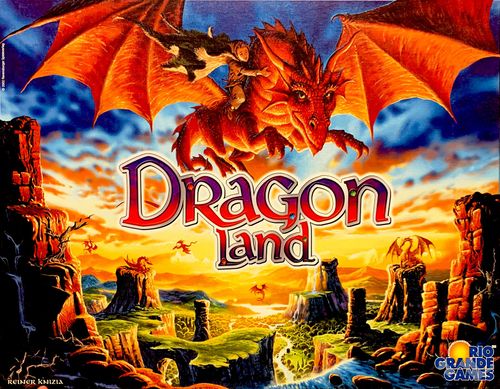
Dragonland
Dragonland Rulebook
Table of Contents
Table of Contents
Components
- 1 game board
- 12 playing pieces
- 12 white magic rings
- 4 screens
- 2 dice
- 1 "Tower of Fate"
- Treasures: 18 dragon eggs, 57 gems (16 each of red, green, and blue, plus 9 transparent), 28 tiles (6 each of "Boatman" and "Little Dragon"; 4 each of "Quick Steps" and "Reroll"; 3 each of "King Dragon" and "Ring"; 2 "Magic Hand")
Object of the Game
Each player leads a group through Dragonland. Along the way, they try to collect dragon eggs and gems. This earns them points.
The player with the most points at the end of the game wins.
Setup
Note: the following pages describe the game for 3 and 4 players. The variations for the game with 2 players can be found at the end of these rules.
Before the first game, carefully punch the screens, dragon eggs, tiles, and the Tower of Fate out of the die-cut sheets.
The tower is assembled before every game as follows:
- Break out the slots. (Only necessary before the first game!)
- Bend the tower so that the dark side faces inward.
- Insert the two panels into the slots you broke out.
- Insert the front (gate) of the tower from above into the punched slots of the two side pieces.
- Insert the tower into the catch tray.
Place the game board in the middle of the table. Place the Tower of Fate next to it, within reach of all players.
Each player receives:
- 3 identically-shaped playing pieces in the colors red, green, and blue,
- the screen marked with their playing-piece symbol, and
- the 3 tiles "Little Dragon," "Boatman," and "Reroll," which are likewise marked on the back with their playing-piece symbol.
The playing pieces and the face-up tiles are placed in front of the screen.
When playing with three, the unneeded playing pieces, screen, and 3 tiles stay in the box.
The tiles with a dragon on the back are shuffled face down. Then one face-down tile is placed on each volcano. The leftover tile is put back in the box unseen.
In addition, place as many dragon eggs and gems on each volcano as indicated there.
The gems are distributed randomly; however, no volcano may hold more than 2 gems of the same color.
The dice and the white magic rings are placed ready next to the game board.
Sequence of Play
The oldest player begins. Play then continues clockwise.
The first round proceeds as follows:
The first player enters Dragonland with one of their pieces through one of the 3 entrances and moves that piece 1 space.
The next player chooses either the same entrance or a different one and moves one of their pieces 2 spaces; then the third player moves 3 spaces and the fourth player 4 spaces. The entrances do not count as spaces.
Once every player has brought their first piece into play this way, the actual game begins.
From now on, the player whose turn it is rolls the dice and moves exactly 2 of their 3 playing pieces (one per die!). Each turn, a player may decide anew which two pieces to move. They may not move the same piece twice in their turn.
When it is a player's turn, they first carry out the move for one piece. Once that is complete, they then carry out the move for their second piece. Once that is finished too, the next player takes their turn.
A single piece's move consists of 2 phases, which must be carried out in the order given:
- Movement
- Taking treasures
1. Movement
The player whose turn it is begins their turn by throwing both dice into the Tower of Fate. They then choose one of the two dice, take it out of the tower's tray, and move one of their pieces (= the active piece) forward accordingly. (The second die stays in the Tower of Fate for now, to be used for moving the second piece.) The following applies:
- The number rolled does not have to be used in full; unused pips are forfeited.
- A piece may jump over another piece. However, no more than one piece may ever stand on a single space.
- Any number of pieces may stand on a volcano.
- If a piece reaches a volcano with a face-down tile on it, that tile is immediately revealed. This ends that piece's movement phase, though it may still take treasures afterward.
- A volcano on which a tile lies face up, or from which a tile has already been taken, may be passed through. It counts as one space.
- A piece may not leave Dragonland again once it has entered.
2. Taking Treasures
On their way through Dragonland, the individual groups collect treasures (dragon eggs, gems, and tiles). If a player ends the movement of their (active) piece on a volcano, they may take treasures there. They may take either:
- all the gems that are the same color as the piece standing on the volcano, or
- one transparent gem, or
- one dragon egg.
If a tile lies on the volcano, the player automatically receives it as well when they take the dragon egg, unless it is a King Dragon or Ring tile (see below).
The dragon eggs and gems are always placed behind the screen. Tiles that have been taken are placed face up in front of the screen.
Notes:
If a piece is already on a volcano at the start of its move, the player may forfeit a die and leave the piece where it is, then take treasures as described above.
Since only 2 pieces may ever be moved (one piece per die!), the third (passive) piece can neither be moved nor take treasures, even if that piece happens to be standing on a volcano!
Playing the Tiles
A distinction is made between tiles that may only be played in the first phase of a piece's move (Reroll, Boatman, Quick Steps, King Dragon, Little Dragon) and those that may only be played in the second phase (Magic Hand, Ring).
Tiles may be played in the corresponding phases in any number and combination. However, the tiles played must apply to the piece that is currently active.
Once played, tiles are removed from the game — with the exception of the Rings and the King Dragons. Rings and King Dragons can be used repeatedly by all players.
Meaning of the Tiles
First-Phase Tiles
Reroll
This tile entitles a player, at the start of the first phase, to declare their own throw invalid and throw both dice into the tower again.
Boatman
With the Boatman, a player can move one of their own pieces from a volcano, across an adjoining river or waterfall, to a neighboring volcano.
Quick Steps
By playing this tile, the active piece may advance up to 3 additional spaces.
King Dragon
Once revealed, a King Dragon tile stays on that volcano until a playing piece flies with it, or first calls it to itself. King Dragons only fly from volcano to volcano, never onto other spaces. There is one King Dragon each in the colors red, green, and blue.
Flying with a King Dragon. A playing piece can fly with a King Dragon under the following 3 conditions:
- It must be the same color as the King Dragon.
- It must be on the same volcano as the King Dragon.
- The player must have a rolled "4" available.
Instead of moving a piece according to the die, the player sets aside a die showing a "4" and moves their piece together with the King Dragon to any other volcano of their choice.
Example: A player has their red piece on a volcano where the red King Dragon is also located. They use a rolled "4" and move their red piece together with the red King Dragon to another volcano, in order to take two red gems there.
Calling a King Dragon. A player can also use a rolled "4" to call a King Dragon to their piece of the same color. In this case too, the player may then take a treasure on the volcano where that piece stands.
Example: A player has their blue piece on a volcano where a blue gem still lies. They use their "4" to move the blue King Dragon to their blue piece, and at the same time take a blue gem.
Little Dragon
Like a "4," the Little Dragon helps a player call a King Dragon to their piece of the same color, or, should the matching-colored King Dragon already be on the same volcano, fly with it to another volcano.
The Little Dragon does not allow a player to move a piece 4 spaces!
Example: A player still has a "4" available in their turn. They call the green King Dragon to their green piece. They then play the Little Dragon, which allows them to move their green piece and the King Dragon to another volcano.
Second-Phase Tiles
Magic Hand
This tile entitles a player to take one additional round of treasures on the volcano where their piece is located.
Ring
Once revealed, Ring tiles stay face up on the volcano for the rest of the game. Only on volcanoes where a Ring tile lies can pieces receive the white magic rings.
If a player's piece is on a volcano where a Ring tile lies, they may choose in Phase 2 — instead of taking treasures — to slip a white magic ring onto that piece. Each piece can carry only one magic ring.
Important: if a playing piece has no ring at the end of the game, that player may not score the gems of that piece's color!
Game End and Scoring
The game ends immediately when the last dragon egg is taken from the game board.
If a player now has a piece that carries no magic ring, they must give up all gems of that color; they are not scored.
Now each player determines their score.
A complete set, consisting of one dragon egg, one red, one blue, and one green gem, is worth 10 points. Transparent gems can be used as jokers in place of any colored gem (see the Player A example below).
Every additional dragon egg and every additional gem counts as one point.
The player with the most points wins the game.
Example: Player A
| Treasures shown | Points |
|---|---|
| dragon egg + red gem + blue gem + transparent gem (as green joker) | 10 |
| dragon egg + red gem + blue gem + transparent gem (as green joker) | 10 |
| dragon egg + red gem + blue gem + transparent gem (as green joker) | 10 |
| dragon egg + red gem + blue gem + transparent gem (as green joker) | 10 |
| dragon egg + red gem + blue gem | 3 |
| red gem + blue gem | 2 |
| 3 green gems (crossed out — do not count) | 0 |
R = Red, B = Blue, G = Green, T = Transparent.
The green piece belonging to Player A carries no magic ring at the end of the game. So their green gems do not count toward the score. But because they can assign their transparent gems (jokers) to a color of their choice, they reach 45 points and win the game.
Example: Player B
| Treasures shown | Points |
|---|---|
| dragon egg + red gem + blue gem + green gem | 10 |
| dragon egg + red gem + blue gem + green gem | 10 |
| dragon egg + red gem + blue gem + green gem | 10 |
| dragon egg + red gem + transparent gem (as blue joker) + green gem | 10 |
| dragon egg + green gem | 2 |
| green gem | 1 |
Player B reaches only 43 points.
Rules for 2 Players
The rules for 2 players are — apart from the following changes — the same as for 3 and 4 players:
- Only one dragon egg is placed on each volcano. The 3 remaining dragon eggs are not needed.
- The starting player begins the first round by moving one of their pieces 2 spaces on the game board. The second player then moves one of their pieces 4 spaces. In the following rounds, the players roll dice as described above.
Variants
Variant 1: Any number of gems of the same color may now lie on a volcano.
Variant 2: The game is played without screens.
The author and publisher thank the many playtesters who contributed to the development of this game, especially David Farquhar, Chris Bowyer, Ross Inglis, Kevin Jacklin, Chris Lawson, and Ivan Towlson.
The Origin of the Tower of Fate
The game device referred to in this game as the Tower of Fate is known in history as the dice tower.
The dice tower was invented by the Romans, who are known to us as brilliant strategists, outstanding engineers, and perfect organizers. As we know today, they were also enthusiastic gamers. Dice games in particular appealed to them, especially when high stakes were involved.
Since even in that time there were dice sharps who could deliberately throw certain numbers, the Romans solved this problem with an equally beautiful and practical piece of game equipment — the dice tower. It was a rectangular tower, open at the bottom of its front side, made of wood or metal, with stairs arranged inside so that dice thrown in at the top first rolled down the stairs before tumbling out at the bottom.
A unique specimen, very likely made between 367 and 369 AD, was found around 17 years ago near Vettweiß/Froitzheim in the Düren district, and is now held in the Rheinisches Landesmuseum Bonn.
Unfortunately, the dice tower vanished from memory after antiquity. In more recent times, however, it has resurfaced, among other places, at the Kuhlmann-Geschichtsspiele publishing house in Hannover. This dice tower, designed as a medieval fortified tower, served as the model for the Tower of Fate used in this game.
© 2002 Ravensburger Spieleverlag