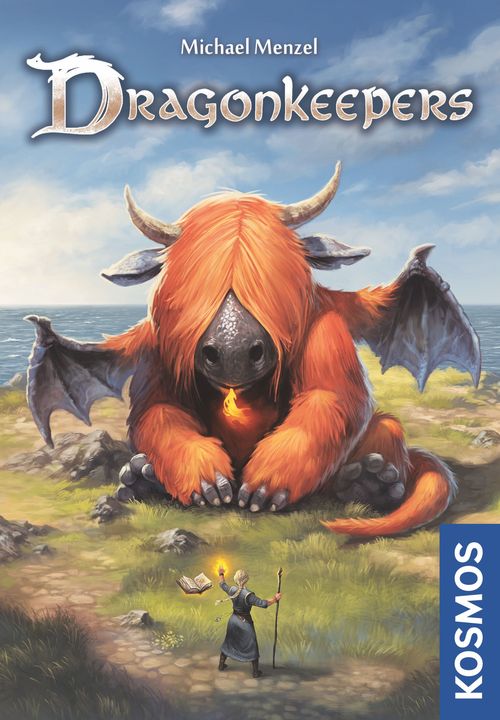
Dragonkeepers
Dragonkeepers Rulebook
Table of Contents
Table of Contents
Game Material
123 Cards (with different backs), comprising of:
- 104 Dragon cards
- 8 Starting cards
- 11 Shadow dragons
Plus:
- 45 Amulet pieces (8x 1 point, 8x 4 points, 5x 6 points, 4x 8 points, 8x 10 points, 4x 12 points, 5x 16 points, 3x 20 points)
- 15 Pearls (3x red with 8 or 9 points, 12x blue with 3 or 4 points)
- 3 Crests (with 16, 10, and 6 points)
- 10 Crystals
- 9 Golden eggs (with 4 points on one side and 16 points on the other side)
- 6 Magic chests with various items (game variant for experienced dragonkeepers; see "The Magic Chests")
The four dragon colours are: White Pasture Dragon, Red Fur Dragon, Blue Slate Dragon, Green Swamp Dragon.
Setup
- Before the first game, carefully remove all the pieces from the punchboards.
- Return the 6 magic chests back to the box. You won't need them before you've played the game a few times.
- Also return the companion booklet back to the box. You don't need it for your first game.
Now follow the numbered steps to set up the game together:
1. Sort out the 11 shadow dragons (with the number 6 on the back of the cards) and place them as a stack on the table.
2. Sort out the 8 starting cards (with the red ribbon printed on the back of the cards) and place them as a separate stack on the table.
3. Decide who will be the starting player. The other players take 1-3 starting cards in a clockwise order. Any remaining starting cards are returned to the box.
4. Shuffle the remaining 104 cards and place them as 2 stacks in the middle of the table. They form the magic book!
Important: The backs of the cards on the left only show numbers, whereas the backs of the cards on the right only show small colourful dragons. The stacks must never be mixed up.
Reveal one card from each page of the magic book and place them in front of their respective stacks. They form the display.
5. Shuffle all 45 amulet pieces face down, then return a specified amount to the box depending on the number of players:
- 2 players remove 16 amulet pieces
- 3 players remove 12 amulet pieces
- 4 players remove 8 amulet pieces
Finally, turn the remaining amulet pieces face up. Sort them according to their values and arrange them in ascending order.
6. Place the rest of the game components as supply next to the amulets:
- 3 crests (remove the 16 in a two-player game)
- 9 golden eggs (showing number 4)
- 15 pearls (numbers hidden)
- 10 crystals
Game Objective
You are magical dragonkeepers and it is your job to look after the young dragons. On your turn, you take up to 3 dragon cards into your hand. You then try to play cards from your hand in front of you, for which you immediately receive points.
The highlight of the game: How many dragons of which colour you can play is determined by the pages of the magic book; in other words, what is depicted on the back sides of the two stacks of cards. Naturally, that changes all the time as the game progresses!
Example: In this case (the left page shows the number 4, the right page shows a green dragon) you may play exactly 4 green dragons in front of you.
Whoever has the most points at the end, wins the game!
Is that all clear? Fantastic! Now let's learn what to do on your turn!
Turn Overview
1. Taking dragon cards
When it is your turn, you may take 1, 2 or 3 dragon cards one at a time from the display into your hand. Whenever you take a card, you must immediately fill this empty space with a new card from the corresponding page of the magic book.
Note: You may hold any number of cards in your hand.
2. Changing the magic book
Important: Before you play cards in front of you, you may change the magic book in your favour!
To do this, place a card from your hand, face down, on either the left or right page of the magic book.
Note: You may place one card from your hand on each page of the magic book.
Example: After taking 3 dragon cards, the magic book shows that you may play 4 green dragons. Unfortunately, you only have 1 green dragon. Therefore, you place one of the cards from your hand onto the left page of the magic book. Now the magic book shows that you may play exactly 1(!) green dragon. That works much better for you!
Tip: Each dragon card shows the respective colour of this dragon in the upper corners. Below that you can see a reminder of which number or colour is shown on the back of this card. (For example: a red dragon with a 1 on the back; a white dragon with the colour green on the back.)
3. Playing dragon cards in front of you
In accordance with the magic book, you may now play this exact (!) number of dragon cards of this colour in front of you. In another turn, if you play more cards of the same dragon colour, you place them on top of the stack of that colour that is already in front of you. If you play a new dragon colour, you must start a new stack.
Placement rule: No card may be placed on top of a stack that is between 2 other dragon colours!
Example A: During the course of the game, you have already played white and green dragons in front of you. Now you want to play red ones, too. You have to decide whether to play them to the right or left of these two stacks.
Example B: You played the red dragons on the left. From now on, you can no longer play white dragons.
Important: You must not alter the position of the dragon card stacks in front of you.
4. Receiving a reward
When you play dragon cards, you immediately receive the reward displayed on the left page of the magic book. You can find a detailed description of the individual rewards in the "Rewards for Playing Dragon Cards" section.
You always get at least 1 amulet piece, which you then place face down in front of you. If you already have an amulet piece, place the new one against it to create part of a ring. If you receive a third amulet piece, you close the ring. Without looking at its value, you then take a face-down pearl and place it in the middle of the ring. This completes the amulet.
Example: If you play 2 blue dragons, you receive a reward of 1 amulet piece + 1 shadow dragon.
Note: The red pearls are more valuable. They have a value of 8 or 9. When all the red pearls have been taken, you can only take blue ones. These have a value of 3 or 4.
The third amulet piece closes the ring. Then a pearl is placed in the centre and completes the amulet.
5. Completing the turn
Regardless of whether you have played dragon cards or not, at the end of your turn everyone else (always in a clockwise direction) may decide whether they want to, or can, play dragon cards on their stacks to complete the turn and receive the associated rewards. Of course, their cards must be played according to the magic book as you left it. They are not allowed to change it!
Then it is the next player's turn in a clockwise direction.
Rewards for Playing Dragon Cards
- Lowest amulet piece: You receive the amulet piece of the lowest value currently available.
- Highest amulet piece: You receive the amulet piece of the highest (!) value currently available.
- Shadow dragon: You receive a shadow dragon. You may add one or more shadow dragons as wild cards (but never on their own) in order to reach the number specified by the magic book. Note: As with other dragon cards in your hand, you may use the back of the shadow dragon card to change the magic book.
- Crystal: You receive a crystal. When taking dragon cards, you may return 1 crystal to the supply to take a fourth (!) card from the display. Note: You cannot discard multiple crystals to take more than 4 dragon cards in a turn.
- Golden egg: You receive a golden egg. Each golden egg is worth 4 points. Whoever has the most golden eggs at the end of the game flips one (!) of their golden eggs and receives 16 points instead of 4 points for this egg. In the event of a tie, all players involved flip 1 egg each.
Crest bonus: As soon as you have at least 1 dragon of each of the 4 dragon colours laid out in front of you, you take the most valuable "crest" currently available from the middle of the table.
Important: In a two-player game, the crest with the value of 16 is not available.
Note: Shadow dragons, crystals, golden eggs, and crests are limited in quantity. If they run out, these additional rewards are no longer available.
The End of the Game
The game ends after the turn when you have completed a certain number of amulets in total. How many amulets depends on the number of players:
- 2 players: 7 amulets
- 3 players: 8 amulets
- 4 players: 9 amulets
Note: It may be possible that a player who is playing dragon cards to complete the turn, completes the last amulet needed.
Afterwards you reveal all your amulet pieces and pearls and add up the points. If you also have crests and/or golden eggs, add the respective values to your score. Whoever has the most points wins.
In the event of a tie, the tied player who has laid out the most dragon cards in front of them wins. If that number is also tied, then everyone involved in the tie wins.
Understood everything? Then you may begin. The starting player begins the first turn and takes up to 3 cards. Let's go!
Note: If you still have questions after the first game, just take a look at the companion booklet. It includes further examples, special cases and tactical advice!
Companion Booklet: Explanations, Tips and Recommendations
Important: You only need to read the rulebook before your first game.
Starting cards
The starting player does not receive a starting card. The person to the left of the starting player takes 1 face-down starting card (red ribbon) from the stack and adds it to their hand. If you play with more than 2 players, the next person in clockwise order takes 2 starting cards and in a four-player game the last person takes 3 starting cards.
Note: There are no dragons which show the same colour on the back of a card as on the front. This means, for example, that the back of a card with a small green dragon on it can only show a blue, white, or red dragon on the front.
Taking dragon cards
When taking dragon cards, you may only choose from the 2 face-up cards on display. You may never take a face-down card directly from the two stacks of the magic book.
It is perfectly valid to take fewer than 3 cards if you like the magic book the way it is. However, you have to take at least 1 card when it is your turn.
On the rare occasion a page of the magic book consists of only 1 card, the end of the game is triggered early. The player whose turn it is may not take any more dragon cards or change the magic book, but they and the other players may still play dragon cards on their stacks to complete the turn.
Changing the magic book
The magic book can only be changed by the player whose turn it is.
Tip: Pay attention not only to the colour on the front, but also to the back of the cards. You can use the back of a card to change the magic book so that you can play the exact number and colour of dragon cards you want and thus score points!
Note: When you use the back of a shadow dragon card to change the magic book, the shadow dragon will later be moved to the display. It can then be taken like any other dragon card.
Playing dragon cards
Even if you can fulfil the requirements of the magic book, you do not have to play dragon cards, you may keep the cards in your hand.
Tip: As explained in the instructions, the placement rule states that you must not place a card on top of a stack that is between 2 other dragon colours. Therefore, consider carefully if and when to start a stack with a new dragon colour, as this will limit your options in future turns.
Recommendation: If you play Dragonkeepers with children under the age of 8, we recommend playing without the crests and the placement rule so you can always play dragon cards of any colour.
Receiving rewards
You cannot use the crystal or shadow dragon rewards in the same turn on which you receive them.
Example: You play 1 dragon card and receive an amulet piece + 1 crystal. You cannot immediately use the crystal to draw a 4th card. The earliest you can do this is on your next turn.
Completing the turn
Because you can play dragon cards to complete the turn, pay attention to how the other players leave the magic book on their turn. This way you can get rewards even when it is not your turn.
Tip 1: You can speed up the end of the game by playing dragon cards to complete the turn. You should weigh up whether and when this is useful to you.
Tip 2: Pay attention to which colours the others have already played in front of them. As soon as there is a dragon colour between two other stacks, this player cannot play dragon cards of that colour anymore.
End of the game
The game ends after the turn in which all players have completed a certain number of amulets in total.
It may be possible that a player who is only playing dragon cards to complete the turn also completes the last amulet needed.
Due to the "completing the turn" action it is possible that you will end up with more than the specified number of completed amulets after the end of the game has been triggered.
Example: You are playing with 3 players and it is your turn. You play dragon cards, receive your reward and thus complete your third amulet. As a group, you have now completed 8 amulets. This triggers the end of the game. However, the others can still play dragon cards to complete the current turn. If one of the other players also completes an amulet, there would now be 9 completed amulets at the end of the game.
At the end, partially completed amulets (1 or 2 individual amulet pieces) are scored as well.
The Magic Chests
Game variant for experienced dragonkeepers
When setting up the game, shuffle the 6 magic chests face down and then reveal 1 of them. The other 5 magic chests go back into the box. In this game you have 1 powerful item from the magic chest at your disposal, which can have a big influence on the game and your play style. This item is available to everyone. Each time you want to use it, you must return 1 crystal to the supply. However, you are not allowed to use an item more than once per turn.
Note: Except for the dragon mint, you can also use each of these items when playing dragon cards to complete the turn.
- Twilight flute: After playing dragon cards and receiving the rewards, you may take all but one back into your hand.
- Dragon mint: At the start of your turn, take the top card of both pages of the magic book into your hand.
- Troll horn: When laying out dragon cards, you can ignore the placement rule and also lay out cards of a colour that is already between two other colour stacks.
- Green ore hammer: If your reward includes an amulet piece with the currently lowest value, you may upgrade it and take an amulet piece with the next highest value instead. Note: If you play 3 cards, you can only upgrade one of the two amulet pieces. You cannot use a second crystal to upgrade both.
- Prism ink: When playing dragon cards, you may play a different colour than the magic book currently specifies. Tip: This can be an advantage, especially when playing dragon cards to complete the turn!
- Swindle feather: When playing (at least 2) dragon cards, you may play one fewer card than the magic book currently specifies. Note: You will still get the reward shown on the left side of the magic book.
Recommendation: If you already know the items well, you can decide together before the game which item you will choose and whether you want to place more than one. Important: If you have collected several crystals, you can use several of them to use different items at the same time.
Example: You have collected 3 crystals. The person whose turn it is leaves the magic book in such a way that you cannot actually play dragon cards to complete the turn, because you have one card too few in your hand. Luckily, the swindle feather is available in this game. You return a crystal to the supply and play one less card than required by the magic book. With a second crystal, you cannot reduce the number of cards by one more. Instead, you give up another crystal in order to use the green ore hammer that is also on display and thus upgrade your reward in the form of amulet pieces. You save your third crystal for later.
For more information: www.dragonkeepers-the-game.com