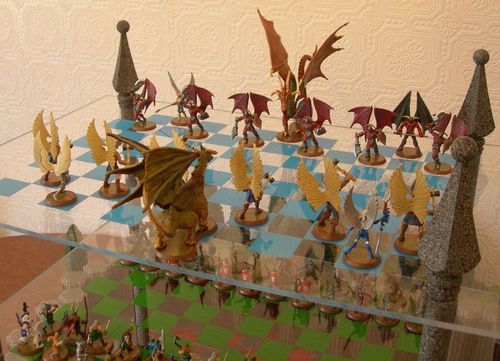
Dragonchess
Dragonchess Rulebook
Table of Contents
Table of Contents
Rules
Dragonchess is played on three 8x12 boards, each laid out on a grid of alternating squares of light and dark color, with a light color square to the bottom right of each board. The boards represent the Sky, the Ground, and the Underworld, with the Sky traditionally represented by white and blue spaces, the Ground by yellow and green, and the Underworld by red and brown. The two sides are referred to as Gold and Scarlet, with Gold moving first.
The game is played as if the boards are stacked on top of one another, although they may be placed in a line between the players, with the Sky board towards Scarlet and the Underworld board towards Gold. A move between boards is referred to as a move "up" or "down", with the Sky the Upper Board, the Ground the Middle Board, and the Underworld the Lower Board.
Play proceeds as chess, with each of the players moving a single piece in their turn until the King is checkmated. No piece can move in such a way as to expose their King to attack, and if an opposing piece moves in such a way as to capture the King on the next turn, "check" must be declared. There is no castling or en passant rule in Dragonchess, as will be noted below.
Algebraic notation for the squares of the board is in the form of a number, letter, and number, as in "2g1" for the location of the Gold King. 1 is used for the Lower Board, 2 for the Middle Board, and 3 for the Upper Board. The file is indicated by the letters "a" to "l", and the rank is indicated by 1 to 8, with 1 being the Gold side. All Dragonchess pieces are referred to by the initial letter of their name, except for the Dragon, which uses "R" to distinguish it from the Dwarf. Gygax himself used "Dr" in his rules, as descriptive notation was still in common use, which used "Kt" for the Knight.
Initial Layout
Layout of the pieces closely resembles Courier-Spiel chess on the Middle Board. From outside to center, the layout is Oliphant (rook), Unicorn (knight), Hero (courier-spiel bishop) and Thief. (modern bishop or "courier") The central four spaces are occupied by the King and Mage (queen), flanked by the Paladin (counsellor) and Cleric (fool). The Mage is placed on her color, with the Paladin King Side and the Cleric Mage Side.
The Upper and Lower boards are laid out starting with the Dragon above and Elemental below their King. The two Griffons on the Upper Board and Basilisks on the Lower are placed four spaces to either side of the Dragon and Elemental. This places the King side Griffon above a Unicorn, and the Mage side Griffon above a Hero. All these pieces are placed on dark for Gold, and light for Scarlet, matching their King.
Finally, the six Sylphs and six Dwarves are placed above and below, respectively, the Warriors in the second row. The Sylphs are placed on the light squares for the Gold side, and the Dwarves on the dark squares. Scarlet sets up on the reverse colors. This setup ensures that the Dragon and Elemental can both move freely on the first move of the game.
Consult the attached Initial Layout diagram to help set up the board. This will be included at the end of the document, along with the Move diagram card, described below.
Piece Count per Side (from the Initial Layout diagram)
- Upper Board: 6 Sylphs (S), 2 Griffons (G), 1 Dragon (R). Total: 9 pieces per side.
- Middle Board: 12 Warriors (W), 2 Oliphants (O), 2 Unicorns (U), 2 Heroes (H), 2 Thieves (T), 1 Paladin (P), 1 Cleric (C), 1 Mage (M), 1 King (K). Total: 24 pieces per side.
- Lower Board: 6 Dwarves (D), 2 Basilisks (B), 1 Elemental (E). Total: 9 pieces per side.
Total for both sides: 84 pieces.
Note: the Initial Layout diagram labels its bottom group of pieces "Upper Board". Those pieces sit on the Lower Board (Underworld), as the setup text above and the Lower Board section below make clear; the label is corrected here.
Moves of the Pieces
In addition to the section below, you can also consult the Move diagram card which is attached to the end of this guide. This card can be printed out on the front and back of a page, or on an actual card for quick reference. Each piece also has an exchange value, as estimated by Gary Gygax, which is included below and on the card.
Upper Board
The Upper Board is an open board, and most of the pieces on this board move on the diagonal. This means that early in the game the Upper Board is the setting for a lot of long ranging movements, primarily from the Dragon. Should a Dragon be lost early on without a trade, the surviving Dragon will have a definite advantage.
Sylph (S, value 1)
The Sylph's move is the opposite of a pawn in chess. It moves without capturing one space forward along the diagonal and captures only straight forward. This is the move of the Berolina pawn in the chess variant of the same name. The Sylph, like the Warrior, does not get a two square move as its first move and cannot capture en passant. (But see below)
The Sylph can also capture any opposing piece in the square directly below it. Once on the Middle Board, the Sylph cannot move, and must return to the Upper Board by a non-capturing move. The Sylph can return to the square directly above, if it is empty, or it can return to any of the six starting squares for the Sylphs of that side, again if they are unoccupied.
Sylphs are vulnerable to attacks by the opposing Dragon, including one that can be captured in the very first turn. Although this is not part of Gygax's original rules, as a variant I would suggest giving the Sylph a version of en passant. If a Dragon captures a Sylph that is on a starting space, it may be captured in turn by any other Sylph on the Upper Board.
The return capture must be taken in the next turn, or it is lost. Sylphs on the Middle Board cannot make this capture, but a Sylph that has made a capture on the Middle Board and returned to a starting space has its protection restored until it moves again. See the Variants section, below, for more potential variants.
Griffon (G, value 5)
The Griffon's move is inspired by the elephant in janggi, the Korean version of chess. Its move can variously be described as a move one space along the rank or file followed by two spaces diagonally, or a jump between the corners of a 3x4 rectangle. Like the chess knight, it jumps over the intervening squares, and may either move or capture in the destination space.
The Griffon can travel to the Middle Board with either a move or a capture, by moving one square straight down and then one space diagonally. Again, this move is unblockable, and could be performed as a move diagonally followed by a move down. The Griffon can move freely on the Middle Board, by moving or capturing one square diagonally. It may return to the Upper Board with an upward move followed by a move or capture diagonally. It cannot travel to the Lower Board.
The Griffon's ability to move freely between the Upper and Middle boards is very powerful and allows it to compensate for its vulnerability to close attack while on the Upper Board. Movement on the Middle Board will limit the Griffon to a single color on the grid, so the Upper Board move is required for the Griffon to cover the entire board. (Or the upper two boards anyway)
Dragon (R, value 8)
The Dragon may be the most powerful piece in the game. Even if Gygax's estimation of its value is correct, and he did not underrate it, it is the piece he named the game after. It combines the move of the chess bishop and king, like a promoted bishop in shogi, the Japanese version of chess. It may move any number of spaces diagonally, or one space along the rank or file. If it did not have this one step move, it would be limited to only the spaces of one color and cover only half the board.
The Dragon cannot leave the Upper Board, but its most powerful ability may be to attack the Middle Board from afar, without moving into the space attacked. The Dragon may capture from afar any opposing piece directly below it, or adjacent to that space along the rank or file. This counts as the Dragon's move, and the Dragon cannot move and capture from afar in the same turn. If a Dragon moves into a position where it can capture the King from afar in the next move, that counts as check, and must be announced as such.
The Dragon is so powerful, and the Upper Board is so open for long distance attacks by the Dragon, that many players have suggested limiting the power of the Dragon. See below for a list of these variants. If the option to give Sylphs the ability to capture the Dragon en passant is used, however, these variants may not be needed.
Middle Board
The Middle Board is where the battle to checkmate the King takes place and should be the focus of a player's strategy even early on. Note that unlike other 3D chess variants, action takes place on all three boards at once. There is no "White Board" or "Black Board" that the opponent must gain ground on. Most defensive formations will be built on the shared Middle Board, of either Warriors or Dwarves that have been moved up to replace them.
Warrior (W, value 1)
The Warrior is the Middle Board's counterpart to the chess pawn, along with the Sylph on the Upper Board and the Dwarf on the Lower Board. I recommend using the term "pawn" in Dragonchess to refer to the Warrior, Sylph and Dwarf as a whole, to distinguish this class of piece from the others.
The Warrior moves one space forward (i.e. towards the opponent's side), or captures one space forward along the diagonal, just like a chess pawn. Unlike a chess pawn, it cannot move two spaces on its first move and cannot capture en passant. When it reaches the rank furthest from its starting rank (rank 8 for a Gold Warrior or rank 1 for a Scarlet Warrior) the Warrior is promoted to a Hero. It cannot promote to any other piece but may promote even if no Hero has been captured.
The Warrior cannot move or capture onto to the Upper or Lower Board. It is limited to the Middle Board only. Extra Hero pieces can be provided for a Dragonchess set, or markers can be placed on or under a Warrior to indicate its promotion.
Oliphant (O, value 5)
The Oliphant moves and captures identically to a rook in chess. It can move or capture in a straight line of any number of spaces along the rank or file. (horizontally or vertically) It cannot leave the Middle Board and has no ability to move or capture onto the Upper or Lower Board. There is no castling in Dragonchess.
The name Oliphant is not only an archaic spelling for elephant, but it is also an elephant-like monster in Dungeons and Dragons. Gygax may have selected the name just to make it sound mystical. It should be noted that the rook was originally a chariot, and then a tower carried by an elephant, and finally just a tower by itself. The elephant has also been the bishop.
Unicorn (U, value 2.5)
The Unicorn's move is identical to that of a knight in chess. It moves one square along the rank or file, and then one square diagonally, capturing any opposing piece located in the destination square. Alternately, its move can be described as an L-shaped move, or a jump to the opposite corner of a 2x3 rectangle. It jumps over any intervening pieces, whatever the path.
The Unicorn is limited to the Middle Board and cannot move to or capture on the Upper or Lower Board.
Hero (H, value 4.5)
The Hero is the modern version of the elephant from shatranj, a piece that moved two squares diagonally. Its current move comes from Courier-Spiel chess. The Hero moves or captures either one or two squares diagonally, leaping over the intervening square like a knight. In addition, the Hero can move one square diagonally and then move to or capture any opposing piece in the square directly above or below that square. This is identical to the Griffon's move to the Middle Board, and like that move, it cannot be blocked by an intervening piece.
Once on the Upper or Lower Board the Hero cannot move and must return to the Middle Board by a move one step diagonally, and then up or down to the Middle Board. Again, the Hero may move or capture on this move, and the move cannot be blocked. While the Hero is limited to only one color and thus only half of the squares on the board, this freedom to move and capture between boards distinguishes it from the rest of the Middle Board's paired pieces.
Elven Thief (T, value 4)
The Thief moves and captures identically to the chess bishop. It moves or captures any number of spaces in a straight line along the diagonal. It cannot leave the Middle Board.
In Gygax's short story "At Moonset Blackcat Comes", included in Dragon #100, Rexfelis states that the Thief is an "Elven Thief", and can also be called the "Elf". As an elf, it is possible that it is a multiclassed Fighter/Thief. In many early versions of chess, the bishop was sometimes called the archer. While Gygax dropped the connection to the clergy (reserving that for the Cleric) he may have envisioned the Thief as a crafty, elusive archer and scout, much like Robin Hood or Legolas from Lord of the Rings.
Cleric (C, value 9)
The Cleric is the first of four unique pieces on the Middle Board that have access to the Upper and Lower Boards. Along with the Dragon and Elemental, they are Dragonchess's "heavy pieces", or "major pieces". The Cleric's move is simple, it moves or captures one square in any direction, or straight up or straight down, no matter which board it is on.
On other words, the Cleric's move is the same as the king in standard chess. While this does not seem very powerful, the fact that the Cleric has the same move no matter what board it is on means that it does not lose anything by moving to the Upper or Lower Board.
Mage (M, value 11)
The Mage is the counterpart of the chess queen. Although she is not necessarily the King's wife, I prefer to refer to her with the feminine pronoun. It is possible that the Mage is an advisor, like Merlin, but given the Dungeon & Dragons setting, I would expect a powerful King to be paired with a queen who is a powerful Mage in her own right.
The Mage moves or captures any number of spaces in a straight line on the Middle Board, either along the rank and file or diagonally. On the Middle Board, she is the most powerful piece in the game, and the key to any strategy. To move between boards, the Mage can move or capture up or down any number of boards. This means that the Mage can travel from the Upper Board to the Lower Board, or vice versa, in one move. But only if the intervening square on the Middle Board is empty.
While on the Upper or Lower Board the Mage may only move or capture one square along the rank or file. This makes her much weaker than the Paladin and Cleric when not on the Middle Board, and she will want to return as soon as possible. Note that in Courier chess (but not Courier-Spiel chess) the fool moves one space along the rank or file. Thus, the Mage has the moves of the queen or courier fool, depending on what board she is on.
Paladin (P, value 10)
The Paladin combines the moves of the chess king and knight, moving and capturing either one square in any direction, or one square along the rank and file and then one square diagonally, leaping over the intervening squares. When not on the Middle Board, the Paladin loses the ability to move like a knight but retains the ability to move (and capture) like the king.
The Paladin's move between boards is complex, and like the knight move on which it is based, unblockable. It can be made as either a move or a capture. The Paladin first moves one or two boards up or down, so the Paladin can move from the Upper Board to the Lower Board in one move. If the Paladin moved one board, he must move two spaces along the rank or file, jumping over any occupied spaces. If the Paladin moved two boards, he may move to any of the four spaces adjacent to the space above or below his starting space.
In other words, the Paladin makes an L-shaped move between boards exactly like his normal knight move. This gives the Paladin a lot more power on the Upper and Lower Board than the Mage or Cleric, even though he is strongest on the Middle Board. According to Rexfelis, (see Elven Thief, above) this piece is often called the "Assassin" on the Scarlet side.
King (K)
The King is just like the king in standard chess, and losing the King means the end of the game. The King moves or captures one square in any direction, including up or down to the Upper or Lower Board. Unlike the Cleric, however, the King has no power to move on the Upper or Lower Board. If he is ever forced off the Middle Board by a forced capture or check, he must return to the Middle Board as soon as he can, or risk being pinned down.
Because of the increased directions from which check can come in Dragonchess, "check" should be announced to ensure the other player notices it. Both players should also be diligent in ensuring that no move places a players' own King in check. If the King is found to be in check and both players did not notice for at least two moves, the players should retrace their moves until the King is no longer in check and continue play from there. If the moves cannot be reconstructed, the position stands, with the player that is in check reversing his move if needed to give him the next move.
The King cannot castle in Dragonchess, as the ability to leave the Middle Board serves the same purpose.
Lower Board
While the Lower Board is as open as the Upper Board, the lesser mobility of the pieces on this board means that development will be slow and methodical. The Lower Board is primarily defensive, intended to protect the King from attack on the Middle Board, and give him a place to retreat to. Note that the Elemental, although its move is limited, primarily serves the purpose of a rook in the endgame with its control over the rank and file. Even early in the game, it can serve as a counter to the Dragon, merely by moving to a more defensive position and letting the King escape the Dragon's reach.
Dwarf (D, value 2)
The Dwarf can move and capture like a pawn in chess, meaning that it can move and capture the same as a Warrior. In addition, the Dwarf can move but not capture to each of the adjacent spaces along the same rank. This allows Dwarves to shift sideways and fill in the holes in their formation. Like the Warrior, it cannot move two spaces on its first move, or capture en passant. Like the Sylph, it cannot promote.
A Dwarf can capture but not move into the square directly above it. Once on the Middle Board, the Dwarf can continue its normal movement, or return to the Lower Board with a move but not capture directly down. The Dwarf cannot move to the Upper Board.
The Dwarf shares with the Griffon to ability to move freely on both the Lower and Middle Boards, but unlike the Griffon, it can only reach the Middle Board by making a capture. In addition, when the Dwarf reaches the final rank on its side of the board, it can no longer move forward. While it can still shift from side to side, and possibly make captures from underneath, the Warrior and Sylph are able to promote and return to their starting row, respectively. See the Variants section, below, for some of the variants that have been suggested to compensate for this limitation.
Basilisk (B, value 3)
The Basilisk can move or capture one square forward, or one square forward along the diagonal. The Basilisk can also move one square backwards, but this move cannot involve a capture.
While the Basilisk can never move to the Middle Board, like the Dragon it has influence on the Middle Board without moving there. Any opposing piece on the square directly above the Basilisk is frozen is place and cannot move or capture. Unlike the Dragon, this power is automatic, and occurs the moment the Basilisk moves underneath an opposing piece, or that piece moves on top of the Basilisk. If the Basilisk moves away or is captured, the frozen piece is freed.
Gary Gygax seemed to like this piece, as he notes that its ability to "freeze" an enemy may not be as good as capturing it, but it might as well be captured. To remember its unique move, it may help to picture the Basilisk on the board, with its head and claws in front, and tail spiraling behind. You can think of the eight-legged D&D Basilisk, which is sluggish and slow to turn around, or just a giant snake, as in Harry Potter.
Elemental (E, value 4)
The Elemental moves or captures one or two squares along the rank and file but cannot leap over the intervening space. The Elemental can also move one square diagonally, but this move cannot involve a capture. The Elemental cannot move at all on the Middle Board.
The Elemental may capture a piece on the Middle Board by moving first one square along the rank or file, and then one square up. The square underneath the piece to be captured must be empty, and the Elemental cannot move to the Middle Board without making a capture.
The move back to the Lower Board is the reverse, and the Elemental can either move or capture. However, the Elemental must move one space straight down to an unoccupied square, and then one space along the rank or file. The order of movement is important, because while the Elemental has a choice of directions when moving to the Middle Board, there is only one choice when moving back to the Lower Board, and if that square is occupied, the Elemental is trapped.
This restriction on the return to the Lower Board is why I prefer an alternate name for the Elemental, the Troll. To me it is an excellent mnemonic for the move. If an opposing piece can be moved underneath the Troll, it is "turned to stone by the light of day" and can no longer move. This is not a D&D Troll, however, but the Troll as described in mythology.
The rules posted to chessvariants.com by Edward Jackman are inconsistent about whether the Elemental can move to the Middle Board without capturing. He describes the move as capture only, but the move diagram shows move or capture. Since Gygax's original rules didn't include diagrams of the moves between boards, it's possible that Jackman made a typo while creating the diagram.
Some players may be familiar with the chessvariants variation and are used to moving the Elemental between boards freely. See below for a list of variants that try to resolve this inconsistency in the Elemental's definition.
It is never stated what kind of Elemental the piece represents. I prefer the Stone Elemental for obvious reasons, but many other players seem to like the Fire Elemental. A set could have both Elemental types, one for each side.
Variants and Inconsistencies
As mentioned above, the original article in Dragon magazine included some typos and vague descriptions which had to be interpreted by the players of Dragonchess. The following is a list of all known inconsistencies, taken from Wikipedia.
- It is not stated whether the Cleric and Paladin's moves between boards may include a capture. (Not listed on Wikipedia, but reported by Donald Walsh)
- It is not stated whether the Mage's Upper and Lower Board (one space rank or file) move may include a capture.
- The Mage's move from Upper to Lower Board, or vice versa, is not stated to be blockable. This is implied by the other moves of the Mage, and the absence of any statement that it is unblockable, but this is not certain.
- It is not stated if the King's move to return to the Middle Board after being driven off may include a capture.
- The Elemental's two space moves are not stated to be blockable. Again, this is implied by Gygax's precise definition of the moves between boards, but this is not certain.
- The Elemental's move to the Middle Board is stated to be capture only, but many move diagrams created after Gygax's article list it as move and capture. (Wikipedia reproduces the correct definition)
- Gygax numbers the boards starting with 1 for the Upper Board initially, but then changes it to 1 for the Lower Board for all other pages. Again, Wikipedia lists the correct rule, but chessvariants.org reverses it.
Most of these inconsistencies can be eliminated because the rules of chess assume that a move is blockable and may involve either a move or a capture unless stated otherwise. As noted above, in most cases moves can be assumed to be consistent with other moves by the same piece.
Since there are also many attempts to correct flaws with the game design as well, I would recommend the following set of "official variants" for Dragonchess. Players must agree before the game begins to use one or more of these variants:
Summon Elemental Variant
Allow the Elemental to either make a move or capture when moving to the Middle Board. (Introduced by an inconsistency in the move diagram by Edward Jackman on chessvariants.com)
Note that there is little advantage to this variant, as the Elemental does not control any territory while on the Middle Board. The only reason for the Elemental to move to the Middle Board is to block an attack on the King, or a more valuable piece like the Mage or Paladin that is worth more than the Elemental. This may make the Elemental more useful than the standard rule.
Harnessed Dragon Variant (Type I)
Limit the Dragon to diagonal moves only. Do not allow it the single step along the rank or file. (Suggested by Anthony Valterra on chessvariants.com) You may want to add a restriction that the Dragon cannot capture the Sylph on its first move.
Harnessed Dragon Variant (Type II)
Limit the Dragon to capture from afar to the square directly below it only. Do not allow it to attack the adjacent squares from afar. The Gold Dragon can capture the Scarlet Sylph in its first move, but the Oliphant below it will be safe from attack unless the Dragon subsequently moves a space forward. (Suggested by Edward Jackman on chessvariants.com)
Synchronized Sylphs and Dwarves Variant
Place the Sylphs above the Dwarves, instead of offset by one square. Give Dwarves the same ability as the Sylphs to return to any of their home squares on return to the Lower Board. (Suggested by Jean-Louis Cazaux on chessvariants.com)
En Passant Sylph Variant (Type I)
This is my suggestion from the rules section above. If any Sylph is captured by the Dragon on its home square, any other Sylph on the Upper Board can capture it en passant.
En Passant Sylph Variant (Type II)
My suggestion above prevents the Gold Dragon from capturing the Scarlet Sylph, but it discourages the players from developing their Sylphs. In the early game at least, the Sylphs are more valuable in their starting spaces, where they can obstruct the movement of the Dragons and keep them from attacking the back rank of the Middle Board.
As an alternative, change the en passant rule so that if any Sylph is captured by a Dragon along its diagonal of movement, any other Sylph on the Upper Board can capture it. All other rules of Sylph en passant apply. This lets the Sylphs spread out into a defensive formation on the Upper Board, while still providing protection to each other against the opposing Dragon.
The Dragon can still capture a Sylph, just not directly from the front. The Dragon can also depend on its allies to clear out the Sylphs, but its movement will be restricted until it can maneuver around them. I suspect that with this change, the Dragon's value is closer to what Gygax intended, as the potential for unstoppable Dragon rampages will be greatly reduced.
The idea of this variant is that while the Dragon is attacking the first Sylph, she is evading the attack along her movement diagonal, serving as a distraction. The second Sylph teleports into position, using the same "magic" she uses to return to the home row, and attacks the Dragon as it passes. The Berolina pawn is also able to capture en passant, and even though in this case there are three pieces involved, not two, I think the move and concept is consistent.
Reversing Dwarf Variant
When any Gold Dwarf reaches rank 8, or Scarlet Dwarf reaches rank 1, reverse their movement so they move and capture back towards their home row. There will have to be some means of marking the Dwarves as "promoted". The Dwarf will retain this backwards move even on the Middle Board. (suggested by Sean Shubin on chessvariants.com)
Above Ground Dwarf Variant
Give the Dwarf an altered move on the Middle Board where it can move one step backwards, like a Basilisk, but it loses the ability to move sideways. Its move on the Lower Board is unchanged. (Suggested by Anthony Valerra on chessvariants.com, although I also came up with the same idea independently)
Troll Variant
This variant is a collection of variants, most of them my own. Give the Sylphs the En Passant Variant Type II. Make the Dwarf able to move backwards on the Middle Board, as in the Above Ground variant, and let it move and capture freely on moves between the Middle and Lower Boards. Rename the Elemental the "Troll" as a reminder that the Dwarves are free to go where the Troll cannot. (You could also use "Ogre" or "Giant", but as I said "Troll" fits the aversion to sunlight)
The idea of this variant is that instead of giving the Elemental the ability to move and capture between boards, give it to the Dwarves, who can make use of this ability. This makes it so the Griffons and Dwarves can move freely between the boards they are allowed to move on, the Sylphs and Troll can only move to the Middle Board on a capture and are immobilized there, and the Dragon and Basilisks affect the Middle Board from afar. Note that while the Troll can move back to the lower board with a capture, while the Sylph cannot, the Troll's ability to be "turned to stone" gives it an equivalent restriction.