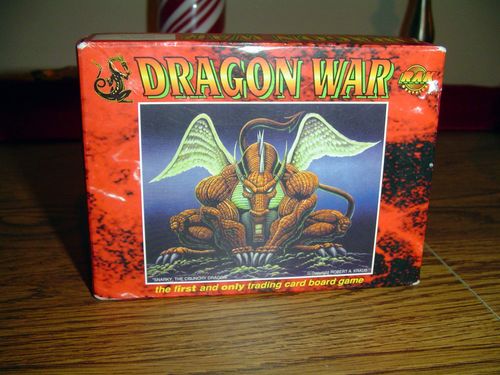
Dragon War
Dragon War Rulebook
Table of Contents
Table of Contents
Startup
Two or more players may participate in a Dragon War game. First, the players must choose a Character Card, the corresponding Character Tile, and a Death Counter Tile (token with skull). The next step is to deal the cards onto the table, this will create the game board that you progress along. Each player puts their Character Tile on the Start Card and rolls the die to determine who goes first, highest roll wins.
Death Counters
Each player has a Character Card that has a grid of numbers ranging from 25 to 0 on the back. Place the Death Counter Tile on the number 25 (this indicates how many life points the character has). Throughout the game, many cards or battles will add or subtract life points from the character (never going above 25). The Death Counter Tile helps keep track of the remaining life points. For example: If a character has 25 life points and loses 3 in a battle, the player moves the Death Counter Tile from 25 to the 22 square. When a player reaches 0, he is out of the game.
Game Play
The object of the game is to get your character to the Finish Card and roll a sum of 13 or higher with 3 rolls of the die. To achieve this, all players begin the game at the Start Card. At the beginning of each player's turn, the player rolls the die and moves the player's Character Tile that many squares on the game board. The player must instantly follow the directions of the square. If a square adds or subtracts life points, it must be marked on the Character Card (see Death Counters section) before the player continues.
Squares & Their Effects
A player landing on a square called "SAFE HAVEN" is protected from any form of harm while they occupy that square.
A player landing on a square called "PICK A CARD" draws a card from the Fate Card deck (see Fate Cards).
A player landing on a square called "BATTLE" is forced to choose an opponent to engage in combat. This also happens when a character lands on a square occupied by another character (see Battle section).
One of the great features of the game is the ever-changing layout from game to game, but this also allows a player to get caught in a loop (rarely). For example: A player may land on a square that sends them back 3 spaces. Then that square may send the player forward 3 spaces. In such a case, the player follows the first square and ignores the effect of the second square.
Once a character reaches the FINISH CARD, he gets to roll the die 3 times to get a sum of 13 or higher to win the game. If the rolls do not add up to 13 or more, the player must wait and try again during the player's next turn.
Battle
A battle consists of 2 characters fighting by each rolling the die. Whoever gets the higher roll wins (if it is a tie, each player rolls again). The winner of the battle rolls again to determine how many life points are subtracted using the loser's Death Counter. When characters land on the same square, they must battle each other; however, when a character lands on a "BATTLE" square, the player can choose which player to battle.
Fate Cards
Fate Cards are broken down into 4 groups. The Life and Death Cards must be played instantly and then placed back into the bottom of the deck. These cards either add or subtract life points that affect the player's Death Counters. Treasure and Weapon Cards may be held until the player decides to use them (it must be during the player's turn or a battle the player is involved in). These cards consist of items that will help characters along their journeys.
Unique Features
-
With the game cards being shuffled and then placed down as the game board, this ensures that you can never have the same game twice.
-
The rows that are suggested to be 4 rows of 10 can easily be changed to accommodate playtime. It can also accommodate time. If players wish to have a shorter game, they just need to leave some game cards out. The Start and Finish Cards are the only ones that need to stay in play.
-
Optional Rule: If a player dies, the player may return to the Start Card with 20 life and continue playing. Your group can decide the number of times this can be done.
Congratulations and Strategy Tips
Your rewards for completing your apprenticeship are the following strategies and tips that will enhance your Dragon War experience.
- Before starting the game, check the position of some of the more powerful game cards. The positioning of the REAPER, ENCHANTRESS, and GOLD DRAGON may affect your use of Fate Cards or how aggressive you play while near them, etc.
- Remember to play this game in the spirit it was intended: A loud, rough, and rowdy game with no holds barred. So don't take it too seriously and have a great time.
- With so many variables, don't be afraid to experiment with your own optional rules. If a dispute arises, group consensus will decide. Remember, it's just a game.
House Rules
These house rules demonstrate how to bend the rules and add personal flavor to the game.
Type I Rules
Safe Havens: Safe Havens protect the occupying player from any combat. Any card not using a die roll can affect a player within a Safe Haven. The Safe Haven only really protects the player from the prospect of damage. Players within Safe Havens are affected by trading places, etc.
Battle: Battle is anytime a player lands on a square already occupied by a player. Only those players within the square battle. If more than 1 player occupies that square when landed upon, then the landing player must battle each occupying player separately. There are no multiplayer combats in Type I games. The order of combating the occupying players is based upon life with the attacker combating the player with the most life first. The player landing on the square is considered the attacker in all battles, and the occupying player(s) are the defender(s).
Battles happen also when a player lands on a "BATTLE" square. In this case, the player landing on the square chooses a player to battle against. The player landing on the "BATTLE" square is considered the attacker, and the target player is considered the defender.
Combat Resolution: Combat is anytime 2 or more player battle each other. Each player rolls a combat die (1d6) including any modifiers after the roll with the highest roller winning. The winner then rolls a damage (1d6) including any modifiers after the roll. A tie results in the players rolling again.
Fate Cards: All instants after being resolved are placed into a discard pile. After the Fate Card deck is exhausted, the discard deck is reshuffled and used as the Fate Card deck.
Life Totals: A player may exceed the starting total of 25 life. There is no life ceiling in Type I games.
Card Hand Size: Players may have any amount of Fate Cards in their hands at any time.
Starting Over: Players that die may start over at the Start Card with 15 life. Players may only start over 3 times.
Marginal Victory: The last player to die is declared the default winner of the game.
Type II Rules
Safe Havens: Safe Havens protect the occupying player from any combat. Any card not using a die roll can affect a player within a Safe Haven. The Safe Haven only really protects the player from the prospect of damage. Players within Safe Havens are not affected by trading places, etc.
Battle: Battle is anytime a player lands on a square already occupied by a player. Only those players within the square battle. If more than 1 player occupies that square when landed upon, then the landing player must battle each occupying player separately. There are no multiplayer combats in Type II games. The order of combating the occupying players is based upon life with the attacker combating the player with the most life first. The player landing on the square is considered the attacker in all battles, and the occupying player(s) are the defender(s).
Battles happen also when a player lands on a "BATTLE" square. In this case, the player landing on the square chooses a player to battle against. The player landing on the "BATTLE" square is considered the attacker, and the target player is considered the defender.
Combat Resolution: Combat is anytime 2 or more player battle each other. Each player rolls a combat die (1d6) including any modifiers after the roll with the highest roller winning. The winner then rolls a damage (1d6) including any modifiers after the roll. A tie results in the defender winning.
Fate Cards: All instants after being resolved are placed into a discard pile. After the Fate Card deck is exhausted, the discard deck is reshuffled and used as the Fate Card deck.
Life Totals: A player may exceed the starting total of 25 life. There is no life ceiling in Type II games.
Card Hand Size: Players may have only 5 Fate Cards in their hands at any time.
Starting Over: Players that die may start over at the Start Card with 10 life. Players may only start over once.
Marginal Victory: The last player to die is declared the default winner of the game.