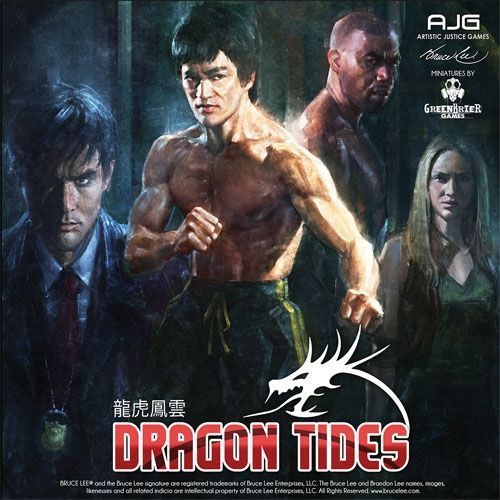
Dragon Tides
Dragon Tides Rulebook
Table of Contents
Table of Contents
Game Components
- Character miniatures (8): Bruce Lee, Brandon Lee, Viktoria Jovovich, Luke Elba, Ivan Castle, Tiger IP, Goliath, Train Wong
- Character boards (8)
- Showdown cards (8 sets)
- Signature Move cards (6 per character)
- Action dice (10)
- Henchmen board (1)
- Map boards: Bunker, Dojo, City Streets, Corporate Office, Cubicle Farm, Garden Park, Open Air Market, Fountain, Rooftop, Factory A, Factory B, Restaurant
- Item tokens: Pistol, Knife, Rifle, Nunchucku, Manhole Cover, Whip, Billy Club, Handcuffs, Brass Knuckles, Soda, Chicken, Sneakers, Data Stick, Dynamite, Money, Crowd, Chair, Key, Sack, Crate, Barrel, Thug, Guard, Special Op
- Buff tokens (Grapple +1)
- Alarm token
- Round tracker, Super tracker, Health tracker, Henchmen tracker, Grapple penalties tracker, Speed tracker
- Closed door and open door tokens
Learning Combat
"Adapt what is useful, reject what is useless, and add what is specifically your own." - Bruce Lee
To get comfortable with Dragon Tides, we're going to play a small sparring match in the Dojo.
Get the Dojo map board from the game box and put it in the middle of the play space. Pick a starting player. Beginning with this player, each of you picks a named character. Place your mini in any empty space on the Dojo mat. Take a set of Showdown cards and your character's Signature Moves. Set up your character's mat by filling the Health spaces with Health tokens and placing a SUPER progress marker (inactive side up) on 0%.
You're ready to play!
Fights in Dragon Tides are played in rounds. A round is completed once each character has taken a turn. More details about rounds are on page 16, Playing Rounds in Movies. For this introduction, the first turn will be taken by the starting player and play will proceed clockwise from there. Once everyone has had a turn, the round is over and you start a new round. This sparring match is over when any character is incapacitated.
On Your Turn
Each turn in Dragon Tides is broken into three parts.
- Lights! Your character sets a Signature Move.
- Camera! Your character gets into position.
- Action! Your character acts.
Lights!
The stage is set and your character gets ready. Will you be defensive, or will you press the attack? Will you use the Hidden Dragon technique, or will you draw your pistol? The lights are set and it is your time to choose!
Your character has a selection of Signature Moves. These Signature Move cards represent your Dragon's special abilities: special skills, secret moves, inner powers. You get to use one of these each round. Pick one and put it on your Dragon's character board.
Most Signature Moves may be placed face down. In this way, you can surprise your opponents by revealing them at a dramatic moment. Some Signature Moves must be placed face up. Each Signature Move states when it may be revealed.
The first thing to do each turn is check your Signature Move. If this is your first turn during a scene, you won't have one in play yet. Choose one and place it in the Signature Move space on your character board.
If there is already a face-up Signature Move card on your mat, you must choose a different Signature Move from your hand. Place the new Signature Move in the Signature Move space on your character sheet, and pick up the old one.
If there is already a face-down Signature Move card on your mat, you may change it or keep it. If you choose to change it, then place a new Signature Move and return the previous one to your hand.
Your face-down Signature Moves should be kept secret from your opponents, but you may freely show them to your allies.
Camera!
Your character wants the best position and the best camera angle. It is now time to get into position. To get there, your character can (A) Take a step or (B) Sprint.
Camera Option A: Take a Step. Move to an adjacent space which does not contain a character or obstacle, or stand your ground. You may move onto an item. (See Items, p. 13 for more details.)
When you choose the Take a Step option, you receive a +1 die bonus (roll one extra die) the next time you roll the dice this turn.
Camera Option B: Sprint.
- Move a number of spaces up to your character's Move stat.
- You may move through items and end your move on items. See Items, p. 13 for more details.
- You may move through spaces occupied by allies but may not end in one.
- You may move over obstacles but you may not end your movement on an obstacle. (See Obstacles, p. 15 for more details.)
- You may not enter or move through spaces occupied by enemies, Cameos, or Crowds.
- You may not cross walls or closed doors. See Walls, p. 14 for more details.
Action!
You have your Signature Move. You are in position. Now, to act! You can (A) Attack, or (B) Interact with a Person or Object, or even (C) Pass. Choose one of these and your character carries it out.
Action Option A: Attack.
Declare a target. Your target must be in your character's Reach. Unless something specifies otherwise, characters have Reach 1. This means the target must be next to your space (or, in some special circumstances, in your space). Some Items, Signature Moves and SUPERs give Reach 2 or even more. You may declare any target within that many spaces of your character.
Your target must also be visible to your character (see Line of Sight on page 12 for more details).
Some attacks may have multiple targets. See Multi-Target Attacks on page 12 for details on these types of attacks.
Now it's time to choose a Maneuver. Take a look at your three Maneuver cards: Strike, Grapple, and Throw. Each one represents a different way to attack your opponent.
Your opponent (the defender) will be doing the same thing while you're choosing a Maneuver. This is called the Showdown.
Both players (attacker and defender) simultaneously reveal their selection: Strike, Grapple, or Throw. Compare your Maneuvers. If both players chose the same Maneuver, each player rolls dice equal to the character's appropriate Stat. If the players chose different options, the winner will be rewarded.
Each time you win a Showdown, you get two rewards. You advance your SUPER one space (See Character SUPERs, p. 11 for more details). You also add two bonus dice to your roll in this Showdown.
Now the attacker and defender each roll their dice.
Did the attacker roll more fists than the defender rolled shields? If so, the attack was successful. Subtract the number of shields rolled by the defender from the number of fists rolled by the attacker. The number of remaining fists is the attack's Advantage.
Did the attacker roll the same number or fewer fists than the defender rolled shields? If so, the attack was unsuccessful AND the defender gets a chance to counterattack! If a counterattack happens, first check the defender's Reach. If the attacker is within the defender's Reach, proceed with the counterattack. (If the attacker is not in the defender's Reach, there is no counterattack.) The counterattack uses the same roll as the attack. Do not reroll the dice for the counterattack.
Was the attack unsuccessful and the defender rolled more fists than the attacker rolled shields? If so, the counterattack was successful. Subtract the number of shields rolled by the attacker from the number of fists rolled by the defender (see above). This is the counterattack's Advantage.
Each time an attack or a counterattack succeeds, the loser suffers penalties.
In the case of Strike, the loser loses an amount of Health equal to the winner's Advantage (as described above).
In the case of Grapple, the loser loses 1 Health. The loser also gains a number of Grapple tokens equal to the winner's Advantage (as described above). Characters with Grapple tokens have all their Stats (Move, Strike, Throw and Grapple) reduced. Subtract 1 from all Stats for each Grapple token the character has. Character Stats may be reduced below zero but characters are always allowed to roll one die, no matter how badly grappled they may be. Grapple tokens remain until the end of your team's phase. Each time your team ends its phase, return all Grapple tokens on your character to the supply.
In the case of Throw, the loser loses 1 Health. The winner may also throw the loser a number of spaces up to the winner's Advantage (as described above). In addition, the attacker may also interact with one object the loser lands next to. (See Interact with People or Objects on page 10 for more details.)
After your attack has completely resolved, check each character to see if it is incapacitated. Incapacitated characters are those who have no Health remaining. Unless the scene specifies otherwise, incapacitated characters are removed from the map, along with any items that character is carrying.
Instead of using Health tokens to track the Health of Minions, you can simply flip the Minion token over for a single Health lost, and remove it from the board once it loses its second Health.
Action Option B: Interact With People, Items or Objects.
Your character can interact with a huge number of things in the game world. Just as with an attack, your character must have Reach to the things and have Line of Sight to the thing.
Some things are simple, like pushing a barrel aside or opening an unlocked door. Choosing to interact with them is all it takes.
Other things are more complex or more difficult: knocking a bolted door open, accessing computer files, stopping the countdown on a detonator. You will have to roll a Stat against these things to interact effectively with them.
Unlike in combat, Maneuver cards are not used against objects, but you still need to have Reach and Line of Sight to the object. (See page 12.) Roll your number of dice in the relevant Stat. The object will roll the number of dice listed. Roll more fists than the number of shields the object rolled to be successful. If the object's roll has as many or more shields than you rolled fists, you have failed. Better luck next time!
Things Which Need No Roll:
| Thing | Resolution |
|---|---|
| Barrel | Move the barrel one space into an empty space |
| Crowd | Move the crowd one space into an empty space |
| Bound/unconscious person | Pick person up |
| Simple unlocked door | Open the door |
| With a key, at a closed and locked door | Open the door |
| With a key, at an open door | Close and lock the door |
| Item on your character mat | Give item to adjacent ally |
| Item on adjacent ally's character mat | Gain item from ally |
Each scene will list the difficulty for any objects your characters can interact with. To give you a sense of scale, here are some common objects.
Objects and People Which Require a Die Roll:
| Thing | Difficulty of Interacting with the Object |
|---|---|
| Conveyor belt control panel | Grapple, difficulty 2D |
| Crate the informant is trapped in | Grapple, difficulty 4D |
| Knock open a typical door | Strike, difficulty 2D |
| Knock open a reinforced door | Strike, difficulty 4D |
Action Option C: Pass. Sometimes, you cannot or do not want to act. In these cases, you may choose to pass and end your turn.
Character SUPERs
Characters in Dragon Tides have special SUPERs which enable them to do amazing tricks or maneuvers. Your SUPER starts at 0%. Each time you win a Showdown, advance the marker on your SUPER track one space.
When your SUPER is fully charged (your marker is on the space marked SUPER), you can activate it! Each SUPER says when it may be activated. Flip your SUPER marker to its active side, announce to everyone that you're using your SUPER and tell everyone its effect. You can do this in addition to any other movement or action you are doing this turn. At the end of the current turn, flip your marker back to its inactive side and return it to 0%.
Example: Brandon Lee has the Officer Sidearm SUPER. Officer Sidearm says "You have Reach 4 this turn." To use this, you would activate Brandon's SUPER right before making an attack or before being attacked.
Example: Goliath has the Inhuman Resilience SUPER. Inhuman Resilience says "Cancel an attack or counterattack against you. (Ignore all effects from that attack or counterattack.)" To use this, you would activate Goliath's SUPER just as he is about to be hit.
All Minions in a scene share a single SUPER track on the Minion Control Mat. This marker advances one space each time any Minion wins a Showdown. Minions have a variety of SUPER effects. Consult the script for the effects of that scene's Minion SUPER.
Multi-Target Attacks
Some characters in Dragon Tides have the ability to attack multiple targets simultaneously.
When you make a multi-target attack, your Showdown is simultaneous with all targets. Choose a single Maneuver to use against all of your targets. Each of your targets makes its own Maneuver selection.
If you win the Showdown against any targets, gain one step on your SUPER and roll two extra dice against all targets. Any targets which win the Showdown against you gain one step on their SUPER. If any targets win the Showdown against you, all your targets roll two extra dice. Sometimes this means both sides get to roll extra dice.
The attacker's full roll applies to all the targets of the attack. Each defends (and possibly counterattacks) with their own roll and Maneuver. All effects of the counterattacks are applied simultaneously, so roll well, or you may get struck, grappled, and thrown, all at once!
Line of Sight
To attack a character or interact with an object, you need to have Line of Sight to that character or object. Line of Sight is especially important for ranged attacks, but you need Line of Sight for standard melee attacks too. Line of Sight is also needed to interact with things.
To check if you have Line of Sight to a space (and whatever's in that space), trace a line from the center of your space to the center of the target space. You have Line of Sight so long as that line does not cross any walls or blocking items.
If the line does cross any walls, closed doors, or Crowds, Line of Sight is blocked and your character cannot attack or interact with that space or anything in it. (Some scripts may specify other things that block Line of Sight for that scene.)
Items
Each character in Dragon Tides can use items to great effect. Characters can only have one item at a time (unless something says otherwise).
Your character may freely pick up one item each turn while moving. To pick up an item, simply pass through or end your movement in its space.
Your character may also freely drop items. You may drop an item at any time. Dropped items are removed from the scene and returned to the game box unless otherwise specified in the scene.
- Billy Club: Roll +1 die when attacking.
- Brass Knuckles: Strike +1, Throw -1.
- Chair: Roll +1 die when defending. You have Reach 2.
- Nunchucku: Roll +1 die when attacking. You have Reach 2.
- Rifle: Strike +2. You have Reach 7.
- Whip: Grapple +1. You have Reach 2.
- Chicken: Yummy! Regain 1 Health.
- Pistol: You have Reach 5.
- Soda: A burst of energy! Increase your SUPER by 2 steps.
- Sneakers: Roll 1 die at the start of your turn. Gain Move +1 for each fist rolled.
- Manhole Cover: Roll -1 die when attacking. Roll +1 die when defending. You have Reach 3. When you attack or counterattack with Reach, discard Manhole Cover.
- Knife: Strike +1. You have Reach 2. When you attack or counterattack with Reach, discard Knife.
- Handcuffs (undeployed): On a successful Grapple, you may choose to deal no damage. If you do, your opponent discards their item and gains these Handcuffs (deployed).
Special Map Elements
Objects. Your character can interact with a huge number of objects in the game world. Objects are covered in detail on page 10.
Items. Each character in Dragon Tides can use weapons and other items to great effect. Items are covered in detail on page 13.
Cameos. Each Cameo represents a Person who is important to the scene. Each scene will give specific rules for handling any Cameos in that scene. Unless otherwise specified, characters may not pass through or stop on any space occupied by a Cameo.
Cameo tokens: Female Cameo, Informant, Male Cameo.
Walls. Characters can move into spaces containing a wall, as long as the center of that space is on the correct side of the wall. Characters cannot move across walls. Line of Sight cannot be traced through walls. (Line of Sight is covered in detail on page 12.)
Obstacles. Characters can move through spaces containing obstacles, but cannot end their movement on them.
Exit Points. Many scenes include spaces designated as Exit Points. These spaces generally allow a character, usually on a specific team, to escape from the area. At the end of a character's turn, if that character is on an Exit Point affiliated with their team, they may (optionally) exit the scene. A character that exits the scene is removed from play, and cannot re-enter the scene. The script will tell you what the consequences of exiting that specific scene are. Some scenes end when a certain number of characters have exited, for example.
The Warehouse Conveyor Belt. The conveyor belt is controlled from a panel in the control room. Unless the scene specifies otherwise, it moves at the end of each Villain phase. At that time, move anything on it forward a number of spaces equal to its speed. Movement is always toward the chute at its end.
Changing the conveyor belt's speed requires the character to Interact with the control panel using Grapple against 2D difficulty. Success changes the conveyor belt's speed by one, making it faster or slower. Tokens numbered 1-6 have been included to track the conveyor belt's speed. Place the appropriate number token next to the control panel, as needed.
The Warehouse Chute. Characters can be Thrown into the chute. Characters can also end up there due to the conveyor belt's movement, or any other effect that moves them. Any time a character falls into this chute, that character is removed from the scene. Unless the script states otherwise, treat this character as incapacitated for that scene.
Playing Movies
All-out brawls can be fun. It's a blast to throw down with your friends and see who's the lord of the dojo! Dragon Tides also lets you be the star of your own action movie!
This game set comes with two movies: Glitterbang and Shakedown in Little China. We recommend that Glitterbang be the first movie you play.
When playing a movie, one player will need to volunteer to be the villain. The other players will play as Dragons.
Each Dragon player chooses one named character to play. After each Dragon player has chosen, the Villain player chooses a named character to cast as the Main Villain and a named character to cast as the Subboss.
Players take the character mat, Health tokens, SUPER marker, and Signature Move cards for their named characters. Keep three Signature Move cards at the beginning of the movie and set the rest aside. You will have a chance to earn more throughout the movie.
In addition to the Main Villain and Subboss, the Villain player will also be in charge of all Minions throughout the movie. The Villain player takes the Minion Control Mat, Health tokens, Round Counter and SUPER marker for the Minions.
Once you've done these things, you're ready to start your movie. Go to the movie booklet, choose your movie, and begin!
Playing Rounds in Movies
There are two teams in a Movie. The Dragons are one team. The Villain, Subboss and Minions are the other team. Each scene will state under scene-specific rules which team acts first. That team takes a phase. Within a phase, each member of that team takes a turn. Players on that team may decide among themselves the order in which teammates take their turns.
Once each character on your team has taken a turn, your phase is complete and the phase passes to the other team.
Once both teams have taken their phase, the round is complete. Some scenes may have things that occur at the end of the round (like a conveyor belt moving, or a counter incrementing). Then begin another round in the same order as the previous one.
Moving From One Scene to Another in Movies
Each scene describes how it ends under End of Scene Trigger. Most scenes have multiple triggers. The scene ends immediately if any trigger is met.
When the scene ends, consult Outcomes. Each team gets the listed rewards for that Outcome. The Rewards section will also tell you where to go next in the movie.
Unless the scene specifies otherwise, items are not carried over between scenes. Return any items your character carries to the game box.
Take the booklets entitled "The Movie: Glitterbang!" and "The Movie: Shakedown in Little China" from the box and select which of the two movies you'd like to play. From there, read the first scene aloud and go to the scene setup corresponding with the scene you are on.
Once all the pieces are ready, it's time to play Dragon Tides!
Glossary
- Adjacent. Two spaces which are next to each other, with nothing that blocks Line of Sight (such as a wall) between them.
- Advantage. After a die roll, the difference between one character's shields and the other character's fists.
- Ally. Any character who is on your team. The opposite of Enemy.
- Camera! The second part of a player's turn. Characters move (by Sprinting or Taking a Step) during Camera.
- Cameo. A scene-specific token. Each scene details how its Cameos should be used.
- Character. Any Dragon, Villain, Subboss, Minion or Cameo that can attack or be attacked.
- Counterattack. An attack launched by the defender when the defender's fists exceed the attacker's shields.
- Crowd. A token representing a group of people. These people are so close together that there is no room to move through them. Crowds may be moved with an Interact action, and block movement and Line of Sight.
- Dragon. The heroes of the action movies. Any named character may be cast as a Dragon.
- Enemy. Any character who is not on your team. The opposite of Ally.
- Exit Point. The path out of some scenes. A character that ends their turn on an Exit Point may be allowed to exit the scene; see the script for specifics.