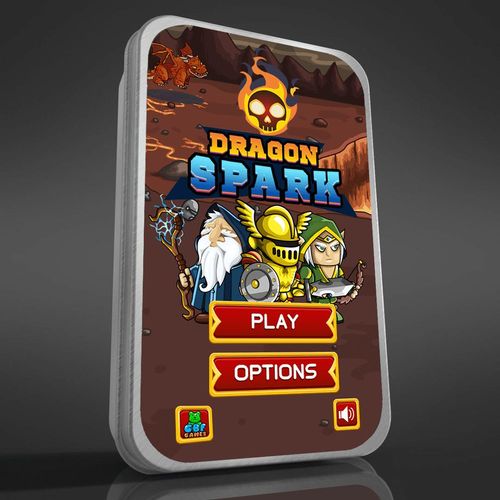
Dragon Spark
Dragon Spark Rulebook
Table of Contents
Table of Contents
Components
- 8 x Hero Cards
- 1 x Hero's Skill Card
- 1 x Basic Skill Card
- 3 x Dragon Cards
- 40 x Monster/Skill Cards
- 1 x Tin
- 4 x Tin Stickers
- 4 x Blue Discs
- 4 x Blue Dice
- 5 x Green Dice
- 6 x Red Dice
- 1 x Black Cube
- 6 x Cubes (2 each Blue, Red, Green)
- 10 x Gems (2 each of Red, Blue, Green, Yellow, White)
Tin Sticker Placement
- Place Cover sticker on top (Lid).
- Place back sticker on bottom.
- Place 10 | 20 (with cube reference) inside of Lid.
- Place 0-9 inside of tin bottom.
Game Setup
- Shuffle the 8 Heroes and blindly draw 4. Place the unchosen cards out of play as they will not be used in this game.
- From the 4 Heroes drawn, choose 1 to play with, and flip the other 3 over to their Skills side. These 3 Skills represent your starting Skills. Your Hero will also begin with the Basic Skill and Hero's Skill cards as well. Place all 5 Skills into your hand.
- Place the colored cubes matching your Hero's current stats. This is what it would look like if you chose the Ranger:
- 15 (Life) = Place a Red cube on the 10 and the other Red cube on the 5.
- 2 (Defense) = Place the Blue cube on 2.
- Place the 2 Green cubes and the other Blue cube near the tin for use later.
- Then place 3 Blue Discs (Energy) in front of the player.
- Next, blindly shuffle and draw 1 Dragon card. Flip the card to its Dragon Hunt side.
- Place the Black cube on the "1" space at the top of the track. This represents Wave 1. There are 5 waves in each Hunt.
- Finally, shuffle the 40 Monster cards, then place them face down (so the Skill side is facing up) to form the Game Deck. Next, place the Colored Gems and Dice near the Game Deck forming a supply. Place the Game Deck, Dice, and Gems within easy reach.
- 6x Red Dice
- 4x Blue Dice
- 5x Green Dice
Card Layout
Hero Layout
- Hero's Title
- Hero's Skill
- Hero's Stats
- Gem Limit
- Skill Limit
- Max Life
- Defense
- Attack Strength
- Hero's Inventory
- Weapon Limit
- Armor Limit
- Trinket Limit
- Consumable Limit
Monster Layout
- Monster's Name
- Monster's Stats
- Attack
- Life
- Defense
- Reward
- Monster's Ability
- a) Passive
- b) Ambush
- c) Buff
- Loot
Dragon Hunt Layout
- Dragon Hunt Name
- Wave Number
- Wave Modifier
- Wave 5 Dragon Loot
Starting Skill Layout
- Skill Name
- Energy Cost
- Skill's Effect
- [Set] Effect
- 1st Wave Size
Skill Layout
- Skill Name
- Energy Cost
- Skill's Effect
- Charged Effect
- Gem Cost to Charge
- [Set] Effect
- Wave Size
Dragon Layout
- Dragon's Name
- Dragon's Stats
- Attack
- Life
- Defense
- Dragon's Passive Ability
- Dragon's Activated Abilities
How to Play
Introduction
You are a hero with a specific class, ability, and skills. You will begin your adventure on 1 of 3 Dragon Hunts. Each Hunt consists of 5 waves of monsters. However, the player must decide on when it's best to fight the Dragon: Early into the Hunt but less prepared - or - Later into the Hunt in which the Monsters are more difficult but your Hero will be much stronger against the Dragon.
During each wave, you will spend your energy to play your skills, add modifiers from collected loot, and spend gems to and charge your skills for the more powerful effects. Each skill will help defend, heal, attack monsters, and much more making each play-through unique. After each wave you will learn new skills, possibly forget old ones, and prepare yourself for the next wave or one of the three Dragons. Defeat all three Dragons and win the game.
Getting Started - 1st Wave
There are a few special steps in getting the 1st Wave started:
- Using the 3 Starting Skills (seen on pg 2) as an Example, look at the bottom of the cards at the "1st Wave Size". Add these up (2 in this case) and draw that many monsters from the top of the Game Deck. Add them in a row - from left to right - and place them face up (so the monster can be seen).
- Once the Monster have been drawn, activate any Ambush abilities. If multiple monsters have Ambush abilities, then activate each from left to right.
- Monster abilities (Passive, Ambush, and Buff) are found on pg 10 Combat.
- In this EXAMPLE, Goblin has an Ambush ability that adds another Monster to this Wave.
- All Monsters prioritize everything from left to right, so the newly added monster would be added to the far right since the Cerberus is at the far left.
- You will then move into Turn Structure -> HERO TURN.
Game Flow
After setting up your 1st Wave (of your 1st Hunt only), you'll move into HERO TURN. Follow the steps below until you have defeated your first Dragon. After your first Hunt is completed, follow the Game Flow for setting up the next Hunt. Below is a summary of the Game Flow:
- HUNT STRUCTURE PART 1
- WAVE START
- TURN STRUCTURE
- UPKEEP
- HERO TURN
- MONSTER TURN
- Turn Structure will repeat until all monsters are defeated or the Hero has been defeated.
- HUNT STRUCTURE PART 2
- WAVE END
- Depending on the wave just completed, you will either begin a new wave repeating Hunt & Turn Structures or move into the Dragon Battle.
- DRAGON BATTLE
- Repeat Game Flow until all 3 Dragons have been defeated.
Hunt Structure Part 1
WAVE START
- Reset your hero's Block (Blue Cube) to their current Defense. Be sure to add any modifiers your Hero may have from equipped loot.
- Draw monsters equal to the Skill that was chosen at the end of the last wave.
- If no skills were chosen, set up the next wave using the unchosen skill with the highest "Wave Size".
- Once monsters have been drawn, activate all Ambush abilities from left to right.
- Move into Turn Structure.
Turn Structure
UPKEEP
- If any monsters are STUNNED, remove all STUN from all monsters.
- Apply Poison damage to monster (if any). 1 unblockable damage for every 1 Poison.
- Poison acts differently for monsters and the Hero. Details on Poison on pg 10 Combat.
- Monsters recover their Defense. Be sure to add any modifiers or Buffs from other monsters or the current wave.
- Hero recovers their Energy. Return the Blue Discs (Energy) from the Skills you played last turn, and place them back in front of you. You will always start each turn with 3 Blue Discs (Energy) unless your Hero is equipped with loot that grants the player with 1 Energy.
- IMPORTNAT [sic] A Hero can never have more than 4 permanent Energy. MAX IS 4 Blue Discs (Energy).
HERO TURN
- Play skills from your hand.
- Collect any rewards from monsters you have defeated during your turn.
- Defeated monsters are place next to the Game Deck in what's called the Archive. This is a discard pile specifically for the Game Deck.
MONSTER TURN
- Monsters attack the Hero from left to right.
- a) Passive abilities - These abilities must read any time the monster is affected. Whether you attack the monster or the monster is attacking, these abilities may trigger providing advantages or disadvantages to the Hero or monster.
- b) Buff abilities - These abilities will always affect the other monsters in that way. These will normally modify (buff) other monster's stats or effects.
- Are all monsters defeated?
- a) If monsters are still alive, repeat the Turn Structure.
- b) If all monsters are defeated, move into Hunt Structure -> WAVE END.
- c) If your Hero is defeated, the player has lost the game.
Hunt Structure Part 2
WAVE END
- Draw 3 cards from the bottom of the Game Deck. Place them Skill Side face up in front of you. You may [sic] choose 1 of these skills and add to your hand.
- a) If the chosen skill exceeds your Skill Limit, you must Forget (discard into the Archive) a skill from your hand or your discard pile.
- b) Place the unchosen skills into the Archive.
- c) You may choose not to take any new skills, in which case, place all unchosen skills into the Archive.
- Move the Black cube down to the next Wave of the Hunt.
- a) If you just completed Waves 1 or 2, you must move into Hunt Structure -> WAVE START.
- b) If you just completed Waves 3 or 4, you may move into Hunt Structure -> WAVE START or you may choose to move into the Dragon Battle.
- c) If you just finished Wave 5, you must move into the Dragon Battle.
YOU NEVER RECLAIM SKILLS BETWEEN WAVES OR HUNTS. ONLY RESTING WILL LET YOU RECLAIM YOUR DISCARD PILE BACK INTO YOUR HAND.
Dragon Battle
Setup
The Dragon utilizes the Game Deck in order to activate their abilities:
- Shuffle the Archive back into the Game Deck. Return the Game Deck near the supply, but this time make sure that the monster side is face up.
- Flip the Hunt card over to its Dragon Side. Be sure to remember which Wave you just completed. You'll gain Stars and special rewards if you defeat the Dragon.
- Wave 3 = 1 gold Star and 2 silver Stars, and a white gem (icon).
- Wave 4 = 2 gold Stars and 1 silver Star, and a wooden chest.
- Wave 5 = 3 gold Stars, and a gold chest.
(The reward icons were read from the page image; the Wave 3 reward icon is a silver/white gem-style token.)
Upkeep
Follow the same rules for Upkeep during Turn Structure.
Hero Turn
Follow the same rules for Hero Turn during Turn Structure.
Dragon Turn
- Dragon Activates an Ability
- a) Draw the top card from the Game Deck and flip it to the Skill Side.
- b) Identify which Colored Gem is in the center of the Skill Card.
- c) Activate the Dragon Ability that matches the Gem on the drawn card.
- d) Place the drawn skill card into the Archive.
- Dragon then ends their turn.
- IMPORTANT - STUNNED Dragons still draws a card and activates Abilities. However, if the activated Ability is "Attack", the Dragon will not Attack.
The Dragon Battle will continue to repeat until the Dragon or the Hero is defeated. If the Dragon has been defeated, gain the reward and keep track of your Stars. Stars are considered the Hero's overall Score at the end of the game. The higher the Stars, the greater the Score, but the more difficult the Hunt.
Card Basics and Effects
Skills Explained
Every Hero starts their turn with 3 Energy, and some loot may even grant the player with permanent Energy. However, the MAX Energy a player can ever start their turn with is 4 Energy. During your Hero Turn, you may choose as many skills from your hand as you would like to play, just so long as you have enough Energy to pay for your skills. Most skills cost Energy and once you are out of Energy, you can no longer play anymore skills (unless of course you have any that cost 0 Energy).
Energy is represented by the Blue Discs. To play a skill, choose a skill from your hand and place it in front of you. Then place Blue Discs on top of the skill you just played equal to the Energy cost of the skill.
Any skills that were played are considered "discarded". This just means that they are in front of you and can no longer take effect. The player may be able to play skills that allow you to "Reclaim" a skill. This would allow you to return 1 discarded card back into your hand.
HERO'S SKILL
A player can also Rest. Resting allows the player to reclaim all discarded cards back into their hand. The Hero's Skill is the only way to Rest. This skill costs 2 Energy, but will allow the player to activate it's Hero's Special Skill (from their Hero card) and Rest. The downside is that you must immediately end your turn.
- IMPORTANT - The Hero's Skill can never be discarded or forgotten (removed forever).
GEMS & CHARGING SKILLS
All skills, except starting skills, can be charged for their much more powerful secondary ability. Many monsters drop colored gems as rewards. You can charge a skill by spending the matching colored gem. Once the gem has been spent, return it to the supply, and activate the bottom portion of the skill card chosen.
SETTING SKILLS
All skills, except "Hero's Skill" and "Basic Skill", can be Set. Setting a skill means ignoring the skill effect entirely and playing it sideways for 1 of 3 minor actions. These actions are:
- Gain 1 Temporary Energy to use by the end of your turn
- Deal 2 damage to 1 monster
- Heal 1 Life
You can NEVER Set more than 1 skill each turn (unless an ability or effect allows your Hero the opportunity to Set a second skill on their turn).
Once the player has run out of energy, Rested, or simply chosen not to play anymore skills, the Monsters will move into the MONSTER TURN. After they are finished, move into UPKEEP like normal. Notice that you will recover any Energy that was spent (bringing you back to 3 Energy in most cases), but your played skills are still discarded. Be sure to play your cards right and choose the perfect timing on reclaiming and/or Resting.
Combat Explained
The Hero can attack Monsters and the Monsters will attack the Hero. The best offense is a good defense in which Heroes and Monsters both have as well. All damage that comes from attacks must go through the Defense/Block first (more on Block below). Once a target's Defense/Block has been reduced to 0, all remaining damage will be dealt to the target's Life.
Hero Turn Combat - Skill Terminology
- Attack: Hero chooses a Monster(s) and does damage equal to the Hero's Attack.
- Damage must reduce the Monster's Defense before Monster's Life is reduced.
- If the Monster's defense was reduced to 0, it remains 0 until Upkeep.
- Attack (+1): The Hero's Attack is increased by 1 (or equal to the + "value") for that Attack only.
- Deal Damage: Damage is dealt, equal to the "value" shown, to a Monster(s) (Defense then Life).
Monster & Dragon Turn Combat - Skill Terminology
- Attack: All Monsters will Attack the Hero from left to right.
- Damage Dealt to the Hero is equal to the Monster's Attack.
- Damage must reduce the Hero's Defense before Hero's Life is reduced.
- Passive: These abilities must read any time the Monster is affected. Whether you attack the Monster or the Monster is attacking, these abilities may trigger providing advantages or disadvantages to the Hero or Monster.
- Ambush: These abilities are immediately activated at the start of a Wave. If new Monsters with Ambush are added to a Wave (due to an effect), activate them after all other Monsters have finished their Ambush abilities.
- Buff: These abilities will always affect the other Monsters in that way. These will normally modify (buff) other Monster's stats or effects.
Additional Common Terms
- Block: Using the Blue Cube, keep track of your Hero's Defense/Block in the Hero's stats (in the tin). Block is a way for the Hero to increase their defenses during each Wave. Gaining Block can exceed your Hero's Defense. However, at the start of each Wave, the Blue Cube is reset to the Hero's current Defense value.
- Heal: Healing allows the Hero (or Monster in some cases) to recover Life that they have lost equal to the value shown. Healing can NEVER exceed the Max Life of the Hero (or Monster).
- STUN: Only Monsters can be STUNNED, this means that they will not attack during the Monster Attack. To show that a Monster is STUNNED, turn the Monster card sideways.
- Forget: This means to remove and place into the Archive.
- Reclaim: Choose a skill card that has been discarded, either this turn or previous turns, and place it back into your hand.
- Poison: This a status that does damage over time. However, Poison effects Heroes and Monsters differently.
- Poisoned Heroes: Using a Green Cube, adjust the Poison value on the Hero's stats (in the tin) equal to the Poison dealt. If the Hero's Life is less than or equal to their current Poison, they are immediately defeated. Heroes do not take Poison damage during Upkeep.
- Poisoned Monsters: Place Green Dice on a Monster equal to the Poison value dealt. Monsters receive Poison damage equal to their current Poison value during Upkeep, this damage ignores the Monster's Defense.
-
- Poison ignores ALL Defense/Block & Poison is not considered an Attack.
Hunt and Waves Explained
Each Dragon Hunt consists of 5 Waves, and each of these Waves will modify the game play in certain ways. This can be from adding more Monsters to a Wave or modifying Life, Attack, or Defense of all Monsters in a Wave.
Waves 1 & 2
- Wave 1: If you've defeated 2 Dragons, add a Monster to this Wave.
- Wave 2: If you've defeated 1 Dragon, add a Monster to this Wave or if you've defeated 2 Dragons, add 2 Monsters to this Wave.
Waves 3, 4, & 5
- Wave 3, 4, 5: In these Waves, ALL Monsters stats are modified depending on the Wave. Use the dice to keep track of the modified stats.
- Wave 5: Reward (chest) after defeating a Dragon. Gain the Spark; in this case the Frost Spark.
Wave 1 and Wave 2 never change. Waves 3-5 will have different modifiers depending on the Hunt.
Loot Explained
Most of the time, the only way to gain Loot (chest), it will be rewarded after defeat certain Monsters or Dragons. However, there are some skills that can grant the Loot as well.
When the Hero gains Loot, the player will draw the top card from the Game Deck. Flip the card over to the Monster side. Look at only the bottom of the card.
Loot comes in four types: Weapon Loot (for example, Battle Axe), Armor Loot (for example, Ancient Robes), Trinket Loot (for example, Studded Helmet), and Consumable Loot (for example, Wood Elf Arrow).
You can choose to either equip the Loot to your Hero or discard it to the Archive. You can only equip Loot to your Hero just so long as it meets the Hero's Inventory Limits. If you choose to equip the Loot, place the card under your Hero card. Loot will permanently modify your Hero's stats and give the Hero new ways to deal with Monsters.
When you draw new Loot, you may choose to unequip Loot and exchange it out for the newly drawn Loot.
Consumables are unique as they are equipped to your Hero, but as a Free Action, you may discard the Consumable Loot to activate it's effect.
Equipping Loot with Life, the Hero does not Heal Life. This only increases your Hero's Max Life.
End Game
The game is over if the Hero has defeated all 3 Dragons or if the Hero has been defeated. No matter the result, talley up your Stars from your Hunts. Also, gain 1 Star for each Dragon Spark you gain just so long as you have defeated all 3 Dragons. This is why each Dragon Spark is a Consumable Loot, but does not say "then discard" like other consumables. You may still choose to use each Spark, but don't discard it as it is worth 1 Star just so long as your Hero survives.
End Game Scoring
- 1 gold Star and 2 silver Stars = Wave 3
- 2 gold Stars and 1 silver Star = Wave 4
- 3 gold Stars = Wave 5
- 1 gold Star and 2 silver Stars = Dragon Spark (only if all 3 Dragons are defeated)