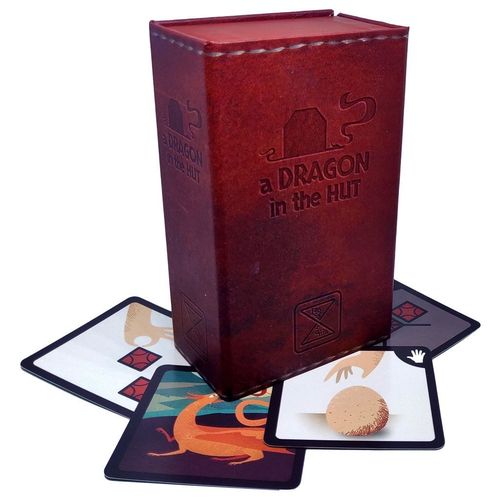
Dragon in the Hut
Dragon in the Hut Rulebook
Table of Contents
Table of Contents
Preparation
All you need to play is Dragon Cards and Forest Cards, and some room for placing your cards. Snacks and drinks are recommended but not mandatory.
Divide Forest Cards from Dragon Cards, shuffle each deck separately and put them in the center of the playing space.
Deal five Forest Cards to each player, moving clockwise. You will play in turns, clockwise, and one player at a time.
Plus the cards from the Frost&Fire mini-expansion, already included in the base game.
Goal of the Game
Your goal is to be the first player to own three Dragons.
To get a Dragon, you need to:
- have a free Hut or Dragon in play
- find a Dragon Egg Card in the Forest (or steal it from another player)
- place the Egg in a Hut or under a Dragon
- wait for the hatching counter to reach 0.
Once your Dragon hatches, you won't have to worry about its safety: a Dragon can look after itself!
How is a Dragon born?
To hatch a Dragon, you need two things: an Egg and a safe place to incubate it — either a Hut or the protective wing of an adult Dragon.
If, during your turn, you have a free Hut or Dragon in play and an Egg Card in your hand, you can start the incubation. To do so, place the Egg card face down just beneath the Hut or Dragon that will host it.
On the back of Forest Cards, you'll find a turn counter with four markers: III, II, I, and 0. This represents the incubation time — the countdown to your Egg's hatching.
At the start of each of your turns, update the turn counter on all your incubating cards. When a counter reaches zero, immediately reveal and discard the card: if it's an Egg, bring a Dragon into play.
Hatching time varies according to the number of players:
- for 2 players, the counter starts at III turns
- for 3 to 4 players, the counter starts at II turns
- for 5 players up, the counter starts at I turn
What could go wrong?
An opponent may try to steal or smash your incubating Eggs. To do so, they must discard a "Steal Egg" or "Smash Egg" card. The opponent will point to one of your incubating cards and reveal it. If they find an Egg and attempted to steal it, they add it to their hand. If they tried to smash it, the Egg is discarded.
We said "if they find an Egg" because to deter theft, you can hide Traps instead of Eggs. When a Trap is triggered, its effect is applied to the player who tried to steal or smash what they thought was an Egg.
Finally, players can use a "Steal from Hand" card to draw cards from an opponent's hand.
Now that you have an idea of what could happen, let's see how to play!
How to play
Phase 1 — Setup
In the first round of the game, all players skip phase 1 (having no card to update).
- Rotate the counter on each of your incubating cards 90° counterclockwise to update them.
- Reveal any cards whose incubation is complete.
- Discard Traps and hatch Eggs into Dragons. When the counter reaches zero, the card is revealed. Discard it. If it's an Egg, place a Dragon into play.
- If you have three or more Dragons, you win! The game ends as soon as a player has 3 (or more) Dragons.
Caption to the diagram: "The card that has reached zero has finished its incubation: it is revealed and converted into a Dragon (if it's an Egg) or discarded (if it's a Trap)."
Phase 2 — Search
Everyone starts the game with 5 cards in hand. There is no minimum or maximum number of cards a player must have in hand. When the Forest Deck runs out, shuffle the discard pile and place it in the center as the new Forest Deck.
- Draw two cards from the Forest Deck.
- Now, you can draw two additional cards and end your turn. Choose whether to go back into the Forest and draw two more cards or move to the Action phase. Decide before playing any cards: if you draw the additional cards, you cannot play cards during this turn.
- If you don't draw extra cards, proceed to the Action phase.
Caption to the diagram: "During your turn, you always draw 2 cards from the Forest Deck... ... you can look at them and then choose whether to draw 2 more cards and end your turn, or proceed to your Action phase. In your Action phase, you can play only one Hut, and all the other cards you want."
Phase 3 — Action
- Play your cards!
- When you're finished playing, pass the turn to the next player.
Playing Cards: Rules and Limits
You can play only one Hut per turn. Play a Hut from your hand by placing it face-up in front of you. There's no limit to the number of Huts you can have in play, but you can only add one per turn.
Play only one card at a time, apply its effects, and add it to the discard pile before playing another one. Any new card you draw during your turn can be played immediately.
Playing Action Cards
During your turn, you can play as many Action Cards as you want. To play an Action from your hand, place it in the discard pile and apply its effect.
When an effect forces you to discard, you choose which card to discard. However, if a player steals cards from you, they decide which ones to take.
Playing Eggs or Traps
Egg and Trap Cards can also be played without limits: you just need to have a free Hut or Dragon in play. Each Hut or Dragon can only host one card at a time.
To place Eggs or Traps, put the card beneath a Hut or Dragon: it will stay there until it hatches or a card forces you to discard it.
Traps and Their Effects
When a player tries to steal or make you discard a Trap in incubation, the Trap activates and its effects apply. Positive effects will apply to the owner of the Hut or Dragon incubating the Trap. Negative effects will hit the player who triggered the Trap.
Handling Player Mistakes
If a player makes a mistake in using a card (e.g., placing an Action card in incubation or trying to play a Trap directly against a player as if it were an Action), the card is discarded.
Turn Summary
Editor's note: the printed page is an untitled flowchart; this heading is the transcriber's label for it. The diagram is transcribed as its printed boxes and branch labels, in order.
Phase 1 — Setup
Rotate the counter on your incubating cards. Has the turn counter of a card reached zero?
- No
- Yes: Reveal and discard the card. Convert Eggs into Dragons. Do you have 3 or more Dragons?
- No
- Yes: You win! The game ends.
Phase 2 — Search
Draw 2 Forest Cards. Do you want more cards?
- No
- Yes: Draw 2 more cards. Your turn ends.
Phase 3 — Action
It's time to play your cards! You can:
- Put only one additional Hut into play.
- Place Eggs or Traps under a Hut/Dragon and play as many Actions as you want.
- End your turn.
Cards and their use
Forest Cards compose the main deck. On their back they have trees in the corners and a counter with Roman numerals I, II, III, and a nice egg icon. The counter tracks how many turns the card still needs to hatch.
Egg Cards are marked with egg icons and have an egg illustration. They come in different colors, but only for aesthetic purposes: an Egg's color does not affect the game.
If you keep an Egg safe inside a Hut or under a Dragon long enough, the Egg will hatch and you'll score a Dragon.
Hut Cards can be recognized for the tiny house icons and the illustration of a hut on their front. A Dragon needs its space, and a Hut is the perfect place to hatch a Dragon.
Dragon Cards have four little dragons on their back, while on their front, there's... a dragon, of course.
When an Egg of yours hatches, you draw the first card of the Dragon Deck and put it into play right in front of you. All the players must be able to see at any time how many dragons each player has hatched.
You can use Dragon Cards to host Egg Cards or Trap Cards (as you do with Huts).
Action Cards are marked with hand icons in the corners and have an illustration of their effect in the center. With Action Cards (shown in the images beside), you can hinder other players by stealing or forcing them to discard cards from a Hut or under a Dragon, or by drawing cards from their hand. The top card is "Steal Egg", the middle one is "Smash Egg", and the bottom one is "Steal from Hand". The number of cards shown in the illustration indicates how many cards your action affects (either stealing or discarding).
Each player will try to get three dragons as fast as possible and do anything to succeed.
You better protect yourself!
Trap Cards have the icon of a foot stepping onto a trap. The illustration shows the effect triggered by the player who activates the Trap: discard 3 cards (top image), discard 2 cards (middle), give away 2 cards from your hand (bottom). Illustrations are similar to those on Action Cards, but their background is darker to tell Traps from Actions easily. Trap Cards are placed in a Hut or under a Dragon (as if they were Eggs) and remain hidden until their hatching counter reaches the egg icon or an opposing player tries to steal or force the owner to discard them, activating the Trap.
If no one interacts with the card before it hatches, the Trap is discarded without applying its effect.
Frost&Fire Mini-Expansion
"Frost&Fire" is Dragon in the Hut's first expansion (included in the base game box) adding two Action Cards and a little more meanness to the game.
Fire cards burn a Hut down. Target Hut will be discarded along with any hosted card. Fire cards can't target Dragons.
Frost cards slow down opponents' cards hatching time. Target covered card's hatching counter is increased by 1 (delaying hatching time of one card by one turn, up to III).
To play the expansion add Frost and Fire Cards to the Forest Deck and remove 3 Steal from Hut and 3 Discard from Hut cards before shuffling.
Components (Base Game)
- Dragon Cards: 18 cards (printed as "18 carte" in the manual)
- Forest Cards: 80 cards (printed as "80 carte" in the manual)
- Huts: 16 cards
- Eggs: 16 cards
- Traps: 16 cards
- Actions: 32 cards