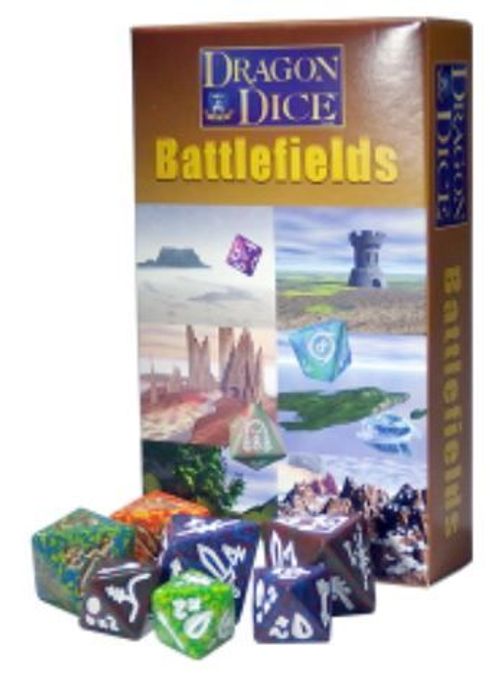
Dragon Dice: Battlefields Expansion
Rulebook PDF: SFR, Inc. · PDF
Dragon Dice: Battlefields Expansion Rulebook
Table of Contents
Table of Contents
Basic Terms
Eight-sided: The smaller eight-sided dice included in expansion sets are called Minor Terrains. They represent lesser objectives for an army to capture at a particular terrain while trying to secure the terrain itself.
Terrain: The faces on each terrain die are numbered from 1 to 8, and each face features an icon. These icons determine, abstractly, the distance between armies at the terrain and the type of action they can engage in. So a low value or number showing on a face means the armies are very far apart, while a large value means the armies are very close. When you maneuver a terrain to its eighth face, you capture that terrain. At the start of the game, each player brings two terrains: a Home terrain and a Frontier terrain.
Home Terrain: The terrain die placed in front of you at the start of the game. You select this die, and your home army starts here.
Frontier Terrain: The terrain die placed in the center of the table at the start of the game. Each player proposes one of the terrains brought to be the frontier terrain. The frontier terrain to be used during play will be selected from these proposed terrains. Certain special terrains (see advanced rules) can only be placed at the frontier.
Aspects and Elements: The colors of the items, terrains, and dragons represent the magical elements that make up each item, terrain, or dragon. Gold signifies earth; blue indicates air; red typifies fire; green represents water; and black connotes death.
The following depicts the elements of the terrains: Coastland is blue and green (air and water), Flatland is gold and blue (earth and air), Highland is gold and red (earth and fire), Swampland is gold and green (earth and water), Feylands are green and red (water and fire), and Wastelands are blue and red (air and fire).
Starting the Game
Step 3: Set the Battlefield
Players must choose one of the two terrain dice they brought and place it in front of themselves to be their home terrain. Then, players place their second terrain die in the center of the playing area as their proposed frontier terrain.
Step 4: Determine Order of Play
Reveal your forces at the same time as the other players. Then roll your entire horde army and add up all the maneuver and ID icon results.
The player who rolls the most points of maneuver results may choose to play first or select the frontier terrain. If the player chooses to play first, then the one with the second highest total selects the frontier terrain. If the player who rolled the most maneuver results decides to select the frontier terrain, then the player with the second highest total would play first. Any of the proposed frontier terrain dice, even one proposed by another player, may be selected. The other proposed frontier terrain dice are not used and are out of the game. In the event of a tie, tied players reroll until there is a winner.
The remaining players will take their turn in decreasing order based on the amount of maneuvers they rolled. Players should sit around the table in clockwise order from the first player to speed play along and make it easier to keep track of turn order.
Step 6: Determine Starting Distances
Each player rolls their home terrain die to determine initial battle distances. The player that selected the frontier terrain rolls this die. Any results of an eight (8) are rolled again and any results of seven (7) are turned down to six (6).
Minor Terrains
Minor Terrains are found in Battlefields, and Magic Items are found in Battle Chest.
The smaller (18mm) eight-sided dice from expansion sets are minor terrain dice. These dice represent lesser objectives for an army to capture at a particular terrain while trying to secure the terrain itself. These dice do not count toward victory, but they can help achieve that goal. The large terrains from the basic set are called “major terrains” and these smaller dice are “minor terrains.”
Each time an acting army successfully maneuvers (outmaneuvers all opponents or is unopposed at its location) the army’s owner may bring a minor terrain into play instead of turning the major terrain a step. An army that has captured an eighth face may not bring in a minor terrain. Minor terrain must match the major terrain the army is located. An army may only have one minor terrain in play at a time at the same major terrain. Immediately upon adding the minor terrain to an army it is rolled. Modify the army’s actions accordingly (see Minor Terrain Icons below.)
Each time the army’s owner spends a march on an army containing a minor terrain, that minor terrain is rolled before any maneuver or action is attempted and its result is applied to the army. The result stays in effect until another march is spent on the army. The only SAIs that can be applied during a roll to avoid a disaster effect (i.e. Flood or Landslide) are those that have their application during a maneuver avoidance roll. If the army containing a minor terrain captures the major terrain (turns the terrain die to the eighth face) or leaves the terrain (all the units in the army move or are killed) then the minor terrain is placed out of the game. A player may bring up to four minor terrain dice to a game. Until brought into play, they are kept in the summoning pool.
Summoning Pool: This is where dragons, dragonkin, and minor terrains are put at the start of the game. The summoning pool is usually kept to the left, but is separate from the DUA and BUA.
Minor Terrain Icons
[Editorial: the printed chart shows the ID faces (Bridge, Knoll, Village, Woods) on one row, the Disaster Face icons (Flood, Landslide, Revolt, Lost) beneath them, and the Common Icons (Magic, Melee, Missile, Double Maneuvers, Double Saves) at the bottom. The chart is an image; the names below are its labels.]
ID: The ID icon on each minor terrain either allows the owning army to conduct melee, missile, or magic actions as the owner sees fit, or it doubles the owning armies maneuvers and saves (under the same conditions as the Double Saves or Double Maneuvers minor terrain icons). Immediately after the ID icon is rolled, the army’s owner decides which effect will remain until the minor terrain is rolled again.
Magic: Allows the owning army to conduct a Magic action even when the major terrain is set on another action.
Melee: Allows the owning army to conduct a Melee action even when the major terrain is set on another action.
Missile: Allows the owning army to conduct a Missile action even when the major terrain is set on another action.
Double Maneuvers: This icon allows the owning army to double its maneuvers as long as this face is in effect. This effect is cumulative with racial abilities. However, the double maneuver effect does not apply where a unit requires maneuver results to avoid an individual-targeting effect.
Double Saves: This icon allows the owning army to double its saves as long as this face is in effect. This effect is cumulative with racial abilities. However, the double save effect does not apply where a unit requires save results to avoid an individual-targeting effect.
Flood: This Disaster Face icon is found on the minor terrain with a Bridge ID icon. Five health-worth of units in the acting army must each make a maneuver avoidance roll. Those units that roll a maneuver result avoid the Flood’s effect. Those that do not are killed. The acting army’s maneuver results are halved until the beginning of your next turn. Place the minor terrain out of the game.
Landslide: This Disaster Face icon is found on the minor terrain with a Knoll ID icon. The owning army instantly takes damage equal to its number of units (not health). To determine the damage, count all the units in the army, including Dragonkin, but excluding magical items. The entire army (including magical items) makes a maneuver avoidance roll. Each maneuver result negates one point of damage. Note that only ID and maneuver icons rolled by the army negate damage; save results or maneuvers from spells do not count for anything and are ignored. Place the minor terrain out of the game.
Lost: This Disaster Face icon is found on the minor terrain with a Woods ID icon. The owning army loses the remainder of its current march. It may neither maneuver nor take an action. Place the minor terrain out of the game.
Revolt: This Disaster Face icon is found on the minor terrain with a Village ID icon. The acting army’s melee and save results are halved until the beginning of your next turn. Place the minor terrain out of the game.
Special Terrains
With the expansion Battlefields, special terrains were added to the game. They are distinct as shown by their gold ink.
Special terrains act just like normal terrains, except that special terrains can only be placed at the frontier. They can never be home terrains. So there will only be one special terrain playable in a game. The other difference from normal terrains is that the action icon progression on the die is set by the eighth face icon, not by their elemental colors. There are four special terrains: Castle, Dragon’s Lair, Grove, and Vortex. They come in all six color combinations.
Castle: When you turn the terrain up to 8, you declare the terrain to be one of the four basic types (City, Standing Stones, Temple, or Tower). It stays that type as long as it stays at 8.
Dragon’s Lair: At the beginning of your turn, summon any Dragon with at least one color matching either of the terrain’s colors, to any terrain.
Grove: At the beginning of your turn, if there are any buried non-dragonkin units (even of an enemy), any one non-dragonkin unit in a BUA must be placed in the corresponding DUA. No army can double magic at this terrain by any means (including when it’s not at an eighth face).
Vortex: During any non-maneuver roll by an army controlling this terrain, any one unit in the target army whose last roll result has not been finalized may be rolled again. The selected unit ignores its last roll result and applies the new roll result instead. Note: this takes affect at the same time as other rerolling effects (i.e. “Instant” SAIs or group monster IDs).
Cross-reference from the Initial Effects phase: “Eighth Face Special Location Icons: City, Temple. Dragons’ Lair, and Grove: see section on Eighth faces.”
Cross-reference from the White Dragons section: “Dragon Staffs and Dragon’s Lairs have no effect on white dragons.”
Glossary of Dragon Dice Terms
The entries below are the Battlefields-relevant glossary entries, reproduced verbatim from the printed glossary. Entries are shown in the order they appear in that glossary, with some entries excerpted where a passage concerns other game elements.
Component: Any die that can be part of an army; specifically, a unit or a magical item. Note: minor terrains, when placed at a terrain, are not considered components.
Disaster Face Icons: The icons on minor terrains that depict a specific disaster effect upon an army.
Frontier Terrain: The designated terrain die placed in the center of the game area at the start of the game. Each player proposes one of the two terrains brought to be the Frontier Terrain before the game begins, but only one of these terrains can be selected for use during play. The others are removed and considered out of the game. Each player can also bring one Special Terrain with gold ink, it can only be placed at the Frontier.
Health (excerpt): Major and minor terrains have no health-value.
Home Terrain: The terrain die placed in front of you at the start of the game. Players select his or her own home terrain where their home army is placed at the start of the game. None of the Special Terrains with gold ink may be placed at the home.
Major Terrain (excerpt): Note that whenever the term “terrain” appears, it always refers to a major terrain. Minor terrains will always be referred to explicitly. See also Home Terrain and Frontier Terrain.
Minor Terrain: The smaller 8-sided dice (5mm smaller than major terrain) that represent lesser objectives for an army to capture at a particular terrain while trying to secure the terrain itself.
Out of Play (excerpt): Dice that are not currently in play, but could potentially be brought into play in the future (e.g., by a spell, SAI, or other game effect). This includes unsummoned dragons and Dragonkin, unused minor terrains, units that have been killed or buried, and magical items that were removed from play. Dice that are out of play do not collectively constitute an army, so effects that affect armies cannot target them. Similarly, these dice are not at a terrain, so effects that target terrains cannot target them.
Out of the Game: Any dice that are not currently in play and cannot potentially be brought into play in the future or affected by any game effect by any means whatsoever. This category encompasses terrains that were not selected for use as the frontier terrain, minor terrains that have been removed from play, and dragons that have been banished by a Dragonhunter. Syn. Removed from the Game.