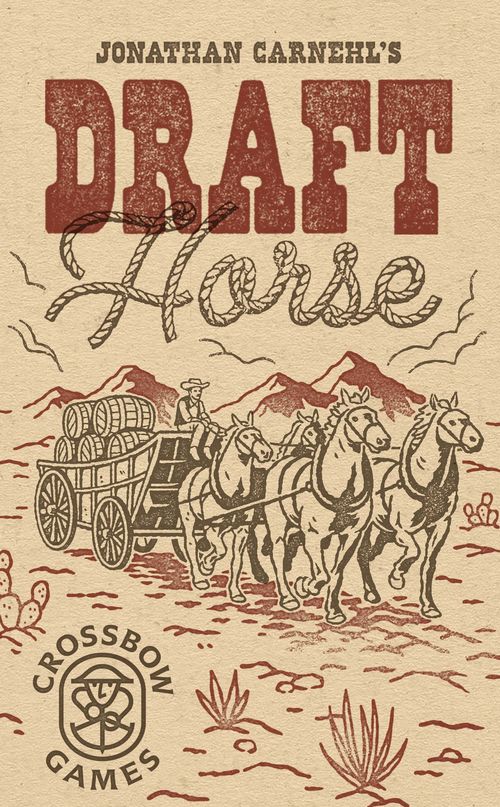
Draft Horse
Draft Horse Rulebook
Table of Contents
Table of Contents
Contents
50 Standard Cards (23 Cargo, 27 Horses) 1 Reference Card 3 Expansion Cards (marked with a ★) 1 Accordion-fold Rule Book 1 Mint Tin
Card Layout
Each card shows:
- Value (Weight/Horsepower) in the top left.
- Icon (Cargo Type/Horse) beneath the value.
- Card type (the cargo name, or the horse's position name) printed at the bottom.
- Distribution reference: a small number at the bottom of each card showing how many cards of that cargo type or horse value are in the deck.
Setup
Set aside the rules, reference card, and 3 expansion cards. Shuffle the remaining 50 cards into a single deck and place it in the center of the table. Leave room for a discard pile. The starting player is the last person to ride a horse.
Game Phases
Draft Horse is played over 5 rounds. Each round has three phases.
1. Deal
Deal 5 cards to each player.
2. Draft
Each player simultaneously chooses one card and places it face-down in front of himself. Then, players pass the remaining cards to each other. Repeat this process until each player has 5 face-down cards. This is their new hand.
3. Play
Beginning with the starting player and alternating each round after that, each player plays his entire hand of 5 cards. Cards are either added to wagons or can be discarded to send shipments (more on this later). Each card must be played in one of these two ways - you may never simply discard a card you don't want or hold it for later. However, you don't have to send shipments every turn, so you may leave cards in your wagons round over round.
Wagons
The area in front of each player is where they create their wagons. Each player can have up to 2 wagons at any time. A wagon is a row of cards with any number of cargo to the left and horses to the right.
Horses must be played from left to right and with values (horsepower) in descending order. In other words, a horse can only be added to the front of the line and cannot be stronger than the horse behind it. Horsepower values may repeat themselves, however.
Example: 5, 3, 3, 1
Cargo can be played in any order and in any combination of type. The sum of the cargo values is the wagon's weight.
Example of a wagon that cannot be shipped yet: a Gold 8 cargo card, followed by Swing Team horses of 3, 2 and 2. This wagon cannot be shipped until the player adds a "1" or "2" horse to the front of the wagon.
Send Shipments
At any time during your play phase, you may discard any card from your hand to ship one or both of your wagons. For each wagon, the total horsepower must be greater than or equal to the total weight. Then, all cargo goes into your face-down score pile. Horses are discarded unless scored as bonus points (more on this later). You may choose not to ship or may ship multiple times during your play phase.
Example of a wagon worth 6 points if shipped: Wheat 1, Lumber 3, Furs 2, then Wheelers 5 and Swing Team 2.
Bonus Points
When shipping, there are two ways to score bonus points:
1. Balance Bonus
If a wagon's total weight equals the total horsepower, as a bonus, score that wagon's front-most horse in addition to its cargo.
Example: This wagon is worth 7 points if shipped because the "2" horse at the front of the wagon is also added to the score pile. The wagon holds Wheat 2, Whiskey 2, Wheat 1, then Swing Team 3 and Swing Team 2.
1. Matching Bonus
(The printed rulebook numbers both bonuses "1.".)
If a wagon has 2 cargo of the same type and only that type, score the front-most horse. For each additional matching cargo, score an additional horse.
Example: This wagon is worth 22 points if shipped because all three horses are added to the score pile; one for a balance bonus and two for a three-cargo matching bonus. The wagon holds Lumber 5, Lumber 2, Lumber 4, then Wheelers 6, Swing Team 3 and Swing Team 2.
Game End
After 5 rounds, add up all the points in your score pile. The player with the most points wins. In case of a tie, the players share the victory.
Advanced Scoring Mode
For a more strategic game, take note of the bonus icons in the upper right of every "1" horse card. At the end of the game, score 1 additional point for each cargo card in your score pile that matches the bonus icon on a "1" horse also in your score pile.
Example: The "1" horses in this score pile would yield an additional 4 points at the end of the game for each cargo they match. Currently, this score pile is showing 21 points total.
Expansion Cards
For a more dynamic game, shuffle any of the 3 expansion cards into the deck during setup. Discard the same number of cards. The rules for each expansion card are printed on the card itself. Expansion cards may be discarded to send shipments like any other card.
Notes & Tips
- Sometimes, multiple smaller wagons are better than fewer bigger wagons.
- You may intentionally exceed a wagon's weight in horsepower.
- You cannot discard a card except to send a shipment. However, you may intentionally ship multiple times during your play phase as a way to "burn" unwanted cards.
- You may not look at your score pile mid-game.
- Horses and cargo left unshipped at the end of the game count for nothing.
- When shipping, you can score the balance bonus and multiple matching bonuses.
- Each bonus collects the next horse in front of the wagon.
- At the bottom of each horse/cargo card, there is a small number indicating the distribution of that card's value/type in the deck.
- The horses' position names (ie "Leaders" and "Wheelers") are added for thematic value and have no effect on the game's mechanisms.
- In the advanced scoring mode, the trick is to get your "1" horses in your score pile through balance and matching bonuses earlier in the game. But, is it always worth it?
- There are two "1" horses with a gold bonus icon. So, in the advanced scoring mode, you can score up to 4 additional points if you have both gold cargo and both "1" horses with the gold bonus icon in your score pile.