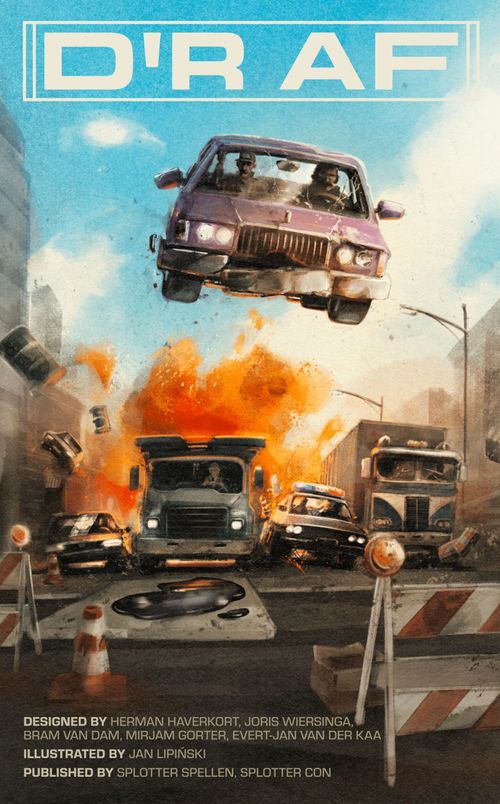
D'raf
D'raf Rulebook
Table of Contents
Table of Contents
Components
Ingredients: five cars, five sets of cruise control cards numbered 2 to 10, road tiles and a turn marker.
Further requisites (not enclosed): a table.
Setup
Determine the starting point on the table at an appropriate distance from an edge (playing time will be about 30 minutes per meter). Place four rows of blank road tiles with the grey side up on the table at the starting point. Each row should have as many lanes as there are players (see figure). Every player chooses a colour for his car. When each player has chosen a colour, one of the players takes all cars in his hand — then he takes them out in random order, one by one, without looking. The cars are set up at the starting point, one in each lane, in the order in which they are drawn: the first car in the leftmost lane (the top lane in the picture), the last car in the rightmost lane. Each player takes a complete set of nine cruise control cards numbered two to ten.
[Figure: "Starting area for three players" — a grid of blank road tiles, three lanes wide, with the arrow marked "30 min. per meter" running to the edge of the table.]
Put the remaining road tiles face down in the box. Each player takes out eight road tiles (without looking) and places them face-up on the table right in front of him. Give the turn marker to the starting player, the driver of the car in the rightmost lane.
Outline of Play
The game proceeds in a number of rounds. Each round consists of two phases. First every player determines his speed. When all players have done that, they take turns in placing some road tiles and moving their cars. When everyone has had a turn, the next round begins.
The player who drives off the table first, wins the game.
Phase 1: Setting the Speed
The speed is determined by playing cruise control cards. Each card indicates the number of road tiles you will play, the number of steps you will make, the number of lane changes you are allowed and the number of cruise control cards you will lose in possible collisions (see figure).
[Figure: a sample cruise control card. Labels: "You will place five road tiles" (the tile icon with the number 5); "You will make six steps" (the 6); "You are allowed one lane change" (the lane-change icon); "In case of a collision you lose two cruise control cards" (the two-card icon). The large number at the bottom of the card is the speed.]
Starting with the starting player (the one with the glass stone) and proceeding clockwise, every player plays one cruise control card face-up on the table. Thus everyone will see at which speed the other players will be driving.
It is not allowed to play a card that indicates the same speed (the large number) as one of the cards played by the other players in the same round.
Example: Mirjam plays a 7. Evert-Jan is now allowed to play any card, except the 7. He chooses a 5. Now Bram can play everything except the 5 and the 7.
Sometimes this rule leaves a player with no possible cards to play. Then he will just stand still and will not be allowed to place road tiles or to move in this round.
Phase 2: The Action Phase
When all players have determined their speed, the action phase starts. Players take turns in order of increasing speed: the player who has chosen the lowest speed plays first. Every player's turn consists of three parts:
- constructing the road;
- driving (and possibly taking damage);
- taking new road tiles.
Constructing the Road
The player whose turn it is places some of his road tiles face-up on the table to construct the road. You should place exactly as many tiles as are pictured on the cruise control card you played.
These tiles should be placed in such manner that the road is not broken; each lane should remain continuous. It is not allowed to construct gaps or bends.
In principle every road tile may be placed in any lane. However, there are two exceptions to this rule:
- the not-too-far rule: when the longest lane is eight or more tiles longer than the shortest lane, the shortest lane must be extended before the longest;
- the not-too-wide rule: the number of lanes equals the number of players; nothing can be placed outside these lanes. Since it is possible that players are disqualified during the game, the road may get narrower while playing. Then some lanes cannot be extended further from some moment on (see page 11).
As a result of events which will be explained later, there may be a gap in a lane. In that case, you have to fill the gap before you are allowed to extend the lane at the front.
[Figure: an example grid of lanes labelled A to H, with notes on which spots may be filled:]
- A: You cannot place a tile here: bends are not allowed.
- B: You cannot place a tile here yet. The longest lane is eight tiles longer than the shortest one. Before placing a tile at B, you should fill up E first.
- C, E, F1, H: Here you may place a tile.
- D: You cannot place a tile here: it is not allowed to construct gaps.
- F2, F3, F4: Before you can place a tile at F2, F3 or F4, you must fill up the lower numbered F-spots behind it first.
- G: Before you can place a tile at G, you should fill up the gap F1 to F4 first.
Driving
Driving Straight Ahead and Changing Lanes
When finished with placing road tiles, the player moves his car. The big number on the card played indicates the number of movement points that must be spent.
Each step straight ahead takes up one movement point. Moving backwards is not allowed. Lane shifts are allowed but they take two movement points: one point for moving one step aside, then one point for moving one step ahead. Please note that you always have to make one step ahead after stepping aside! Each cruise control card pictures a number of bend signs. Each turn a car is allowed to make as many lane shifts as there are bend signs pictured on the card played.
You have to drive on until you have used exactly as many movement points as indicated on your cruise control card. It is not allowed to voluntarily stop.
Example: Herman played a 7. With this card he is allowed to change lanes twice. He drives two steps ahead, then one left and one ahead, then another one ahead, then one left and one ahead, which makes a total of 7.
[Figure: a lane grid showing the path described in the example, with numbered steps 1 to 7.]
Special Tiles
As long as you drive over normal (grey) tiles only, there is no problem. However, there is something special on many road tiles.
- Politie (police icon): Speed control. You have to pull up for a minute to prevent the police from taking you out of the race. This will take up two extra movement points. So stepping onto a police tile takes up three movement points in total: one for the step, and two extra. If you had left only one or two movement points before moving to the police tile, then the car halts on the police tile.
- Arrow (ramp): Ramp. You will jump over the next tile and land on the tile beyond. This will not take up any movement points and the tile you jump over will not influence your trip (not even if there is another car or a symbol on it).
- Puddle: You skid and have to move your car one tile aside (this does not count as a step or a lane shift). The player who sits to your right determines whether you skid left or right. Should you thus drive off the outer side of one of the outer lanes, you will bump into the crash barrier. In that case, you will not be put aside, but you will remain on the road and suffer a collision (see truck).
- Caltrops: You will take one point of damage: hand in one cruise control card (see page 9).
- Truck: You suffer a collision. You lose as many cruise control cards as there are danger signs on the card you played (see page 9). Put an ordinary grey road tile on top of the truck: it is off the road now. Put your own car where the truck had been. After the collision you have to drive on as usual.
- Tool (A.A.-patrol): small repair. You will get back one cruise control card of your choice (only if you lost at least one, of course).
- Joker: You may exchange two road tiles on the table. However, tiles that picture jokers or hold players' cars cannot be moved.
Example: A played the 4. He drives one step ahead, then shifts to another lane (one step aside, one step ahead). By the ramp he jumps over car C. This does not cost him any speed: it is part of his third step. Finally he makes another step ahead.
B played the 6. He drives one ahead and loses two of its speed to the police. Two steps later he drives into a puddle. His right neighbour could send him to the left (which would yield a collision with C, see page 9), or to the right (and then B would have to make one last step).
[Figure: the lane grid for the example above, showing A, B and C positions with the Caltrops, Puddle, Police, Ramp and Joker tiles.]
Driving Off the Road
If you move onto a position where there is no road tile, whether it is voluntarily or not, then there are two possibilities:
- You drive off the road at the outer side of one of the outer lanes. Then you bump into the crash barrier. Your car is not moved as a result of this: it stays on the road. Hand in as many cruise control cards as there are danger signs pictured on the card you played. Note: colliding with the crash barrier does not end your turn!
- You move onto a position where a road tile could have been, but the lane concerned was not yet built that far. In that case a road tile is taken from the bag or cup (without looking) and it is put on the table at the position where the car lands.
In both cases the turn continues as usual.
Handing In Cruise Control Cards
The cruise control cards you lose are put in the box and cannot be used anymore. You may choose freely which cards you lose, but the card you played this turn may be handed in only if it is the only card you have left. If you have not got any cruise control cards left anymore, you may finish your turn as usual. You might reach a tool tile so that you may take back one cruise control card. However, if you do not have any cruise control cards at the end of your turn, you are practically out of the game, since you will not be able to set your speed and drive in following turns.
Colliding With Other Players
If you take a step towards a tile that is occupied by another player's car, then your car is not moved at first. Proceed as follows:
- hand in as many cruise control cards as there are danger signs on the card you played;
- the player who is run into (the victim) hands in one cruise control card;
- determine what happens to the victim's car (see below);
- if the victim has been pushed off its place, then the originator of the collision takes his place on the road (there can never be more than one car on a tile);
- if the originator thus moves onto a special tile (with a symbol on it), he undergoes the consequences (see page 7);
- after that, he stands still automatically: his turn is over.
In principle the victim's car is shoved up one step in the direction of the collision. Then four events are possible:
- it lands on an ordinary grey tile: nothing special happens;
- it lands on a special tile, and undergoes the consequences (see above);
- it bumps into a third player: then the collision is handled as if the victim of the first collision caused the second collision;
- it is pushed off the road at the outer side of one of the outer lanes, and thus collides with the crash barrier.
In the last case the victim should hand in as many cruise control cards as there are danger signs on the card he played himself. However, the victim's car does not move, nor does the originator of the first collision as a result.
Note: the only ways to end your turn without spending all your movement points, are driving off the edge of the table or colliding with another player. A collision with a truck or the crash barrier does not end your turn.
Example: A complex collision. To the left the situation before the collision. A played the 10. D played the 5. It is his turn now and he collides with A from aside. The consequences:
- D loses two cards (since he has got two danger signs on his cruise control card). A is run into and thus loses one card.
- A moves one tile to the left, lands on the ramp and runs into C. C loses one card; A loses four (see cruise control card).
- C moves one tile ahead, A takes C's place, and D takes A's (see the situation in the figure to the right).
(The printed text reads "It his turn now"; read as "It is his turn now".)
All this happened during D's turn. Later in this round, A will have his turn and spend his ten movement points as usual.
Taking New Road Tiles
After driving you take new road tiles until you have eight again. Then it is the next player's turn; out of the remaining players, the one with the lowest speed plays first.
[Figure: a cruise control card showing 5 and 5 beside a lane grid, with an arrow to the grid after the new road tiles were taken; and a card showing 10 with the tile icons.]
A New Round, Disqualifications
When all players have had their turn, everyone takes back his cruise control card (unless it has been lost in a crash). Then determine if there are players who are so far behind that they have to be disqualified. This occurs if there are two cars separated by six or more rows without cars. All cars behind the foremost car of the two will be taken out of the game.
For each player who is disqualified, one of the outer lanes is discontinued. This lane may not be extended any further. If only one of the outer lanes holds a car, then the other (empty) lane is discontinued. If both outer lanes hold a car, then the lane with the foremost car stops. If both cars are at the same level, or if none of the outer lanes holds a car, then a toss is made.
All road tiles after the hindmost car will be put back into the bag or cup. The starting player hands on the turn marker to his left neighbour and the following round starts.
Example: Between A and B there are at least six tiles, but C is in between. No disqualification.
Between B and D there are six empty rows. D and E are disqualified. Two lanes have to be closed. The first is the empty lane nr. 5. Now we have to choose one out of nr. 1 and 4. A in lane 1 is ahead of C in lane 4. Therefore lane 1 is closed. A has to steer to the right soon to stay on the road.
[Figure: a five-lane grid with cars A, B, C, D and E marked, illustrating the example.]
Winning the Game
You win the game as soon as your car drives off the edge of the table. This happens if you drive off the last road tile which fits completely on the table. It does not matter whether you drive off the edge all by yourself or as a result of a collision. The other players will not have their turns anymore, you win the game immediately. But beware: you cannot win the game if you do not have any cruise control cards left. If you drive off the edge of the table without cruise control cards, then you will be disqualified.
The game will also end as soon as all players except one have been disqualified: of course, the only player who has not been disqualified wins the game.