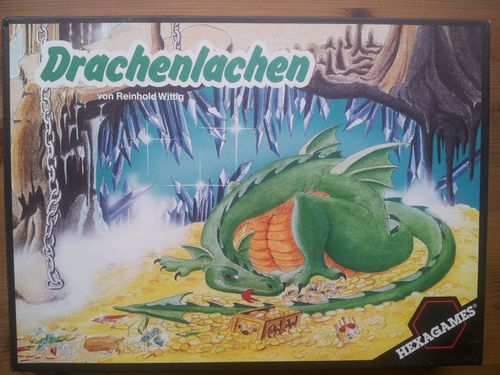
Drachenlachen
Drachenlachen Rulebook
Table of Contents
Table of Contents
Components
- 1 large game board showing the dragon's cave
- 6 wooden dwarves in 6 colours
- 18 rings
- 2 dice
- 1 rulebook
Game Overview
The dwarves start the game directly in the dragon's cave. The dragon has already handed each dwarf a ring from its hoard. Now the dwarves try to leave the cave with their ring. If a dwarf manages to obtain a second ring from the dragon and bring it to the surface, that dwarf wins the dragon's game. But beware! The dwarves do not hesitate to seize the rings of their fellow dwarves. And once the Dragon's Laughter sounds, it can have even worse consequences...
Setup
Each player chooses one dwarf and places it directly in the cave, next to the dragon. Each dwarf receives a ring placed on it. The remaining rings are placed by the dragon. The youngest player begins rolling the die. The other players follow in clockwise order.
Moving the Dwarves
On their turn, a player rolls a single die and moves their dwarf over the numbered spaces according to the number rolled. Dwarves carrying a ring always move towards the exit of the cave, that is, upwards. Dwarves without a ring must always move towards the dragon, that is, downwards.
If a "1" is rolled, however, no dwarf is moved. Instead, the Dragon's Laughter sounds and the dragon itself takes its turn (see "The Dragon's Laughter" below).
A dwarf always leaves the cave via space "8". The dragon with its rings can only be reached via space "11". A player must always use the full number rolled. When moving out into the open or towards the dragon, any excess pips are lost.
Dwarves Meeting
When two dwarves meet on the same space, what happens depends on which dwarf was on its turn and whether each dwarf is carrying a ring or not. The following situations can occur:
A. Both dwarves with or both without a ring
If both dwarves are equipped the same way, that is, both carry no ring or both carry a ring, they swap places. The dwarf whose turn it was places the dwarf it met back on its own former space, i.e. moves it back by the same amount.
Example: Red dwarf with a ring stands on "space 31". It rolls a "4" and meets the green dwarf with a ring on "space 35". Red comes to stand on "space 35" and the green dwarf must go back to "space 31".
B. Dwarf with a ring meets dwarf without a ring
In this case the dwarf with the ring is the stronger one and throws the dwarf without a ring out of the cave. The dwarf thrown out must continue its hunt for the rings this time from the surface.
C. Dwarf without a ring meets dwarf with a ring
In this case the dwarf without a ring steals the ring from its fellow dwarf and also throws it out of the cave.
The Dragon's Laughter
Each time a "1" is rolled, the Dragon's Laughter sounds. Any player rolls two dice for the dragon. The pips shown are then combined into two two-digit numbers.
Example: "1" and "3" were rolled, which gives "spaces 13 and 31".
If a double (two identical numbers) is rolled, only one number is formed, of course. If "6" and "6" were rolled, this gives only "space 66".
The dragon can take its turn in three ways:
-
The rolled spaces: If a dwarf with a ring stands on one of the rolled spaces, the dragon takes the ring away from it again, but the dwarf remains standing on that space. If a dwarf without a ring is on a rolled space, it has a choice: either it starts again at the surface, or it starts again in the dragon's cave (in each case with a new ring).
-
The spaces linked by the chain: When a double is rolled, all spaces connected by a chain to the rolled double space are also affected. Example: "Space 66" was determined. The Dragon's Laughter then also catches all dwarves on the spaces "66, 54, 44, 32 and 22". The dragon deals with the poor dwarves as under 1.
-
The spaces with only one number: The spaces with only one number are always affected when a "1" causes the Dragon's Laughter, but this depends on the number of players. Only on those spaces whose value is higher than the number of players does the Dragon's Laughter catch the dwarves. Example: With 5 players, the Dragon's Laughter can strike on spaces "6, 7 and 8". Spaces 3, 4 and 5 are safe.
End of the Game
As soon as a dwarf brings its second ring to the surface, it is named the winner by the dragon.
It may be agreed that three rings must be brought to the surface.
In Brief
Setup: One dwarf per player. Each receives a ring placed on it. Remaining rings go to the dragon.
Turn by turn: Movement according to the pips of one die. Dwarves with a ring move upwards. Dwarves without a ring move downwards.
A roll of "1": The Dragon's Laughter sounds. Roll two dice. This gives two two-digit numbers (2 and 4 = 24 and 42). On a double, there is only one number (6 and 6 = 66), and the whole chain is affected. A dwarf with a ring on the determined space loses the ring to the dragon. A dwarf without a ring starts again at the surface or in the dragon's cave (player's choice!).
Spaces with a single-digit number: The Dragon's Laughter always also affects spaces 3 to 8, provided the number is greater than the number of players.
Capturing: A dwarf with a ring throws a dwarf without a ring out of the cave. A dwarf without a ring robs a dwarf with a ring and throws it out of the cave. Two dwarves both with, or both without, a ring only swap spaces.
New rings: Always obtained automatically from the dragon.
End: As soon as a dwarf brings its second (or, if agreed, third) ring to the surface.